State Election Board Invites Chaos, Disruption With Unauthorized Letter
Seeking DOJ Intervention
October 5, 2026 We are providing this detailed account so that the press, the public, and election officials have the facts necessary to understand a consequential dangerous decision by the Georgia State Election Board: its formal request for federal intervention in Georgia’s elections. Five days after the September 30 letters were sent, the Board has still not rescinded them, nor have members issued public statements to repudiate them. (The blank check was sent, but no one is trying to cancel it.)
Their reckless sweeping demands remain before federal officials as early voting approaches, which seems to be a clear Board-issued invitation for chaos and disruption. Their motivations merit serious questions. The record warrants close examination because the Board’s public statements, its past actions, the instructions given to its executive director, and the letters ultimately sent, tell substantially different stories. Campaigns, lawmakers, and the political parties should take note and use their influence to stop this potential wrecking of Georgia's November election.
Executive Summary
The State Election Board should immediately rescind its September 30 requests for intervention by the Department of Justice and Department of Homeland Security. The letters combine legitimate, longstanding election-security concerns with wildly erroneous allegations, unsupported theories, and demands for an unquestionably infeasible statewide software overhaul in the next 9 days forced by the DOJ.
The central issues are these:
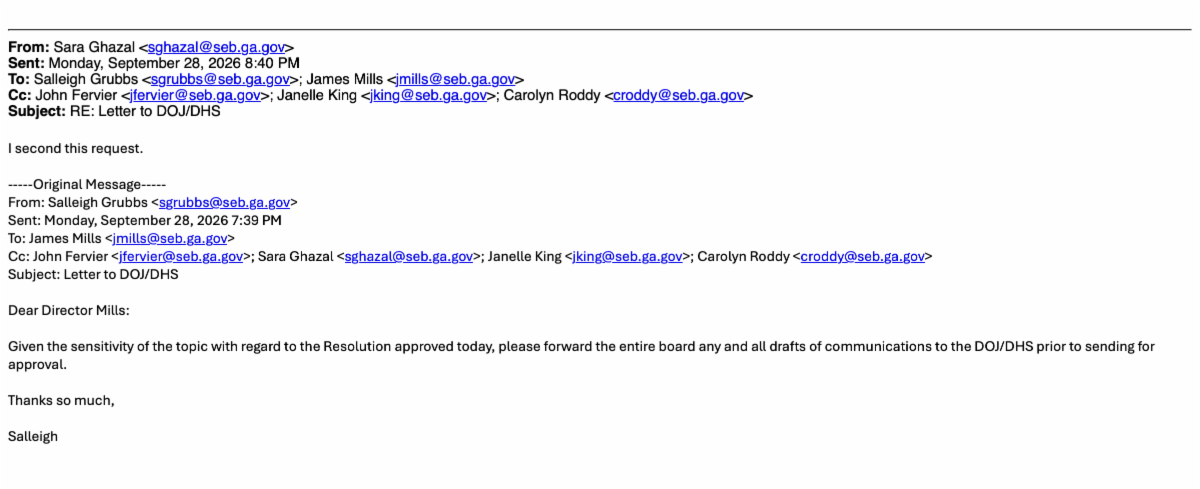
·The letters bypassed expressly requested review. Although the Board’s September 28 resolution broadly authorized federal outreach, members Salleigh Grubbs and Sara Ghazal instructed Executive Director James Mills to provide drafts for review before sending correspondence. (See details below for a copy.) Mills nevertheless transmitted the letters without that review. The public deserves to know who prepared, reviewed, and approved their contents and transmission.
·The demands conflict with the advocates’ own positions. Members who resisted a relatively simple and limited ballot-secrecy remedy as too burdensome for local election officials, strangely demand a completely unrealistic software overhaul on the eve of the election, bringing their real motivations into question.
·The Board has failed to fulfill its duty to solve the very problems they ask the DOJ to solve. CGG has repeatedly asked the Board to address voting-system weaknesses through requested rulemaking, enforcement actions, and the long running Curling lawsuit in which they are defendants. The appeal to Washington does not explain why the Board has long-resisted those efforts, or why federal intervention should suddenly substitute for responsibilities the Board members already possess.
·The letters are riddled with errors and unsupported assertions. They conflate voter ballot verification with ballot secrecy, combine unrelated security problems without explaining how the proposed remedies fit, misstate a statutory effective date, and seek investigations without establishing the factual and legal grounds or federal jurisdiction for the requested action.
·The potential consequences extend beyond the stated requests. We fear that the letters could become a pretext for an unnecessary federal presence at polling places, attempts to obtain control of voting equipment, or post-election challenges carrying the apparent endorsement of Georgia’s election oversight agency. These are risks the Board has unreasonably invited, and now stand by silently, ready to watch the disruption begin.
CGG calls on the Board towithdraw and repudiate the letters, correct the public record, disclose the drafting and approval history, and terminate Mills’s employment. The Board should promptly address the underlying problems through lawful, technically supported measures that can protect voters. Five days of silence have left this consequential invitation to election disruption standing. The Board must act before that invitation produces consequences it cannot control.
The Startling Background Details (in their own words)
The Georgia State Election Board should immediately withdraw the September 30 letters to Attorney General Todd Blanche, Assistant Attorney General Harmeet Dhillon, and Secretary of the Homeland Security Mark Wayne Mullin, that formally requested federal intervention in Georgia’s elections. Executive Director James Mills sent those letters without authorization and against the explicit instructions of SEB members Salleigh Grubbs and Sara Ghazal for an advance review before any communications were released.
There’s no doubt that if Mills had obeyed Grubbs’ and Ghazal’s directives those recklessly dangerous letters would have been sidelined. The letters’ sweeping demands, unsupported accusations, and confused reasoning now carry the authority of an official state agency, just as voters prepare to cast their ballots in 9 days.
It is hard to see this action as anything but a dog whistle inviting disruption and chaos in the November election.
This is a serious failure of ethics, judgment and accountability. The letters ask federal officials to compel impossibly massive changes to Georgia’s voting system before the November election, which the consenting board members (Carolyn Roddy and Janelle King) know quite clearly are infeasible. Their untruthful claims and requests incorporated in the letter exposes their insincerity, but the motivations for their reckless demands remain murky and unclear. The Board has not shown the public a credible implementation plan or a sound factual and legal basis for these demands, or why they walked away from their own oversight duties for years and called on the federal agencies at the 11th hour to do the Board's work.
We at Coalition for Good Governance have spent years repeatedly seeking remedies for the verified weaknesses in Georgia’s election system. We continue to do so in the 9 year old Curling v Raffensperger casein federal court (in which the SEB is a defendant), and in multiple complaints and rule petitions to the State Election Board. That history makes this episode especially disturbing. Members of the SEB who have vigorously denied and resisted addressing those weaknesses in court and in SEB meetings,--even this spring and summer-- are now invoking them to justify a sudden federal intervention would almost certainly disrupt the very election they claim to want to wave in federal authorities to “protect.”
We at CGG call on the Board to immediately rescind, cancel and repudiate the letters and requests, correct the public record, and hold the responsible officials accountable. Voters deserve competent work on actual remedies. Voters and county officials should not have to absorb the sudden unpredictable consequences of an irresponsible letter seeking dangerous federal intervention in the state’s November election.
The egregious actions, an insult to every voter, poll worker, candidate, and election supervisor in the state, merit swift remedies. We call on members Carolyn Roddy, the Georgia Republican Party appointee, and Janelle King, the House of Representative’s appointee to promptly rethink their support of the letters, and support a cancellation and withdrawal of the letter. We call on the Board to immediately terminate Executive Director Mills's employment and that of any staff members who aided in the issuance of the unauthorized letters sent without the requested prior review of the Board.
Why these letters are dangerous
Our concern extends well beyond an embarrassing exchange between government agencies based on extensive misinformation and baseless assumptions, devoid of legal analysis. A formal invitation from the State Election Board can be used by the DOJ to justify disruptive actions far beyond the limited assistance some members described during their September 28 discussion. Some of our concerns include:
Polling Place MonitorsFirst, we fear that the letters will become a pretext for DOJ monitors’ presence at Georgia’s polling places. The letters do not expressly request polling-place monitors, but given the nature of the complaints and the recently announced plans for over 1,000 observers, one can read between the lines. The broad appeal for intervention, and complaints about the polling place machines could be invoked to support a federal monitor presence that the Board has not remotely justified. Legitimate enforcement of voting rights has a purpose; an open-ended blank check invitation built on muddled, misinformed allegations is a different matter altogether.
Excuses to Seize Machines Second, we worry that the correspondence could be used to support threats or attempts to seize control of voting equipment as President Trump has previously contemplatedconcerning these very machines. The resolution expressly contemplates providing copies of election-system hard drives to federal agencies. That is not itself an order to seize machines, but it makes the scope, safeguards, and intended use of the requested federal involvement especially important. The Board should immediately rescind those reckless requests before those requests produce disruptive consequences.
Post-election challenges Third, the letters give official standing to allegations that could be repurposed after the election to fuel election challenges. Unresolved ballot-secrecyand security problemsdeserve responsible attention by the Board and all 159 counties now. Presenting them through an official state letter, with unsupported claims and demands that lack an implementation plan, can supply material for challenges to the election without the SEB doing anything practical to protect voters.
These are risks we believe the Board has shamelessly and recklessly invited. They are not evidence that a particular federal action has already been ordered. The Board must withdraw the requests immediately and replace the confusion with a clear public explanation. We respectfully offer such a draft letterfor the Board’s consideration to encourage prompt action. The Board’s silence since the release of the letters five days ago has been truly disappointing.
How did we get here?
On September 28, the Board adopted Carolyn Roddy’s resolution by a three-to-two vote. Roddy and Janelle King were Board Member advocates for the resolution, and Salleigh Grubbs, Senate appointee, reluctantly supported it with conditions, (which were immediately violated).
Chairman John Fervier and Democratic Party Appointee Sara Ghazal opposed it.
The resolution’s breadth is breathtaking. It directs Mills to seek assistance “from any quarter,” including the Department of Justice and Department of Homeland Security. It authorizes him to engage in any act necessary or, in his (exceptionally poor) judgment, desirable to carry out the resolution. It calls for providing copies of election-system hard drives to federal agencies and contains language ratifying any actions taken by Mills in connection with the resolution. We have never seen such unbridled authority granted to a manager in a government agency or business. Strangely, there was no discussion of this outlandish irresponsible grant of unilateral authority contained in the resolution during the Board meeting. We cannot understand why loud objections were not raised.
A responsible board should have insisted on defined limits, legal review, technical advice, and approval of any consequential demands made in its name. Instead, the majority handed an Executive Director extraordinary unilateral discretion on matters affecting an imminent statewide election involving millions of voters.
In the letter, Mills included inflammatory and misleading allegations and demands without the board review Grubbs and Ghazal instructed him to obtain. The resolution itself also required him to copy the Board immediately on related communications. But Broad authority, however misplaced, cannot excuse inaccurate claims or the disregard of oversight.
The board members’ discussion at the September 28 meeting makes the letters even more troubling. Some members described assistance, financial grants, encouragement, and a “nudge” to the Secretary of State to make improvements. The actual letters that followed formally requested “intervention,” federal investigation, compulsory relief, and an infeasible statewide software change before the election. We’re confident that had Mills and his accomplices followed Grubbs’ and Ghazal’s review instructions, those letters would never have been sent.
Roddy’s and King’s explanations cannot withstand scrutiny
Let’s start with what Roddy and King told the public about the software on September 28. What’s behind these strange claims and demands?
Ms. Roddy bizarrely claimed that Dominion had issued 6 to 14 software updates that the SOS should have been installed, calling the failure to make these (imaginary) 6+ updates “highly irresponsible”
Slight problem-- only two EAC certified Dominion updates have been released. (5.17 and 5.20) What is she suggesting? That the feds should compel the SOS install 6 to 14 updates that may not have even been released and certainly were not EAC certified?
But here is the self-own:
Yep, there is “no interest in the state doing anything about it.” And who is “the state,” with the authority? The SEB is!
And then there’s this…
Which is it? Their accounts cannot both be right. The documented history shows both counts are gross misrepresentations.
There was a software change in the fall of 2020, not 2023. The minor update took the better part of 2 weeks, which also does not substantiate Roddy’s account of a four-day update in 2023. (And it was a minor, not major update, as required now.)
When these members know so little about the problems they are delivering to the feds, what are they really trying to do?
It is well understood such updates require a matter of weeks with significant planning and not after ballots have been built using a completely different software version. Every expert consulted agrees that the software update window closed several weeks ago. Yet, at the August 19 meeting, Ms. King insisted that she had no use for a briefing by experts on this topic, with a "I don't need no stinkin' experts" attitude, and was not going to change her mind about her lack of desire to safeguard the system. (Seems that maybe she did need such a briefing, after all!)
Calling all of this a “patch” does not make it a quick installation. Availability and software certification do not establish readiness for deployment across 159 counties. Election databases and configurations must be addressed, affected equipment prepared, and the resulting system tested. A serious request would explain how those steps could be completed before voters begin using the equipment. (And would have been delivered to the Secretary of State, not federal agencies.) This is not a serious request, because it is clearly infeasible to do. The motivations of the advocates must be questioned, by the public and those who appointed them.
Early voting begins October 13. The letter asked for a software overhaul in less than two weeks. That practical deadline cannot be wished away as the authors knew. What then is the purpose of this pretext?
Where is the record of the Board doing its job?
Remarkably, King portrayed the Board as having exhausted its options to address the issues. (Never mind they never tried.)
Please show the public any record of those requests. (Spoiler alert--it doesn’t exist.) Before September 28, when did the Board formally demand this software update? What resolution did it adopt? What enforcement action did it initiate? What specific request did it send to the legislature, and what response did it receive? We urge Ms. King to produce that record.
Ms. King has led the repeated refusals to consider the very issues listed in the letters during multiple board meetings, even stating in the August 19 meeting that she would not consider rulemaking for ballot secrecy problems and was not interested in an expert briefing on the software facts and options Yet she demands that the feds intervene to address the ballot secrecy problems, --the very ones she refused to listen to or discuss, to fulfill her own duty to address the problem at the state level.
CGG has experienced repeated difficulty obtaining meaningful SEB member consideration of complaints and proposed remedies, including CGG’s submissions concerning ballot secrecy and voting-system weaknesses. Too often, the response has been delay, an assertion that someone else should act, or an unwillingness to use the Board’s own tools and responsibility.
The SEB has the authority and the duty to remedy the problems.
The Board is not merely an advisory audience for the Secretary of State. Its independent enforcement responsibilities are real. In Grizzle v. Kemp, the Eleventh Circuit recognized the Board’s authority and duty under Georgia law to issue orders directing compliance with the election code or prohibiting violations. That authority has legal limits and procedural requirements, but it refutes the idea that the Board itself has no meaningful means of enforcing compliance. The SOS has no such authority.
If the SEB believes the law is being violated, they should identify the violation, hear the evidence, obtain legal advice, and use the broad authority it actually has to do its job. If the counties do not comply, the SEB has the unique statutory ability to sue the counties to enforce compliance. If additional legislation or funding is necessary, it can explain precisely what is needed and ask the General Assembly for it. None of that requires inventing a fictitious emergency federal “solution” at the last minute.
The sudden discovery of problems the Board has long ignored.
Yes, it is irresponsible to use this system, as it has been for years. But why is the Board itself not addressing this, and why did they wait until now to admit the serious problems?
These are not members who take the problems seriously or feel responsible for carrying out their assigned duties.
It is suddenly “wrong” to vote on the system that has the vulnerabilities identified by experts and confirmed by CISA in 2022? But it hasn’t been wrong for the 7 years CGG has been urging Board action? After 7 years of board denial, there is a last minute call to the feds to intervene?
The President found vulnerabilities?
Apparently the President’s sentiments now supply urgency that years of expert analysis did not, and Ms. King and other Board members have spent years and millions in taxpayer money denying the proven vulnerabilities in federal court in our Curling v. Raffensperger case. While we are pleased that she has accepted our experts’ and CISA’s findings now, a voting system software change is obviously impossible before voting begins. The Board dragged their feet and buried their heads in the sand since August 2019 before finally foolishly declaring last week that since they had done nothing, something must be urgently done under the jurisdiction of the DOJ.
But the institution cannot plausibly present itself as a newly alarmed bystander to problems that have been repeatedly brought before it, as petitioners have requested Board action. They have repeatedly declined hearing complaints, discussing rulemaking to cure the problems, and presented a “everything is fine” position to the court, despite their knowledge that there are severe software security problemsand ballot secrecy problems.
We welcome a serious change of position, but it must be supported by a workable plan. What we have instead is an abrupt unhinged demand for disruptive unneeded federal action, accompanied by conflicting descriptions of the system, the software needs, and no demonstrated path to the requested result. What can be done is to promptly address the constitutional ballot secrecy violationrequiring shuffling of ballots prior to scanning, --a somewhat “low tech" remedy given the lack of timely attention to doing it the right way. We still urge the board to adopt emergency rules to require that the ballot secrecy flaw be remedied to prevent an unconstitutional election and the resulting risks of that.
Asking the feds to supply the "courage" to govern
On the failure of leadership, we agree. The timid SEB leadership has been woefully lacking and aggressively ignoring the system problems, including the ballot secrecy issue. But why should the answer be a letter asking the Department of Justice to supply the courage that Georgia’s State Election Board lacks? King has repeated refused to vote for any measure to safeguard the system, protect voter privacy, or improve security.
The Board’s responsibility is to act within its broad authority. If it believes the Secretary of State is failing to comply with the law, it should make the case, establish the facts, and undertake appropriate relief with a cease and desist order, or file litigation with the state courts, or turn to the General Assembly. Calling for immediate federal pressure without doing their own basic enforcement work first, is an evasion of responsibility.
Again, show us the record, Ms. King. The Board has not been asking for system updates or better security. We know of no such SEB requests to the SOS or the General Assembly. Where are the formal requests and the Board enforcement efforts that supposedly left no option but federal intervention? Something is quite amiss, that calls the motivations into question.
Grubbs offered a more direct assessment of the Board’s responsibility:
That is the central point. The Board should begin with the powers and obligations it already has.
Too much trouble to protect voters’ privacy rights, but time for a major statewide overhaul?
The contrast with the Board’s actual treatment of ballot secrecy is especially revealing.
For months, Roddy and King repeatedly resisted requesting a SOS software update, or more recently a proposed change in ballot scanning intended to address ballot secrecy risk, once the software update time window was closed. Their objection was the ballot shuffling burden on local election officials, poll managers, and poll workers so close to voting. We believe that the proposed remedydeserved serious consideration as a practical way to protect voters from an unconstitutional non-secret ballot election, after the SEB and SOS neglected their duties to address this for so long.
Yet the September 30 letter demands an impossibly complex and resource-intense software overhaul including backups and independent verification, before the November election. Where was Roddy’s and King’s comparable concern for the county employees who would have to implement that impossible demand they make? Such a reckless, clearly infeasible demand begs for an explanation of their motive.
This is why we regard the request as disingenuous. Its advocates invoke massive and impossible administrative burdens after months (actually years) of refusing to address the problem when asked repeatedly, opposing a concrete remedy, then disregard much greater burdens when demanding federal intervention. Roddy, an experienced attorney with federal agency experience, fully understands that a request for federal litigation is not an implementation plan.
The foreseeable effect is to encourage federal intervention disruption, heighten alarm and invite political conflict, while leaving the ballot secrecy
Grubbs asked for action on the ballot secrecy issue
Grubbs expressed her concern about the Board’s failures to address the constitutional ballot secrecy problem, and her reluctance to invite federal intervention.
She wanted the Board to meet, consult experts, and do the work, as often as necessary.
After directing Mills to send any drafts to the board for review, Mills defied the order and the letters were delivered. The resulting correspondenceis shockingly unprofessional and ill-informed for a state agency seeking action from senior federal officials. Its allegations and demands required careful technical and legal review. Instead, the letters combined legitimate concerns with unsupported conclusions and mistakes that should have been caught before transmission. Our draft recommended cancellation letteraddresses some of those mistakes, as does the letter submitted by Eternal Vigilance Action.
The promised review never happened
Within an hour after the September 28 meeting ended, Grubbs instructed Mills not to send correspondence concerning the resolution before the Board could review the drafts. Ghazal added her instruction that correspondence should not be sent without review.
Nonetheless, Mills sent the September 30 correspondence to the federal agencies. Our understanding is that the full Board was informed just before its 9 a.m. meeting on Thursday, October 1, that the letters had already gone out—without the required review.
Members sought an opportunity to check the allegations and proposed demands. Roddy had assured them they would be kept informed. Mills proceeded without that review, and the public received an official request containing errors that review could have exposed.
The Board must also disclose who else participated in the preparation of the letters. Who drafted the letters, crafted the allegations, selected the legal citations, and approved transmission? Which members saw the drafts? Did anyone outside the agency assist? Those are questions for the correspondence and draft history to answer. The public and those who appoint board members should not be left guessing.
Misinformation and False Allegations in the Letters
The letters’ weaknesses and errors are pervasive and embarrassing. Several examples show why a formal correction and withdrawal is necessary.
Voter verification and ballot secrecy are conflated. Whether a voter can verify the choices that will be counted is different from whether ballots can be linked to the voter who cast it. Both matter. But the letter does not explain or establish a QR code/ballot secrecy problem, nor issue that remotely merits federal investigation. Naming HAVA does not supply the missing explanation.
Different security mechanisms are treated as a single remedy. Under its ballot-secrecy demand, the letter combines changes to tabulator security keys with remediation of the DVSorder issue, the ballot-order and record-identifier privacy flaw. Shared keys concern access and authentication; DVSorder concerns the possibility of linking ballots to voters. Each problem needs its own technically supported remedy. All of which are available under the direct jurisdiction for enforcement of the code by the SEB.
A sweeping deployment demand comes without a deployment plan—just confusion and chaos. The letter improperly seeks federal intervention to obtain forensic backups, statewide software installation, and independent verification. It does not establish how the massive work could be completed before voting, identify a supported implementation schedule, or address what would happen if installation or testing failed. A demand addressed to Washington does not remove those practical constraints or the jurisdictional barriers.
Records allegations outrun the evidence supplied. The letter moves from disputes over access to records to requests for investigation and accountability for alteration or destruction, without identifying the particular acts and evidence needed to substantiate those allegations, much less suggest a federal law violation. Federal preservation law can apply to a certain limited set of election record, none of which are alleged to have been altered or destroyed; an access dispute alone does not establish that a federal preservation offense occurred. The State Election Board has the responsibility to enforce the records preservation statutes embedded in the state election laws. Penalties are serious for actual violations.
An outdated statement of Georgia law. The request concerning QR-code tabulation cites a July 1, 2026 effective date for the state-law restriction. Section 4 of SB 1EX changed the effective date of the relevant provision of SB 189 to January 1, 2028. Whatever one thinks of that postponement, a state agency asking federal officials to intervene should be able to accurately describe the law it invokes and make a straight faced argument for why this is a federal law enforcement matter, if they believe it.
These examples are enough to show why the requests should be withdrawn. They do not mean that the underlying security, secrecy, or records issues should be ignored by the authority changed with law enforcement and rule-making—the SEB. Serious problems require accurate analysis and remedies connected to the evidence—something that Mills, Roddy and King seem to be ignoring in their quest to write the DOJ a blank check for chaos and voter confusion.
Federal authority does not cure the spurious request
It would repeat the letters’ mistakes to claim that federal agencies have no election-law jurisdiction. DOJ has authority to enforce applicable federal laws, including HAVA, and may seek judicial relief where the legal requirements are satisfied. But federal authority is not unlimited, and a state agency’s invitation because it failed in its job, does not enlarge it. A disagreement over state administration, costs, or legislative priorities does not become a federal violation simply because an executive director asks DOJ to investigate it.
A carefully framed request for technical consultation can be useful if there is an actual question of federal oversight. This correspondence instead seeks consequential federal action without doing the work necessary to justify its demands.
What the Board must do now
The responsible members should act immediately to rescind, withdraw, and cancel the September 30 requests. They should expressly supersede any part of the September 28 delegation that might otherwise be invoked to continue pursuing those demands. Every federal agency recipient should receive a clear correction explaining that the Board repudiates the unsupported allegations and no longer seeks the intervention requested. We are disappointed that no such letter went out Wednesday morning once the Board learned of the Mills missive. (Here’s our suggestion.)
We hope that the bodies which appointed Ms. King and Ms. Roddy will urge them to retract their reckless letter to seek DOJ involvement.
The Board should release the drafts and related communications and identify everyone who participated in preparing or approving the improperly issued letters. It should preserve the complete record, including communications conducted through personal accounts or devices.
We call for Mills’s immediate termination. The judgment displayed in these error-riddled letters, and the disregard of members’ requirements to review them, are incompatible with the responsibility entrusted to the Board’s executive director.
Any board member shown to have participated in bypassing that review or approving unsupported allegations should face public censure.
Finally, the Board should promptly convene to address the actual problems within its authority, with qualified technical advice and realistic schedules. It should hear the complaints and proposed remedies it has deferred, explain its decisions, and distinguish measures that can still protect this election from changes requiring longer preparation.
As of this writing, we are not aware of a public Board action withdrawing the letters. That silence is troubling. Every day the requests remain uncorrected allows others to invoke the State Election Board’s name and authority for demands the public has ample reason to distrust. Every day allows the DOJ to mobilize to interfere with permission in Georgia’s election.
We believe this episode invites political and election administration chaos while offering little prospect of timely repair. Members who object to that result must do more than express private disappointment. They must use their votes, correct the record, and revoke the invitation they have allowed to stand.
Please write the State Election Board members to urge them to take timely action:
Coalition for Good Governance is a non-profit, non-partisan organization dedicated to protecting voters’ rights to secure, fair, and transparent elections with verifiable outcomes. The Coalition works to ensure that every voter can cast a completely secret ballot and have confidence in the accuracy and integrity of election results.
Coalition for Good Governance | P.O. Box 28097 | Atlanta, GA 30358 US