|
Dear GAIN Community,
GAIN26 in San Francisco is already a few weeks behind us, and we’ve had some time to reflect. We are delighted by the high level of participation and are taking away many impressions from the conference. We’d like to share a few of them with you in this issue.
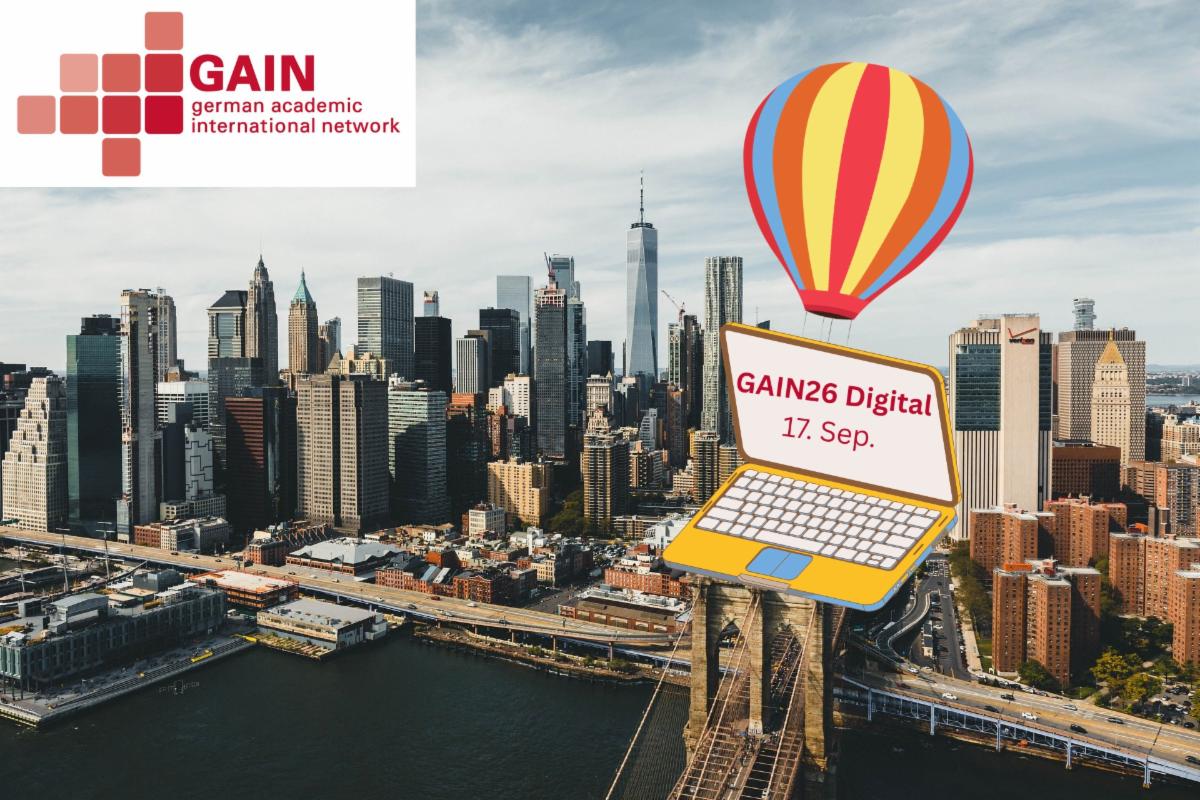
Fortunately, GAIN26 isn’t quite over yet: our digital workshop event kicks off on September 17. A series of workshops will focus on academic career paths in Germany. If you haven’t signed up yet, there is still time to register!
In this issue, we also address current debates surrounding science and science policy and, given recent events, we focus particularly on the framework conditions required for science to remain free, open, and international.
As always, we have also compiled information on upcoming events and new calls for applications.
Enjoy the read, and we hope to see you on Thursday at GAIN26 Digital!
Warm regards,
Your GAIN Team Anna & Jana
| | |
GAIN26 Digital Workshop Event
As a digital component of the 26th GAIN Annual Conference, these online workshops provide information on academic career paths in Germany. This online event is open to postdocs worldwide.
The GAIN26 Digital Workshop Event will take place following the in-person conference on Thursday, September 17, 2026. As a virtual component of the event, it offers guidance through selected workshops on topics including career paths at universities and non-university research institutes, as well as the tenure track system in Germany.
| | |
The full program can be found here.
Registration
Date: September 17, 2026
Location: Online (MS Teams)
Time: 3:00 p.m. – 10:15 p.m. CEST | 9:00 am – 4:15 pm EDT | 6:00 am – 1:15 pm PDT
| | That was GAIN26: Impressions and reports | | |
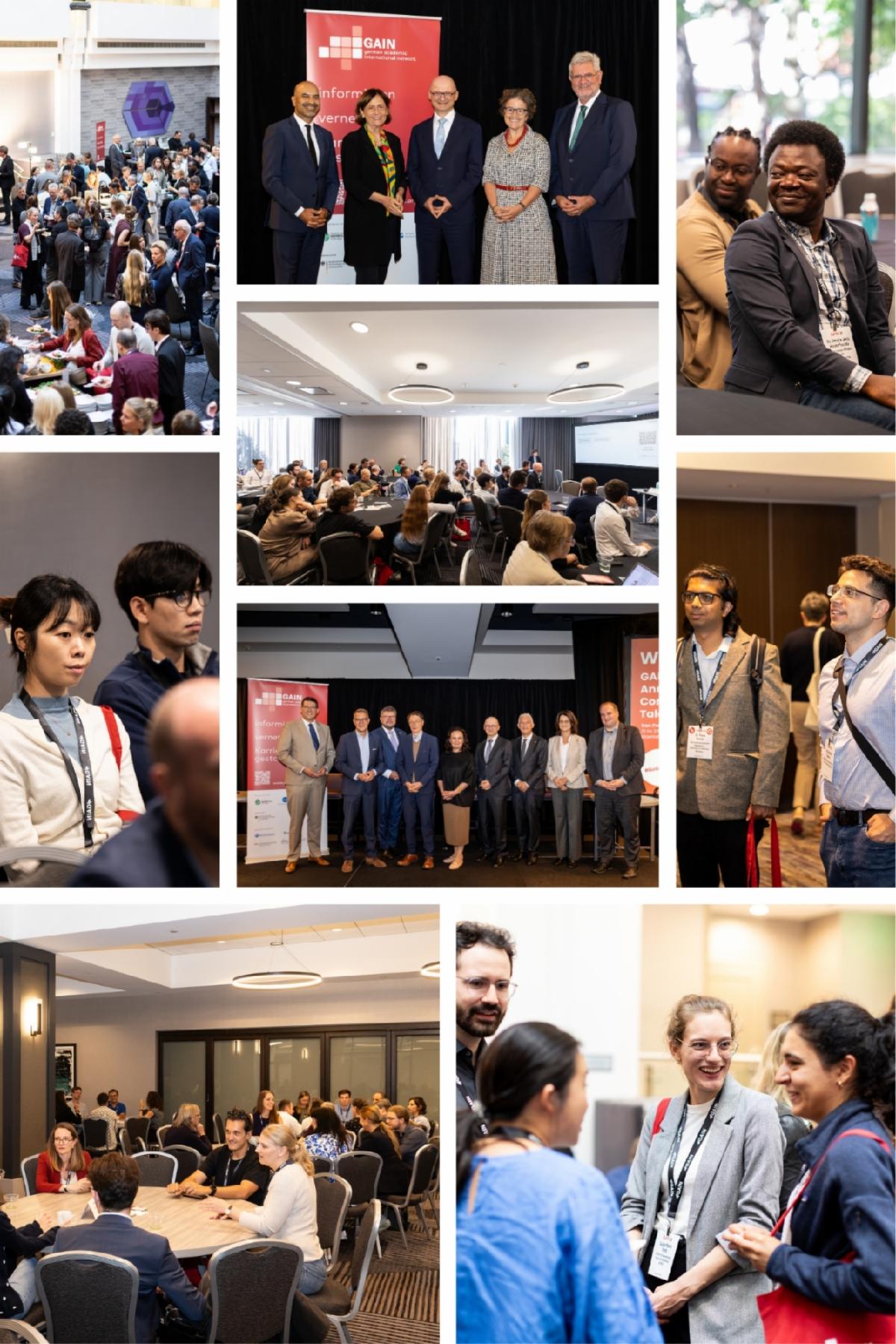
Photo credits: GAIN/BarakShrama - Collage featuring photos from the GAIN26 annual conference in San Francisco.
The GAIN26 annual conference in San Francisco has now concluded: three full days dedicated to networking, exchanging ideas, and finding inspiration. With around 640 registered participants, the conference was a great success.
Networking was the central focus, as always: more than 350 individual meeting appointments were arranged via the conference tool, and over 275 job postings were available to the postdocs. Participants came from 22 US states and four Canadian provinces. The entire conference was also open to non-German-speaking postdocs; around 100 of them attended, 59 with a scholarship covering the full conference.
The program was equally impressive:
- 40 workshops featuring 182 speakers
- 70 Talent Fair booths representing 92 institutions from all 16 German federal states
- A total of 137 German institutions represented at GAIN26
In addition to the formal program items, formats such as breakfast sessions, the Talent Fair, the GAIN Reception, and the GAIN Pub Night offered numerous opportunities for informal conversations and personal interaction.
A photo gallery of GAIN26 and the exhibitor receptions on Thursday is available on our website: GAIN26 Photo Gallery
This year, the GAIN conference received even more press coverage than in previous years. We are collecting and linking to these articles in our press review.
We would like to extend our sincere thanks to all participants, exhibitors, and partners for their commitment, and we look forward to continuing this successful exchange on September 17 at GAIN26 Digital.
| | |
GAIN26 Science Slam
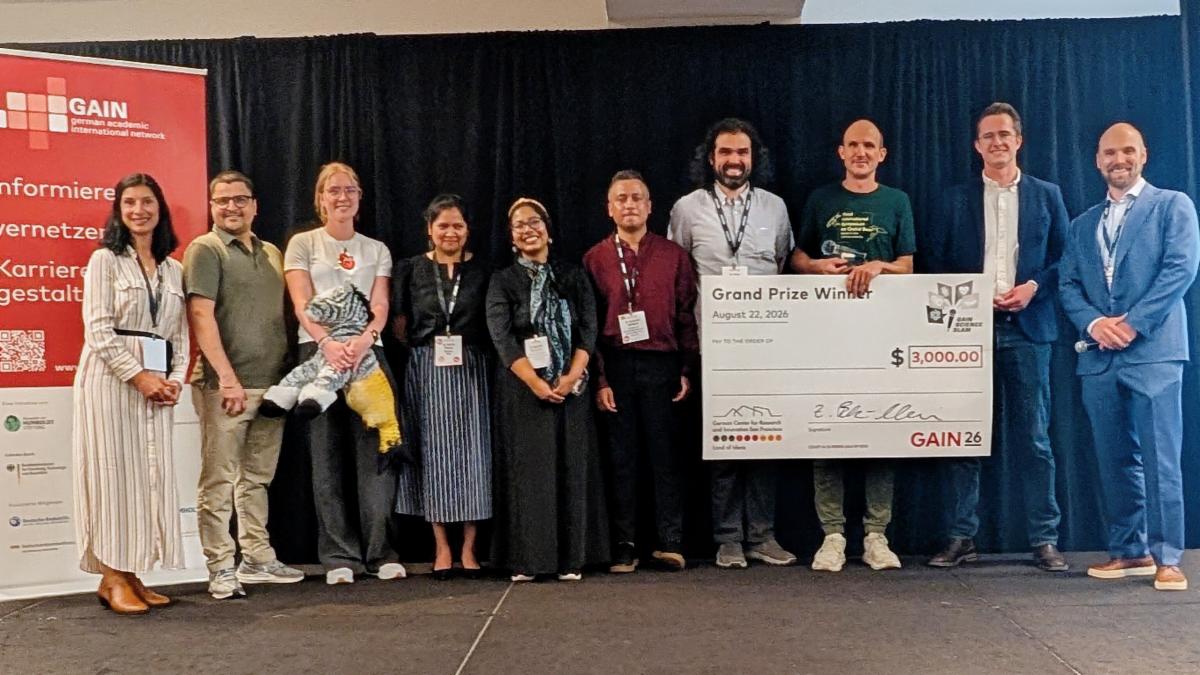
The GAIN Science Slam has become a tradition at the GAIN conference: a relaxed, fun, and interactive format where participating postdocs present their research with plenty of humor. Among the eight finalists, Jonas Henske ultimately prevailed, winning the $3,000 prize sponsored by DWIH San Francisco, based on audience voting. Dressed in a homemade bee costume, he both impressed and entertained the audience with his topic, "Better Than Chanel: Perfume Communication in Orchid Bees." Congratulations, Jonas!
A big thank you goes to Zahar Barth-Manzoori and Dominik Otto for their charming hosting!
Photo (GAIN): GAIN26 Slammers & Moderators, from left to right: Zahar, Jitendrapuri, Lisa, Verima, Aparajita, Anukram, Pedro, Jonas, Dennis & Dominik.
| | |
GAIN26: A First-Time Appearance with Our Own Booth at the Talent Fair
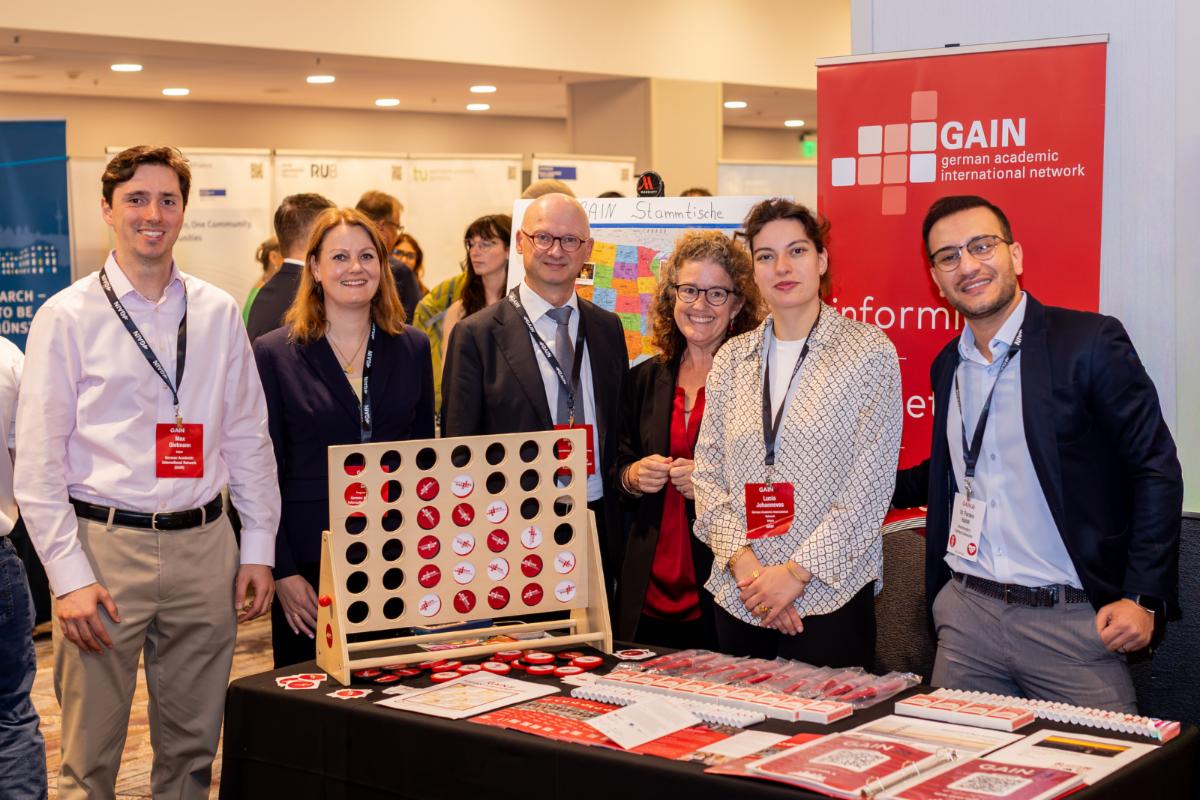
A first for GAIN26: For the very first time, the GAIN network hosted its own booth at the Talent Fair, and we are delighted that the feedback was consistently positive!
At the booth, visitors could challenge each other to a game of "Connect Four" while networking with fellow postdocs. Those who stopped by could also learn about our regional meetups, subscribe to the newsletter, and register in our researcher directory. As a small token of appreciation, we handed out branded merchandise: lip balms, a card game, and portable cutlery sets proved very popular with participants.
A special highlight was our inaugural Postdoc Bingo. We were thrilled by the enthusiastic participation! At the close of the Talent Fair on Sunday, our Program Director Anna Oberle-Brill drew the winner of the grand prize, a bag packed with snacks, from all the fully completed and submitted bingo cards.
We thank everyone who stopped by the booth, played along, and connected with us, and we look forward to the next opportunity to bring the GAIN network to life in person beyond the annual conference!
Photo credits: GAIN/BarakShrama
| | GAINxGSO-Stammtisch Meetups | | |
Dates
Berkeley: more information via this Google form
Boston: Wednesday, September 30 at Democracy Brewing Downtown (35 Temple Pl., Boston, MA 02111) at 6.30 p.m., more information via e-mail: toupalas@mit.edu
Chicago: Friday, October 2, further information via e-mail: StammtischCH@gso-gain.org
London (UK): more information in this Facebook group
New York: Thursday, September 17, at Anable Basin Sailing Bar & Grill starting at 6 p.m. – advance registration required, remaining tickets available here; please email groh@gain-network.org to be added to this Stammtisch meetup's WhatsApp group
Salt Lake City: more information in this Facebook group
San Francisco: Wednesday, September 16 at Standard Deviant Brewing Pier 70 (1070 Maryland St Ste 195, San Francisco, CA 94107) at 6 p.m.; more information via this Google form
Seattle: more information via this Google form
Singapur: more information via e-mail: StammtischSIN@gso-gain.org
Toronto: more information in this LinkedIn group
| | |
Academic Sector Reacts with Concern to Saxony-Anhalt Election
Following the election results of September 7, in which the AfD emerged as the strongest political force in Saxony-Anhalt, numerous voices from the academic and higher education policy communities have spoken out. The HRK, the LRK Saxony-Anhalt, the DHV, and the DAAD have issued a collective warning that academic freedom, university autonomy, and a welcoming culture for international students and researchers must not become bargaining chips in day-to-day political disputes. DAAD President Joybrato Mukherjee expressed concern regarding the region's openness to the world as a hub for science and research. Political scientists offer varying interpretations of the result, ranging from a rejection of the incumbent state government to a "profound turning point" for the party system.
Forschung & Lehre: Wissenschaftssektor reagiert besorgt auf Wahl in Sachsen-Anhalt (in German)
| | |
International Students Generate Billions for Germany
A new study by the German Economic Institute (IW), commissioned by the DAAD, reveals that international students represent an economic asset for Germany. Just two years after graduating, they contribute more to the tax and social security systems than the cost of their education, thereby offsetting the expenses associated with their university places and doctoral studies. Almost one in two stays in Germany after completing their studies, with one in three remaining employed here on a long-term basis. The 2023 cohort of first-year students alone could generate a surplus of around 23 billion euros for the state. DAAD President Joybrato Mukherjee emphasizes that retaining international talent requires attractive living and study conditions, as well as a genuine culture of welcome.
Die Zeit: Internationale Studierende bringen laut Studie wirtschaftlichen Nutzen (in German)
| | |
DFG President Katja Becker Discusses Hostility towards Science in an Interview
In the interview, DFG President Katja Becker addresses the AfD’s science policy plans, which she views as a threat to academic freedom, and explains how the DFG intends to shield its committees and procedures from political interference. Becker advocates for mutual support within the scientific community, extending to the "domestic exile options" currently being discussed for researchers at risk, while also highlighting systemic weaknesses such as precarious employment and declining funding success rates. A key priority is the development of an internationally coordinated framework for research security that fosters responsible openness rather than isolationism. She also cites GAIN as an example of international interest in Germany as a hub for science and research.
Wiarda-Blog: "Im Zweifelsfall muss jeder von uns aufstehen" (in German)
| | |
A Plea for Courage in Science
Taking as her starting point a speech by Federal Minister of Education Karin Prien commemorating the resistance against National Socialism, Kärin Nickelsen explores what courageous action in science means today. The essay begins by dispelling the popular Galileo legend before turning to real-world examples, ranging from the White Rose and the resignations of Jewish Nobel laureates in 1933 to Andrei Sakharov. Nickelsen demonstrates that courage is revealed not only in spectacular acts of resistance against authoritarian regimes but also in the everyday commitment to integrity within one’s own institutions, such as when standing up against questionable proposals in committee meetings.
Forschung & Lehre: Was ist Mut in der Wissenschaft? (in German)
| | |
More International Scientists in Germany Following US Research Cuts
The magazine article uses personal stories to illustrate how US-based researchers are moving to Germany in the wake of funding cuts under the Trump administration, including cancer researcher Ilias Tzelepis, who was able to save his career thanks to a Humboldt Fellowship. Around 25,000 scientists lost their jobs after the US government eliminated 7,840 research grants. Germany is strategically positioning itself as a destination for these researchers through the "Global Minds Initiative," launched by Federal Research Minister Dorothee Bär and the Humboldt Foundation; more than 80,000 international researchers are now working in the country.
The Scientist: US Research Cuts Drive Scientists to Germany
| | |
Lecture Series on AvH Funding Opportunities for Academic Careers
Humboldt Discoveries is an event series that offers prospective fellows, hosts, and all interested parties the opportunity to learn more about specific programs of the Alexander von Humboldt Foundation. Recognized experts present the respective program and answer open questions. Current fellows and/or alumni share their experiences.
Upcoming dates of the Humboldt Discoveries series:
- 24 September 2026, 2:00 - 3:00 CET - Info Event: Feodor Lynen-Foschungsstipendium
Please click here for further information.
| | |
Info Talks on DFG Funding Opportunities for Research Careers
Germany’s largest independent research funding organization offers funding opportunities for all career stages between doctorate and professorship. The organization regularly offers info talks on funding instruments.
Upcoming talks in the Prospects Series:
- 22.09.2026, 9:30 a.m. - 11:00 a.m. CEST – DFG funding Opportunities for Postdocs (in English)
- 07.10.2026, 10:00 a.m. - 11:30 a.m. CEST – The Heisenberg Programme (in English)
- 11.12.2026, 9:00 a.m. - 10:30 a.m. CET – The Emmy Noether Programme (in English)
Please check here for more information.
| | |
Job Offers at Hanover University of Applied Sciences
With approximately 9,000 students across five faculties, Hannover University of Applied Sciences and Arts (HsH) is the second-largest university in the capital city of Lower Saxony. It has an international focus with over 100 partner universities, facilitating intensive collaborations in teaching, research, and administration, as well as international exchanges of students, faculty, and staff. At the same time, the university is firmly rooted in the region and currently employs over 1,000 faculty, academic, artistic, and administrative staff.
Application deadline: October 01, 2026
Application deadline: October 4, 2026
| |
Job Offers at the University of Cologne
The University of Cologne is one of the oldest and largest universities in Europe. Due to its outstanding scientific achievements and the high quality and diversity of its degree programs, it enjoys an excellent international reputation. The following positions are available:
Deadline: September 27, 2026
Deadline: October 10, 2026
Deadline: October 24, 2026
Deadline: November 3, 2026
| | |
Job Offers at Karlsruhe University of Applied Sciences
Karlsruhe University of Applied Sciences (HKA) is one of the largest and most research-active Universities of Applied Sciences in Baden-Württemberg. Its passion for excellent teaching and innovative research defines the institution and is reflected in its strong ranking results. HKA works closely with regional and national industry partners and stands for diversity, innovation, sustainability, international orientation, and collaboration, with students and staff at the center of its development.
Application deadline: October 15, 2026
Application deadline: September 30, 2026
| |
Job Offer at University of Wuppertal
The University of Wuppertal is a dynamic, well-connected, research-oriented campus university. More than 25,000 researchers, lecturers, students, and staff work together to address challenges in science, education, culture, economics, social issues, technology, and the environment.
Application deadline: November 02, 2026
Application deadline: November 02, 2026
Application deadline: November 02, 2026
| | |
Job Offers at Saarland University
Saarland University is a campus university with an international outlook and a strong research profile. Its identity is shaped by four priority areas: Computer Science, BioMed, Sustainability, and Europe. Numerous research institutes in the university’s ecosystem and targeted support for start-ups make Saarland University an ideal environment for research, teaching, and innovation
Application deadline: October 15, 2026
Application deadline: October 15, 2026
| | |
GAIN is a joint initiative of the Alexander von Humboldt Foundation (AvH), the German Academic Exchange Service (DAAD), and the German Research Foundation (DFG).
Associated members include the Fraunhofer-Gesellschaft, German Cancer Aid, the Helmholtz Association of German Research Centers, the Max Planck Society, the Leibniz Association, the German Academic Scholarship Foundation, and the German Rectors’ Conference.
| | |
GAIN - German Academic International Network
c/o DAAD New York
871 United Nations Plaza
New York, New York 10017
newsletter@gain-network.org
The GAIN newsletter is provided by:
DAAD office New York, 871 United Nations Plaza New York, NY 10017,
legally represented by Mr. Kai Sicks,
Deutscher Akademischer Austauschdienst e.V.,
Kennedyallee 50, 53175 Bonn
Tel: (212) 758-3223
Fax: (212) 755-5780
E-mail: info@gain-network.org
Internet: https://www.gain-network.org
Registered office:
Bonn (Deutschland), registered at the Bonn District Court, registry number VR 2105
Editorial team:
Anna Oberle-Brill
Jana Groh
Liability notice:
We assume no liability for third-party content. The content of linked pages is the sole responsibility of their providers.
Copyright © by DAAD e.V. The content of this newsletter is protected by copyright. All rights reserved. The use of text - even in excerpts - and images is not permitted without prior written consent from DAAD.
Unsubscribe:
If you no longer wish to receive the GAIN newsletter, please write to us at info@gain-network.org or use the unsubscribe link below.
| | | | |