Geography/Habitat:
Harris’s Sparrow, (Zonotrichia querula), was first described by Thomas Nuttall in 1840, a British ornithologist, geologist and botanist who pioneered natural sciences in the US. It is likely monotypic and grouped with four other Zontrichia Sparrows although most likely closely related to Juncos. It is the largest sparrow in North America, except for towhees.
The Harris’s Sparrow’s range is confined to the U.S. and Canada, breeding in northern Canada and wintering in the central US from North Dakota into Texas. It’s wintering grounds in Texas includes, the eastern panhandle, north central, north east and down into central east regions, into central Texas and Hill Country, and as far south as the upper Texas coast region. It inhabits tundra forest in the breeding season but takes advantage of most wooded or shrubby habitats during the winter months.
Harris’s Sparrows are omnivores, feeding on seeds and berries but also supplementing its diet with insects, spiders, and the occasional snail. It is typically a ground feeder and behaviorally very like Juncos and Towhees.
Breeding season is typically in June and July where 3-5 white to pale green spotted eggs are laid in nests made of leaves and plants on the ground, or at the base of a bush. Nest making and incubation is 12-15 days and is carried out by the female. Harris’s are monogamous, forming bonds again during the breeding season.
Identification
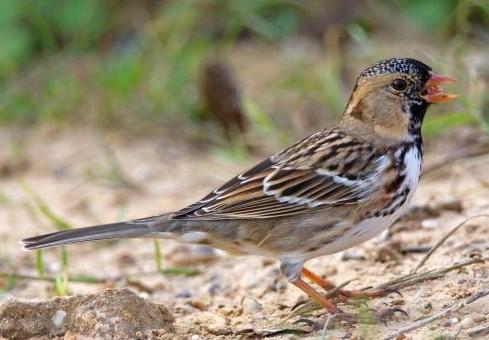
A very large distinctive sparrow with a very long tail. It has dark streaked upperparts with a black crown, face, chin and throat with a gray-brown cheek and auricular. The crown is often finely speckled white. Underparts are primarily white. Note the distinctive white wing bars and streaked flanks. The bill and legs are pink. Sexes are somewhat similar, but the female has much less extensive black being more buffy and has a lighter chin. Winter plumage is most subdued and variable.
Harris’s Sparrow have a distinctive song consisting of a series of high-pitched notes followed by a low one. Its call is a high pitched “tseet”.
Harris’s Sparrows are locally common, but numbers have been declining by up to 63% since the 1970s, mostly likely in big part due to habitat loss. Breeding population is estimated at 2 million birds by Partners in Flight, and therefore is classified as a bird of concern.
Interesting Facts:
·Harris’s Sparrow is Canada’s only endemic breeder songbird and is wholly reliant on semi forested tundra for breeding habitat.
·It is named after American ornithologist Edward Harris, a contemporary of Nuttall and Audubon.
·A group of Harris’s Sparrows is known as a Poll of Sparrows.