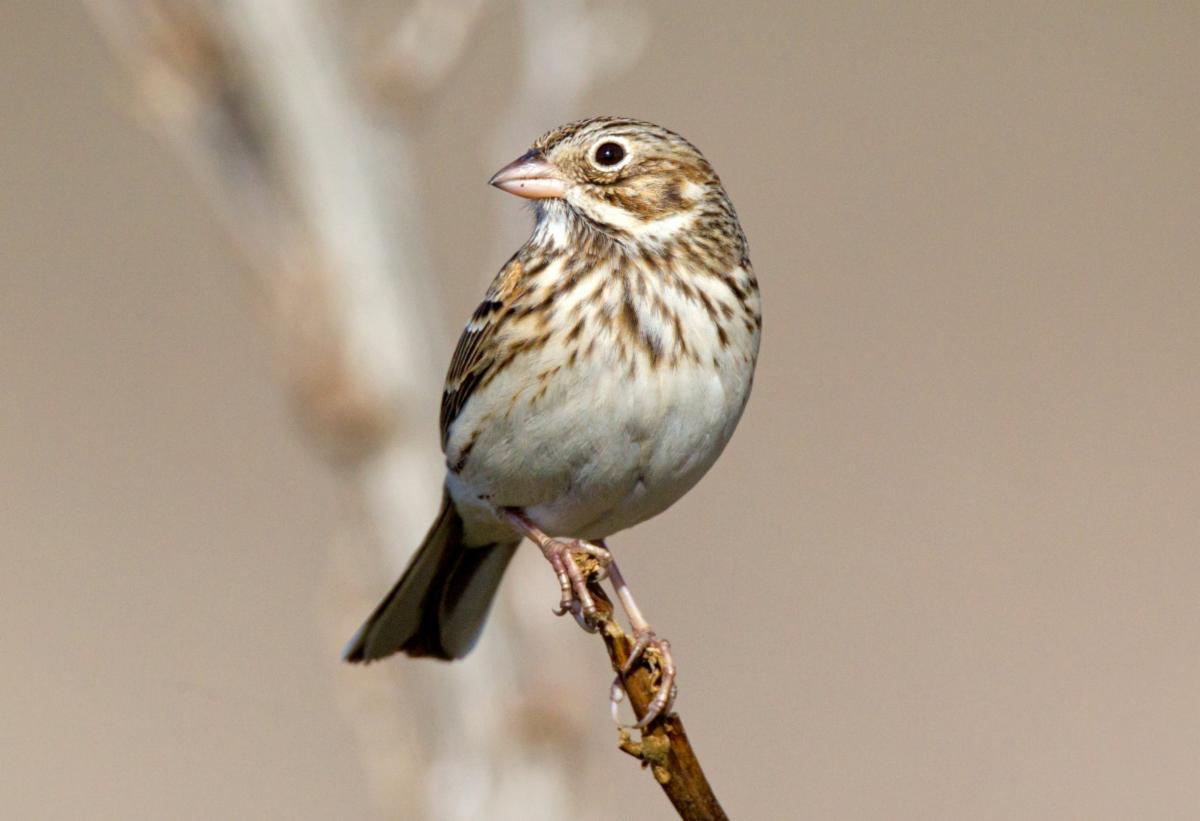
|
Geography/Habitat:
The Vesper Sparrow (Pooecetes gramineus) was first described by JF Gmelin in New York in 1799. Three subspecies are currently recognized with another 1-2 proposed. It is the only member of the genus Poocetes but is likely closely related to some Melospiza species.
The Vesper Sparrow has wide distribution, breeding across most of the Northern US and Southern Canada and wintering across the Southern US and into North and Central Mexico
Preferred habitats are open grasslands with sparse vegetation but also in farmlands and fallow fields.
Breeding season runs from May until August with one to two clutches of 2 to 6 white to pale green eggs laid in a cup of grass weeds and stalks on the ground. The nest is lined with moss and fine grasses. Incubation is 12-13 days and is carried out by both parents.
Vesper Sparrows are mostly insectivores in Summer, feeding on spiders and insects. In the Winter they are mainly seedeaters, foraging on the ground.
Identification
Vesper Sparrows are quite streaky and usually gray-brown and similar to Savannah Sparrows, but have a longer, heavier tail with white outer tail feathers. They have a bold and distinctive white eye ring. Note the underparts are off white to cream/brown, notably duller than the Savannah Sparrow
Its song is a repeated two note chip “here-here where-where” followed by a descending trill. Its call is a short “tsip”.
Interesting Facts
- Was long known as the Bay Winged Bunting but was renamed due to its song being more melodious.
- A very adaptable species, it is often the first to colonize reclaimed land.
-
A group of sparrows is known as a liturgy or congregation
|