|
Geography/Habitat:
The Burrowing Owl, (Athene cunicalaria), was first described by CL Bonaparte in 1835. There are at least 19 recognized subspecies (2 now being extinct). Considered by some to be monotypic and placed in its own genus “Speotyta”, recent DNA work has shown its relationship with some old-world owls, notably the similar Little Owl. Burrowing owls are found across much of the New World, ranging from southern Canada through the western and central United States, into Mexico and Central America, and extending into western South America as well as southern Brazil, Argentina, and Chile. There are also distinct populations in the West Indies and the ABC islands etc. Note that in North America, Burrowing Owls are migratory. They can be found in Canada and Northern US in Summer to the Southern states and Mexico in Winter, but are present in Central and South America all year.
Burrowing owls inhabit grasslands and deserts particularly those with large populations of burrowing mammals for nesting/roosting sites. Here they feed on large arthropods, mice, rats, small amphibians, and large insects. Burrowing owls are crepuscular, feeding at dawn and dusk, but will hunt at any time when food sources are scarce.
Burrowing owls nest in burrows, (sometimes which they dig but are commonly abandoned by burrowing mammals) and culverts, making a nest of twigs, grass pellets, and droppings in which they lay 8-10 white eggs. They then can incubate for 21-30 days. The young fledge in another 44 days but often stay in the area and while burrowing owls are monogamous they often form loose colonies when breeding.
Identification
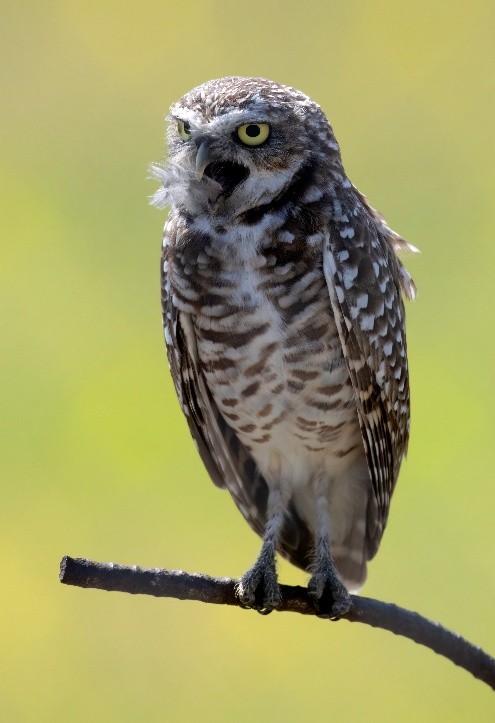
A small owl, (9-11 inches), its underparts are buff with brown barring on the upperparts. It has distinctive lemon-yellow eyes and its brownish face having a lighter edging and buffy eyebrows. In flight the wings are white underneath with brown barring. The upper wing is much darker but has a distinctive white buffy patch.
Burrowing owls call is a “coo-roo-roo” or “co-hoo” often made at dusk. Its alarm call is a distinctive rattle
Interesting Facts
-
Burrowing owls are typically diurnal or crepuscular and uniquely will eat seeds and berries, (especially cactus), as well as mammals, insects etc.
- Males are unusually bigger than females
- A group of owls is known as a bazaar, a parliament, a glaring, a stooping or a wisdom.
|