|
Greetings!
Things are heating up all over the world this month — fortunately, that has not yet included the Atlantic Hurricane season. With the climatological peak of the season approaching in early September, NOAA’s prediction for below-normal activity in the Atlantic basin stands, according to the updated statement released earlier this month.
NOAA’s National Weather Service is still predicting 7-13 named storms (with winds of 39 mph or greater), including 2-6 storms that could become hurricanes (winds of 74 mph or greater) and 0-2 major hurricanes (winds of 111 mph or greater). (This includes the two tropical storms that have already come and gone.) NOAA’s taking advantage of the Atlantic lull to fly rare missions in the Pacific, where they flew out of Hawaii to get a better read on storm Lala.
While hurricane activity in the Gulf may not be especially hot this year, temperatures here certainly are, with meteorologists tracking above-average temperatures in the Gulf. While we’re not actively tracking a marine heatwave (MHW) here, it’s interesting to look at the data trends over time via buoy and satellite data on our MHW data portal . You can also see what’s happening in real-time by visiting our glider piloting dashboard, GANDALF, where we’re tracking more than a dozen autonomous vehicles.
Temperatures aren’t the only things we’re tracking, though. This week, I’m heading to Veracruz, Mexico, with GCOOS Marine Mammal Biologist Megan Howson for additional work on CETACEAN (created to help restore open-ocean marine mammal populations in the Gulf), including investigating a potential sperm whale aggregation. Co-Data Manager/Developer Bob Currier and Megan are also working on a new project analyzing hundreds of hours of recently recovered audio recordings from a Sperm Whale Seismic Study led by former GCOOS Executive Director Dr. Ann Jochens. Collected between 2002-2005, the data provide a unique opportunity to better understand sperm whales in the Gulf prior to the Deepwater Horizon oil spill. Today, with Bob’s exciting AI work, we're getting an unprecedented look at what was happening historically with cetacean populations in the Gulf.
GCOOS has often been at the forefront of finding new ways to process, quality control and make ocean data publicly accessible. In fact, we have some exciting new things on the horizon that we look forward to sharing later this year!
Until next month,
| | GCOOS Fall Members’ Meeting | | We’re in the early stages of planning for our Fall Members’ Meeting, which is tentatively scheduled for the first week in November — after election day, of course. Be sure to watch your inbox for updates in the coming weeks. | | Tracking OA Across the Gulf | | |
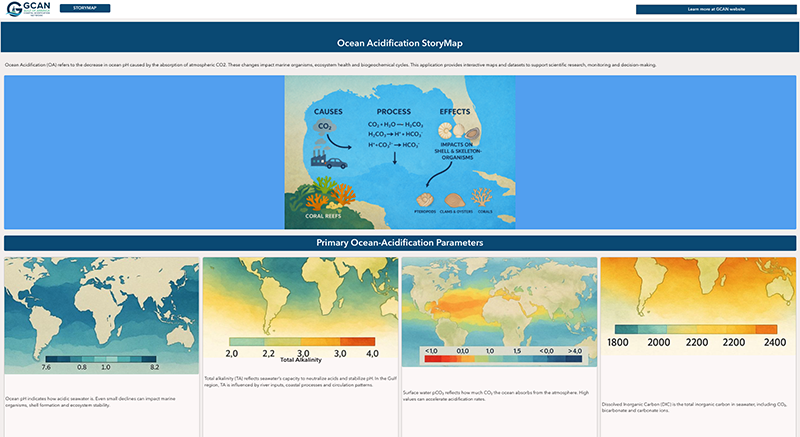
On Monday, GCAN hosted a webinar featuring Dr. Natalia López Figueroa, GCAN Coordinator and NASEM Fellow, and GCOOS Research Specialist and GIS Administrator Pallavi Tummeti who presented a new OA StoryMap. The StoryMap illustrates how researchers are monitoring ocean and coastal acidification across the Gulf, showcasing the data, research projects, and regional partnerships featured in this new interactive resource.
- If you were unable to attend, you can watch the recording. Just click on the right or visit our YouTube channel — our handle is @GCOOS1.
-
Check out the StoryMap here
-
You can also help us make the StoryMap more effective, just by taking a quick survey! Click here to take the survey now.
| | More GCAN Webinars: Mark Your Calendar | |
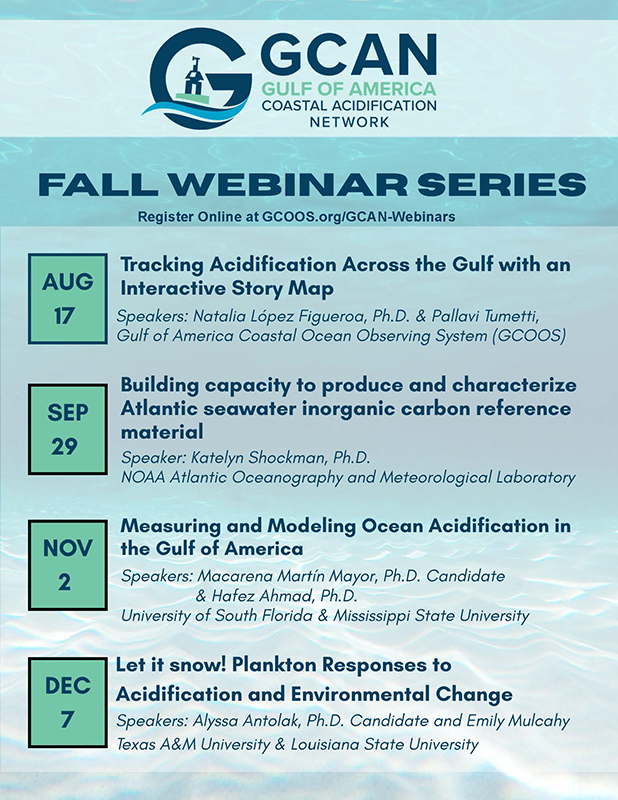
Mark your calendar for more webinars from the GCAN Fall 2026 Webinar series.
-
Sept. 29: “Building capacity to produce and characterize Atlantic seawater inorganic carbon reference material,” with speaker Katelyn Shockman, Ph.D., NOAA Atlantic Oceanographic and Meteorological Laboratory (AOML). Click here to register and review the speaker's abstract.
- Nov. 2: “Measuring and Modeling Ocean Acidification in the Gulf of America,” with speakers Macarena Martín Mayor, Ph.D. Candidate University of South Florida and Hafez Ahmad, Ph.D., Mississippi State University
- Dec. 7: “Let it snow. Plankton Responses to Acidification and Environmental Change,” with speakers Alyssa Antolak, Ph.D. Candidate, Texas A&M University, and Emily Mulcahy, Louisiana State University
Webinars will take place from 1-2 p.m. EST (Noon-1 p.m. CST). Registration for the November and December webinars will be posted here.
| Community Workshop: Louisiana’s Changing Coast | |
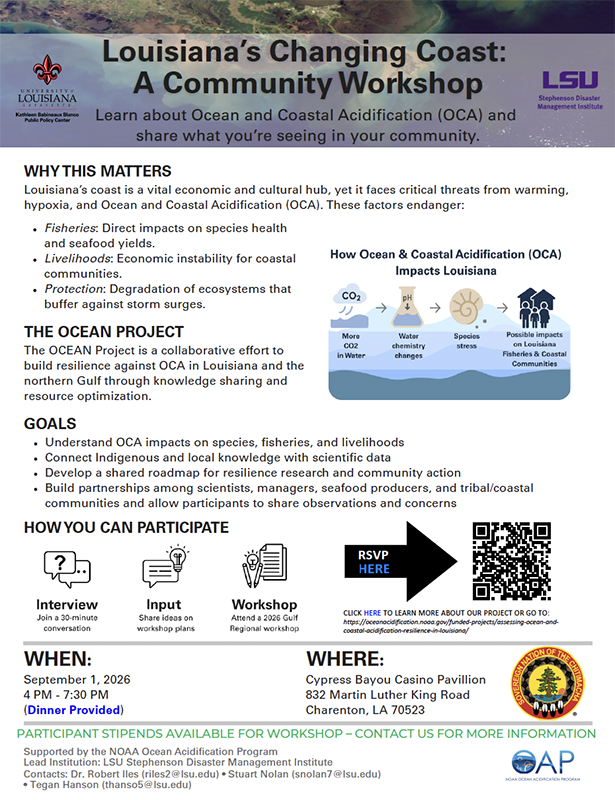
NOAA’s Ocean Acidification Program (OAP) along with Louisiana State University and the University of Louisiana at Lafayette are sponsoring a community workshop as part of the OCEAN Project, which is building resilience against ocean and coastal acidification in Louisiana and the northern Gulf.
- When: 4-7:30 p.m. CT Sept. 1 (dinner provided)
- Where: Cypress Bayou Casino Pavillion, 832 Martin Luther King Road, Charenton, LA 70523
-
RSVP here
-
Click here to learn more about the project
| | Celebrating and Sharing Student Successes | |
Congratulations to the students, interns and fellows who presented their research projects during the Student Experiences 3-Minute Lightning Talks hosted by the NOAA Gulf of America Regional Collaboration Team’s GoA Forum Webinar on Aug. 6. Topics ran the gamut from quantifying forever chemicals in fish and improving heat forecasts to the need for better communication about the natural mosquito mitigation benefits provided by bats.
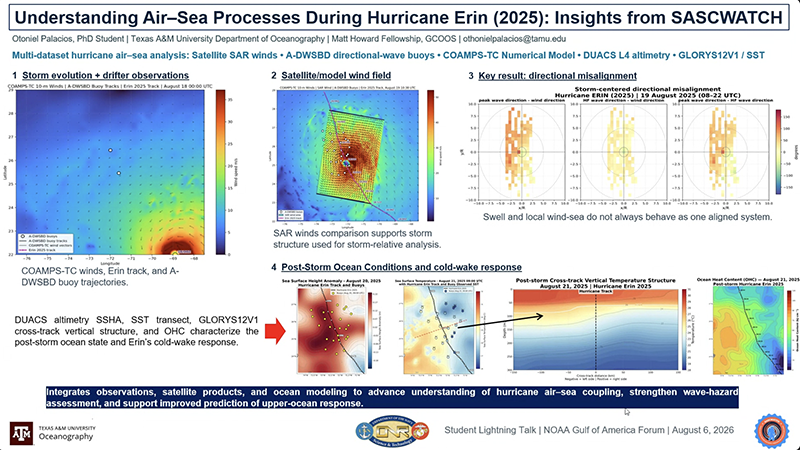
GCOOS was proud of our 2026 Matt Howard Fellow, Otoniel Palacios, who presented his dissertation research focused on understanding the air-sea processes that shaped Hurricane Erin during the 2025 Atlantic hurricane season (data snapshot below). “Presenting at the NOAA Gulf of America Forum was a meaningful milestone in my Ph.D. journey and I truly appreciate the support and confidence that GCOOS has placed in its fellows,” said Palacios. GCOOS looks forward to the continued journey of all the student presenters and their exciting contributions to the advancement of science.
If you’d like to help support the next-generation of Gulf ocean researchers and data scientists, please donate today to the Matt Howard Scholarship Fund, which supports GCOOS Fellows by providing travel support for professional conferences and mentorship from GCOOS staff and Board members.
| | Register Today for 2026 IOOS Code Sprint | | |
Registration is now open for the IOOS 2026 DMAC Code Sprint being co-sponsored by GCOOS. During this three-day hackathon style event, teams of developers, academic researchers, and community members will work on projects that address pressing data and information challenges that relate to the IOOS mission to produce, integrate, and communicate high quality ocean, coastal and Great Lakes data that meets the nation’s safety, economic, and stewardship needs.
- When: Nov. 17-19
-
Where: Texas A&M University Mays Business School — City Centre, in Houston, Texas, (click for map) with an option for virtual participation.
-
Topics: As in previous Code Sprint events, the topics are identified by the participants. Have a problem that’s been nagging you? Need some help pushing something over the finish line? Have an idea but need to brainstorm on a solution? Submit your ideas here
-
To review the list of proposed projects, click here
-
Registration: Register here before Nov. 1
-
Hotel: Room block rate is available at The Moran Hotel . Reservations must be made before Friday, Oct. 16 using the group code 2611GCOOSR. · Click here and here for more details
- Travel Vouchers: There are a limited number of travel vouchers available to assist with travel and hotel costs made available by the IOOS Program Office for IOOS Regional Association staff, members and partners. Please indicate your need for travel support in the registration form and one of the GCOOS organizers will reach out to you. If travel support is approved, the travel voucher will be paid with check in advance of the event.
| | |
Coastal Hazards &
Hurricane Season
| Could Sharks Help with Hurricane Predictions? | |
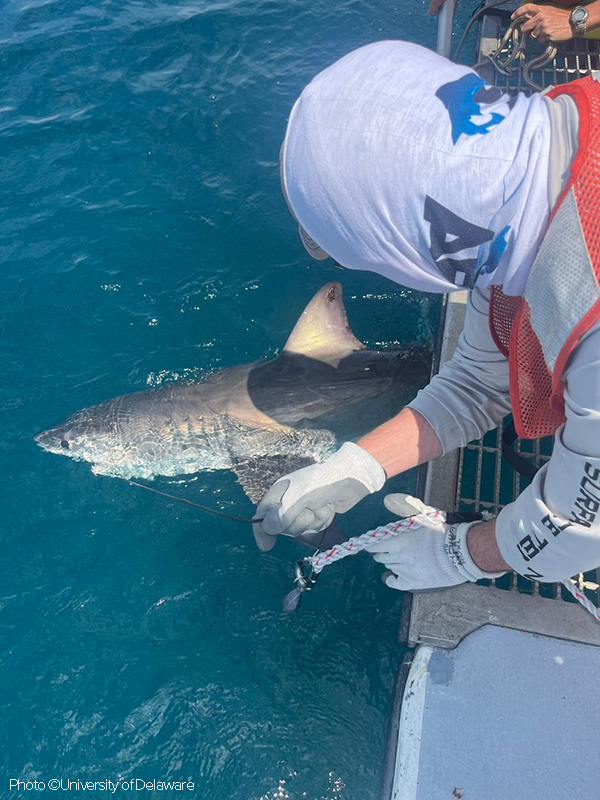
Researchers at the University of Delaware are outfitting shortfin mako and blue sharks, chosen because of the frequency they surface, with satellite-linked CTD sensors collecting data on ocean temperature, depth and conductivity off the East Coast. The project is designed to help provide another layer of data to help inform hurricane forecasting. GCOOS’s East Coast counterpart, MARACOOS, will quality control the data and host it on its OceansMap.
|
| Saronic Autonomous Ship Test Site Announcement | | |
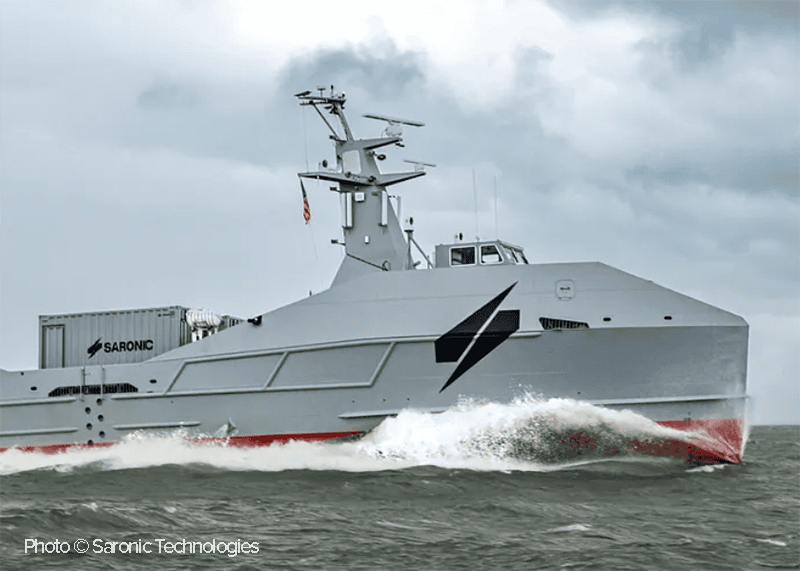
Saronic Technologies, a company that builds autonomous boats for commercial and military purposes, has established a test site at the Port of Gulfport, Mississippi. Saronic said the site will support on-water testing and commissioning of the company’s 180-foot Marauder Medium Unmanned Surface Vessels (pictured here) that are between production and final delivery. This partnership with the Port and Coastal Mississippi will contribute to the Port’s continued operations and growth.
| |
Capstone Hydrographic Survey Results Now Available | |
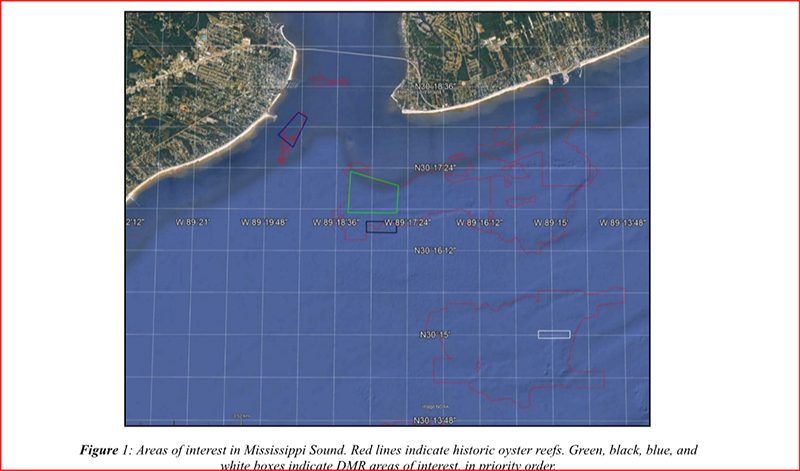
Congratulations to University of Southern Mississippi hydrographic science students Keely Martin, Charles Williams, Hettithantrige Deshapriya and Edgar Benjamin Ramirez Del Valle who recently completed a capstone hydrographic survey south of Henderson Point, Pass Christian, Mississippi, collected as part of the USM CAT-A program requirements. “The project exemplifies the importance and value of the USM program and it is great to see this effort go from early planning and coordination with local authorities to development and implementation,” said Tim Osborn, Manager, NOAA Office of Coast Survey. Now that the survey and processing efforts are complete, the team is working on sharing project results more broadly, including finding conduits for the project’s data and imagery.
-
If you’re interested in accessing any of the raw files, QPS project files, grids, and/or mosaics for multibeam, side scan and backscatter, please email Raymond Beets, USM Affiliate Hydrographic Coordinator and Professor, at Raymond.Beets@usm.edu.
| | |
Healthy Ecosystems and Living Resources
| | Gulf Dead Zone Smaller Than Average | | |
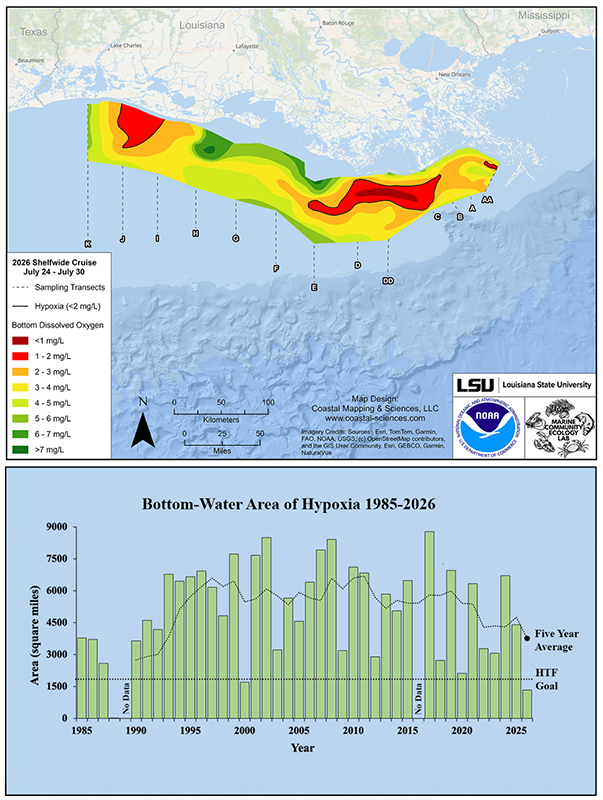
Researchers from Louisiana State University and the Louisiana Universities Marine Consortium (LUMCON) recently completed the annual hypoxia survey at the mouth of the Mississippi River. This dead zone — or hypoxic zone —occurs annually in the northern Gulf when oxygen concentrations drop to less than 2 parts per million in bottom waters. The low-oxygen is primarily caused from nitrogen loading from the Mississippi River watershed, which fertilizes the Gulf of Mexico’s surface waters to create excessive amounts of algal biomass. Decomposition of plant material in the bottom layer and sediments leads to oxygen loss.
The survey, which took place aboard the R/V Pelican from July 24-30 found a dead zone estimated to be 1,332 square miles (3,449 square kilometers) on the Continental Shelf off Louisiana and Texas. While the prediction made in May 2026 was that the size would be larger than average, the lack of river discharge in July was below average. Tropical Storm Bertha also helped with water mixing to keep the zone smaller than average.
| | Taking a Deep Dive for Coral Conservation in the Flower Garden Banks | |
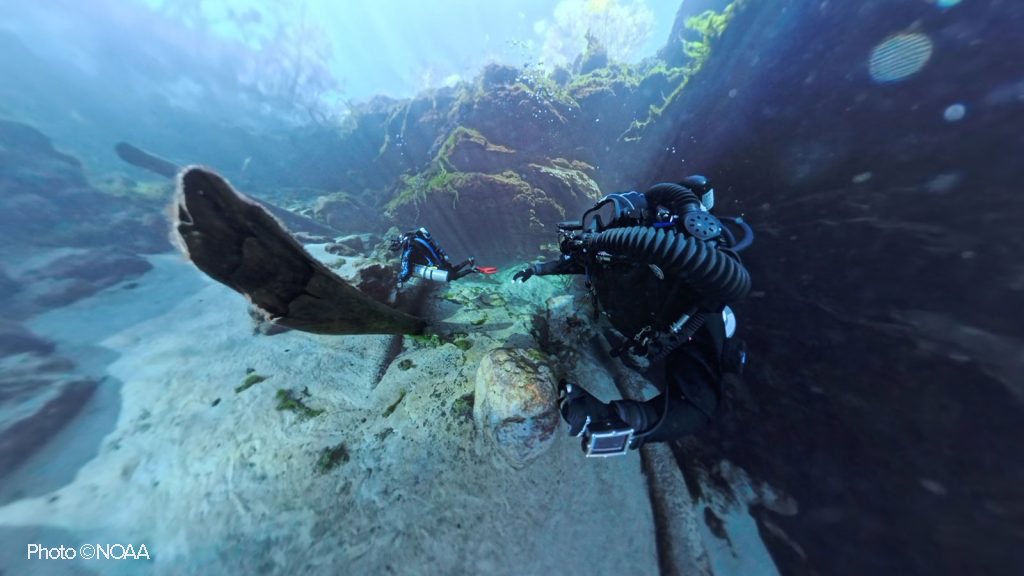
Under a collaborative, five-year project recently funded by the NOAA RESTORE Science Program led by the Flower Garden Banks National Marine Sanctuary (FGBNMS) and the National Marine Sanctuary Foundation, scientists at the Cooperative Institute For Marine And Atmospheric Studies (CIMAS) at the University of Miami and NOAA’s Atlantic Oceanographic & Meteorological Laboratory (AOML) will extend existing long-term coral reef monitoring efforts that the team currently leads into deeper waters — to the mesophotic coral ecosystems.
FGBNMS consists of 160 miles of dispersed banks with underwater mountains, ridges, and troughs covering 80 miles off the coasts of Texas and Louisiana, and it hosts the highest recorded coral cover of any reef within the greater U.S. Atlantic region. While the relatively shallow coral reef caps of East and West Flower Garden Banks specifically have remained remarkably stable despite global declines, those reefs found in the region’s “twilight zone” pushing 100 to 500 feet may play a vital role in the future of these essential and vast ecosystems. To investigate them, scientists are preparing to explore those depths using advanced technical diving techniques.
-
Read more about this partnership here
-
And read more about deep-diving innovation here
| | Interior Announces Change to Endangered Species Act | | |
The Department of the Interior's U.S. Fish and Wildlife Service has announced revisions to regulations under the Endangered Species Act (ESA) designed to “strengthen American energy independence, improve regulatory predictability, and ensure federal actions align with the best reading of the law.” The rule change will take effect Aug. 20, though there are several pending legal challenges (read about those here and here).
- Threatened species protections (Section 4(d)): Eliminates the “blanket rule” option under section 4(d) of the ESA for “threatened” species to be treated as endangered. They will instead be treated as threatened and the Service may tailor a customized 4(d) rule to better suit each species.
- Critical habitat exclusions (Section 4(b)(2)): Revises the “critical habitat” designation process to consider the economic, national security, and other relevant impacts following the designation of any particular area as “critical habitat.”
Another redefinition, this one on the use of the term “harm” is also scheduled for implementation on Sept. 14.
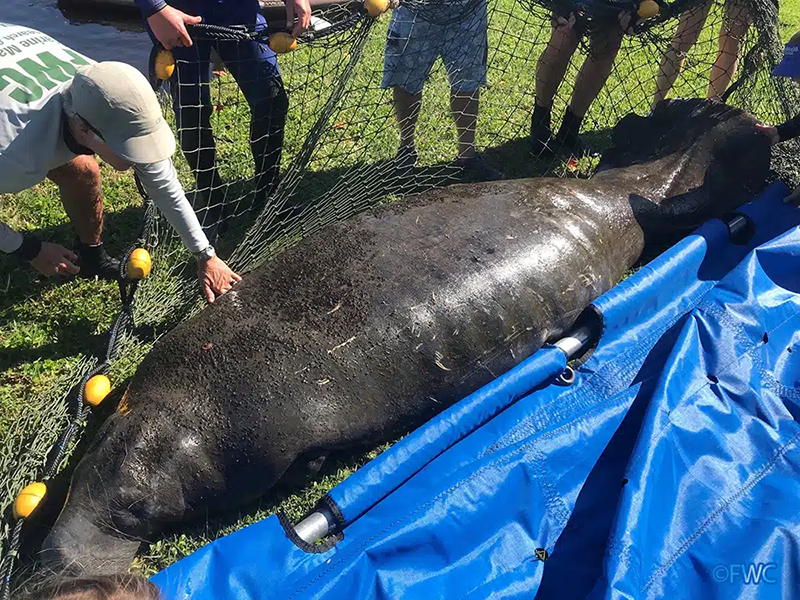
| | Environmental groups worry that changing key definitions in ESA regulations would reduce protections for endangered and threatened species, leading to more extinctions. Widespread environmental degradation caused an unusual mortality event (UME) of manatees in Florida that lasted more than two years. In this photo, an emaciated manatee is rescued by the Florida Fish & Wildlife Conservation Commission (FWC). Photo courtesy FWC. | | |
-
NOAA - NOS: Director Office of Coastal Management
-
University of Southern Mississippi: Visiting Instructor or Assistant Teaching Professor
-
Hello.gov: Sr. Cloud and Data Engineer
- Mote Marine Laboratory
-
CODAR Ocean Sensors seeks to fill an algorithm and software engineering role.
Postdoctoral Positions:
-
Sustainable Marine Solutions: postdoctoral researcher to play a leading role in a five-year project, "Cooperative Research and Management for Fish Spawning Aggregations in the Gulf of America
- Knauss Marine Policy Fellowship
- Marine Research Scientist / Postdoctoral Scientist
-
Monterey Bay Aquarium Research Institute: Postdoctoral Fellowship
-
National Research Council: Research Associateship Programs Postdoctoral and Senior Research Awards
-
Mississippi State University: Postdoctoral Associate
-
Downeast Institute: Research Scientist
Fellowships:
- ARL Distinguished Postdoctoral Fellowships
-
National Academies of Science, Engineering and Mathematics: Early Career Fellowships
- Department of Defense: Visualization of Coastal Data, Coastal Vulnerability Assessment Fellow
| |
-
Gulf of America Alliance: Biodiversity Net Positive Impact
-
2026 US HAB CTI: Funding Opportunity
-
National Oceanic and Atmospheric Administration: Ernest F. Hollings Undergraduate Scholar
-
National Academies of Sciences, Engineering and Medicine, Gulf Research Program: Empowering K-8 Through Place Based Education
-
Gulf of Mexico Alliance: Increasing Participation in Clean and Resiient Marine Programs
-
The National Academies of Sciences, Engineering, and Medicine: Early Career Research Fellowship
-
National Oceanic and Atmospheric Sciences: Prevention, Control, and Mitigation of Harmful Algal Blooms
-
BOEM: Environmental Studies Planning
| | GCOOS Fall Meeting (date TBD) | | 7-11: AGU 2026, San Francisco, California | | Dr. Jorge Brenner, Executive Director • Marcus Ogle, Associate Director • Dr. Chris Simoniello, Outreach & Education Manager • Dr. Natalia López Figueroa, GCAN Coordinator and GCOOS 2025-26 Gulf Science Policy Fellow with the National Academies of Sciences, Engineering and Medicine • Felimon Gayanilo, Systems Architect, Co-Data Manager • Bob Currier, Product Developer, Co-Data Manager • Pallavi Tummeti, GIS Administrator and Developer • Tuomo Saari, Scientific Computing Specialist • Xiao Qi, Scientific Computing Specialist • Megan Howson, Marine Mammal Biologist and Data Scientist • Sandeep Jilla, Software Developer • Grant Craig, Project Manager and HABscope Volunteer Coordinator • Nadine Slimak, Public Relations & Content Marketing, Vetted Communications, LLC • Laura Caldwell, Program Assistant | | | | |