Access our research on the Bloomberg Terminal with ERH GXY <GO>
|
|
gm -
we have two excellent new reports for you this week:
-
Chuck Yu offers a comprehensive overview of Avalanche in the second installment of our Ready Layer One series. This report is packed with detailed overviews of the technology, roadmap, and ecosystem, and contains novel adoption metrics and blockchain data never before published on Avalanche.
-
Brandon Bailey and Karim Helmy explain the hashprice metric and offer a new way to assess the breakeven thresholds of mining operations by proposing breakeven hashprice.
cozy reading for your winter weekend. wishing you all the best --
alex
|
|
After more than 6 years, bitcoin stolen from crypto-exchange Bitfinex was recovered by the US government in its largest asset seizure in history; members of the House Financial Services Committee pushed back on the Treasury's proposed law overseeing stablecoins; Nike has filed a lawsuit over an NFT collection the company says infringes on its trademarks. |
|
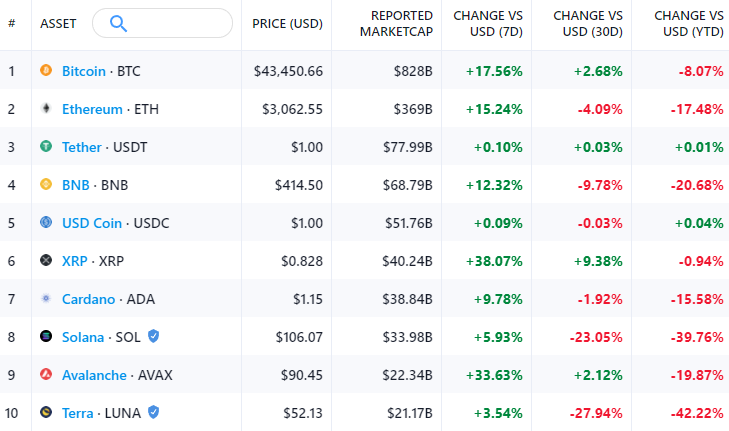
The total implied network value (market cap) of the digital assets market stands at $1.95tn, up 16% from last week (when it stood at $1.68tn). Bitcoin’s network value is 6.84% of gold’s market cap. Over the last 7 days, BTC is up 17.5%, ETH is up 15.2%, XRP is up 38%, and AVAX is up 33.6%. Bitcoin dominance is 42.39%, down half a percentage point from last week. |
|
Data current as of 6:45pm ET on February 10, 2022. Prices and Data via Messari.
|
|
The U.S. Department of Justice has seized 94,000 BTC, worth approximately $3.6bn that was stolen in a hack from 2016 of Hong Kong-based cryptocurrency exchange Bitfinex. This is the largest financial seizure ever in the history of the DOJ. According to the DOJ’s announcement, the stolen crypto was traced to the financial accounts of two individuals, Ilya Lichtenstein and his wife Heather Morgan. They have been accused (but not yet indited) of laundering over 100,000 BTC through a variety of means, sending funds through darknet markets such as Alphabay and Hydra and using privacy wallets such as Wasabi Wallet to obfuscate their money trail.
Though charged with conspiracy to commit money laundering, Lichtenstein and Morgan have notably not been identified as the original perpetrators of the hack where some 120,000 BTC, worth $60m and representing one-sixth of the total market trading volume at the time, were looted from Bitfinex. This has sparked speculation within the cryptocurrency community over what role Lichtenstein and Morgan truly played in executing the 2016 hack and with whom. The past activities of Razzlekhan, which is the alias the DOJ listed for Heather Morgan, as a TikTok content creator, journalist, rapper, and perhaps most importantly social engineer have been at the center of ongoing postulation over how exactly the hack happened.
In addition to unknowns about the details of the heist, there remains outstanding questions over the legal proceedings to determine who gets the rights to recovered funds. Immediately after the theft in August 2016, Bitfinex created two tokens to restore customer funds. One BFX token was issued for every dollar that was stolen. Over the course of eight months, Bitfinex either allowed customers to redeem their BFX tokens for dollars or exchange them for iFinex stock. (As background, iFinex is the parent company of Bitfinex and the stablecoin Tether.) As an incentive to choose the stock option, customers who did convert their BFX tokens into iFinex shares also received a separate coin known as the Recovery Right Token (RRT).
In the event the stolen bitcoins are recovered and within the possession of Bitfinex, RRT tokens can be redeemed by its holders at up to $1 per RRT. There are 30 million RRT tokens outstanding, meaning in the event the $3.6b seized by the DOJ is given back to Bitfinex, customers will be recouped up to $30 million. Bitfinex has announced that in this event they will use the majority of remaining funds to buy back UNUS SED LEO tokens. UNUS SED LEO tokens launched in 2019 are exchange tokens that holders use to save on platform fees such as trading commission, withdrawal and deposit fees. Not surprisingly, the statement by Bitfinex has caused the LEO token to surge in recent days and hit record highs as traders anticipate the potential for a supply crunch from the potential token buyback.
|
|
OUR TAKE: The process of determining the rights to the stolen bitcoin will likely take at least a year, perhaps much longer, to reach a conclusion given not only the sheer amount of money in question, but also the competing interests between Bitfinex, Bitfinex customers, and the DOJ which are bound to complicate the legal forfeiture process. Given that the outstanding RRTs would only recoup customers that had lost funds in the dollar value of bitcoin at the time of the hack instead of directly in bitcoin, there is clear financial motivation for victims to try and reclaim rights to the seized assets directly from the DOJ instead of Bitfinex. When it comes to the interests of the DOJ, it is hard to imagine the Department is enthused at the idea of handing over $3.6bn to an organization that has been fined by the CFTC for facilitating illicit transactions and by the NYAG for covering up financial losses, let alone to a company that is affiliated with Tether, a stablecoin that has been under scrutiny for years by the U.S. government. It is not clear the extent to which Bitfinex’s history will ultimately impact the process but that history could be reason enough for increased caution, scrutiny, and time from officials over these proceedings.
Much about the forfeiture of seized bitcoin by the DOJ remains to be determined and there is a high probability that the 94,000 BTC in the DOJ’s possession will remain frozen and inaccessible to the markets for several years. The more immediate implication of the DOJ’s announcement this past week on the crypto industry is how it changes the American government’s posture, as well as public sentiment, towards the use of crypto in criminal activity. Speaking on the arrests, the Deputy Attorney General Lisa O. Monaco, said, “Today’s arrests, and the department’s largest financial seizure ever, show that cryptocurrency is not a safe haven for criminals … the department once again showed how it can and will follow the money, no matter what form it takes.” The second largest seizure of cryptocurrency by the DOJ was back in November 2020 when the Department took over funds totaling more than $1bn at the time in bitcoin. These seizures highlight the DOJ’s increasing capabilities when it comes to tracking down illicit transactions through blockchain analytics, which undoubtedly also dispels fears about the increasing use of cryptocurrencies on public blockchains making financial crimes harder for law enforcement to catch.
Despite the pseudonymity of the Bitcoin blockchain, maintaining digital anonymity remains a difficult task due to the multitude of ways moving bitcoin, especially in bulk size, can be traced by authorities to and from certain exchanges, digital wallet service providers, and even darknet markets. These capabilities have yet to uncover all the mysteries about Bitcoin, however, such as the true identity of Bitcoin creator Satoshi Nakamoto, the existence of block number 528249 theorized to be virtually un-mineable, and the sudden disappearance of crypto funds from the cold wallets of the now-defunct cryptocurrency exchange QuadrigaCX, just to name a few. Perhaps in a few years, like with the Bitfinex hack, some of the mystery around these events will get solved.
|
|
💸 Bipartisan Pushback for Treasury on Stablecoins |
|
Treasury’s proposed law overseeing stablecoins rejected by members of House committee. The US House Financial Services Committee convened virtually on Tuesday to discuss the Stablecoin Report by the President's Working Group on Financial Markets (PWG). Resolutions tied to the event were to reauthorize the Artificial Intelligence Task Force and Financial Technology Task Force to conduct relevant studies and issue reports detailing any findings and recommendations to the Committee. Prior to the meeting, a memo was circulated summarizing the PWG's findings.
The Treasury's Nellie Liang, Under Secretary for Domestic Finance, presented the report's findings and testified on behalf of the PWG. In her prepared remarks, Nellie Liang had emphasized that the current regulatory framework did not provide consistent and comprehensive standards for overseeing the issuance, custody, and payments use of stablecoins. Many committee members were in consensus that stablecoin issuers needed to make more disclosures and have more reputable audits over the nature of reserves.
Committee members had asked Nellie Liang questions regarding the report, particularly around its recommendation to limit stablecoin issuance to federally chartered banks. The concerns around such a setup were shared by both Republican and Democrat lawmakers. Key reasons for skepticism for limiting stablecoin issuance to federally insured banks included: (i) deposit insurance would add financial risk that would ultimately fall on the shoulders of taxpayers if a bailout was needed, (ii) concentration risk in major banks that would limit competition, and (iii) potential negative impact on racial equity among customers. Nellie Liang had responded that banks are equipped to handle some of the risks associated with stablecoins, and that there could be regulatory flexibility to allow non-banks to issue stablecoins.
|
|
OUR TAKE: Overall, the hearing was a success for the crypto industry as past crypto skeptics had become new crypto advocates. The report's recommendation to limit stablecoin issuance to major banks faced bipartisan skepticism, which suggests lawmakers would be unlikely to pass such legislation in its proposed form. Some committee members had expressed concern that there were no mentions in the report of the existing regulatory framework at the state level and that certain meaningful benefits of stablecoins were omitted. Given the difficulty in overseeing stablecoins due to unique risks and new service providers involved, additional federal studies that demonstrate a more thoughtful and longer-term approach on regulating stablecoins are needed before any new legislation will likely pass.
Several states and crypto entities have already taken initiative to shape the design of a proper regulatory framework including New Hampshire establishing a commission to study crypto and recommend policies, and Kraken launching an audit showing proof of reserves of BTC and ETH. These initiatives set a strong example for other states and entities to follow, and should draw meaningful learnings that could be adopted by federal lawmakers. Having stronger assurances about dollars that exist on-chain can only benefit the growth of the ecosystem.
|
|
⚖️ Dispute with Nike Tests NFT Legal Limits |
|
Nike tests the legal boundaries of NFTs in its lawsuit against StockX. On Thursday, Nike filed a lawsuit against StockX (a reseller of sneakers, bags, and streetwear that was most-recently valued at $3.8 billion) in New York federal court. Nike claims StockX’s NFT collection infringes on its trademarks, and Nike is concerned that StockX’s NFTs “are likely to confuse consumers, creating a false association between those products and Nike”. Nike cites some preliminary evidence on Twitter to support these claims as multiple tweets responding to StockX’s Vault announcement incorrectly point out that 1.) Nike partnered with StockX on this venture and 2.) that Nike receives a royalty on each NFT sale (both of these statements are false). So far, StockX has sold over 500 Nike-branded NFTs, and Nike is seeking both injunctive relief and damages through court-order.
The genesis of this legal battle can be traced back to January 18th when StockX first launched its Vault NFTs product. Essentially, StockX’s vault product allows its users to purchase, sell, and trade ERC-1155 NFTs, with each NFT representing physical ownership of sneakers that are authenticated and custodied by StockX. Eventually, StockX will open up additional functionality that will allow a user to redeem their NFT in exchange for the sneaker (or whatever physical good the NFT represents). Given that StockX’s core competencies are centered on the logistics of physically authenticating and moving around valuable goods, at scale, its NFT Vault product makes logical sense in the context of their business model. By decoupling the ownership of sneakers from the physical sneakers themselves, StockX hopes to see increased liquidity and visibility into its markets with its Vault product.
Resellers, one of the largest userbases within StockX, would benefit most from this type of product as the Vault NFT platform would be their “fastest way to flip”. Resellers could also simplify their operations by offloading the logistical challenges of storage, packaging, and shipping to the blockchain. The key issue is that a large portion of StockX’s best selling products are also Nike products, and both companies have different businesses with different visions for their NFT ambitions. Ultimately, this legal battle underscores the ongoing struggle amongst corporations to capture the economic value being created by NFTs in the absence of both legal and operational precedent.
|
|
OUR TAKE: While this is the first major corporate battle over NFT legal rights, it won’t be the last. Many experts point to the first-sale doctrine as evidence that StockX is in-the-right. (For those unfamiliar, the first-sale doctrine refers to the notion that IP holders do not have the right to restrict the resale of any products involving their IP). On the other hand, some would argue that this doctrine only applies to physical goods, leaving NFT applications in a legal grey area. One thing that is clear is Nike does not want to create any confusion about its involvement in the NFT space, and this is especially true in light of its recent acquisition of RTFK. While NFTs have captured the collective conscious of the mainstream (relative to other crypto sectors), the NFT space is still in its infancy, rife with bad actors and shoddy projects. Nike has spent decades building up its world-class brand image, and they have no interest in jeopardizing their brand equity to make a quick buck. Instead, they will favor a prudent strategy of exercising maximum control over their entire NFT product experience.
This question of control over the economic value capture in resale markets is not unique to luxury fashion goods. Game developers have been frustrated with retailers like Gamestop who have made consistent revenue from used-game sales at prices that are often marked near their brand-new price. This is what motivated an industry-wide push to digitize game marketplaces so that publishers and developers keep more of the revenue from the labor around developing complex games, and this trend obviously is happening at the expense of gaming retailers like Gamestop (who ironically have NFT aspirations in an effort to salvage their declining retail-dominated business model).
Nike likely is concerned that StockX’s business model, which is anchored by a 3% payment processing fee on all sales, may benefit more from the tidal wave of NFT adoption as the secondary sales numbers for NFTs are in the same ballpark as primary sales, implying that both parties would benefit equally from a culturally-relevant product that was developed entirely by Nike. Nike is not interesting in letting this happen, leading to frustration that has yielded litigation. It will be interesting to watch how this legal battle plays out and the knock-on effects this will have on future NFT rollouts.
|
|
-
Cash App launches Lightning Network support for Bitcoin withdrawals and deposits
-
Sources tell CoinDesk that BlackRock plans to offer crypto trading
-
YouTube publishes a blog post detailing “incredible potential” of Web3 and NFTs
-
Binance invests $200m in Forbes several years after filing a lawsuit for defamation (which it later dropped) against the publication
-
Gucci buys virtual land in The Sandbox
-
Zynga plans to launch an NFT-based game this year
-
McDonalds and Panera Bread file trademarks for virtual restaurants in the metaverse
-
Bitcoin mining firm Compute North raises $385m in equity and debt funding
-
Crypto infrastructure and dev tooling firm Alchemy raises at a $10.2bn valuation
-
Aave debuts protocol for decentralized social media “Lens”
-
Bank of England official says it’s “highly unlikely” to develop a retail wallet for CBDC
|
|
Access our research on the Bloomberg Terminal with ERH GXY <GO>
|
|
|
|
Read this comprehensive overview of Avalanche--its technology, ecosystem, development, and adoption--from GDR's Chuck Yu. This is part of our ongoing series Ready Layer One examining foundational blockchains.
|
|
|
|
Analyzing Public Miners with Breakeven Hashprice
|
In this report, GDR's Karim Helmy and Galaxy Digital Mining's Brandon Bailey describe the hashprice metric and explain how it can be used to assess breakeven thresholds for mining operations.
|
|
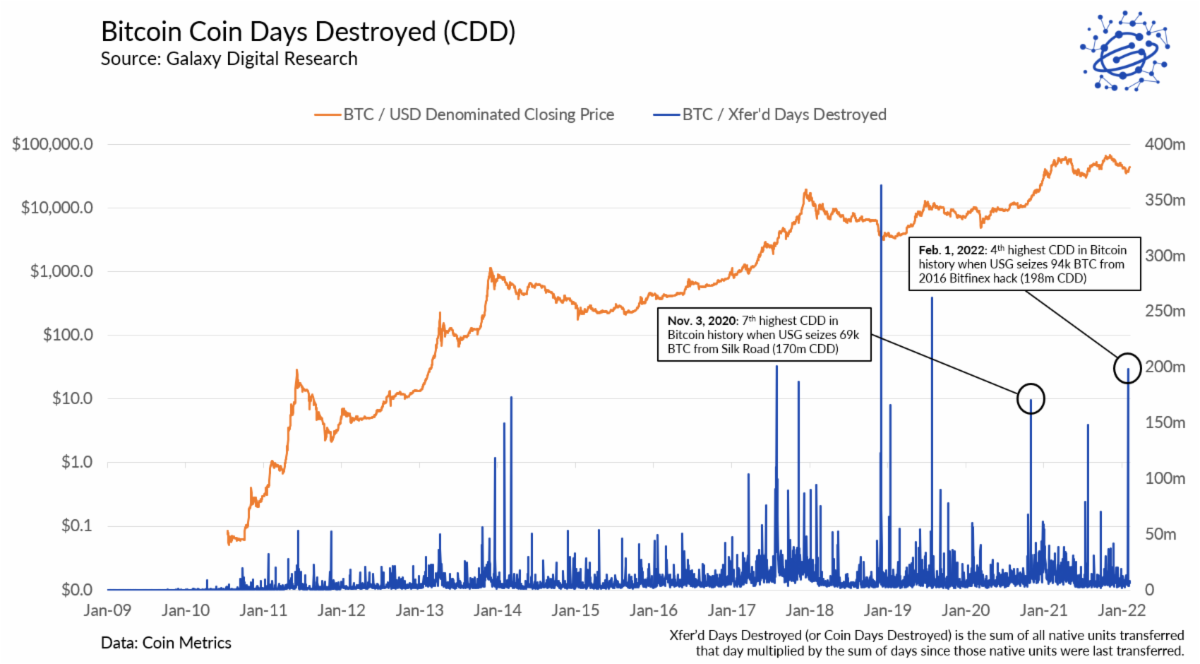
When the US government seized 94k BTC from the 2016 Bitfinex theft last week, they "revived" a giant pile of coins that hadn't moved since August 2016. The metric "coin days destroyed" calculates the sum of coins moved on any given day multiplied by the number of days since those coins last moved. We can see the metric spike on Tuesday, February 1, when a Twitter user noticed the consolidation of the Bitfinex coins on-chain and speculated that the USG was responsible. (We now know that it was indeed the US government). You can also see a similar spike in CDD on November 3, 2020, when the US government retrieved a pile of coins left over from the Silk Road. This metric is sometimes used in on-chain valuation and predictive models because it can indicate that "old coins" are selling, but that heuristic has limitations, as both the 4th and 7th largest days for CDD were the US government transferring coins into their control, rather than selling by an OG whale.
|
|
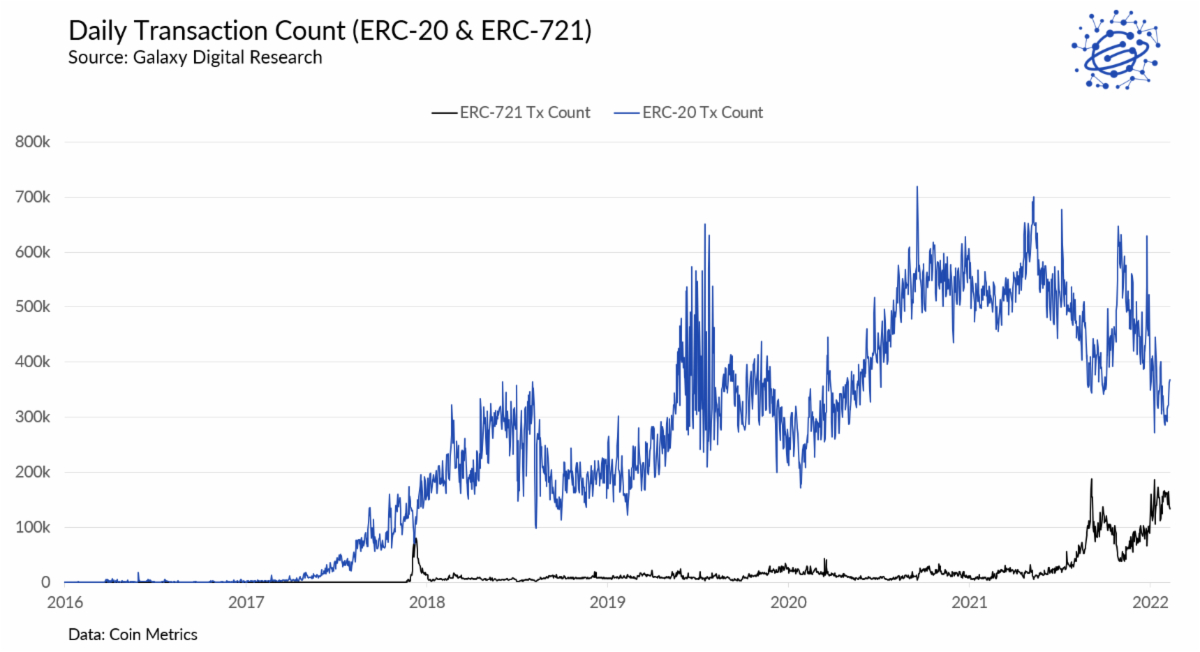
The number of ERC-20 (fungible tokens) transactions per day on Ethereum has been declining since reaching a peak in late 2020. At the same time, the number of daily ERC-721 (non-fungible tokens) transactions has been steadily growing. The only time they reached parity was at the end of 2017 and early 2018 when CryptoKitties launched. The decline in ERC-20 transactions vs. the rise of ERC-721 transactions highlights the shifting use of Ethereum from DeFi to NFTs. |
|
Thanks for reading this week. Have a great weekend.
|
|
Alex Thorn
Head of Firmwide Research
|
|
|
Legal Disclosure:
This document provides links to other websites that we think might be of interest to you. Please note that when you click on one of these links, you may be moving to a provider's website that is not associated with Galaxy Digital. These linked sites and their providers are not controlled by us, and we are not responsible for the contents or the proper operation of any linked site. The inclusion of any link does not imply our endorsement or our adoption of the statements therein. We encourage you to read the terms of use and privacy statements of these linked sites as their policies may differ from ours. This document, and the information contained herein, has been provided to you by Galaxy Digital Holdings LP and its affiliates (“Galaxy Digital”) solely for informational purposes. This document may not be reproduced or redistributed in whole or in part, in any format, without the express written approval of Galaxy Digital. Neither the information, nor any opinion contained in this document, constitutes an offer to buy or sell, or a solicitation of an offer to buy or sell, any advisory services, securities, futures, options or other financial instruments or to participate in any advisory services or trading strategy. Nothing contained in this document constitutes investment, legal or tax advice. You should make your own investigations and evaluations of the information herein. Any decisions based on information contained in this document are the sole responsibility of the reader. Certain statements in this document reflect Galaxy Digital’s views, estimates, opinions or predictions (which may be based on proprietary models and assumptions, including, in particular, Galaxy Digital’s views on the current and future market for certain digital assets), and there is no guarantee that these views, estimates, opinions or predictions are currently accurate or that they will be ultimately realized. To the extent these assumptions or models are not correct or circumstances change, the actual performance may vary substantially from, and be less than, the estimates included herein. None of Galaxy Digital nor any of its affiliates, shareholders, partners, members, directors, officers, management, employees or representatives makes any representation or warranty, express or implied, as to the accuracy or completeness of any of the information or any other information (whether communicated in written or oral form) transmitted or made available to you. Each of the aforementioned parties expressly disclaims any and all liability relating to or resulting from the use of this information. Certain information contained herein (including financial information) has been obtained from published and non-published sources. Such information has not been independently verified by Galaxy Digital and, Galaxy Digital, does not assume responsibility for the accuracy of such information. Affiliates of Galaxy Digital own investments in some of the digital assets and protocols discussed in this document. Except where otherwise indicated, the information in this document is based on matters as they exist as of the date of preparation and not as of any future date, and will not be updated or otherwise revised to reflect information that subsequently becomes available, or circumstances existing or changes occurring after the date hereof. The foregoing does not constitute a "research report" as defined by FINRA Rule 2241 or a "debt research report" as defined by FINRA Rule 2242 and was not prepared by Galaxy Digital Partners LLC. For all inquiries, please email contact@galaxydigital.io. ©Copyright Galaxy Digital Holdings LP 2021. All rights reserved.
|
|
|
|
|
|
|