Access our research on the Bloomberg Terminal with ERH GXY <GO>
If this email was forwarded to you and you would like to sign up to receive it regularly, click here.
|
|
Airdrops and non-fungible token (NFT) giveaways are two strategies that the Ukrainian government floated publicly this week in efforts to encourage crypto donations towards their ongoing war effort against Russia; The crypto industry grapples with compliance orders and social pressure related to the Ukraine-Russia war; Evmos, a new EVM-compatible chain that launched on Cosmos, seeks to be the 'trojan horse' that topples Ethereum. |
|
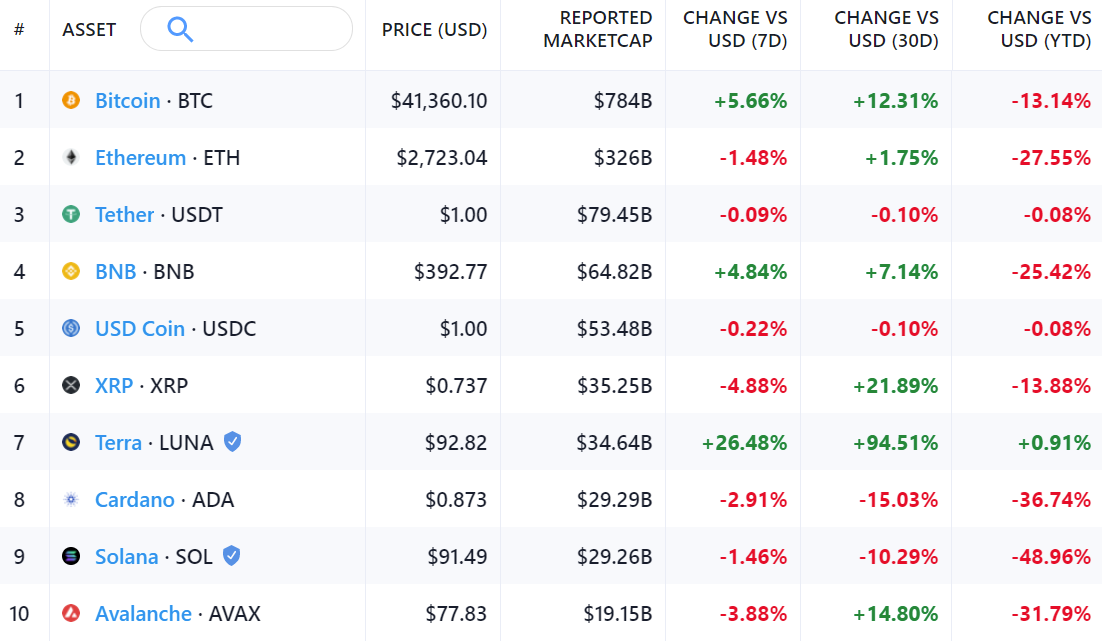
The total implied network value (market cap) of the digital assets market stands at $1.80tn, up 8.4% from last week (when it stood at $1.66tn). Bitcoin’s network value is 6% of gold’s market cap. Over the last 7 days, BTC is up 5.66%, ETH is down 1.48%, and LUNA is up 26.48%. Bitcoin dominance is 43%, down 2 percentage points from last week. |
|
Data current as of 11:08 PM ET on March 3, 2022. Prices and Data via Messari.
|
|
💰 Crypto is Playing a Major Role in Financing Ukraine's War Efforts Against Russia |
|
The government of Ukraine has raised more than $48 mn in cryptocurrency donations over the past week. More than $10 million of this total has been raised in bitcoin. The rest has been raised in ETH, TRON, DOT, DOGE, SOL, and notably one CryptoPunk NFT, worth an estimated $200,000. The funds are actively being disbursed to fund the country’s war effort and provide for the needs of its war-affected population. According to Michael Chobanian, the founder of Kiev-based crypto exchange Kuna, the donations have acted as a huge boon to the nation’s military and civilians. More than $14 mn have already been disbursed to buy food, gas, medical supplies, firearms, and transport.
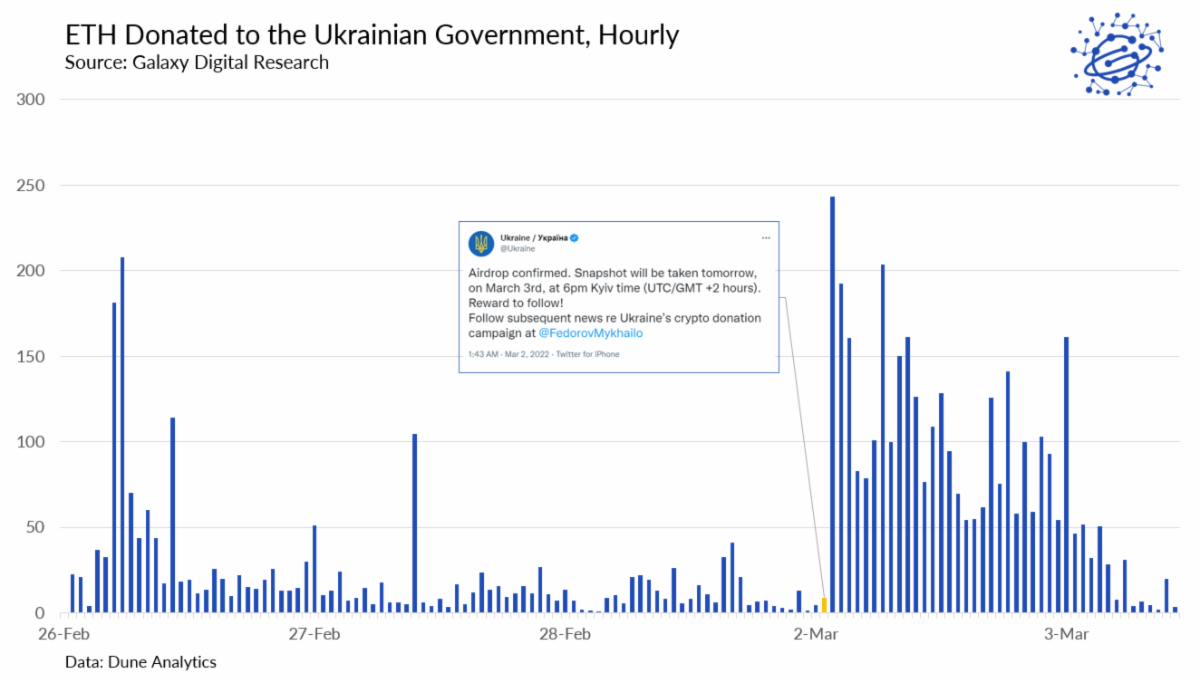
On Wednesday, the Ukrainian government announced on Twitter that it would be hosting an airdrop, awarding all donors who contribute before Mar. 3, 6PM Kyiv time, with a fungible token. Within hours of that announcement, Ukraine received over $7 mn in crypto donations. Roughly 30% of total contributions to the Ukrainian government was received after this announcement.
|
|
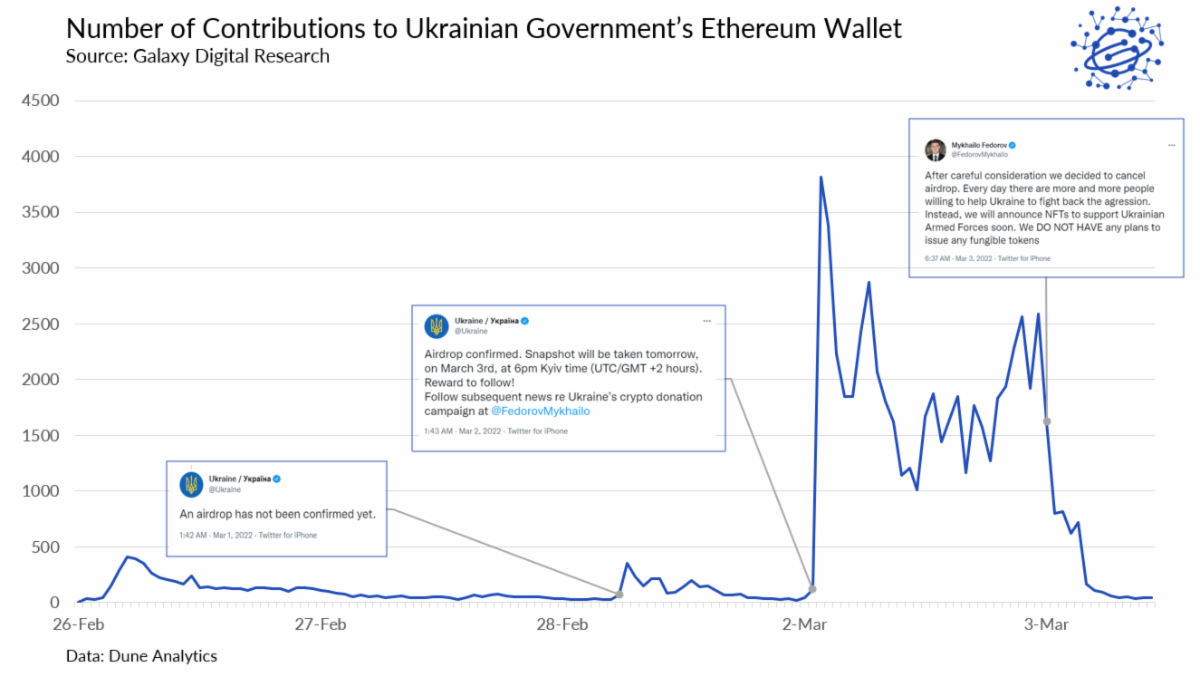
The following day, on Thursday, the Vice Prime Minister of Ukraine and Minister of Digital Transformation Mykhailo Federov tweeted saying that the aforementioned airdrop would be canceled. “Instead, we will announce NFTs to support Ukrainian Armed Forces soon. We DO NOT HAVE any plans to issue any fungible tokens,” Federov wrote. The public reaction to the airdrop cancellation was mixed.
Some accused the government of intentionally swindling crypto holders into donating. Popular crypto podcast host Jordan “Cobie” Fish responded to Federov’s tweet calling the pivot “the best rug ever.” Others such as founder of Tron and ambassador of Grenada Justin Sun praised the decision as “wise.” Multiple phishing attempts and scams were proliferated as a result of the airdrop announcement made on Wednesday. One of these attempts airdropped fake Ukrainian government-sponsored tokens called “Peaceful World” tokens to the wallet addresses of donors. These tokens saw up to $500,000 in trading volume on decentralized exchange Uniswap before being widely outed as a scam.
|
|
OUR TAKE: There are multiple potential reasons why the Ukrainian government backed out of their plans to reward donors through an airdrop. The plethora of sophisticated phishing attempts targeted at donors as a result of the airdrop announcement is one. The highly speculative nature that the fungible tokens most certainly would have taken on in the aftermath of the distribution is another. The uncertain implications of how a state-issued crypto asset would have been regulated domestically and internationally is an additional factor that likely dissuaded officials from ultimately following through with the airdrop.
Many of these concerns do still apply to some extent when considering the implications of state-issued NFTs. However, due to the non-fungible nature of these assets, they at the very least cannot be confused or misused as state-issued currency by donors. It is unclear at this time whether the Ukrainian government will follow through with issuing an NFT collection given that details around the release and token distribution have yet to be announced. In effort to restore public trust, officials are likely to release any future announcements around potential rewards for donors in exchange for their contributions with greater caution and care.
There remains a great deal of speculation over whether the Ukrainian government intentionally hustled cryptocurrency holders for more donations by announcing the airdrop then proceeding to cancel it just a day later. Setting speculations aside, it is worth highlighting the incredible impact the airdrop announcement had in boosting donations to the Ukrainian government. According to on-chain data, the number of unique contributions in ETH to the Ukrainian government surged from 119 to over 3,800 in the hour following the announcement.
In the context of crypto, airdrops are a marketing tactic to increase awareness and adoption of a coin by distributing them, usually for free, to the wallet addresses of a large group of users. It is an especially common tactic used by decentralized finance (DeFi) projects to encourage and reward early user participation. The coins that are awarded to DeFi users are usually given in exchange for completing tasks such as executing trades, providing liquidity, or simply joining a project’s Discord channel.
This is the first time that airdrops have been floated as an idea by a state government to incentivize donations towards a war effort. It along with the potential use of NFTS highlights a high level of sophistication and familiarity with the crypto space by the Ukrainian government unmatched by other governments. The sheer amount that has been raised through crypto to help finance Ukraine’s war against Russia over the past week is a testament to how quickly the crypto community can be mobilized and how effectively transfers of value spanning country borders can be initiated through public blockchains without the help of traditional financial intermediaries.
|
|
❌ The True Efficacy of Using Crypto to Bypass Sanctions
|
|
Crypto industry responds to compliance orders related to Ukraine-Russia war. On Sunday, Mykhailo Fedorov--Ukraine's Vice Prime Minister and Minister of Digital Transformation--requested crypto exchanges to block all Russian addresses, including ordinary users. In response, major crypto exchanges including Binance, Coinbase and Kraken have resisted the call to implement a blanket ban without government order. They contended that they would block users that were sanctioned, while some of the CEOs also argued against the merits of a blanket ban over Russia's users:
-
Binance: "Crypto was meant to provide greater financial freedom for people across the globe"
-
Kraken’s CEO Jesse Powell: "Our mission is better served by focusing on individual needs above those of any government or political faction. The People's Money is an exit strategy for humans, a weapon for peace, not for war."
Despite the crypto exchanges' assurances of compliance with OFAC sanctions, some members of Congress have argued that cryptocurrency can be used as a tool to undermine the effectiveness of US sanctions. On Thursday, Elizabeth Warren posted: "Criminals can use cryptocurrency to move money in the shadows, opening a door for Putin & his cronies to evade economic sanctions. I want answers from @USTreasury on how they'll ensure crypto doesn’t undermine our response to Russia's invasion of Ukraine."
Then yesterday, following new sanctions directives from the US as part of the Ukraine-Russia war, Metamask had restricted users with IP addresses in Iran, Lebanon, and Venezuela--the latter was mistakenly included in the configurations of Infura, the most popular blockchain node provider developed by ConsenSys, which also owns Metamask. The Infura account tweeted: "In changing some configurations as a result of the new sanctions directives from the United States and other jurisdictions, we mistakenly configured the settings more broadly than they needed to be. This was our oversight, and we are grateful that it was pointed out to us. Once we determined what happened, we were able to fix the problem, and service has been restored."
|
|
OUR TAKE: While some public officials continue to criticize cryptocurrencies for enabling criminal activity, now emphasizing how it's being used by Russians to evade sanctions, others including the counselor to the deputy Treasury secretary and the National Security Council's director of cybersecurity, argue crypto's usage has limited incremental effect in mitigating the impact of sanctions. With the inherent transparency of blockchains, governments have the surveillance tools to identify transactions and addresses of sanctioned or blacklisted entities. They have successfully prevented bad actors from accessing their crypto funds through high profile cases like the DOJ's seizure of 94k BTC linked to the Bitfinex hack in 2016 or the FBI's seizure of the Colonial Pipeline ransom. By maintaining a strong hold on the off-ramps from crypto (i.e. through centralized exchanges and banks), governments can minimize the value of crypto to criminals.
Much of the crypto community has commended the major crypto exchanges for their commitment to financial accessibility and inclusion, even if it means that their political enemies can also use the technology. The exchanges have maintained this stance when called by Canada's government officials to restrict access to individuals tied to the trucker protests - Coinbase, Kraken and Binance CEOs disagreed with the merits behind Canada's orders and, at the detriment to their own business interests, even encouraged users to take self-custody of their crypto assets off their exchanges.
Yet, with MetaMask restricting its software to users with IP addresses in broad jurisdictions users may now be wearier of putting all their faith in the most popular crypto wallet software provider. Whether federally ordered or just as a mistake, MetaMask has demonstrated its ability to restrict access to entire countries. The incident should alleviate some of the concerns of Senator Warren and other members of Congress when it comes to crypto, and should prompt more crypto users to question: (i) how centralized are the "decentralized" technologies that they rely on, and (ii) who actually controls their funds. Fortunately for the latter question, users may take comfort in knowing that their funds are technically stored in a blockchain address rather than in their Metamask wallet; MetaMask only serves as an interface to access their wallet. Additionally, alternative solutions exist to get around Infura's centralized points of failure. That said, crypto users should continue to expect that the market service providers are going to follow what's required by law unless they are truly decentralized, in which case they should be credibly neutral.
|
|
🐴 Highly-Anticipated EVMOS Launches Mainnet with Massive Airdrop
|
|
The latest EVM-compatible chain launched on Wednesday, highlighted by its cross-chain compatibility and novel tokenomics. Evmos was originally set to launch on Monday, February 28th before it got delayed 2 days to “ensure a smooth launch”. Now that it has finally been deployed, EVMOS seeks to establish itself as the “trojan horse” for Ethereum users to dive into the Cosmos universe. According to unofficial numbers reported by the Cosmos foundation, the total market cap of Cosmos-enabled projects is $146 billion (or ~7.4% of crypto’s total market cap). In the eyes of the Cosmos ecosystem, this market share only scratches the surface of what they hope to eventually achieve with their suite of products.
The Evmos launch and airdrop is a massive step towards Cosmos ambitions to bridge users in from Layer 1 juggernaut, Ethereum. Evmos launched with an initial supply of 200 million tokens. Half of the 200 million Evmos tokens will be distributed to the community via the airdrop, and the conditions for receiving the airdrop are all-encompassing. The full list of qualifiers can be found here, and it includes Cosmos users, Osmosis users, EVM bridge users, Ethereum dapp users, and individuals who have been “rekt” by prominent exploits. Approximately 1.9 million addresses qualify for the Evmos airdrop based on these qualifiers. The Evmos token itself is highly inflationary, with 300 million tokens being issued in the first year. Eventually, Evmos will have 1 billion tokens issued after 4 years. Though the total Evmos supply is uncapped, the token emissions schedule is set to exponentially decay, and the Evmos community can vote to alter the inflation schedule after year 4.
The key differentiator between Evmos and competing L1s is rooted in the incentives structure that the Evmos token enables from day 1. The goal with this token is to align incentives of developers, end-users, and validators. These three stakeholders will all collectively share in the economic value creation spearheaded by the Evmos development, and this approach stands in contrast with most other L1s who historically have only rewarded validators with their native L1 token. These incentives will materialize in a number of ways, including, but not limited to, usage incentives for Evmos applications, developers sharing in revenues for Evmos dapps, token holders voting on which smart contracts will yield rewards for users. In other words, both the individuals who are writing smart contracts that drive Evmos activity/adoption and end-users of Evmos will be aligned at the protocol level. This tokenomic structure appears to be a first for a prominent L1 protocol.
|
|
OUR TAKE: Aside from the novel tokenomics incentives the Evmos chain employs, an important consideration to pay attention to here is how EVM-powered dapps, such as Aave and Uniswap, will be able to natively run on a Cosmos IBC-compatible chain. In other words, ERC20 tokens may soon be tradable on platforms like Osmosis. Similarly, we may soon see a world where coins like Cosmos’s own ATOM can be borrowed against on protocols like Aave. This is big as it allows Evmos to tap into existing behemoths for various DeFi applications instead of bootstrapping an entire ecosystem from scratch. This means that Evmos can tap into Ethereum’s massive TVL while preserving the innovations enabled by Cosmos’s emphasis on interoperability and modularity.
Another major development here is the fact that Evmos represents a working example of what a modular approach to deploying blockchains looks like. To-date, most protocols (including Bitcoin and Ethereum) have been monolithic in nature, leading to challenges with scalability as seen with high fees and/or low transaction throughputs. However, when Evmos is combined with a data availability protocol like Celestia, the end result is a modular stack for building EVM-based applications that is scalable, secure, and cutting-edge. At its core Evmos + Celestia (aka Cevmos) would execute transactions off-chain through EVM rollups for lower transaction fees while maintaining security of the network by broadcasting the transaction data to a data availability layer in Celestia. Developers building on a Cevmos stack, as opposed to another L1 stack, can avoid network congestion by executing off of the Layer 1 itself. Under this approach, any chain using the Cevmos modular stack will connect to Evmos through IBC and pay for security and gas using the Evmos token.
To reiterate, Evmos is a big deal because it will be the ‘home’ for Ethereum-based applications on Cosmos and it will link the Ethereum Virtual Machine with the rest of the Cosmos ecosystem while simultaneously incentivizing all key stakeholders of the chain (users, developers, and validators) with its native Evmos token. The Evmos launch represents a critical step towards a modular approach to building, and potentially scaling, blockchains in a manner that will directly compete with the likes of other EVM-compatible chains such as Avalanche, Fantom, and Near. Given that Cosmos has historically taken a ‘modular-first’ approach to its ecosystem’s development, coupled with its emphasis on fair launches and minimizing massive pre-mine, VC-driven bag-holding, it will be incredibly interesting to watch this ecosystem evolve over time.
|
|
-
Early-stage venture firm Electric Capital is raising $1 bn to fund crypto networks and Web3 protocols.
-
High frequency trading company Citadel Securities is planning to start market-making in the cryptocurrency sector in the upcoming months.
-
Swiss city of Lugano to make BTC and USDT legal tender.
-
Aave is one of nine partners chosen to contribute to the development of Brazil’s CBDC.
-
Arbitrum introduces new cheaper and faster AnyTrust solution.
-
Crabada announces Swimmer Network, a dedicated gaming subnet on Avalanche.
|
|
Access our research on the Bloomberg Terminal with ERH GXY <GO>
|
|
|
|
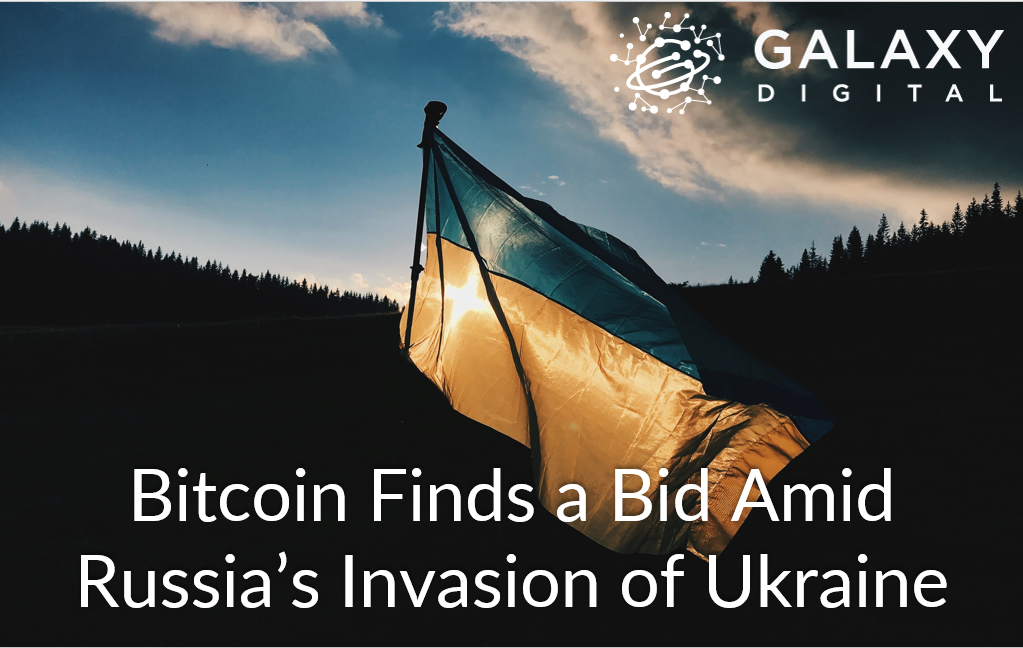
Bitcoin Finds a Bid Amid Russia's Invasion of Ukraine |
Bitcoin is rallying on increased volume from BTC-RUB and BTC-USDT pairs, as well as digestion of Bitcoin as censorship resistant money as a narrative by the market. In this report, Head of Firmwide Research Alex Thorn explains the sweeping market and regulatory impacts of Russia's ongoing invasion of Ukraine.
|
|
The rise and fall in donations to the Ukrainian government illustrates the effectiveness of creating a financial incentive like an airdrop to motivate charitable giving. |
|
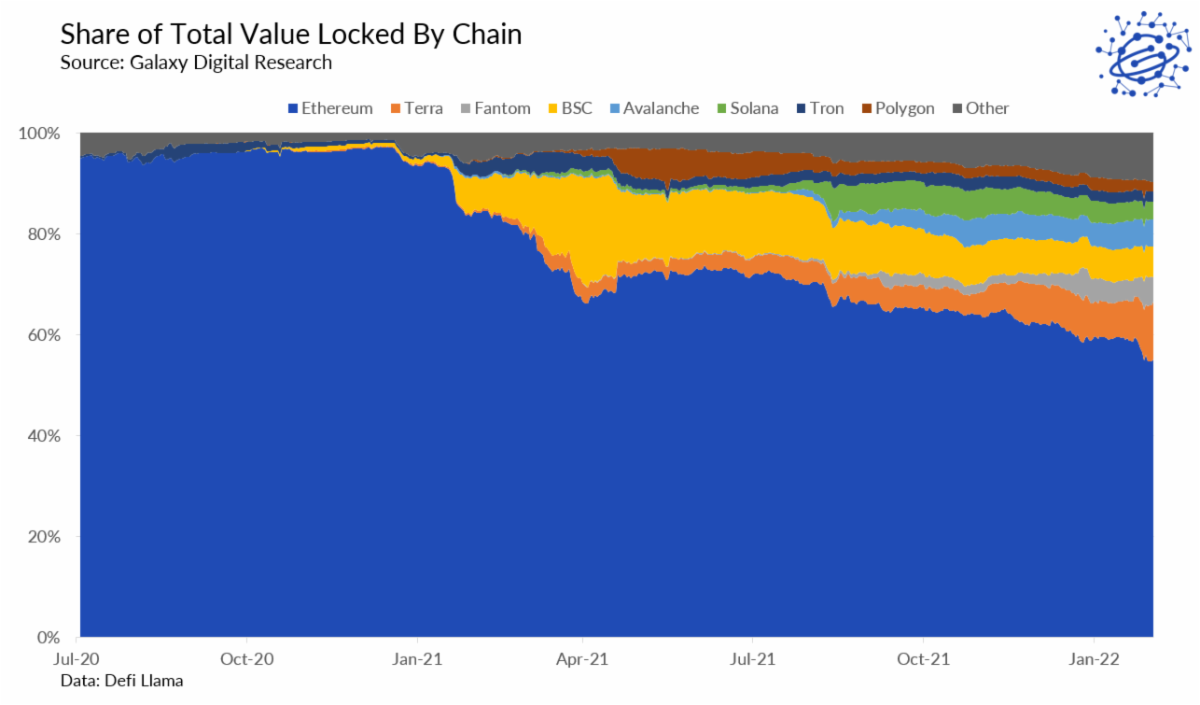
Ethereum’s share of total value locked is at all-time lows trending below 55% for the first time ever. |
|
Thanks for reading this week. Have a great weekend.
|
|
Alex Thorn
Head of Firmwide Research
|
|
|
If this email was forwarded to you and you would like to sign up to receive it regularly, click here.
|
|
Legal Disclosure:
This document provides links to other websites that we think might be of interest to you. Please note that when you click on one of these links, you may be moving to a provider's website that is not associated with Galaxy Digital. These linked sites and their providers are not controlled by us, and we are not responsible for the contents or the proper operation of any linked site. The inclusion of any link does not imply our endorsement or our adoption of the statements therein. We encourage you to read the terms of use and privacy statements of these linked sites as their policies may differ from ours. This document, and the information contained herein, has been provided to you by Galaxy Digital Holdings LP and its affiliates (“Galaxy Digital”) solely for informational purposes. This document may not be reproduced or redistributed in whole or in part, in any format, without the express written approval of Galaxy Digital. Neither the information, nor any opinion contained in this document, constitutes an offer to buy or sell, or a solicitation of an offer to buy or sell, any advisory services, securities, futures, options or other financial instruments or to participate in any advisory services or trading strategy. Nothing contained in this document constitutes investment, legal or tax advice. You should make your own investigations and evaluations of the information herein. Any decisions based on information contained in this document are the sole responsibility of the reader. Certain statements in this document reflect Galaxy Digital’s views, estimates, opinions or predictions (which may be based on proprietary models and assumptions, including, in particular, Galaxy Digital’s views on the current and future market for certain digital assets), and there is no guarantee that these views, estimates, opinions or predictions are currently accurate or that they will be ultimately realized. To the extent these assumptions or models are not correct or circumstances change, the actual performance may vary substantially from, and be less than, the estimates included herein. None of Galaxy Digital nor any of its affiliates, shareholders, partners, members, directors, officers, management, employees or representatives makes any representation or warranty, express or implied, as to the accuracy or completeness of any of the information or any other information (whether communicated in written or oral form) transmitted or made available to you. Each of the aforementioned parties expressly disclaims any and all liability relating to or resulting from the use of this information. Certain information contained herein (including financial information) has been obtained from published and non-published sources. Such information has not been independently verified by Galaxy Digital and, Galaxy Digital, does not assume responsibility for the accuracy of such information. Affiliates of Galaxy Digital own investments in some of the digital assets and protocols discussed in this document. Except where otherwise indicated, the information in this document is based on matters as they exist as of the date of preparation and not as of any future date, and will not be updated or otherwise revised to reflect information that subsequently becomes available, or circumstances existing or changes occurring after the date hereof. The foregoing does not constitute a "research report" as defined by FINRA Rule 2241 or a "debt research report" as defined by FINRA Rule 2242 and was not prepared by Galaxy Digital Partners LLC. For all inquiries, please email contact@galaxydigital.io. ©Copyright Galaxy Digital Holdings LP 2021. All rights reserved.
|
|
|
|
|
|
|