Access our research on the Bloomberg Terminal with ERH GXY <GO>
|
|
gm -
episode 8 of galaxy brains is live and includes a deep conversation on the Fed's latest interest rate hike, Yuga Labs' Otherside NFT mint debacle, and the most recent Solana network outage. listen on apple, spotify, amazon, or wherever you get your pods.
speaking of podcasts, i sat down with stephan livera last week to discuss how and why bitcoin fees are so low. the conversation was based on my report about bitcoin fees, which you can read here. listen to my talk with stephan here.
also in today's newsletter, we discuss the implications of binance's registration as a digital assets custody and trading platform in france.
have a great weekend,
alex
|
|
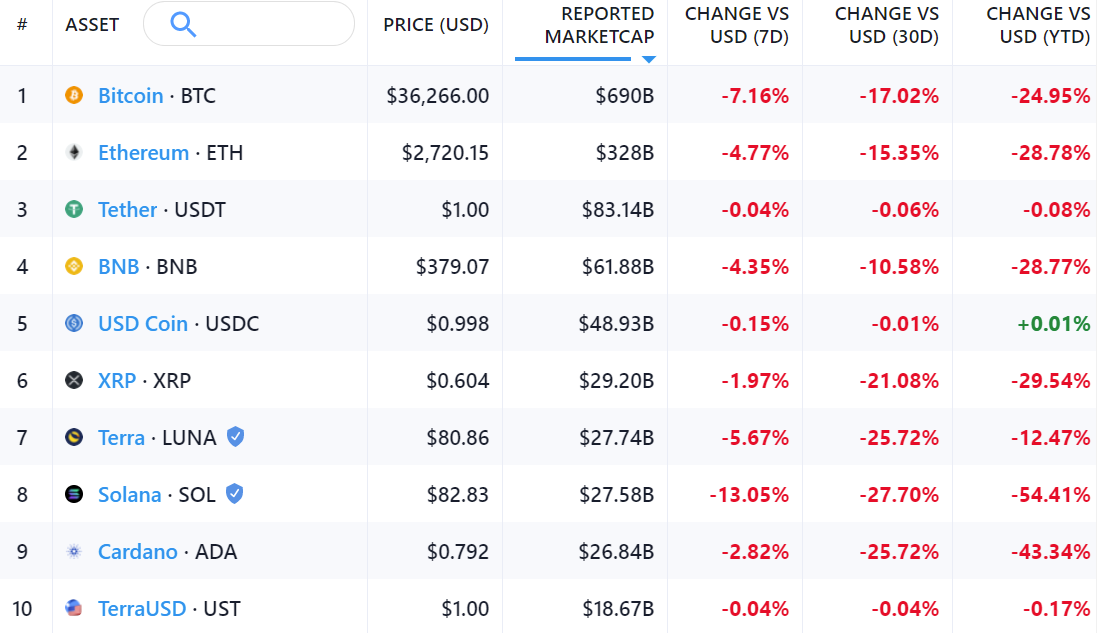
The total implied network value (market cap) of the digital assets market stands at $1.64tn, down 12.3% from last week (when it stood at $1.87tn). Bitcoin’s network value is 5.53% of gold’s market cap. Over the last 7 days, BTC is down 7.16%. ETH is down 4.77%. SOL is down 13.05%. LUNA is down 5.67%. Bitcoin dominance is up two percentage points since last week, trending at around 42%. |
|
Data current as of 8:39 AM ET on May 6, 2022. Prices and data via Messari.
|
|
🏔️Yuga Labs Metaverse Land NFT Mint Clogs Ethereum
|
|
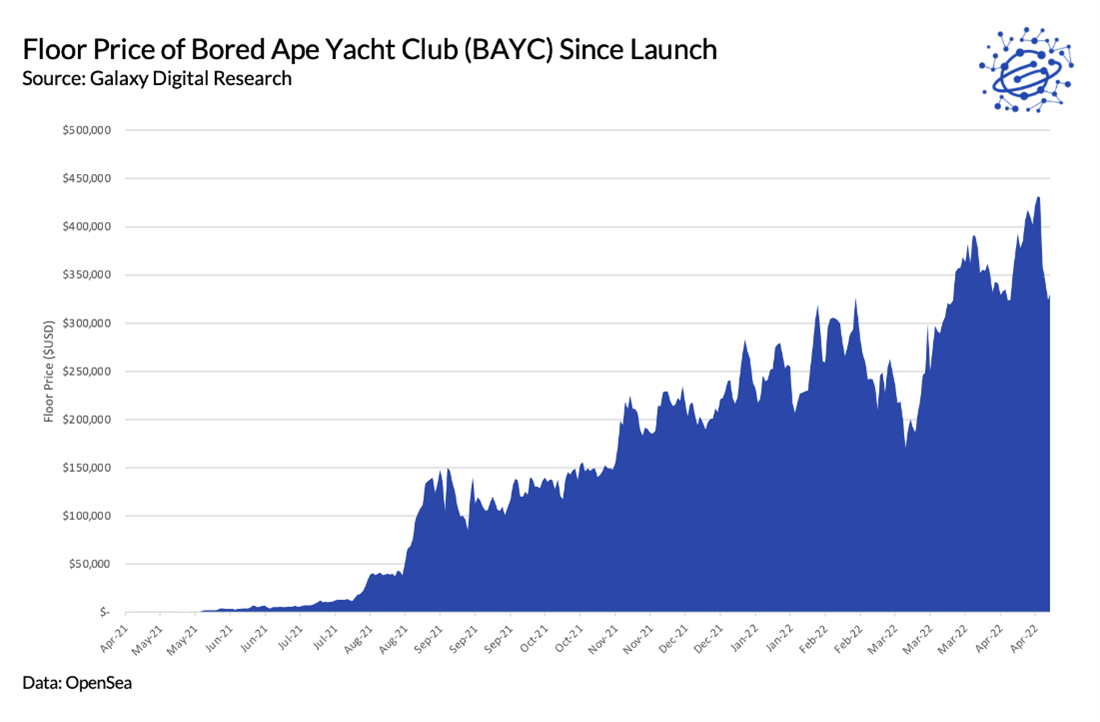
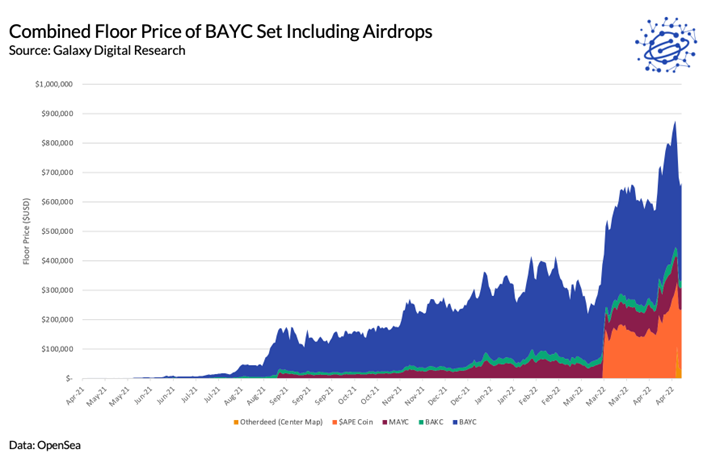
Bored Apes push the Ethereum network to its limits. Yuga Labs, the $4bn company behind Bored Apes Yacht Club (BAYC), conducted its hotly-anticipated mint for Otherside, its upcoming metaverse platform. This land sale was originally announced by Yuga Labs in March, causing a massive run-up in price for both its BAYC-affiliated NFT collections and $APE coin.
|
|
During the mint, 55,000 Otherdeed NFTs were minted at a fixed cost of 305 $APE per plot. $APE traded at ~$19 during this time, valuing the plots of land at ~$5.8k throughout the mint. Yuga Labs brought in ~$300mn from primary sales along with 5% royalties on ~$775mn in Otherdeeds volume since the mint through secondary markets (yielding $38mn in additional revenue for Yuga Labs). It should be noted that the $APE tokens Yuga netted from the primary land sale will be locked for 1 year.
As successful as the sold-out mint was for Yuga Labs, it was not without its hiccups. Tens of thousands of users flooded the Ethereum network to mint these Otherdeed NFTs. This motivated userbase prompted a massive gas war on the Ethereum network to a level never before seen. In some cases, users reported paying upwards of 2.5 ETH (>$7,000) to “jump the queue” and have their mint transaction processed by the Ethereum blockchain first. Many users also paid massive gas fees for failed transactions, adding insult-to-injury to an already frustrated userbase. In total, close to $180mn in ETH was burned in gas fees due primarily to the Otherside mint. Yuga Labs has since refunded gas fees to all users who paid for failed transactions during the mint, distributing ETH directly to user wallets on Wednesday afternoon.
Holders of Bored Apes and/or Mutant Apes have 21-days from Saturday to claim an airdrop containing a free plot of Otherside land. The plots of land associated with these free airdrops are geographically closer to the center of the Otherside metaverse map compared to the plots sold during the mint. This has resulted in an accompanying price premium on the secondary market for these coveted plots of land. Essentially, the lower the serial number on the land plot, the closer to the center of the map that plot of land is (where the BAYC clubhouse will be located). BAYC holders were allocated plots ranging from 1-10,000, MAYC holders were allocated 10,001-30,000, and the remainder were sold during the mint. Any plots of land not claimed during the 21-day window will go back to Yuga Labs who will resell these plots on the open market. Additionally, some plots of land were randomly allocated a coveted Koda. While it is unclear exactly how the mechanics of owning a Koda will play out in the game, these Koda-containing plots also command large price premiums in comparison to their Koda-less counterparts.
With this fresh injection of capital, the Otherside metaverse is positioned to compete directly with the likes of Decentraland and The Sandbox. Yuga Labs envisions Otherside as an open-world, multiplayer online role-playing type game where users can play as their NFTs, speak with each other, and transact through its in-game economy using $APE tokens. The game is being developed by Animonica Brands in tandem with Improbable’s M2 technology, and Otherside will support NFTs outside of the collections owned by Yuga Labs (currently this includes Bored Apes, Mutant Apes, Bored Ape Kennels, CryptoPunks, and Meebits). All of that said, there is still a lot of work left to do before this metaverse game manifests into reality. The Otherside mint is just the beginning of what will be a long journey for the Yuga Labs team.
|
|
OUR TAKE: Yuga Labs was criticized by many for its handling of the Otherside mint. While these criticisms have some merit, it’s hard to envision a universe where the Otherside mint could please all of its would-be critics. Yuga’s stature within the NFT/crypto space is truly staggering. They own the #1, #2, #3, #5, #10, and #14 NFT collections by market cap and $APE coin is the #33 fungible token by market cap according to CoinGecko. Yuga Labs, through their ownership of multiple marquee NFT collections, has a ~70% market share of the entire NFT space (calculated by summing up their collective NFT market caps and dividing by the $10bn total NFT market cap figure reported on CoinMarketCap). Suffice to say, Yuga Labs’ success thus far, in just one year of operation, has rightly earned them sky-high expectations in everything they do.
As far as the Otherside mint goes, Yuga Labs was criticized for not doing a good enough job of optimizing their smart contracts. Gas optimization would theoretically have reduced the fees users paid during the mint, and many thought Yuga could have done more on that front given the high level of demand. However, this criticism assumes the sole reason for network congestion was poorly-optimized smart contract code. The founder of Ethereum Vitalik Buterin disagreed with this line of reasoning and went as far as to tweet that the gas fee would have gone up in tandem with the decrease in gas usage from the optimization, resulting in the same exact outcome for users no matter how much Yuga could have optimized the smart contract code. We tend to agree with Vitalik on this criticism.
Another common criticism was the structure of the mint itself. Many argue that the fixed price of the mint did nothing to control for the amount of demand on the network. This criticism, while true, ignores the fact that Yuga actually tried to mitigate this with a Dutch auction style mint. However, when word got out to the community that they were planning on doing a Dutch auction, the community was furious at the prospect of paying higher upfront prices for the Otherdeeds NFTs. In essence, there was no way for Yuga to make the entire community happy, regardless of how they structured the mint. Ultimately, Yuga decided at the 11th hour to cancel the Dutch auction in favor fixed prices. This decision had the domino effect of moving the upward price pressure from the mint itself to the Ethereum network in the form of high gas fees.
Finally, the third common criticism against the Otherside mint is that Yuga Labs intentionally wanted the mint to go poorly in order to justify an eventual move off of Ethereum and onto a chain of their own. While there are some merits to Yuga Labs taking its massive userbase to a separate chain, and the company has the resources to do so, this seems unlikely. There are a couple of reasons for that. First, ApeCoin DAO board member Yat Siu responded on Twitter to Yuga’s initial “Ape Chain” tweet that there was no discussion or plan within the DAO for Yuga to move their product offering to a new chain. Second, ApeCoin was announced to be integrated with the Polygon (MATIC) sidechain just a few days after the Otherside mint. Occam’s razor says that the move to Polygon makes the most sense long-term. Given that the Otherside metaverse is already being worked on by Animonica and Improbable, our view is, from a business perspective, it is much more feasible to use existing technology that has probably already been battle-tested on Improbable’s platform instead of launching a brand-new chain with a new suite of complexities.
|
|
While there’s no doubt Yuga Labs stumbled through this unprecedented NFT mint, they still emerged a huge winner. They sold out their collection within a day. They created the #5 largest market cap NFT project in a weekend. And, most importantly, they are building towards a metaverse that will leverage an impressive suite of technology and enable users to use some of the most popular NFTs today. All eyes are on Yuga as they continue to traverse through their incredibly ambitious roadmap. -SQ
|
|
🍬Metaplex Candy Machines Causes Outage on Solana
|
|
Solana suffers another outage as bots clog network using Metaplex’s Candy Machine contract. Last Saturday (April 30), the Solana network halted as validators were unable to remain in consensus in the face of a massive flood of transactions sent by bots seeking to mint a new NFT. Specifically, the NFT mint had a fixed sale price (rather than a Dutch auction) and thus the NFTs were awarded on a first-come-first-serve basis, leading traders to rush to mint as quickly as possible. According to the Solana protocol team, more than 6 million transactions per second flooded nodes causing validators to run out of memory and crash.
Developers and validators coordinated to manually restart the network after about 7 hours of downtime. The protocol team detailed several planned developments to help avoid such outages in the future, including moving to a modified version of their user datagram protocol (UDP) called QUIC (which will help prevent message flooding), stake-weighted transaction quality of service (which will guarantee that stakers succeed in submitting transactions based on their % of staked supply), and fee-based execution priority (which essentially is the beginning of a fee market on Solana).
|
|
OUR TAKE: It’s worth noting that these outages, which are effectively the result of spam transactions flooding the network, are made possible by Solana’s design decisions. Every other blockchain has solved this problem—sybil resistance—through the use of transaction fees. Solana’s fixed, low-fee design, coupled with the fact that there is no mempool (queue into which pending transactions can pile up), makes this “spam” problem and the ensuing outages endemic to the protocol. Because fees are so low, there’s little disincentive for programmatic users of the blockchain to send as many transactions as possible during urgent times, even if they are duplicates. This means that, during these times, regular users (who may transact through Phantom Wallet or other “click trading” methods) are at a significant disadvantage to algorithmic bots that simply spam validators to ensure their transactions get in. One of the major downsides to regular user experience is that, in times of economic importance (such as during significant market volatility), regular users are unable to make important transactions (such as depositing more margin collateral into lending platforms to avoid liquidation). With no way to bid for transaction confirmation with higher fees, there’s no way for these non-programmatic but economically important transactions to skip the line and make it onto the chain.
To date, the protocol team has focused on a mix of temporary upgrades (such as improving nodes’ ability to de-duplicate redundant transactions) and more dramatic network enhancements (like QUIC). Solana’s use of UDP instead of TCP is a major design choice that offers incredible speed, as UDP connections don’t require handshakes or receipt acknowledgements, but its inability to distinguish origin and control network traffic makes it impossible to mitigate spam or abuse. QUIC attempts to combine the best of UDP and TCP, and if successful, would represent a significant enhancement that would allow nodes (and the network) many more options for mitigating spam and abuse.
Despite this shot at a major enhancement, which may or may not be successful, the team has avoided the major enhancement that most observers have suggested: adding variable transaction fees and a mempool (transaction queue). Whether they can solve the recurring outage issue without abandoning one of their project’s core value propositions (fixed, low fees) remains an open question.
All that being said, while these outages have become relatively frequent, the network continues to recover and operate functionally most of the time on an absolute basis through tight coordination between the protocol team and validators. This coordination, though, raises valid questions about the network’s decentralization and censorship resistance. For now, the Solana community largely seems to be giving the protocol team and validators leeway on these points. -AT
|
|
✅ Binance granted regulatory approval to operate in France
|
|
Binance receives regulatory approval in France to provide digital asset services. This landmark achievement makes Binance the first major global exchange to legally operate in France. A Digital Asset Service Provider (DASP) designation in France mirrors that of the Crypto-Asset Service Providers guidelines set forth by the EU commission under MiCa legislation. Markets in Cryptoassets (MiCa) is a proposed regulatory framework for crypto businesses operating in the EU. (Read more about it in our prior newsletter here.) Granted by the French financial market’s regulator, the DASP designation permits Binance to custody digital assets, exchange digital assets for legal tender or other digital assets, and operate a trading platform for digital assets. It also allows Binance to plug into Frances’s internal financial markets and payments system, bringing new liquidity opportunities. Along with the regulatory approval comes stringent AML/CFT anti-money laundering requirements for the new entity, Binance France.
|
|
OUR TAKE: Binance has finally found a home after a 5-year saga filled with regulatory investigations, national bans, and uncertain headquarters. Their tumultuous journey is emblematic of how far crypto adoption has come. Like the crypto industry, Binance has continued to adapt and survive and is now leading into a new frontier. Founded in 2017 by Changpeng Zhao, aka CZ, the company was first headquartered in China. Binance had more than 200 cloud-based servers hosted by the Chinese conglomerate Alibaba. By September of 2017, Binance was already fleeing China in advance of the nation’s crypto trading ban. The company moved its cloud functionality to AWS and moved operations to Japan. Then in March of 2018, Japanese authorities cracked down on the firm and banned its unregistered operations, which led Binance to announce it had officially moved to Malta.
Regulatory pressure began to subside for the moment, and then in September of 2019 they began offering perpetual futures contracts trading, allowing leverage as high as 125x. As one can imagine this brought a wave of regulatory attention back to the company. Later that month Binance was banned from the United States, but just a few weeks later a new entity and platform went live, called Binance.US, which only permitted spot market trading. In February of 2020, the Malta Financial Services Authority issued a public statement stating that Binance “is not authorized by the MFSA to operate in the cryptocurrency sphere and is therefore not subject to regulatory oversight by the MFSA”. By the end of 2020, Binance had no known headquarters. Rumors were dispensed that they had set up shop in the Cayman Islands but there is still no substantial evidence to support this. Later in the year, CZ finally resolved the mystery and stated that Binance had no headquarters, which he felt “embraced the decentralized philosophy”.
Entering 2022, Binance has turned over a new leaf. The DAPS approval is a signal that Binance is willing to make the changes necessary to address regulators' concerns. As the first Digital Asset Service Provider in France, they are establishing a legal regional headquarters in a major hub like Paris, which is a crucial step in establishing trust within the eyes of the general public. It is equally significant for France, which up to this point has been one of the most progressive crypto environments in Europe. -LM
|
|
-
Curve Finance, a decentralized exchange for stablecoin swapping, has integrated with Near protocol’s Ethereum Virtual Machine (EVM) layer called Aurora.
-
Block reports $1.73 billion in bitcoin sales via Cash App during Q1 2022.
-
Luna Foundation Guard buys additional $1.5 billion in bitcoin backing for UST.
-
Luxury brand Gucci will begin accepting crypto payments in select stores across the US later this month.
-
Kraken has announces the waitlist is now live for its upcoming NFT marketplace, Kraken NFT.
|
|
Access our research on the Bloomberg Terminal with ERH GXY <GO>
|
|
|
|
Why Are Bitcoin Fees Low? |
Alex Thorn, Head of Firmwide Research at Galaxy Digital, joins the Stephan Livera Podcast to talk about how and why Bitcoin fees are low. The two discuss which factors have had the biggest impact on network fees and what might cause fees to rise again in Bitcoin's future.
|
|
|
|
Crypto & Blockchain Venture Capital - Q1 2022 |
Venture funding for crypto and blockchain startups reached another new all-time high despite a drawdown in broader markets. In Q1 2022, venture capitalists invested more than $10bn in crypto startups, the largest quarterly sum ever. Alex Thorn breaks down VC activity from the past quarter.
|
|
|
|
Learnings from Devconnect |
Christine Kim attended the first-ever Devconnect, an Ethereum developer-focused conference and in this note summarizes the main topic of discussion by developers, which centered around the fast-approaching realities of a multi-chain future for Ethereum.
|
|
|
|
Galaxy Digital Research Podcast |
In this week's episode, we discuss the Fed's latest interest rate hike with Beimnet Abebe from Galaxy's Principal Trading. Also, we debate Yuga Labs' Otherside NFT mint debacle and the most recent Solana network outage.
|
|
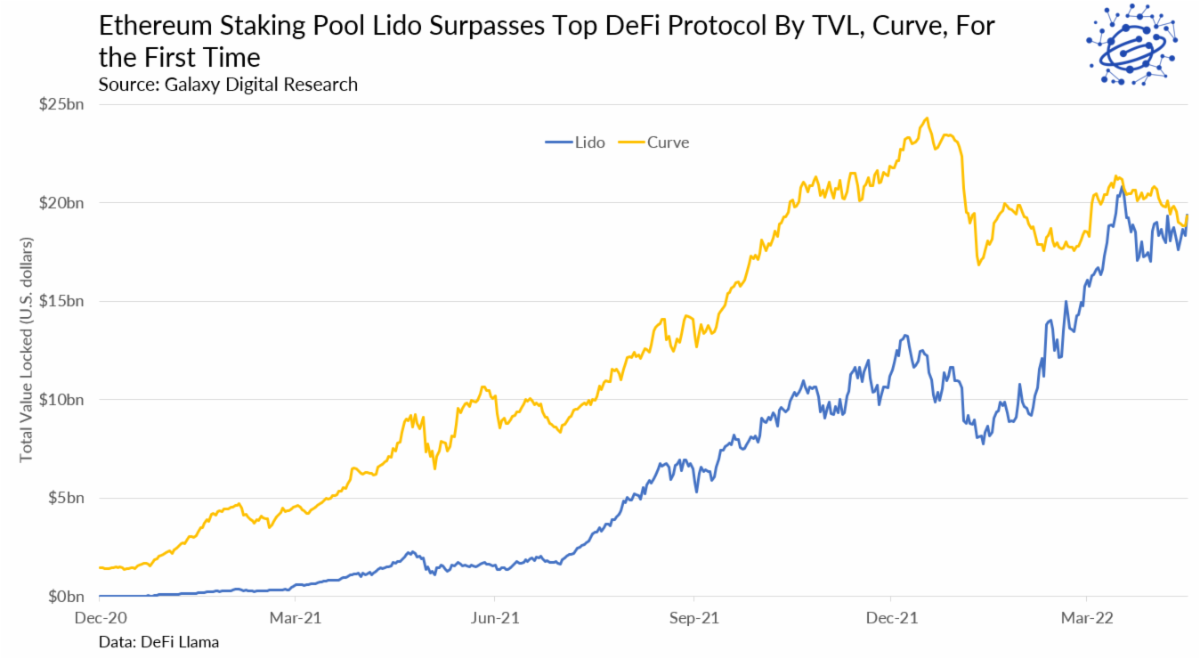
On Thursday, Lido Finance briefly overtook decentralized stablecoin exchange Curve for the first time ever in terms of total value locked. At time of writing, the two protocols are neck and neck with Curve managing roughly $18.54bn worth of collateral across 9 different chains and Lido managing $18.12bn across 4 chains. Increasing optimism as of late around Merge activation on Ethereum is causing influxes of user interest and capital into Lido. In addition to basic staking services, Lido offers its users a liquid derivative token called stETH that tracks the underlying value of a users’ staked ETH that can then be re-hypothecated for additional yield in other DeFi protocols. Lido’s stETH derivative token is by far the most liquid staked ETH derivative on the market at present. |
|
Thanks for reading this week. Have a great weekend.
|
|
Alex Thorn
Head of Firmwide Research, Galaxy Digital
|
|
|
Legal Disclosure:
This document provides links to other websites that we think might be of interest to you. Please note that when you click on one of these links, you may be moving to a provider's website that is not associated with Galaxy Digital. These linked sites and their providers are not controlled by us, and we are not responsible for the contents or the proper operation of any linked site. The inclusion of any link does not imply our endorsement or our adoption of the statements therein. We encourage you to read the terms of use and privacy statements of these linked sites as their policies may differ from ours. This document, and the information contained herein, has been provided to you by Galaxy Digital Holdings LP and its affiliates (“Galaxy Digital”) solely for informational purposes. This document may not be reproduced or redistributed in whole or in part, in any format, without the express written approval of Galaxy Digital. Neither the information, nor any opinion contained in this document, constitutes an offer to buy or sell, or a solicitation of an offer to buy or sell, any advisory services, securities, futures, options or other financial instruments or to participate in any advisory services or trading strategy. Nothing contained in this document constitutes investment, legal or tax advice. You should make your own investigations and evaluations of the information herein. Any decisions based on information contained in this document are the sole responsibility of the reader. Certain statements in this document reflect Galaxy Digital’s views, estimates, opinions or predictions (which may be based on proprietary models and assumptions, including, in particular, Galaxy Digital’s views on the current and future market for certain digital assets), and there is no guarantee that these views, estimates, opinions or predictions are currently accurate or that they will be ultimately realized. To the extent these assumptions or models are not correct or circumstances change, the actual performance may vary substantially from, and be less than, the estimates included herein. None of Galaxy Digital nor any of its affiliates, shareholders, partners, members, directors, officers, management, employees or representatives makes any representation or warranty, express or implied, as to the accuracy or completeness of any of the information or any other information (whether communicated in written or oral form) transmitted or made available to you. Each of the aforementioned parties expressly disclaims any and all liability relating to or resulting from the use of this information. Certain information contained herein (including financial information) has been obtained from published and non-published sources. Such information has not been independently verified by Galaxy Digital and, Galaxy Digital, does not assume responsibility for the accuracy of such information. Affiliates of Galaxy Digital own investments in some of the digital assets and protocols discussed in this document. Except where otherwise indicated, the information in this document is based on matters as they exist as of the date of preparation and not as of any future date, and will not be updated or otherwise revised to reflect information that subsequently becomes available, or circumstances existing or changes occurring after the date hereof. The foregoing does not constitute a "research report" as defined by FINRA Rule 2241 or a "debt research report" as defined by FINRA Rule 2242 and was not prepared by Galaxy Digital Partners LLC. For all inquiries, please email contact@galaxydigital.io. ©Copyright Galaxy Digital Holdings LP 2022. All rights reserved.
|
|
|
|
|
|
|