Access our research on the Bloomberg Terminal with ERH GXY <GO>
|
|
hello -
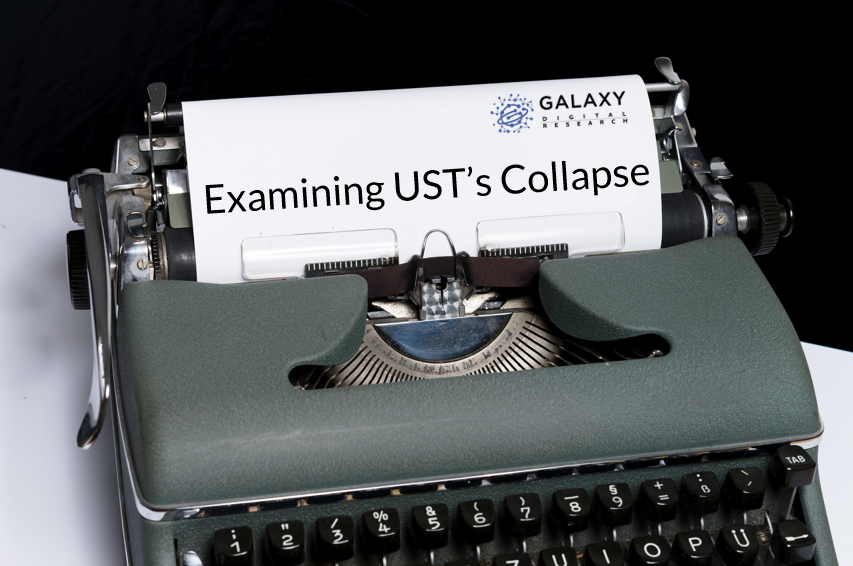
we have a brand new report for you on the Terra ecosystem. the report breaks down everything you need to know about what happened this week's with the stablecoin UST and the corresponding cryptoasset LUNA.
in addition, episode 9 of galaxy brains is live and includes an insightful conversation on markets, Meta's latest foray into NFTs, and the growing centralization of stake on Ethereum. listen on apple, spotify, amazon, youtube, or wherever you get your pods.
have a great weekend,
alex
|
|
NEW REPORT: Examining UST's Collapse |
|
UST de-pegged from $1 over the weekend after seeing large withdrawals from Anchor and a massive sell-off on Curve. Against a weak macro backdrop with high inflation and rising rates, this triggered panic and initiated a bank-run scenario from Anchor, UST, and the broader Terra ecosystem. Despite great efforts from the Terra community to restore faith in UST, market forces prevented the former leading algorithmic stablecoin from fully recovering, leading to a collapse in both UST and LUNA.
|
|
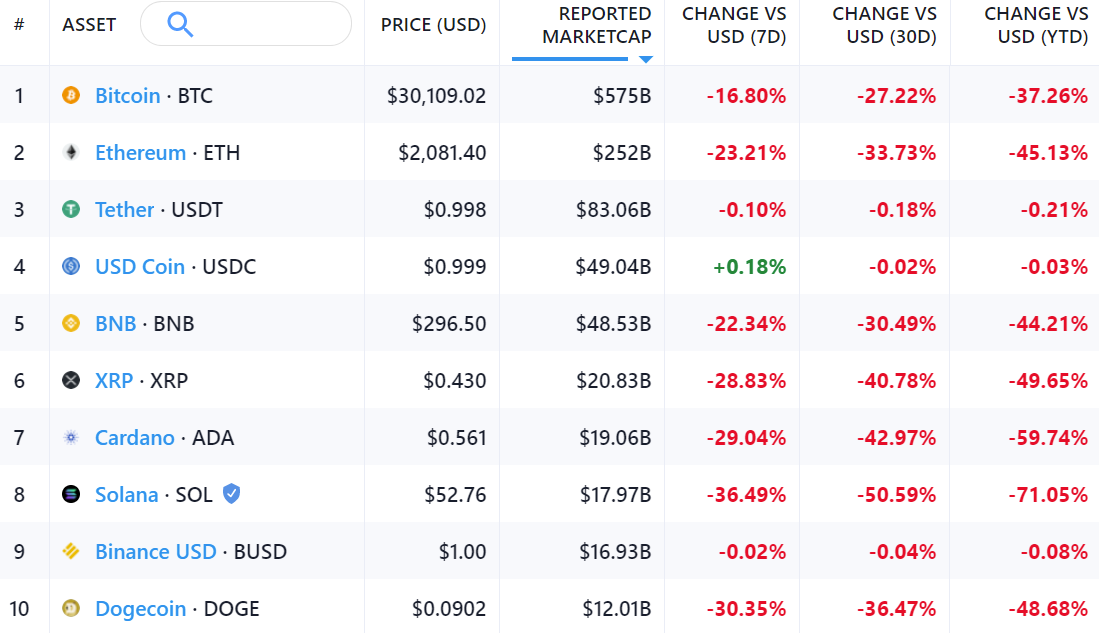
The total implied network value (market cap) of the digital assets market stands at $1.29tn, down 21.3% from last week (when it stood at $1.64tn). Bitcoin’s network value is 4.8% of gold’s market cap. Over the last 7 days, BTC is down 16%. ETH is down 23%. SOL is down 36%. Bitcoin dominance is up two percentage points since last week, trending at around 44%. |
|
Data current as of 1:19 PM ET on May 13, 2022. Prices and data via Messari.
|
|
🌀UST Stablecoin Collapses |
|
UST, the stablecoin in the Terra ecosystem, lost its peg, leading to collapse of both the stablecoin and the LUNA token. Over the weekend, Anchor saw major outflows in UST deposits. Most of the withdrawn UST was then bridged from Terra and sold for other stablecoins on Curve and other exchanges, which led to significant supply imbalances and caused UST to de-peg. At first, the de-peg was small at ~$0.98. But in an adversarial operating environment with rising interest rates and general market-wide weakness, UST’s initial de-pegging was enough to spark concerns and trigger a bank-run scenario on Anchor as depositors rushed for the exits. We described the risk of such a scenario in our March 25, 2022 newsletter. In an attempt to mitigate this risk, LFG had begun to acquire BTC to add more support for the UST peg, but while they had acquired significant BTC, they had not yet deployed a module to allow for it to be selected by users as a UST redemption option.
The Luna Foundation Guard put its bitcoin reserves to work, trying to restore UST’s peg alongside many other members of the Terra community such as Terraform Labs. But their efforts proved to be insufficient in restoring faith in UST as the pace of exits from Terra showed no signs of slowing. LUNA price was collapsing as the algorithmic design of UST enabled more and more minting of LUNA tokens. This dynamic continued for several days until Thursday, when Terra validators elected to halt the chain, and restrict new delegations to preserve the security of Terra. By then, over 6 trillion LUNA tokens had been minted while the algorithmic design of UST had effectively failed.
|
|
OUR TAKE: Read our report from today, Examining UST's Collapse, for a detailed breakdown of the events of this week. - AT / CY
|
|
🤳Instagram Testing NFTs this Week, Zuckerberg Signals Meta’s Push into NFT Space
|
|
Meta to leverage NFTs as a gateway drug into the metaverse. While much attention has been focused on Meta building the metaverse from a hardware perspective, Instagram’s forthcoming NFT integration reveals a multi-pronged approach towards integrating decentralized crypto protocols into Meta’s vision for the metaverse. This is big news and a departure from Meta’s prior forays into the cryptocurrency space with the likes of their blockchain-based payments project Diem. Instagram head Adam Mosseri announced on Monday that the platform will begin testing NFT features with a select group of creators. Initially, this integration will support the Ethereum (ETH) and Polygon (MATIC) blockchains with Solana (SOL) and Flow (FLOW) to follow soon after. This integration will be non-custodial and will enable users to verify ownership of their NFTs. (It will not be an NFT marketplace as rumored earlier this year). Accordingly, this integration will support wallets such as Rainbow, MetaMask, and Trust Wallet. Integrations with the Coinbase Wallet, Dapper Wallet, and Phantom are expected to follow later.
The core feature set enabled by this integration will allow users to share NFTs they purchased or created in their main Instagram feed, their Stories, or in their direct messages. This feature contrasts with that of existing juggernauts like Twitter who currently only support verification of NFTs for profile pictures (PFPs). In building this integration, Meta has shown a high degree of self-awareness in terms of its stature as a centralized company. In his announcement, Adam is quoted as saying, “I want to acknowledge upfront that NFTs and blockchain technologies are all about distributing trust and distributing power...But Instagram is fundamentally a centralized platform, so there’s a tension there.” To this end, Instagram is being cautious with their approach, and they will likely test this functionality extensively before eventually releasing it to the public. While this NFT integration will be deployed exclusively through Instagram initially, it will almost certainly make its way to Meta’s broader product suite if the initial deployment goes well. Mark Zuckerberg also announced plans to support 3D augmented-reality NFTs in Instagram using Meta’s Spark AR (Meta’s augmented reality platform).
|
|
OUR TAKE: The number one takeaway from this news is that Meta’s metaverse will not necessarily be fully centralized or a “walled-garden” as many had initially feared. It seems that Meta has learned its lesson from Diem, which was criticized by many for being overly centralized. Now, it appears Meta is embracing a more open, decentralized, “web3” approach to building a metaverse in their decision to support multiple, permissionless blockchain protocols. Meta’s massive userbase of 3.6bn daily active users will undoubtedly be a boon for the broader crypto industry, and this is a great example of a positive-sum scenario for all stakeholders across web2 and web3. It has always been our view that it is much easier for existing companies with massive userbases to “bolt on” crypto functionality into their existing product than for pure crypto companies to attempt to onboard billions of new users. With that said, we fully expect “pure crypto” companies to also emerge with massive userbases as crypto adoption continues to increase worldwide. Ultimately, our view is that the world’s transition from web2 to web3 will likely be buoyed by the userbases of web2 juggernauts such as Twitter and Meta. In directing the eyes of its billions of users towards NFTs built on permissionless protocols, Meta will unlock 2nd-order effect of growing the crypto industry organically through a web2 application that people already use and understand.
The other interesting thing to note here is Meta’s intended use-case for NFTs on Instagram. By completely avoiding the PFP use-case that is dominating the likes of Twitter, Meta is making a bet that NFTs outside of PFPs will be an important piece of the NFT landscape in the future. We expect this to cause the next NFT bull market for art-based NFTs (including 3d art, animated art, generative art, music, etc.) Historically, PFPs have outperformed all other NFT sectors as evidenced by Yuga Labs, which has a ~70% stronghold over the total NFT market cap. (Yuga Labs only owns PFP NFT collections, with the exception of Otherdeeds which is a metaverse land plot). As Instagram users gain utility from showing off art-based NFTs in their feed, the demand for these art-based NFTs, particularly ones that look good on a full-screen, will increase in tandem.
Instagram is not the first to see the promise in marrying social features with NFTs. Coinbase attempted to bake social functionality into its recently-launched NFT marketplace. Instagram, however, has perfected the science behind engagement-driven social media apps and will probably be able to execute this collision between social media and web3 functionality better than the likes of Coinbase. The final point to note here is that artists and developers of NFTs may start leveraging Meta’s Spark AR Studio now that they can unlock the tangible economic benefits of building NFTs for an audience of over 3 billion daily active users. While this announcement falls under the shadow of other crypto news this week, it may prove to have far-reaching implications for the crypto space down-the-road. -SQ
|
|
💧Ethereum's Most Liquid Staking Derivative Token Deviates From Its Peg |
|
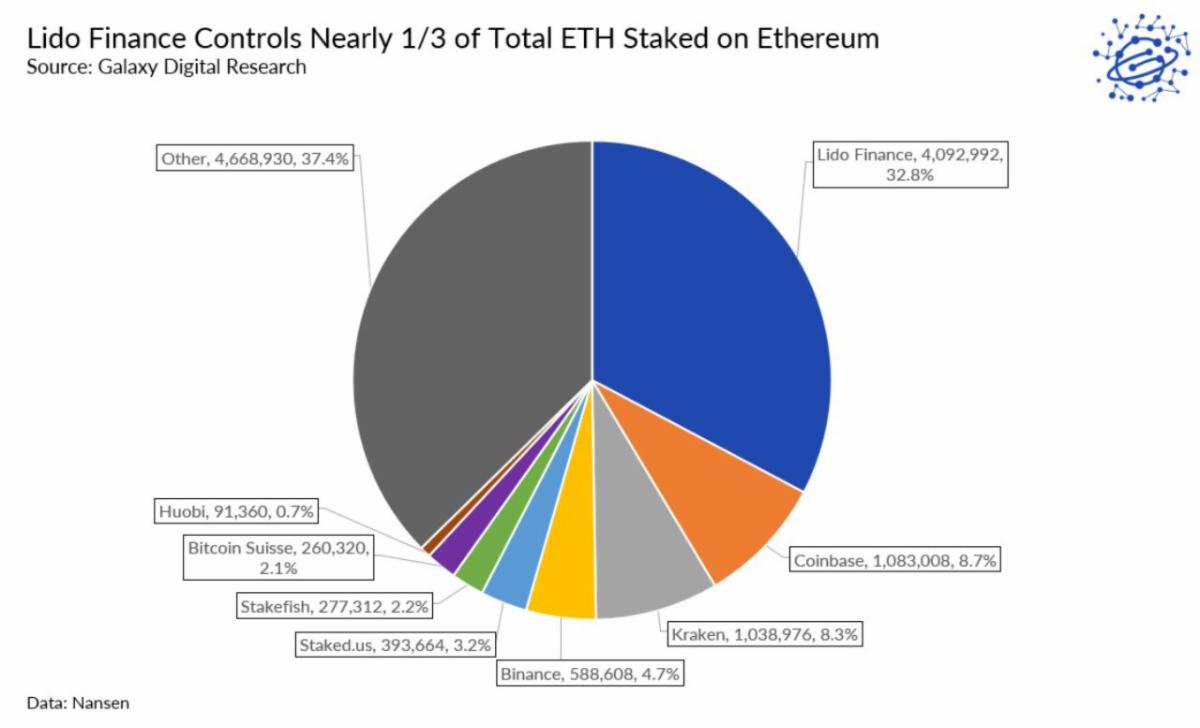
The integration of Ethereum staking protocol Lido with the Terra ecosystem has exposed the protocol's liquid staking derivative token stETH to greater collateral risk. Lido is the most popular staking service on Ethereum controlling close to one-third of total ETH staked in the network’s proof-of-stake blockchain, the Beacon Chain. It announced on Friday that its liquid staking derivative token, stETH, was trading at a 4.5% discount to ETH in light of broader crypto market turbulence. To improve the imbalance, the Lido team deployed an additional trading pool for stETH-ETH pairs on decentralized stablecoin exchange Curve Finance incentivized with an injection of 1 mn LDO in rewards for liquidity providers.
The imbalance of the stETH:ETH swap rate was sparked after Terraform Labs, the team behind the Terra blockchain, announced a halt of the Terra network due to a high risk of potential chain re-orgs and attacks. This meant that the decentralizing lending protocol on Terra known as Anchor would cease temporarily to process any transactions. Lido has been issuing bETH tokens for Terra users representing stETH tokens on Ethereum since August 2021. These bETH tokens have primarily been used to interact with the decentralized lending protocol on Terra known as Anchor. According to Lido, over $200mn worth of bETH remains on Terra as of Wednesday, May 11.
Because the redemption of bETH tokens on Terra was put in jeopardy after the announcement of a chain halt on Thursday, the market value for the corresponding stETH token on Ethereum was impacted, dropping to 0.98 ETH per stETH. For loans on Ethereum collateralized by stETH, a continued de-pegging of stETH could cause a number of cascading liquidations. However, it’s important to note that despite fluctuations of the stETH to ETH ratio in the DeFi markets, eventual redemptions of stETH for staked ETH once withdrawals are enabled on the Beacon Chain should not be affected. Due to the uncertain timeline for when withdrawals will be enabled, ETH staking derivative tokens have generally traded at a discount on decentralized exchanges, though due to its large liquidity over other staking derivative tokens, stETH was the exception, that is until now.
|
|
OUR TAKE: Controlling close to 33% of total ETH staked on the Beacon Chain, Ethereum staking protocol Lido and its derivative token stETH plays an important and arguably outsized role in securing the network’s proof-of-stake blockchain, the Beacon Chain. For now, the role of the Beacon Chain in Ethereum’s broader ecosystem is limited due to the fact the Beacon Chain has not yet been merged with the main Ethereum network and withdrawals of staked ETH on the Beacon Chain have not been enabled.
As such, given that the underlying amount of ETH staked in the Beacon Chain remains locked and redemptions of stETH for staked ETH are not possible, the value of stETH is unlikely to deviate significantly from its peg in the same fashion as UST which plummeted to zero. It is more likely that users will take advantage of opportunities to buy stETH at a discount now and thereby redeem the staked derivative token for its full value once withdrawals on the Beacon Chain are enabled, especially given mounting confidence from core developers that Ethereum’s transition to proof-of-stake (PoS) will happen in the next 6 months.
Post-Merge, it is important to note the mechanisms of Ethereum as a fully PoS network that are intended to protect the network against attack during times of market uncertainty and large validator withdrawals. Withdrawals of staked ETH on the Beacon Chain are limited and dependent on how much total ETH is staked on the network. At less than 12.6mn ETH staked, there is limit of 900 validator exits per day. This forced staging of withdrawals is designed to give enough time for the network to adjust validator issuance rates and increase the incentives for users to stake their ETH back to the Beacon Chain. The lower the amount of stake on Ethereum, the higher the annualized issuance rate is designed to rise. (For more information about the Merge upgrade, read this Galaxy Digital report.) -CK
|
|
-
Decentralized lending protocol Compound receives a B- rating from the S&P, making it one of the first offerings in decentralized finance to receive a score from a major rating agency.
-
Dapper Labs launches $725mn ecosystem fund
-
Yuga Labs teases gameplay footage for its Otherside metaverse game
-
Creator of popular Azuki collection triggers backlash in NFT community for involvement in previous projects
-
David Marcus, the former head of Meta's crypto and digital finance operations, is starting a new company called Lightspark to expand the use cases of bitcoin.
-
US Treasury Secretary Janet Yellen said Thursday that the stablecoin market has not yet reached a size that would pose a systemic risk to the US financial system.
|
|
Access our research on the Bloomberg Terminal with ERH GXY <GO>
|
|
|
|
New Report: Examining UST's Collapse |
Alex Thorn and Charles Yu breakdown the events that led to the unwinding of UST, the stablecoin from the Terra (LUNA) ecosystem.
|
|
|
|
Galaxy Digital Research Podcast |
In this week's episode, we discuss markets with Beimnet Abebe, UST's death spiral with Charles Yu, Meta's latest foray into the NFT space with Sal Qadir, and the health of Ethereum's staking ecosystem with Christine Kim.
|
|
Deposits into liquid staking protocol Lido Finance has increased 40% year-to-date, making it the largest Ethereum staking provider by total ETH staked. The rapid growth of Lido has raised concerns from Ethereum core developer Danny Ryan who tweeted this week that the centralization of stake to a single staking provider increases the potential for network instability and potential “attack.”
|
|
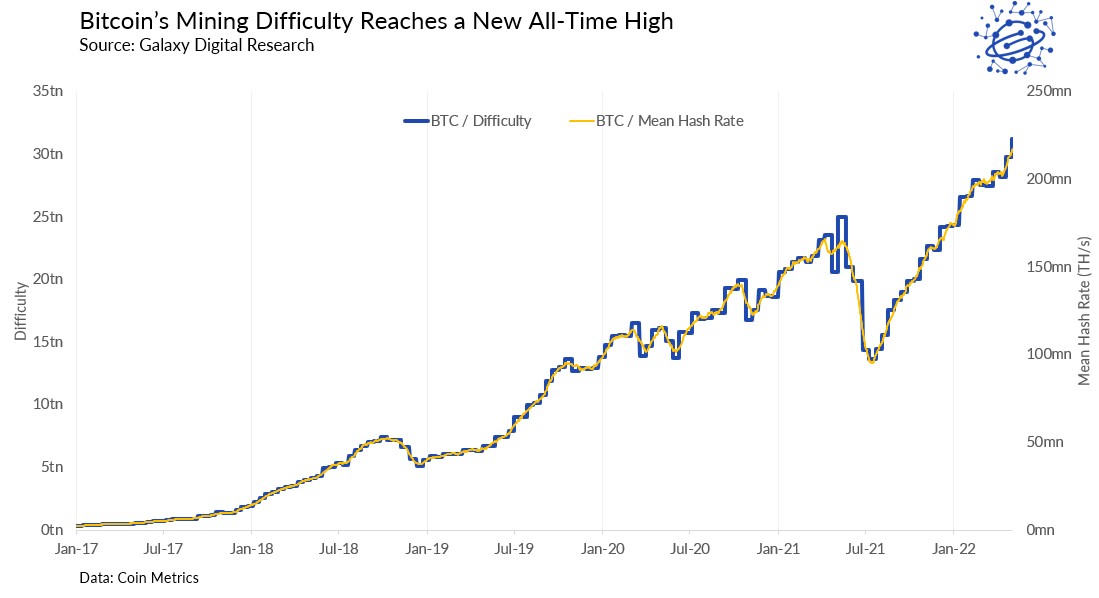
Mining difficulty on Bitcoin adjusted upwards by 4.89% this past Tuesday to reach a new record high of 31.25 tn. Shortly thereafter, on Wednesday, daily average hash rate also soared to a new record high of 218mn TH/s. Both metrics suggests that the amount of computational energy being expended to mine Bitcoin continues to grow despite an over 50% drawdown in BTC price from its all-time high reached back in November 2021. |
|
Thanks for reading this week. Have a great weekend.
|
|
Alex Thorn
Head of Firmwide Research, Galaxy Digital
|
|
|
Legal Disclosure:
This document, and the information contained herein, has been provided to you by Galaxy Digital Holdings LP and its affiliates (“Galaxy Digital”) solely for informational purposes. This document may not be reproduced or redistributed in whole or in part, in any format, without the express written approval of Galaxy Digital. Neither the information, nor any opinion contained in this document, constitutes an offer to buy or sell, or a solicitation of an offer to buy or sell, any advisory services, securities, futures, options or other financial instruments or to participate in any advisory services or trading strategy. Nothing contained in this document constitutes investment, legal or tax advice. You should make your own investigations and evaluations of the information herein. Any decisions based on information contained in this document are the sole responsibility of the reader. Certain statements in this document reflect Galaxy Digital’s views, estimates, opinions or predictions (which may be based on proprietary models and assumptions, including, in particular, Galaxy Digital’s views on the current and future market for certain digital assets), and there is no guarantee that these views, estimates, opinions or predictions are currently accurate or that they will be ultimately realized. To the extent these assumptions or models are not correct or circumstances change, the actual performance may vary substantially from, and be less than, the estimates included herein. None of Galaxy Digital nor any of its affiliates, shareholders, partners, members, directors, officers, management, employees or representatives makes any representation or warranty, express or implied, as to the accuracy or completeness of any of the information or any other information (whether communicated in written or oral form) transmitted or made available to you. Each of the aforementioned parties expressly disclaims any and all liability relating to or resulting from the use of this information. Certain information contained herein (including financial information) has been obtained from published and non-published sources. Such information has not been independently verified by Galaxy Digital and, Galaxy Digital, does not assume responsibility for the accuracy of such information. Affiliates of Galaxy Digital may have owned or may own investments in some of the digital assets and protocols discussed in this document. Except where otherwise indicated, the information in this document is based on matters as they exist as of the date of preparation and not as of any future date, and will not be updated or otherwise revised to reflect information that subsequently becomes available, or circumstances existing or changes occurring after the date hereof. The foregoing does not constitute a "research report" as defined by FINRA Rule 2241 or a "debt research report" as defined by FINRA Rule 2242 and was not prepared by Galaxy Digital Partners LLC. For all inquiries, please email contact@galaxydigital.io. ©Copyright Galaxy Digital Holdings LP 2022. All rights reserved.
|
|
|
|
|
|
|