Access our research on the Bloomberg Terminal with ERH GXY <GO>
|
|
gm -
today we've released a special episode of galaxy brains unpacking the most recent bout of market volatility in both the crypto markets and the broader global economy. i am joined by galaxy's head of derivatives trading robert bogucki, vp of principal trading beimnet abebe, and research associate christine kim to discuss the factors leading up to present market conditions and our outlooks on what happens next. catch episode 14 of galaxy brains out now on apple, spotify, amazon, and youtube.
also in today's newsletter we have a new writeup by christine summarizing the latest ethereum core developers meetings. in addition, we discuss the fallout from crypto lending giant celsius halting customer withdrawals and the strategies being pursued on decentralized finance protocol makerdao to mitigate contagion risks from other defi protocols.
have a great weekend,
alex
|
|
NEW: Ethereum All Core Developers Call #140 & Consensus Layer Call #89 Writeup |
|
Ethereum core developers concluded their 140th bi-weekly Zoom meeting on Friday, June 10th. The All Core Developers (ACD) calls are attended by developers building either the consensus or execution layer of Ethereum. On Friday, developers agreed on organizing a push back to the difficulty bomb schedule and discussed next steps for Merge upgrade testing.
In addition, Ethereum core developers primarily focused on building the consensus layer of Ethereum concluded their 89th bi-weekly Consensus Layer call on Thursday, June 16. On Thursday, developers reiterated decisions made on the ACD call and came to a rough consensus around potentially activating the Merge upgrade on Sepolia during the last week of June.
|
|
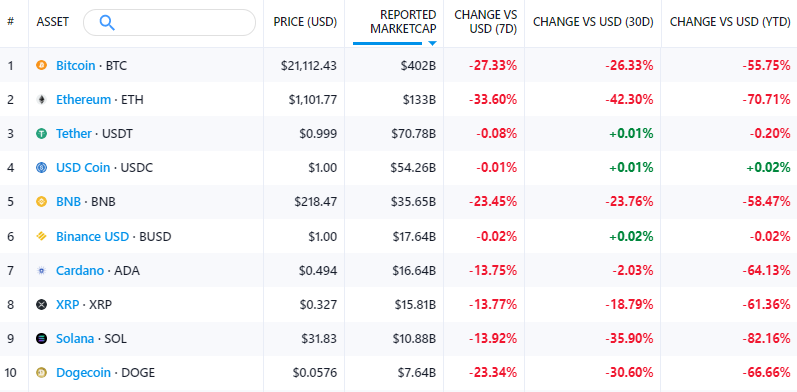
The total implied network value (market cap) of the digital assets market stands at $949bn, down 21% from last week (when it stood at $1.2tn). Bitcoin’s network value is 3.29% of gold’s market cap. Over the last 7 days, BTC is down 27%, ETH is down 33%, and BNB is down 23.45%. Bitcoin dominance is 44%, down slightly from last week. |
|
Data current as of 7:24 AM ET on June 17, 2022. Prices and data via Messari.
|
|
Listen to this week’s episode of Galaxy Brains podcast for extensive market commentary with Alex Thorn and Christine Kim from Galaxy Digital Research and Rob Bogucki and Beimnet Abebe from Galaxy Digital Trading. Catch the episode on Apple, Spotify, Amazon, and Youtube.
|
|
🌊Celsius Halts Customer Withdrawals Amid Turbulent Market
|
|
On Sunday, June 12, lending giant Celsius halted all withdrawals, swaps, and transfers between accounts. The startling announcement sent shockwaves throughout the market, and Celsius stated in a blog post that the move was necessary to ‘stabilize liquidity’. Celsius is a web application serving as a centralized gateway for retail investors and corporations to access crypto products. These products include custody, crypto-backed loans, and yield generation. As a custodial crypto application, Celsius requires all users to go through KYC (Know Your Customer) and AML (Anti-Money Laundering) processes. The project has raised $998m in venture funding to date, according to data from Pitchbook. In November 2021, Celsius raised a GBP 658.73m Series B led by WestCap and Canada’s second largest pension fund, Caisse de dépôt et placement du Québec.
Celsius is perhaps best known for giving users a familiar, Robinhood-esque custodial experience while also offering high yield returns. While Celsius CEO Alex Mashinsky previously described his firm’s strategies as “equivalent to securities lending in a digital world,” over time Celsius engaged in DeFi yield farming and DeFi strategies to deliver higher returns to its clients. These strategies including staking ETH with a very long unlock date (6-12 months after the merge), liquid staking through Lido, recursively borrowing ETH with staked ETH tokens, and collateralizing user deposits to borrow stablecoins. According to Nansen.ai, Celsius was also a major user of Anchor, the now-defunct lending platform in the Terra ecosystem. It was only by engaging in these riskier strategies that Celsius was able to justify the business case for interest rates as high as 9% on stablecoins and 8.5% on Bitcoin.
On-chain data analysis suggests that today Celsius’s positions include 324,576 ETH staked through Figment and an additional 409,260 ETH staked through Lido. In exchange for an annual yield in the mid-to-high single digits, staked ETH is locked for a significant amount of time. Current estimates peg staked ETH withdrawals to be enabled 6-12 months after the merge, which is not set to happen until Fall 2022. On the other hand, liquid staked ETH through Lido (stETH) is a representation of the locked ETH tokens and, for a long time, was believed likely to trade 1:1 with ETH. Recently, stETH has broken the peg and currently trades at 0.943 ETH. (Note, 1 stETH is still expected to be redeemable for 1 ETH once un-staking is enabled on Ethereum mainnet following the merge).
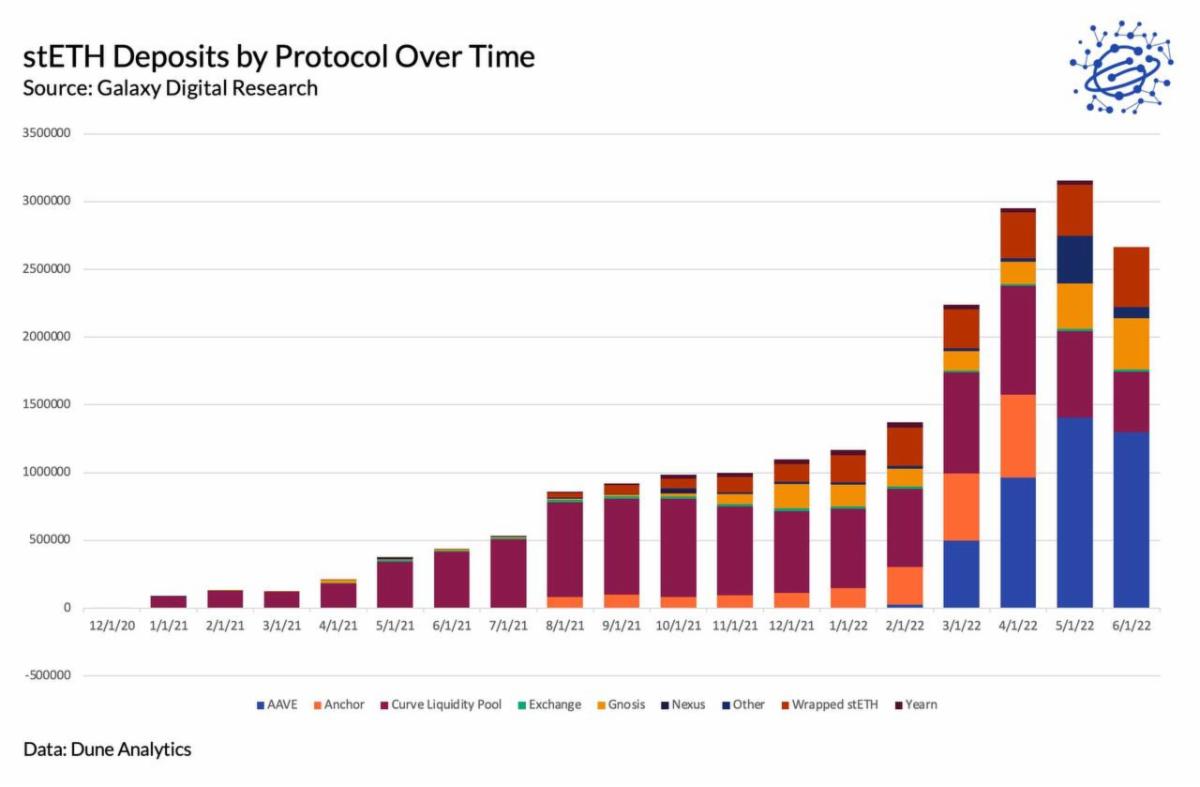
The issue with staking from Celsius’s standpoint is maintaining liquidity in a ‘bank run’ scenario — in other words when many users simultaneously seek to withdraw their deposits. Compounding this is the fact that Celsius also used stETH as collateral in Aave by borrowing stablecoins against their users’ stETH for further yield.
|
|
This strategy of collateralizing stETH allowed Celsius to yield farm by borrowing ETH and staking it again. While this recursive strategy produces a very high yield from staking, it also increased Celsius’s market exposure. This poses a challenge from a risk-management standpoint. The key assumption that Celsius made is that stETH will hold a 1:1 peg, which it unfortunately has not in recent months.
As the markets declined and stETH traded at a discount to ETH, the value of the collateral Celsius has posted started nearing liquidation territory. Since June 12th, Celsius has been rapidly repaying debts and posting more collateral, including lowering their Maker liquidation price from $22,000 per Bitcoin to $14,000. Currently, the average liquidation prices for Celsius DeFi positions stand around $14,500 for BTC and $750 for ETH (assuming stETH doesn’t depeg further).
In light of the withdrawal halt, the Celsius Network token (CEL) has fallen from around $0.80 to $0.145 on June 13th. At one point, it was one of the most shorted tokens, which led to a massive short squeeze to a high of $2.57. The token’s price has since settled around $0.55.
|
|
OUR TAKE: One of the key takeaways is that Celsius is a centralized crypto company that marketed itself as an alternative to traditional banks when their strategies make them look a bit more like an asset management company or a delta-neutral hedge fund. As structural changes in both crypto and macro markets removed safer opportunities for yield, Celsius engaged in increasingly speculative behavior to generate returns for its retail customers. While the stETH depeg was the ‘straw that broke the camels back’. Celsius also lost 35,000 ETH when staking service Stakehound misplaced private keys in June 2021, $22 million in the BadgerDAO hack in December 2021, and had exposure to the UST collapse just last month, according to CoinDesk. Risk management is extremely difficult with highly volatile assets, and at its core, it seems that Celsius ended up with a significant asset-liability mismatch—with liabilities assumed to be short-dated like stETH actually becoming long duration, and a lot of long-term debt has been called by creditors.
The impact that the liquidation of Celsius positions would have on DeFi should not be underestimated. Their Compound position (135M DAI and 79.5M USDC borrowed) represents 47% of all borrowed DAI and 25% of all borrowed USDC in the protocol. A liquidation could cause a cascading effect that might ripple throughout the market. And Celsius is not the only firm facing such a situation, with several other large debt positions in DeFi working hard to add collateral or selling assets like stETH to pay down debt. Over the last several weeks, it’s become increasingly clear that the current DeFi landscape is dominated by several institutional players, leading to a concentration of risk. Despite that, DeFi in its purest form seems well-positioned to prevent these types of systemic breakdowns from happening in the future. Specifically, if DeFi that stays true to the ethos of crypto, where monetary flows are traceable on-chain and users interact with applications non-custodially, can out-compete pseudo-centralized products with none of the self-sovereign and transparency benefits, then the possibility of a more fair, open, and permissionless financial system remains intact. – SQ/KN
|
|
🗳️ MKR Token Holders Vote to Reduce DeFi Contagion Risk
|
|
MakerDAO (MKR) token holders passed a proposal to reduce risk exposure to stETH on Aave. The DAI Direct Deposit Module (D3M) was created to expand DAI's presence outside of just Maker by providing DAI to other lending protocols (e.g. Aave). With D3m on Aave, collateral deposits on Aave that are used to borrow DAI will then be used indirectly to maintain DAI's backing in the Maker Protocol. Maker benefits by earning additional income that's earned on the deposited DAI on these protocols, and with DAI remaining competitive with centralized stablecoins (e.g. USDT and USDC) through lower borrow rates.
New risk developments around Celsius and its stETH position have also put Aave at risk—and by extension, Maker, through D3M (Celsius used stETH as collateral to borrow 100m DAI - representing half of the total DAI borrowed on Aave v2). Maker's Core Risk Unit submitted an urgent Signal Request governance proposal to set the Aave D3M Target Borrow Rate to 0, which would effectively disable D3M and set the vault to unwind only so new DAI debt positions cannot be generated at will, only repaid. This would help prevent Aave's risk exposure to stETH from adding incremental risk to Maker and DAI. [Note: Aave has an active proposal that also similarly seeks to mitigate risk from stETH/ETH price deviations by freezing stETH, increasing the liquidation threshold of stETH to 90% and pausing ETH borrowing—though it currently has 88% voting against.]
The proposal was met with opposition from several community members including from MakerDAO founder Rune Christensen, who said, "Market panic is the only coin at an all-time high. But panic is bad counsel. Aave is one of the most trusted and well-developed protocols. I understand the push to become more isolated in turbulent times and create firewalls for market contagion, but feel this is rushed." Others echoed Rune's thoughts, arguing that the change seems like a knee jerk reaction instead of a measured risk move that would send the wrong message to market participants, and that there are sufficient risk mitigants already in place to protect MKR and DAI holders if market conditions worsen.
Despite these oppositions, the governance proposal ended up passing with 58% voting in support with the change to go into effect on June 17. The Core Risk Unit shared this change may be temporary and would be re-evaluated in 2 weeks during Maker's regularly scheduled monthly governance meetings.
|
|
OUR TAKE: This past month's market volatility and unwinds have demonstrated the risk of contagion in DeFi. As we have seen with UST's collapse, these events can unfold extremely quickly and catch many market participants off-guard. The Crypto Fear & Greed Index is currently at multi-year lows, and this sentiment has seemingly played a role in the passing of Maker's urgent governance proposal, demonstrating the Maker community is largely prioritizes safety over growth. Still, as some community members have detailed, for Maker to be taking a loss from its D3M exposure through Aave, conditions would have to worsen dramatically, starting with stETH having to fall to where liquidations happen.
However, the opportunity cost from withdrawing D3M comes with a relatively low financial impact, at least in the near-term. According to Primoz on the Risk Core Unit Team, Maker was earning 1.4% APY from D3M with 200m DAI borrowed on Aave (~$230k/mo. holding all factors constant). This revenue figure would be higher if more DAI was borrowed, but given that demand for DAI typically comes from leverage, sentiment would have to flip more bullish among market participants for that to happen – which is generally not expected in the near-term. D3M was implemented to expand DAI's presence and to compete with centralized stablecoins, so DAI would likely remain competitive with USDC & USDT as long as demand for leverage remains limited.
Outside of D3M, Maker still has intriguing growth prospects including its cross-chain ambitions and its Real World Asset Initiative, which already has seen some impressive adoption (e.g. SocGen, Tesla, and Huntington Valley Bank). And interestingly, just as Maker governance voted to reduce the risk exposure from stETH collateral on Aave, a separate proposal was just passed to add rETH (a similar staked ETH product to stETH from Rocket Pool) as a new Vault type on Maker. Through all these actions, Maker sets a strong example for DAOs which are often criticized for having weak governance and for not being able to execute or react quickly to market changes -CY
|
|
💣Ethereum Core Developers Schedule 6th Difficulty Bomb Pushback
|
|
The difficulty bomb on Ethereum will be temporarily diffused through a hard fork upgrade dubbed Gray Glacier at block height 15050000, which is estimated to be mined on Wednesday, June 29. As background, the difficulty bomb is a mechanism on Ethereum that, once activated, exponentially increases the network’s mining difficulty every 100,000 blocks. It was originally introduced into Ethereum’s codebase through the Frontier Thawing upgrade in 2015. At the time, core developers assumed the network’s transition to a proof-of-stake (PoS) consensus protocol would be ready for activation sometime in 2016. The bomb was meant to motivate developers to work towards activating the transition by this timeline. It was also meant to make it harder for a forked, proof-of-work version of Ethereum to live on after the network’s transition to PoS by making the coordinated efforts by stakeholders to disable the impacts of the bomb long-term a strict requirement to keep such a chain going.
Unfortunately, the timeline for Ethereum’s transition to PoS has been delayed on several occasions which has forced developers to coordinate multiple hard forks to diffuse the bomb and set it back by a certain number of blocks. The delay that is being coordinated by developers currently for Gray Glacier, which is the 6th delay of its kind, sets back the difficulty bomb schedule by 700,000 blocks or roughly 2.5 months. During the All Core Developers (ACD) meeting when the timing for Gray Glacier was decided, Ethereum Foundation developer Marius Van Der Wijden from the Geth client team stressed that coordinating another difficulty bomb delay would not slow down preparations for mainnet Merge activation. To this end, developers building the consensus layer of Ethereum congregated over a Zoom call this Thursday and tentatively agreed to activate the Merge on Ethereum’s Sepolia testnet as early as the last week of June. For more details around what was discussed on the latest developers’ calls, read this Galaxy Digital writeup.
|
|
OUR TAKE: After several weeks of deliberation, Ethereum core developers have finally agreed to implement another delay to the difficulty bomb. This is to ensure that, as core developers continue to work towards mainnet Merge activation, users and decentralized applications (dapps) are not negatively impacted by significantly longer block times, which recent analysis suggests could hit up to 20 seconds in July. (As background, block times on Ethereum normally range between 12 to 14 seconds.) According to Van Der Wijden, the difficulty bomb delay does not suggest the Merge activation itself is delayed.
In one sense, Van Der Wijden and the sentiment of other core developers around Merge timing is true. Testing for the Merge does continue to progress unhindered and unencumbered by any significant blockers. However, it is also true that even at this pace of testing, it appears unlikely that developers will be ready to activate the Merge upgrade by August as expected by developers back in December 2021 when the bomb’s schedule was last reset. However, the decision to delay the bomb by only 2.5 months suggests developers have high confidence that while the August expectation may not be met, September or October is still likely. Given that testing for the Merge so far has not revealed any serious bugs or issues in code, there remains a high level of certainty around this upgrade’s readiness for a mainnet activation sometime this fall.
Notably, important conversations among core developers have been sparked about the governance of Ethereum in lead-up to the decision of delaying the network’s difficulty bomb. Up until the latest ACD call which occurred on Friday, June 10, it was unclear whether developers were in agreement that reaching 20 second block times would be unacceptable for the network, even for a short duration before the Merge upgrade. As such, there was the possibility that developers could have chosen to leave the difficulty bomb schedule unchanged at the expense of user experience on Ethereum. This sets a dangerous precedent for Ethereum’s governance process. “The core devs are a great group of people but the community has to pay attention to the fact that the core devs have the power to make this decision,” said founder of TrueBlocks Thomas Jay Rush during Friday’s ACD call. While developers have ultimately decided to schedule a delay to the bomb, the reality that core developers on Ethereum wield an outsized voice over miners, users, and other stakeholders in shaping the network's development roadmap remains a prevalent and persisting concern. -CK
|
|
-
Babel Finance announced it has halted withdrawals and deposits
-
OpenSea is migrating to Seaport, a new web3 marketplace protocol.
-
Circle to introduce Euro-backed stablecoin in the United States.
-
TRON DAO deploys $2B to buy TRX and restore USDD peg amidst stablecoin crash.
-
Burger King and Robinhood partner up to give away 20 BTC, 200 ETH, and 2m DOGE in rewards through BK’s Royal Perks program.
-
Sequoia Capital launches 2 new web3 funds.
-
Goldman Sachs trades their first Ethereum derivatives products.
-
International law firm Holland & Knight becomes the first law firm to serve a defendant by an NFT.
-
SEC Commissioner Hester Peirce shares new remarks urging the SEC to stop denying spot crypto exchange traded products.
-
U.S. Deputy Secretary of the Treasury Wally Adeyemo speaks at Consensus 2022 on proposed legislation around unhosted cryptocurrency wallets.
|
|
Access our research on the Bloomberg Terminal with ERH GXY <GO>
|
|
|
|
NEW: Ethereum ACD Call #140 & Consensus Layer Call #89 Writeup |
Christine Kim summarizes the 140th bi-weekly Zoom meeting between Ethereum core developers as part of Galaxy Digital Research’s ongoing coverage of Ethereum and the network's forthcoming Merge upgrade.
|
|
|
|
A Breakdown of Ethereum Supply Distribution |
Christine Kim breaks down supply distribution on Ethereum today and examines the trends impacting ETH distribution on the network under PoW vs. PoS.
|
|
|
|
Galaxy Digital Research Podcast |
In this week's episode, we discuss macro and crypto market trends with Galaxy Digital's Head of Derivatives Trading Robert Bogucki, VP of Principal Trading Beimnet Abebe, and Research Associate Christine Kim.
|
|
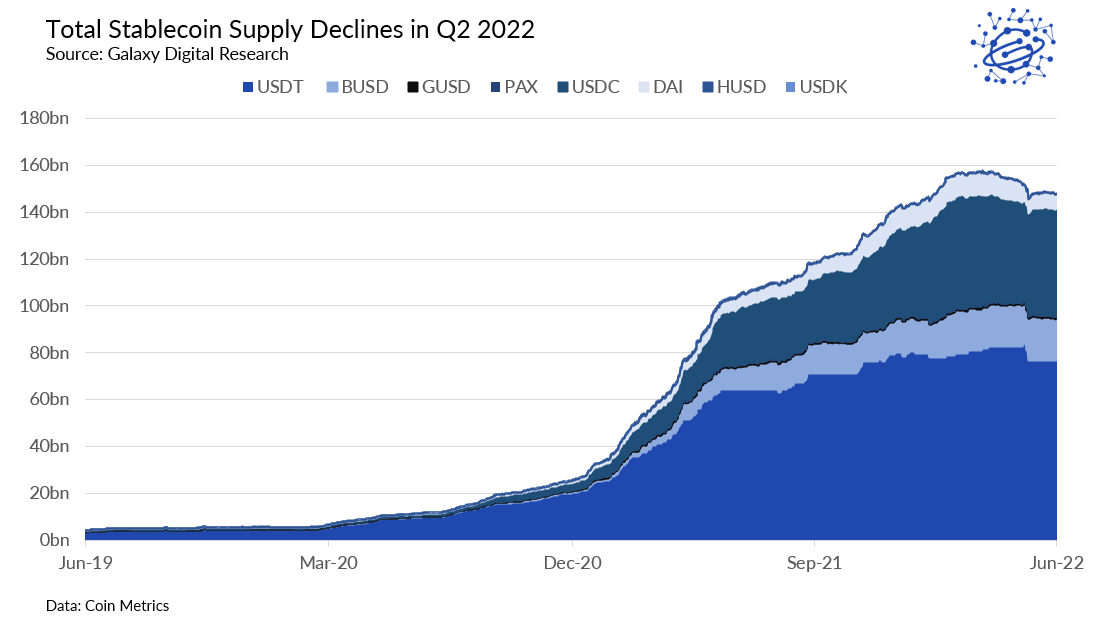
The supply of stablecoins have declined across the board for the first time in the second quarter of 2022. The rise of concerns around short-term liquidity and insolvency for the tokens has driven the decline in supply. Supply has shrunk by $13B across the board, with $10B being redeemed amongst major issuers and $3B having been retired from DAI alone. |
|
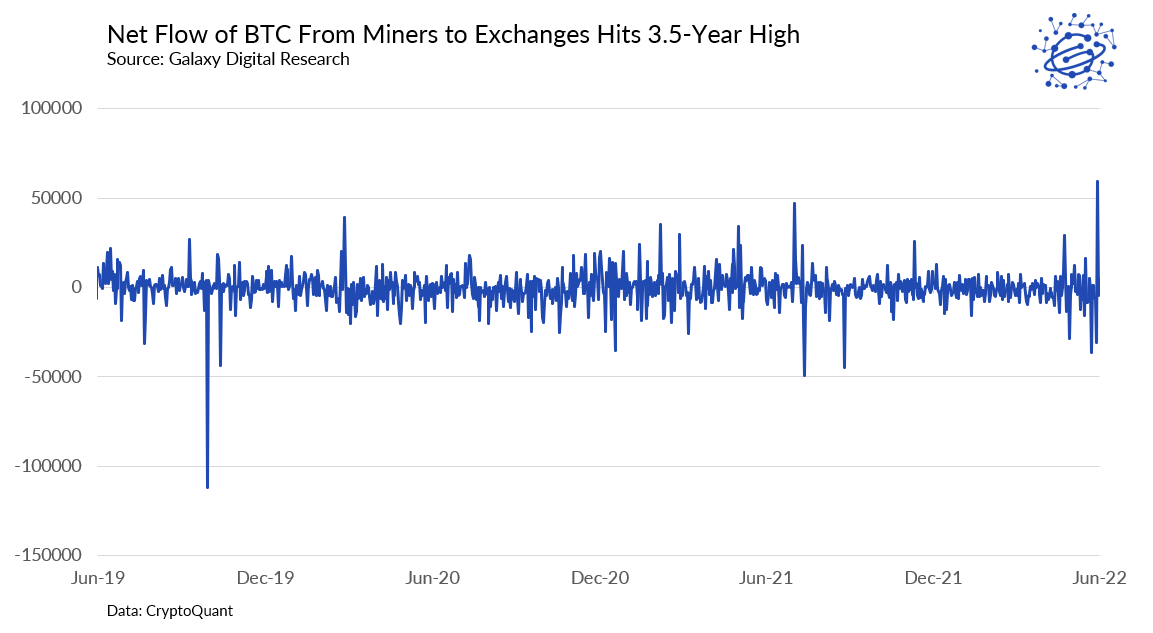
For the first time in over three years, the net flow of BTC sent to exchanges from miners hit a new record high. On June 14th, miners sent 88k BTC, approximately $1.8B, was sent to exchanges around the world. The spike comes at a time where the currency has lost more than 50 percent of its value over the last year.
|
|
Thanks for reading this week. Have a great weekend.
|
|
Alex Thorn
Head of Firmwide Research, Galaxy Digital
|
|
|
Legal Disclosure:
This document, and the information contained herein, has been provided to you by Galaxy Digital Holdings LP and its affiliates (“Galaxy Digital”) solely for informational purposes. This document may not be reproduced or redistributed in whole or in part, in any format, without the express written approval of Galaxy Digital. Neither the information, nor any opinion contained in this document, constitutes an offer to buy or sell, or a solicitation of an offer to buy or sell, any advisory services, securities, futures, options or other financial instruments or to participate in any advisory services or trading strategy. Nothing contained in this document constitutes investment, legal or tax advice. You should make your own investigations and evaluations of the information herein. Any decisions based on information contained in this document are the sole responsibility of the reader. Certain statements in this document reflect Galaxy Digital’s views, estimates, opinions or predictions (which may be based on proprietary models and assumptions, including, in particular, Galaxy Digital’s views on the current and future market for certain digital assets), and there is no guarantee that these views, estimates, opinions or predictions are currently accurate or that they will be ultimately realized. To the extent these assumptions or models are not correct or circumstances change, the actual performance may vary substantially from, and be less than, the estimates included herein. None of Galaxy Digital nor any of its affiliates, shareholders, partners, members, directors, officers, management, employees or representatives makes any representation or warranty, express or implied, as to the accuracy or completeness of any of the information or any other information (whether communicated in written or oral form) transmitted or made available to you. Each of the aforementioned parties expressly disclaims any and all liability relating to or resulting from the use of this information. Certain information contained herein (including financial information) has been obtained from published and non-published sources. Such information has not been independently verified by Galaxy Digital and, Galaxy Digital, does not assume responsibility for the accuracy of such information. Affiliates of Galaxy Digital may have owned or may own investments in some of the digital assets and protocols discussed in this document. Except where otherwise indicated, the information in this document is based on matters as they exist as of the date of preparation and not as of any future date, and will not be updated or otherwise revised to reflect information that subsequently becomes available, or circumstances existing or changes occurring after the date hereof. The foregoing does not constitute a "research report" as defined by FINRA Rule 2241 or a "debt research report" as defined by FINRA Rule 2242 and was not prepared by Galaxy Digital Partners LLC. For all inquiries, please email contact@galaxydigital.io. ©Copyright Galaxy Digital Holdings LP 2022. All rights reserved.
|
|
|
|
|
|
|