Access our research on the Bloomberg Terminal with ERH GXY <GO>
|
|
gm -
the ride continues this week with a slew of interesting developments, including a major dust-up in the solana ecosystem. listen to this week’s episode of galaxy brains to hear about how the team behind solend, a decentralized lending protocol on solana, wrestled with a decision about whether to make an unprecedented intervention and seize a user's funds.
in addition, read about the new announcement of a mobile phone and accompanying tech stack from solana labs below in this week's brief. also in today's newsletter, more developments on the lending front, with two additional firms announcing halts or limitations to withdrawals. we also write about M&A in the NFT space and dYdX’s announcement of a planned move from the ethereum ecosystem to the cosmos ecosystem.
have a great weekend everyone,
alex
|
|
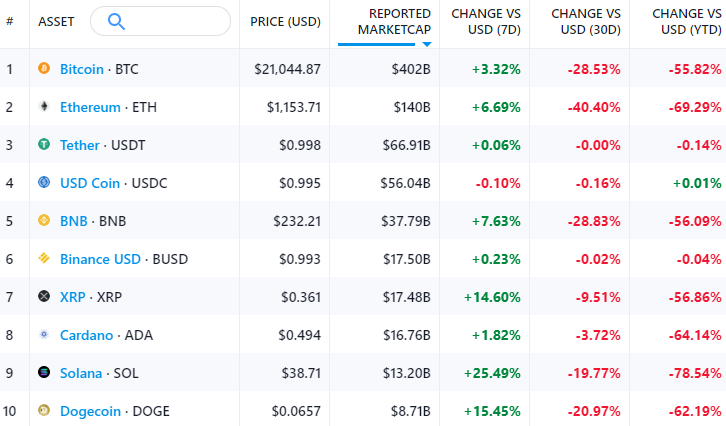
The total implied network value (market cap) of the digital assets market stands at $932bn, down 1.7% from last week (when it stood at $949bn). Bitcoin’s network value is 3.34% of gold’s market cap. Over the last 7 days, BTC is up 3.3%%, ETH is up 6.7%, and SOL is up 25.5%. Bitcoin dominance is 43%, down slightly from last week. |
|
Data current as of 10:26 AM ET on June 23, 2022. Prices and data via Messari.
|
|
📱Solana Labs Reveals the Solana Mobile Stack (SMS) and Saga
|
|
On Thursday, June 23, Solana Labs announced the Solana Mobile Stack (SMS) and Saga, an Android software developer kit for mobile Web3 apps and smartphone. These products will be developed by a new subsidiary of Solana Labs called Solana Mobile. In an announcement on the Solana website, Solana founder Anatoly Yakovenko wrote, “It’s time for web3 devs to start building for mobile usage instead of around mobile usage,” criticizing webtwo2 companies like Apple and Google for lacking clear crypto roadmaps that enable greater mobile integration.
Solana Mobile is partnering with Osom to design and manufacture the phone. Osom had previously been developing the Osom OV1 smartphone which will now be called Saga and be Solana Mobile’s first flagship product. Saga will use the Android operating system and feature a 6.67-inch 120Hz OLED display, 512 GB of storage, and 12 GB of RAM. It will be powered by the Qualcomm Snapdragon 8 Plus Gen 1 chip. Critically, Saga will have a Secure Element built-in that features a Seed Vault Protocol to secure users’ private keys and seed phrases separate from the rest of the phone. As the Saga reveal announcement explains, “the Seed Vault keeps private keys, seed phrases and secrets separated from the application layer yet still capable of interacting with apps running on the device or in a mobile browser.” Saga is expected to be released in Q1 2023 with a $1000 price tag. Since the announcement, nearly 500 have been pre-ordered for a deposit of $100.
SMS, the software component, is “an open-source software toolkit for Android enabling native Android web3 apps on Solana with the Seed Vault secure custody protocol.” The SDK will launch with capabilities like a mobile wallet adapter, a seed vault protocol, and Solana Pay. In addition, the SMS will offer a Solana dApp Store that enables developers to distribute their applications directly to users. Use cases referenced in the announcement include minting NFTs, transacting for goods and services, playing web3 games, and trading on the go. To help accelerate development, the Solana Foundation also announced a $10 million developer fund to incentivize developers to build using the SDK. Prominent figures of the Solana ecosystem – including the founders of Solana wallet Coral, NFT marketplace Magic Eden, Defi protocol Orca, and others – were featured in the announcement showing support for the initiative.
Solana is not the first blockchain to launch a mobile product. In 2018, Sirin Labs launched the FINNEY, the world’s first blockchain phone with an embedded cold-storage wallet. However, the lack of demand quickly made the phone a failure.
|
|
OUR TAKE: With this landmark announcement, the Solana team is recognizing and capitalizing on a critical component in the future of global digitization. Mobile devices will be the axis of user adoption and retention; in 2020, 68.1% of all web traffic was through a mobile device. This data point is more applicable to emerging digital markets, such as India, where populations skipped desktop infrastructure altogether. Due to Apple’s dominance of the mobile phone market in the US, it is unlikely that the Saga phone and Solana mobile stack will meaningfully penetrate the US market in the near future. As of 2021, Apple’s IOS operating system commands 53% of the US market, but globally only 26%. To the extent that Solana’s mobile suite of products can demonstrate product-market fit, they may motivate Apple to take more crypto-friendly stances on its policies governing its hardware and App Store.
Android remains the dominant mobile operating system outside of the US due to the lower entry price of Android phones, and the hardware market is dominated by the likes of Samsung, LG, and Google. Moreover, people are creatures of habit and rarely upgrade or migrate to new brands. For these reasons, the Solana Mobile Stack is by far the most pivotal and impactful of the two announcements and has the power to reach a significant subset of the world population. The Android operating system is the most used globally. As of 2021, 70% of all mobile phones were operated on Android OS, and according to Statista, there are over 6 Billion smartphone users worldwide. Combining these two data points, Solana is now presented with a whopping 4.2 billion potential users. On the application layer, a seamless integration may significantly affect the mainstream usage of crypto as a means of payment, more specifically stablecoins. Imagine a system in which a user could withdraw USDC from one of many DeFi lending protocols and, seconds later, purchase a cup of coffee with Solana Pay, all securely through an Android mobile phone.
At first glance, many may wonder where Solana garners the expertise to move into a highly competitive mobile phone market; look no further than the man at the helm. Before Anatoly co-founded Solana, he was a Senior Staff Engineer Manager at Qualcomm , a leading designer, and manufacturer of telecommunications products. For more information on Anatoly’s background and an in-depth look at the Solana blockchain, refer to our in-depth report, Surveying Solana.
Crypto adoption will not hit the mainstream until compelling user interfaces can be developed on mobile devices. The biggest hindrance to the advancement of mobile-first crypto interfaces has been the likes of Apple, which effectively bans the transfer of money on apps distributed through its App Store with its infamous 30% platform tax. This closed-off policy for app developers has reached a boiling point in recent years with the emergence of Epic Games’ lawsuit against Apple for this very practice. Solana is taking a very calculated approach in embracing the openness of Android to create a sandbox upon which mobile-first Solana applications can be built and proven out. This is an incredibly important development considering that many users overseas don’t even have access to desktop computers to use current web-based crypto apps and wallets. Until crypto offers complete end-to-end functionality on mobile devices, it will never achieve its mission of banking the unbanked. While Solana still has much to prove with this announcement, they have taken an important first step towards manifesting a mobile-first approach to building compelling crypto apps into reality. To the extent that Solana can deliver on its ambitious vision, the likes of Apple may be forced to compete by opening up their software and hardware to make crypto applications first-class citizens in their suite of products. - LM, LT, SQ
|
|
🪐 Decentralized Exchange dYdX to Deploy on Cosmos
|
|
dYdX announced plans to deploy dYdX v4 as a standalone Tendermint chain in the Cosmos ecosystem. dYdX is a derivatives trading platform exchange built as an app-specific rollup on Ethereum that that offers products including perpetual swaps, and well as spot & margin trading, and lending & borrowing. dYdX has over 25k users and saw over $500m in trading volume over the past 24 hours. dYdX is powered by StarkEx, a zk-rollup based platform built by StarkWare that leverages STARK proofs to provide users with speed, data integrity, and privacy.
dYdX announced it would be reploying the next iteration of its project, v4, as a standalone chain on top of Cosmos, an interoperability Tendermint-based platform, by using the Cosmos SDK. dYdX's stated reasons for choosing Cosmos were led by its main requirement for v4 which is "full decentralization," but also included requirements for high throughput to deliver a highly performant orderbook and matching engine. dYdX also considered other options for v4 but wanted more customizability over the tech stack to build the best trading platform possible. It plans to design better value accrual to the $DYDX token, charge no gas fees to trade (following more of a percent-based trading fee) with rewards going to validators and stakers.
dYdX v4 is expected to launch within months, with the team planning to open source it by the end of 2022.
|
|
OUR TAKE: It says a lot whenever a platform's premier app decides to migrate to another platform. dYdX was originally launched on Ethereum in 2017 and eventually moved to an L2 in early 2021 as one of the primary projects built on top of Starkware including DeversiFi, Immutable, and Sorare. Its V3 version has seen a lot of success already, but this announcement from dYdX to leave the Ethereum ecosystem comes just as the Starkware platform was starting to garner a lot more traction (including MakerDAO’s plans to deploy on StarkNet as part of its relatively new multi-chain ambitions).
Despite the promise of StarkNet (and zk-rollups in general), it still faces several challenges including centralization with the role of the sequencer, inefficient costs with batching transactions, and difficult tooling (StarkNet contracts are written in a specialized language called Cairo). There is confidence in the Ethereum community that rollups will eventually deliver a decentralized sequencer but many admit that it’s not ready now and won’t be ready for another year (per @epolyna). dYdX’s announcement certainly is a bit of a setback to StarkNet and other zk-rollups as other projects may question whether their needs can be met by this promising but nascent technology.
However, dYdX also has its fair share of reasons for migrating to its own Cosmos chain that may not apply to other projects. dYdX is looking to create the best trading experience for its users - and better UX can be enabled by having control over the gas token (vs. using ETH). Market making platforms sees a lot of MEV extraction that goes towards the underlying platform but for dYdX v4, that value accrual can go towards the $DYDX token to then be distributed to traders and enable no gas fees to trade. As a derivatives platform, dYdX's perpetual offerings could potentially fall under the purview of the CFTC and other regulatory bodies. A project can only be as decentralized as its underlying platform, and rollups' current reliance on a single, centralized sequencer puts all projects built on top of them at risk. The dYdX team has set out with the goal of open-sourcing v4 by EOY, which sounds ambitious especially given the innovations they are looking to provide through their orderbook and decentralized matching engine.
The move also says a lot about the technology behind Cosmos, particularly that it can meet the latency and high throughput needs of dYdX while still enabling sufficient decentralization. Customizability will continue to be a demanded feature and could be part of a larger trend - which is good news for platforms offering blockchains-as-a-service or the potential for application-specific chains. Applications can provide much better UX when they have greater control over the tech stack so there will be a lot of improvements targeted at users as the underlying blockchain infrastructure continues to mature. - CY
|
|
🖥️eBay Acquires NFT Marketplace KnownOrigin
|
|
E-commerce giant eBay has acquired one of the oldest non-fungible token (NFT) marketplaces in a bid to attract new NFT creators and collectors to its platform. Founded in 2018, KnownOrigin is a UK-based company that has created an online marketplace built atop Ethereum for users to mint, buy, and sell NFT artwork. KnownOrigin has facilitated nearly $8mn in trade volume over the past four years and raised GBP $3.5mn ($4.3mn) in a Series A funding round earlier this year. Speaking to the motivations behind eBay’s acquisition of KnownOrigin, CEO of eBay Jamie Iannone said in a press release, “With this acquisition, we will remain a leading site as our community is increasingly adding digital collectibles.”
NFTs have been available to buy and sell on eBay since as early as May 2021. This year, the company also commissioned its own NFT collection in partnership with Sports Illustrated called “OneOf” on the Tezos and Polygon blockchains. However, eBay hasn’t been the only company to reveal heightened interest in the digital collectibles business this week during NFT NYC, which is a week-long conference hosted in New York City about NFTs. Uniswap Labs, the company behind Ethereum’s decentralized exchange Uniswap, recently announced that they were acquiring NFT marketplace aggregator Genie. “NFTs will be integrated into our products, starting with the Uniswap web app, where soon you’ll be able to buy and sell NFTs across all major marketplaces,” wrote Uniswap Labs in a blog post on Tuesday.
Also in related news, Magic Eden, which is an NFT marketplace built on the Solana blockchain, announced this week the close of their Series B funding round at a 10 times higher valuation than their Series A, having raising $130mn in capital at a whopping $1.6bn valuation.
|
|
OUR TAKE: Due to recent market volatility, most crypto projects and protocols have been cutting back on their products and services, limiting what features users can access under current bearish market conditions. Across several crypto lending platforms including Babel Finance, Celsius, Voyager Digital, and CoinFlex, withdrawals have been halted or limited and once high yields on deposits have plummeted. But one area of the crypto industry where crypto projects don’t appear to be suffering a rollback of features and innovations is NFTs. In fact, a slew of new headlines this week regarding NFT platforms suggests that more than ever investors maintain high confidence that the business models being created around NFTs are here to stay, even through what is likely to become a long and drawn-out winter for the crypto markets.
eBay’s latest push within the digital collectibles industry is a strong indicator of the enduring and long-lasting value that mainstream businesses see in NFTs and in the consumer adoption for NFTs. eBay is the second largest e-commerce platform in the U.S. behind Amazon and services more than 140mn customers. Yet, it is not the only e-commerce giant that sees long-lasting potential in digital collectibles. Shopify announced the launch of their NFT-gated e-commerce shops this week for brands on their platform looking for ways to make their products more exclusive and engaging for customers. In addition, several celebrities including Christian Ronaldo, Bella Hadid, Keanu Reeves, Pharrell, and Bill Murray have recently entered the foray citing exciting potential for NFTs to revolutionize the industries of fashion, gaming, sports, and entertainment.
Despite the ongoing hype for NFTs and their potential to revolutionize many aspects of our society, there remains a persistent concern that the infrastructure and norms around using this technology are not based on an ethos of decentralization or the use of permissionless blockchain technology. As noted during a Galaxy Brains podcast, the licensing around most NFTs does not in fact guarantee ownership over the token and its related artwork but only transfers over some limited usage rights to holders that can be changed by the issuing company. In addition, most NFT marketplaces, including that of NFT marketplace aggregator Genie, rely to some extent on centralized operators, making the process of purchasing and selling NFTs not totally censorship-resistant. As we've seen with crypto lending projects, hype and adoption around a technology does not make that technology immune to centralization failures and risks. - CK
|
|
-
Bitcoin trading volume approaches one year high as volatile market conditions persist.
-
Harmony’s cross-chain bridge drained of $100m in apparent ETH theft
-
KPMG announces its first collaboration hub, entering the metaverse landscape.
-
Crypto exchange CoinFLEX halts withdrawals citing “extreme market conditions.”
-
Voyager reduces daily withdrawal limit from $25k to $10k following revelation of exposure to Three Arrows Capital.
-
South Korea delays 20% crypto tax till 2025.
-
BlockFi secures $250m credit facility from crypto exchange FTX.
-
Tether to launch $GBPT, a new stablecoin pegged to British pounds.
-
Avalanche bridge launches native BTC Support, leading AVAX to surge 7.4%.
|
|
Access our research on the Bloomberg Terminal with ERH GXY <GO>
|
|
|
|
A Breakdown of Ethereum Supply Distribution |
Christine Kim breaks down supply distribution on Ethereum today and examines the trends impacting ETH distribution on the network under PoW vs. PoS.
|
|
|
|
Sal Qadir evaluates Solana in-depth and uncovers how well-positioned it is to capture and retain market share in the Layer 1 blockchain landscape.
|
|
|
|
Galaxy Digital Research Podcast |
In this week's episode, we discuss macro and crypto market trends with Galaxy Digital's Head of Derivatives Trading Robert Bogucki, VP of Principal Trading Beimnet Abebe, and Research Associate Christine Kim.
|
|
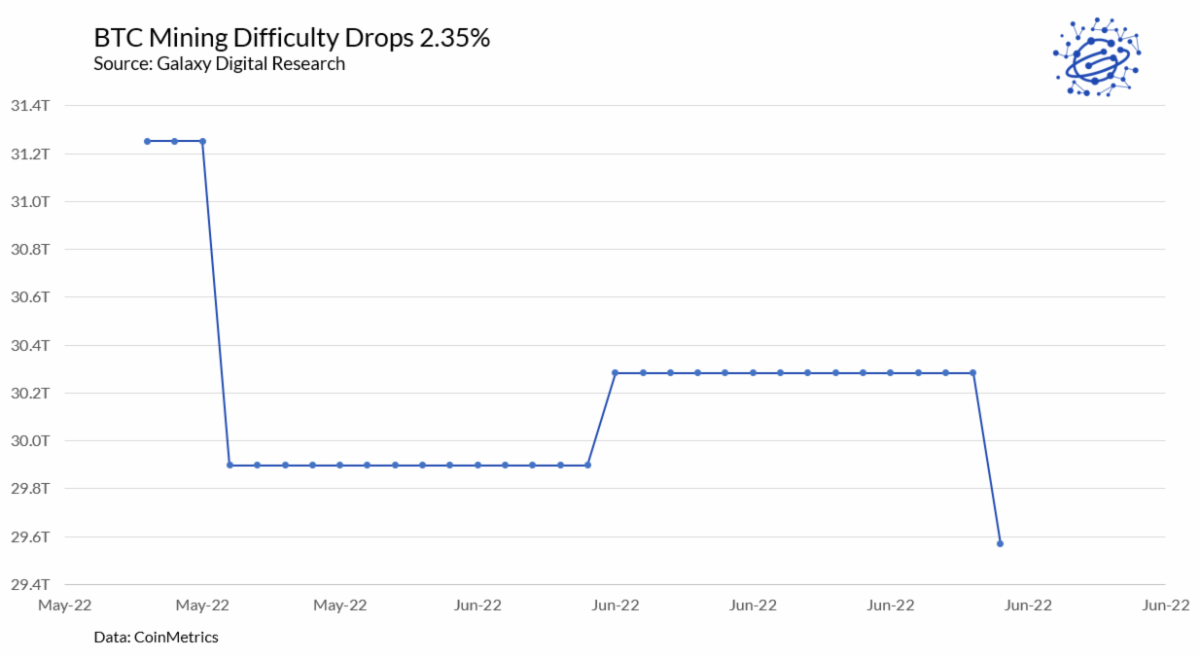
This Wednesday, at block height 741,888, BTC’s mining difficulty decreased by 2.35% to 29.5 trillion. The Bitcoin difficulty adjustment algorithm (DAA) shifts every 2,016 blocks or roughly 2 weeks to keep block times consistent around 10 minutes. The decline in Bitcoin’s mining difficulty is due to slower block times over the prior mining epoch, which most agree is the result of miners capitulating under bearish market conditions by powering down their machines and contributing less total hash power to the network. |
|
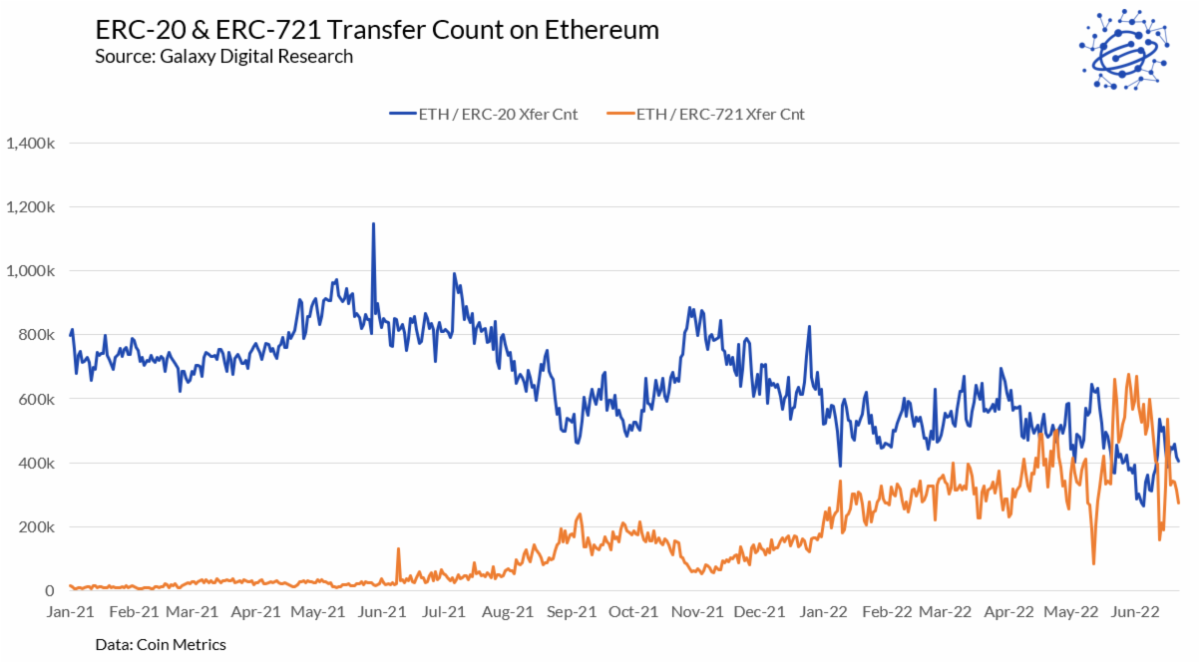
After recently surpassing the number of daily ERC-20 token transfers, the number of ERC-721 token transfers on Ethereum has receded over the last month. ERC-20 is the technical standard for fungible tokens issued on Ethereum, while ERC-721 is the standard for non-fungible tokens (NFTs). Growth in interest in NFTs in 2021 led to a significant rise in ERC-721 usage, briefly surpassing ERC-20 usage earlier this month. Despite the recent decline, NFT usage and ownership remains at elevated levels and an uptick over the last week in floor prices for major collections could lead to increased activity in the near term. |
|
Thanks for reading this week. Have a great weekend.
|
|
Alex Thorn
Head of Firmwide Research, Galaxy Digital
|
|
|
Legal Disclosure:
This document, and the information contained herein, has been provided to you by Galaxy Digital Holdings LP and its affiliates (“Galaxy Digital”) solely for informational purposes. This document may not be reproduced or redistributed in whole or in part, in any format, without the express written approval of Galaxy Digital. Neither the information, nor any opinion contained in this document, constitutes an offer to buy or sell, or a solicitation of an offer to buy or sell, any advisory services, securities, futures, options or other financial instruments or to participate in any advisory services or trading strategy. Nothing contained in this document constitutes investment, legal or tax advice. You should make your own investigations and evaluations of the information herein. Any decisions based on information contained in this document are the sole responsibility of the reader. Certain statements in this document reflect Galaxy Digital’s views, estimates, opinions or predictions (which may be based on proprietary models and assumptions, including, in particular, Galaxy Digital’s views on the current and future market for certain digital assets), and there is no guarantee that these views, estimates, opinions or predictions are currently accurate or that they will be ultimately realized. To the extent these assumptions or models are not correct or circumstances change, the actual performance may vary substantially from, and be less than, the estimates included herein. None of Galaxy Digital nor any of its affiliates, shareholders, partners, members, directors, officers, management, employees or representatives makes any representation or warranty, express or implied, as to the accuracy or completeness of any of the information or any other information (whether communicated in written or oral form) transmitted or made available to you. Each of the aforementioned parties expressly disclaims any and all liability relating to or resulting from the use of this information. Certain information contained herein (including financial information) has been obtained from published and non-published sources. Such information has not been independently verified by Galaxy Digital and, Galaxy Digital, does not assume responsibility for the accuracy of such information. Affiliates of Galaxy Digital may have owned or may own investments in some of the digital assets and protocols discussed in this document. Except where otherwise indicated, the information in this document is based on matters as they exist as of the date of preparation and not as of any future date, and will not be updated or otherwise revised to reflect information that subsequently becomes available, or circumstances existing or changes occurring after the date hereof. The foregoing does not constitute a "research report" as defined by FINRA Rule 2241 or a "debt research report" as defined by FINRA Rule 2242 and was not prepared by Galaxy Digital Partners LLC. For all inquiries, please email contact@galaxydigital.io. ©Copyright Galaxy Digital Holdings LP 2022. All rights reserved.
|
|
|
|
|
|
|