Access our research on the Bloomberg Terminal with ERH GXY <GO>
|
|
gm –
we have an absolutely packed delivery for you today. on tuesday, we published a white paper from sal qadir covering the financialization of NFTs through DeFi. and sal also dropped a great metaverse 101 primer on tuesday. in addition to the two reports we published on tuesday in conjunction with christie’s (NFTs & DeFi and a Metaverse 101 primer), we have two more new reports for you today.
this week on our galaxy brains podcast, we hosted nic carter, partner at castle island ventures, for a wide-ranging discussion about bitcoin, blockchains, and the meaning of web3. this was a really fascinating hour and you don’t want to miss our conversation. listen on apple, spotify, amazon, or youtube.
that’s all for now – wishing you the best for the weekend.
– alex
|
|
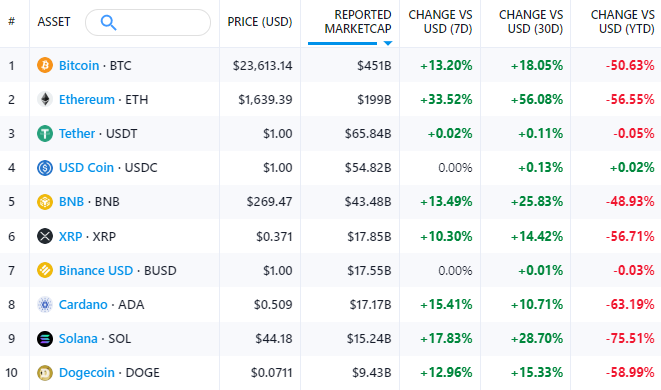
The total implied network value (market cap) of the digital assets market stands at $1.07tn, up 17.3% from last week (when it stood at $912bn). Bitcoin’s network value is 3.95% of gold’s market cap. Over the last 7 days, BTC is up 13.2%, ETH is up 33.5%, and SOL is up 17.8%. Bitcoin dominance is 42.19%, down slightly from last week. |
|
Data current as of 8:00 AM ET on July 22, 2022. Prices and data via Messari.
|
|
⚖️ Former Coinbase Manager Charged with Insider Trading
|
|
Former Coinbase manager charged by DOJ and SEC in insider trading scheme. The Department of Justice, the US government agency tasked with prosecuting federal crimes, charged Ishan Wahi, his brother Nikhil Wahi, and a friend named Sameer Ramani, with wire fraud that they are alleged to have conducted as part of an insider trading scheme. The Securities and Exchange Commission, the federal securities regulator, also filed a civil suit against the trio seeking damages for violating U.S. securities laws.
According to the SEC’s complaint, Ishan Wahi was a “manager in Coinbase’s Assets and Investing Products Group,” and in the course of his job was privy to information about new tokens that Coinbase was preparing to list for trading on its exchange. The DOJ and SEC allege that Wahi provided “nonpublic information about the timing and content of Coinbase’s listing announcements,” specifically an announcement made by Coinbase on April 11, 2022, to his brother and Ramani, who then traded ahead of the announcements to earn “at least $1.1 million in illicit profits.”
According to the DOJ’s press release, “a Twitter account that is well known in the crypto community tweeted regarding an Ethereum blockchain wallet ‘that bought hundreds of thousands of dollars of tokens exclusively featured in the Coinbase Asset Listing post about 24 hours before it was published.” This account, known to be @cobie, host of the Up Only podcast, correctly spotted and described the irregularities publicly only 1 day after Coinbase’s listing announcement. About a month later, Wahi attempted to flee the country, but was stopped by law enforcement. Both Wahi brothers are in FBI custody, while Ramani currently remains at large, according to the DOJ.
|
|
OUR TAKE: It’s important to note that the transparency of public blockchains allowed a public citizen to spot the scheme almost immediately. That’s simply not possible in traditional markets. And for what it’s worth, Coinbase’s Chief Security Officer, Philip Martin, replied to Cobie’s tweet the next day and said that his “team has been investigating since yesterday.” Committing fraud on the blockchain is extremely difficult, much more so than on traditional financial infrastructure.
But perhaps the most important part of this story is that the SEC is alleging in its civil action against the three accused individuals that 9 specific tokens (AMP, RLY, DDX, XYO, RGT, LCX, POWR, DFX, and KROM) are securities, which followers of the cryptocurrency sector know has been an extremely rare occurrence. To be clear, the SEC must allege that some of the coins traded by the accused are securities, or else the SEC would not have standing to bring the suit. (The SEC is empowered by law to create and enforce rules, and bring actions, regarding securities, but not commodities, or currencies, etc.). In the SEC's statement of claim, they broadly allege that 9 tokens are securities because "a reasonable investor in the nine crypto asset securities would continue to look to the efforts of the issuer and its promoters, including their future efforts, to increase the value of their investment." The SEC then proceeds to evaluate each of the 9 tokens individually against the planks of the Howey Test, the legal precedent that determines what is considered a "security" under U.S. federal law. Notably, in another recent instance of crypto insider trading involving a manager at OpenSea, an NFT trading venue, who front-ran front-page promotions of specific NFT projects, the DOJ filed criminal charges for fraud but the SEC has not similarly filed a civil action. (That activity, as in this instance, was also spotted by a public sleuth on Twitter).
While the SEC alleges that the accused individuals illicitly traded 25 digital assets, the regulator only specifically alleges that 9 of them are securities. However, the SEC couches their language by saying "at least 9," which leaves the door open for them to amend the complaint to argue that additional assets as securities. If the SEC does believe that some of the remaining 16 are not securities, it would be extremely beneficial for the cryptocurrency industry to see that analysis. A common way that the financial industry has advanced when questions like this arise is to pursue a “No Action Letter” from the SEC that clearly defines how the interested party can avoid an enforcement action. To date, the SEC has only provided one such letter, a 2019 “No Action Letter” to TurnKey Jet, Inc. following their petition to the agency, which said that TKJ’s token would not be subject to securities registration if TKJ 1) did not use the funds raised to develop the platform; 2) made the tokens immediately available; 3) restricted transfers of the tokens to not allow for secondary market trading; 4) maintained that the tokens would trade at $1 in perpetuity; 5) only repurchased tokens at a discount to the face value of the token ($1); and 6) marketed the token in a way that emphasized the token’s utility and not the potential for the token to increase in value. While this letter confirmed that TKJ’s token would not be considered a security if TKJ abided by these conditions, there remains a lack of specificity for other types of token scenarios.
To date, the SEC has settled with and extracted fines from many token projects over the years regarding unregistered offerings, perhaps most notably Block.One, the issuer of EOS; they forced a settlement with Telegram to halt its TON offering due to the fact that the agency would consider the offering an unregistered security; they sued Kik Interactive Inc. alleging that it’s KIN token was an unregistered security; and they brought suit against Ripple, alleging that XRP is an unregistered security, which is ongoing. This list is not exhaustive, but it is demonstrative of the fact that—with the exception of TKJ’s no action letter—each of these instances of "clarity" from the SEC, including now with these 9 assets, has come through enforcement or litigation rather than rulemaking through public comment or legislative activity. While the SEC’s arguments in SEC v. Ishan Wahi et al. are among the most specific regarding their application of the Howey Test to digital assets to date, the SEC has not formally and comprehensively provided guidance or rulemaking on how they think securities laws apply to digital assets, despite repeated calls from industry stakeholders to do so (including Coinbase, which just yesterday filed a petition for rulemaking and released a blog calling for explicit clarity from the SEC on these and other issues). Many industry participants continue to believe that these claims by the SEC, made in court pleadings rather than through an official regulatory process, lack the specificity and process of detailed rulemaking or guidance. Such rulemaking would allow for a comment period with the industry, which is the type of collaborative approach that industry expects from the securities regulator, as well as clearly define the rules of the road. -AT
|
|
⛏️ NFTs Banned from Minecraft
|
|
Minecraft bans NFTs and other blockchain technologies on its platform. On Wednesday, Minecraft announced that they are updating their Usage Guidelines to address emerging technologies such as blockchain and NFTs. In the announcement, Minecraft effectively banned NFTs, stating that the “scarce and exclusionary nature” of NFTs runs counter to ethos of Minecraft’s safe and inclusive community. Minecraft world files, skin packs, and other mods which utilize any form of blockchain technology to promote scarcity are covered by the ban.
Minecraft is an archetypal early metaverse game (which we cover in our Metaverse 101 primer), so its contributions to the emergence of the metaverse cannot be understated. Minecraft was created by Markus “Notch” Persson in 2009 and it allows users to explore a 3D wilderness survival sandbox composed primarily of large cubes. These cubes can be destroyed for resources to create buildings, equipment, or consumables. Resources are spread across an algorithmically generated landscape, populated with monsters, villages, mineshafts, and ruins. In 2014, Microsoft acquired Mojang, Minecraft’s parent company, for $2.5 billion. According to Playercounter, Minecraft saw between 2.8m and 4m players across all compatible devices in July 2022. In addition, 141maccounts have been created in Minecraft's 10+ year history, and the game currently ranks #10 on Twitch for most hours of gameplay streamed.
Given Minecraft’s popularity, multiple web3 projects launched in the past year seeking to leverage Minecraft’s userbase to spearhead their own NFT/metaverse initiatives. For example, Metacraft allows Minecraft server operators to integrate NFTs directly into their in-game economies. Blockverse, on the other hand, aimed to build a P2E game on Minecraft using funds raised from their 10,000 NFT collection drop (though the project’s creators appear to have absconded with the $1.2m raised). However, the most well-known blockchain project built on Minecraft currently is NFT Worlds, and they have been affected most by this news. NFT Worlds is a platform focused on Minecraft world ownership through NFTs.
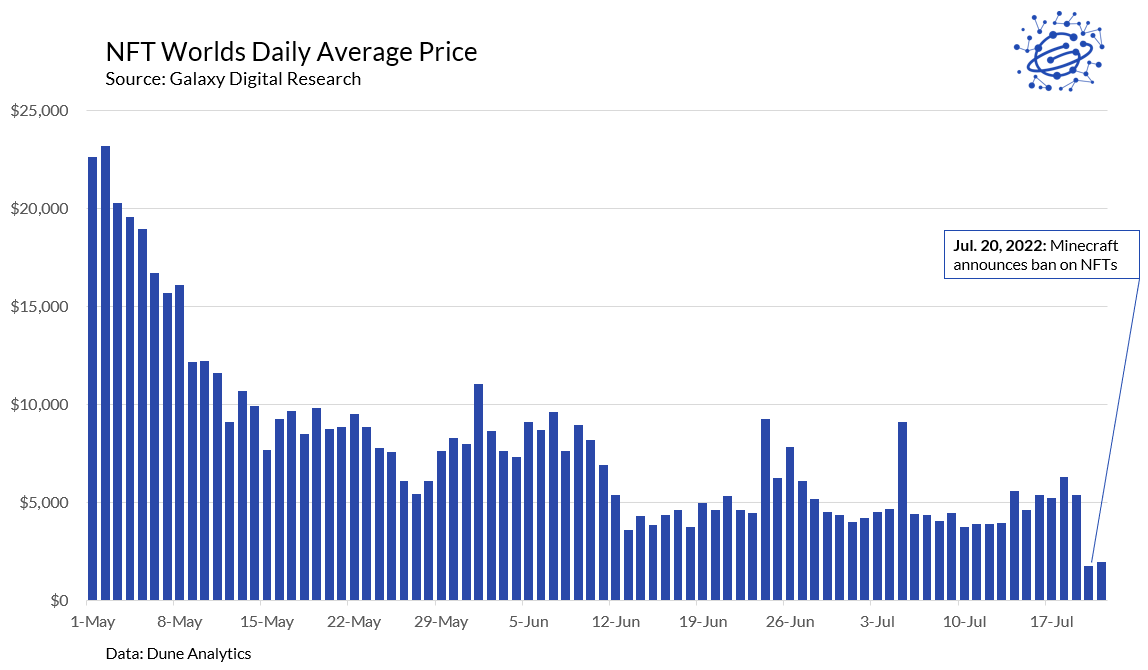
NFT Worlds is a collection of unique Minecraft worlds which traded a floor price of ~3 ETH earlier this week (prior to the announcement). With $80m in total volume, this project has been one of the biggest players in the web3 metaverse space until Minecraft’s announcement banning NFTs. Since the announcement, NFT Worlds’ NFTs fell in floor price by over 70%. While the NFT Worlds community has been in a state of shock and panic, the project’s creators have since proposed two courses of action: 1) that they migrate over to their own Minecraft-like game engine, or 2) pivot to a different GameFi platform. If they pivoted, the implementation of NFT Worlds into a new ecosystem would yield existing NFT Worlds, $WRLD, and Genesis Avatar an equivalent stake in the new ecosystem.
|
|
OUR TAKE: This story, while unfortunate for stakeholders in the NFT Worlds ecosystem, underscores the dangers of tethering a new web3 initiative to a web2 incumbent. Fundamentally, web3 applications can undermine web2 business models, so it is difficult to envision projects that plug into both of these ecosystems succeeding in the long-run. While it may seem shrewd to bootstrap an engaged userbase with an existing web2 platform that already has millions of users, it ultimately leaves the web3 ecosystem vulnerable to the whims of the web2 network upon which the project is built.
The gaming community continues to be skeptical of web3 primitives like NFTs. A study conducted by Fandomspot in April found that 69% of gamers surveyed “hate NFTs” (though only 12% of those same gamers admitted to fully understanding NFTs). Ubisoft, French gaming juggernaut, also witnessed their first NFT collection flop back in April. Based on these past experiences, it’s not surprising that NFTs trigger a knee-jerk reaction in gaming communities today. Minecraft’s ban is effectively channeling this skepticism into formal guidelines in order to protect their existing userbase. We think Microsoft (and by extension Minecraft) is taking a cautious, wait-and-see approach to integrating NFTs and blockchain tech into their existing and forthcoming metaverse products. Clearly, Microsoft has a strong interest in the metaverse trend, evidenced by their $69bn acquisition of Activision-Blizzard. To the extent that Microsoft will eventually get involved with web3, they would likely want ownership of the end-to-end experience. Web2 incumbents typically have plenty of resources to bolt web3 features onto their existing platforms (Twitter already supports PFP NFTs and Meta is working on integrating NFTs into Instagram). The reverse, however, is not true. Building compelling 3d metaverse applications at-scale is orders-of-magnitude more complex than enabling underlying NFT protocols and marketplaces to operate (especially as more protocols emerge to support minting game-friendly NFTs). NFT Worlds needed Minecraft far more than Minecraft needed them.
Epic Games came out on the other side of this debate on Thursday when CEO Tim Sweeny signaled support for third-party NFT and web3 products built on their platform. This stance is in-line with Epic’s ongoing legal battle against Apple and Sweeny’s view that operating systems and application stores shouldn’t force their views onto developers who use their ecosystems for distribution of their products. One interesting trend to watch is the extent to which pure web3 metaverse projects are affected by this news. We suspect that The Sandbox, Decentraland, and Otherside will benefit from new developers flowing to them who may be disillusioned by the mercurial nature of web2’s engagement with web3 technology. -SQ
|
|
🔗 Polygon Open Sources Code for Their First zkEVM Rollup
|
|
On Wednesday, Ethereum scaling project Polygon unveiled the code behind an Ethereum Virtual Machine (EVM)-equivalent zero-knowledge (ZK) rollup. As background, ZK rollups are a specific type of Layer 2 protocol that can batch large quantities of user transactions off-chain and securely prove their validity in a cost-efficient way on the main Ethereum chain. ZK rollups are prized as a scalability solution on Ethereum for their privacy-enhancing characteristics and superior data compression techniques. However, ZK rollups have traditionally only been able to confirm transactions of a specific type, such as transactions that represent peer-to-peer transfers of value or swaps of non-fungible tokens. For computation of general Ethereum-based transactions on most ZK rollups, users are required to learn new coding languages. That is unless the ZK rollup is fully EVM equivalent.
The EVM refers to the engine of Ethereum that processes all smart contract code. An ongoing area of research among Ethereum developers has been to build a ZK rollup where the user experience for executing transactions is near-identical to that of the user experience for executing transactions on Ethereum mainnet. There are three main levels to creating an EVM-equivalent ZK rollup, also called a zkEVM. The first level is equivalence on the language level. This refers to converting an EVM-friendly language such as Solidity into a zk-friendly language such as Starkware’s Cairo language.
The second level of equivalence is on a bytecode level, which means there is equivalence from the machine language level. On Ethereum, Solidity language is automatically converted into a hexadecimal bytecode representation that the EVM can understand. A ZK rollup that can do the same would be able to run all the same transactions on Ethereum without modification or conversion into a different high-level programming language such as Cairo. As a side note, some developers consider zkEVMs that are equivalent on the language level as strictly EVM-compatible and not a full zkEVM.
The third and hardest level of equivalence for ZK rollups to achieve is at the consensus level, which is full EVM-equivalence such that there is no need to translate or recalculate transactions in any capacity from the Ethereum mainnet to the ZK rollup. The zkEVM announced by Polygon on Wednesday targets bytecode-level equivalence. Polygon’s zkEVM implementation has been open sourced on GitHub and will reportedly be ready for a mainnet launch sometime before the end of this year. However, it is not the only zkEVM implementation that was unveiled this week. The Scroll team announced on Tuesday their pre-alpha version of a zkEVM that is bytecode equivalent. In addition, the zkSync team announced on Wednesday a zkEVM implementation that is equivalent on the language level. This implementation will reportedly be ready for mainnet launch in October.
|
|
OUR TAKE: zkEVMs are considered to be the “holy grail” of Ethereum scaling because they marry one of the most efficient and secure techniques for rollups with that of a near identical user experience to that of Ethereum mainnet. However, zkEVMs have long been considered a research objective that would not be ready for production on Ethereum mainnet for at least 1 to 3 years. As such, the explosion of announcements about nearly production ready zkEVM implementations this week has renewed optimism around Ethereum’s scalability roadmap. These three announcements by Polygon, Scroll, and zkSync suggest that the long-term vision for scalability on Ethereum through ZK rollups is not a roadmap based on untested theories but rather working technologies that could be ready for mainnet launch within a couple of months.
The fact that each of these announcements were made less than a day apart from each other highlights the intense competition between different projects to release the first zkEVM implementation on Ethereum. This may be because, outside of minor efficiency gains from one zkEVM implementation to another, the user experience for all zkEVMs should be near identical. They should all in theory replicate the same user experience (UX) as sending a transaction on mainnet Ethereum. In addition, due to the lack of interoperability between different zkEVM implementations, the zkEVM that attracts the highest amount of user and dapp activity will likely be favored over other competitors by nature of the composability that already exists among users and dapps of that specific zkEVM rollup. As such, there is a first-mover advantage to be gained among zkEVM implementations given that all zkEVMs will present to users a near identical experience and an important competitive edge of one zkEVM over another will be dapp adoption. In other words, it could be a winner-take-all scenario.
One common critique of rollup technology in general on Ethereum is a lack of decentralization in regard to the stakeholders that verify and produce proofs of transaction batches, known as sequencers. For background, sequencers are the validators on rollups that verify user transactions and package those transactions into blocks. Provers are another entity that identify blocks generated on a rollup by sequencers and produce a cryptographic proof of all the transactions batched into a single block. On ZK rollups, this proof is then submitted and posted to the main Ethereum blockchain. On optimistic rollups, this proof is only generated when there is a dispute raised against a sequencer for processing an invalid transaction. On most Ethereum rollups, the sequencers and provers are centralized, meaning they are operated by trusted entities such as a protocol’s foundation or core development team.
However, for ZK rollups in specific, one of the primary reasons why sequencers and provers have not been decentralized is because the cryptography for achieving EVM-equivalence had yet to be figured out, meaning the hardware required to run a sequencer and validator was in flux. The process for decentralizing sequencers and provers is not unlike the process for decentralizing a blockchain, for which there are several consensus protocols and algorithms that can be adopted and have already been adopted among Layer-1 blockchains. As such, this critique of rollup technology as lacking decentralization does not appear impossible to overcome, so long as the underlying cryptography for rollups in general is figured out and resolved. -CK
|
|
-
Tesla sells 75% of their BTC holdings, totaling $936 million, leaving them with around 13.4k BTC worth $312 million at the time of writing.
-
An upcoming meeting of the Financial Stability Oversight Council will include discussion of digital assets.
-
Lido, an Ethereum staking service provider, expands to support layer-2 networks.
-
UK regulators introduces new regulation around stablecoins as part of the country’s post-Brexit strategy for competitiveness.
-
OpenSea launches support for first Solana-based NFT.
-
Crypto lender Vauld files for protection from its Singaporean creditors days after suspending withdrawals from its platform.
-
The European Central Bank raises interest rates for the first time in 11 years.
|
|
Access our research on the Bloomberg Terminal with ERH GXY <GO>
|
|
|
|
Crypto & Blockchain Venture Capital - Q2 2022 |
Despite drawdown in crypto markets, venture funding for the crypto and blockchain industry has continued to pour in. Leulaye Maskal breaks down the key trends in crypto & blockchain venture capital in Q2 2022.
|
|
|
|
Ethereum All Core Developers Call #143 Writeup |
Ethereum core developers concluded their 143rd fortnightly Zoom meeting on Thursday, July 21. Christine Kim summarizes the main discussion topics and decisions from the meeting.
|
|
|
|
NFTs & DeFi: A Deep Dive into the Financialization of NFTs |
In this report, Sal Qadir and Kirill Naumov give a comprehensive overview of attempts at financializing nfts as a mechanism to improve pricing, liquidity, and access.
|
|
|
|
Metaverse 101: A Primer and Early Trends |
In this primer, Sal Qadir presents the metaverse as a concept in the most basic terms possible and from three distinct angles: Background & History, Gaming & Web3, and Foundational Pillars.
|
|
|
|
Galaxy Digital Research Podcast |
In this week's episode, we are joined by guest Nic Carter. Nic is a partner at Castle Island Ventures, columnist for CoinDesk, cofounder of Coin Metrics, and host of the On The Brink podcast. We discuss a number of topics including hyperbitcoinization, stablecoins, and the future of Web3.
|
|
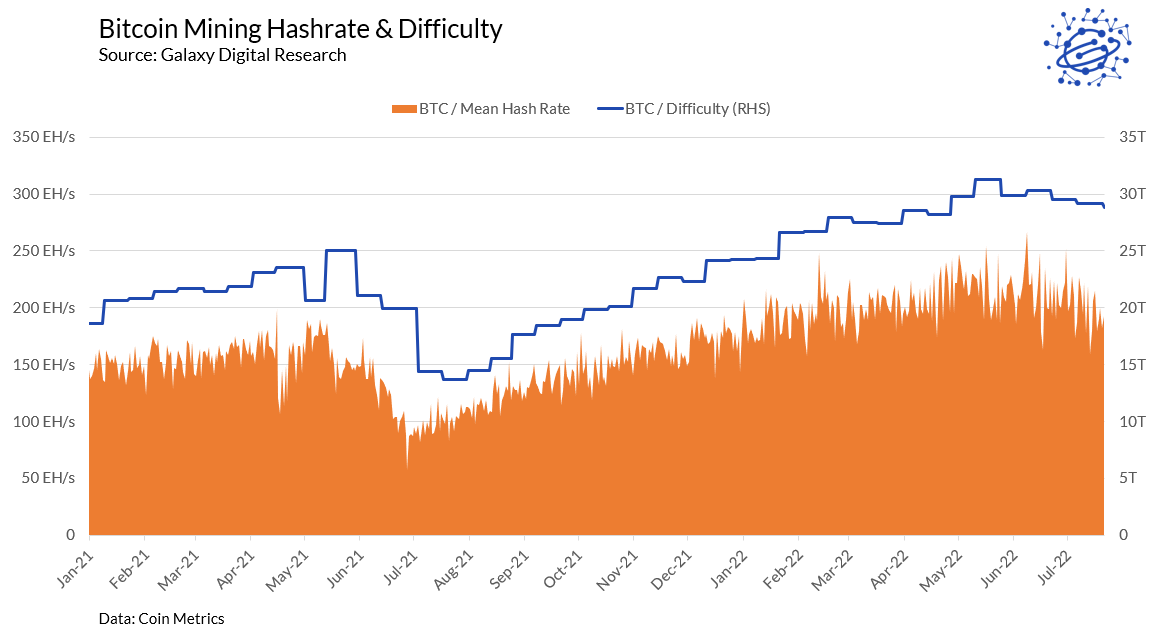
On Thursday, Bitcoin’s mining difficulty dropped by 5.01%, the largest downward individual downward adjustment since July 2021 at the peak of China’s mining ban (when difficulty dropped 27%. As a reminder, the Bitcoin software automatically adjusts the mining difficulty every 2016 blocks (approximately every 2 weeks) to target a 10-minute block time (interval between blocks). When difficulty adjusts downward, it becomes easier for miners to find a block, reducing the block time. Declining difficulty makes miners who remain operational more profitable. |
|
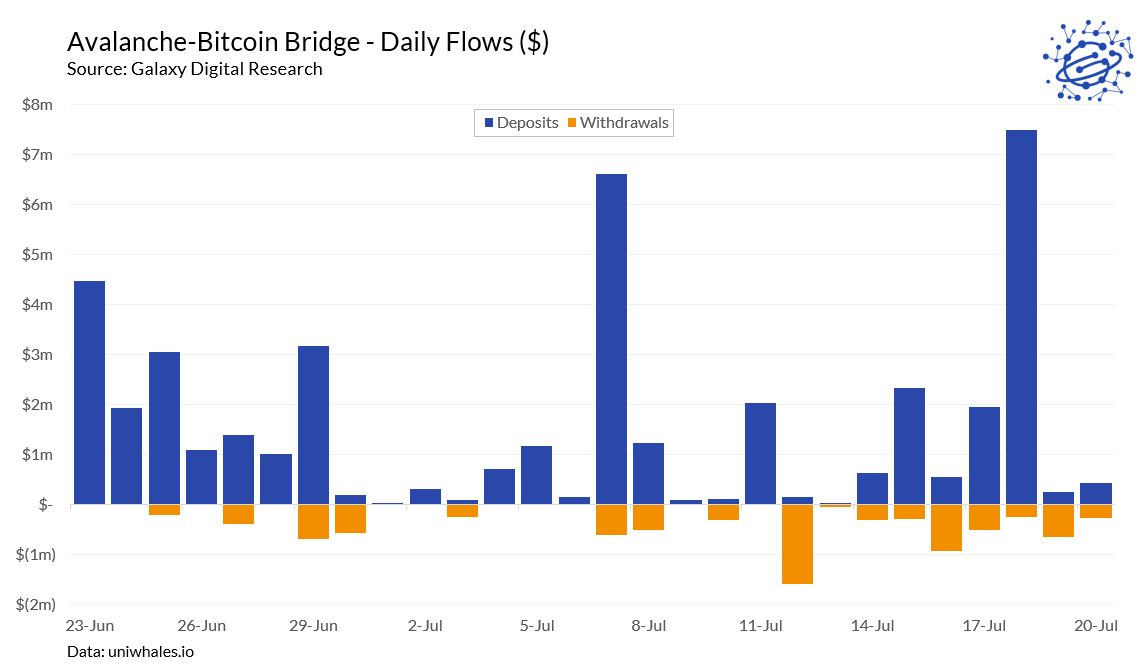
Since launching 1 month ago, Avalanche's Bitcoin Bridge experienced its highest single day of inflows on 7/18 with $7.5m of BTC deposits. To-date, the total dollar amount of bitcoin bridged into Avalanche totals ~$43m. The Avalanche-Bitcoin Bridge enables BTC to be ported over to the Avalanche ecosystem by issuing a tokenized representation of BTC on Avalanche called BTC.b. |
|
Thanks for reading this week. Have a great weekend.
|
|
Alex Thorn
Head of Firmwide Research, Galaxy Digital
|
|
|
Legal Disclosure:
This document, and the information contained herein, has been provided to you by Galaxy Digital Holdings LP and its affiliates (“Galaxy Digital”) solely for informational purposes. This document may not be reproduced or redistributed in whole or in part, in any format, without the express written approval of Galaxy Digital. Neither the information, nor any opinion contained in this document, constitutes an offer to buy or sell, or a solicitation of an offer to buy or sell, any advisory services, securities, futures, options or other financial instruments or to participate in any advisory services or trading strategy. Nothing contained in this document constitutes investment, legal or tax advice. You should make your own investigations and evaluations of the information herein. Any decisions based on information contained in this document are the sole responsibility of the reader. Certain statements in this document reflect Galaxy Digital’s views, estimates, opinions or predictions (which may be based on proprietary models and assumptions, including, in particular, Galaxy Digital’s views on the current and future market for certain digital assets), and there is no guarantee that these views, estimates, opinions or predictions are currently accurate or that they will be ultimately realized. To the extent these assumptions or models are not correct or circumstances change, the actual performance may vary substantially from, and be less than, the estimates included herein. None of Galaxy Digital nor any of its affiliates, shareholders, partners, members, directors, officers, management, employees or representatives makes any representation or warranty, express or implied, as to the accuracy or completeness of any of the information or any other information (whether communicated in written or oral form) transmitted or made available to you. Each of the aforementioned parties expressly disclaims any and all liability relating to or resulting from the use of this information. Certain information contained herein (including financial information) has been obtained from published and non-published sources. Such information has not been independently verified by Galaxy Digital and, Galaxy Digital, does not assume responsibility for the accuracy of such information. Affiliates of Galaxy Digital may have owned or may own investments in some of the digital assets and protocols discussed in this document. Except where otherwise indicated, the information in this document is based on matters as they exist as of the date of preparation and not as of any future date, and will not be updated or otherwise revised to reflect information that subsequently becomes available, or circumstances existing or changes occurring after the date hereof. The foregoing does not constitute a "research report" as defined by FINRA Rule 2241 or a "debt research report" as defined by FINRA Rule 2242 and was not prepared by Galaxy Digital Partners LLC. For all inquiries, please email contact@galaxydigital.io. ©Copyright Galaxy Digital Holdings LP 2022. All rights reserved.
|
|
|
|
|
|
|