|
In this Issue:
- Headlines
- Congress Passes Budget with Farm Bill, Farm Aid, & More
- Update on National Milk Testing Program to Monitor H5N1 in Dairy
- Reminder: Two Relief Programs for Farmers Taking Apps Now
- Upcoming Events
- GMP Classifieds
- SDBII Grants Upcoming in 2025, January Webinar
- A History of a Classic American Christmas Drink
- Register for 2025 GDC
| |
|
Headlines
articles and press releases of interest this week
| Congress Passes Disaster Relief for Farmers, Extends Farm Bill, and Chips in Economic Aid to Boot | |
In the wee small hours of Saturday morning, the US Senate voted 85 to 11 to approve a large piece of legislation that would fund the federal government until March 14, 2025, provide billions in aid to those affected by natural disasters, and contribute $10 billion in economic aid to farmers. Congress had been deliberating the year-end funding measure for weeks and at least three separate versions of the bill were revealed within the last week of the Congressional calendar.
What’s in it for farmers?
-
Disaster aid = $20.78 billion to help producers with disaster losses during the past two years. This will include the hurricanes our readers experienced (Idalia, Debby, Helene, Milton) and events like wildfires out west, excessive heat across most of the U.S., major freeze and flood events, and more. There’s specifically a carve out of $2 billion for livestock producers impacted by drought, wildfire, and flood losses. *Importantly* the assistance can go to the states as block grants and direct compensation to producers. Based on a breakdown shared by Agweb, it appears $18.7 billion has been set aside for disaster assistance more generally, but USDA will pull out funds for mandatory programs and USDA disaster programs first before passing on funds to the individual states via the block grant provision.
- Economic Aid = $10 billion in economic assistance through one-time payments to row crop producers capped at $250,000 for producers who receive 75% or more of their gross income from farming ($125,000 limit for producers who don’t meet the 75% threshold on farm income). The economic aid to farmers is meant to support commodities impacted by lagging commodity prices and sky-high production costs over the past couple of years. Eligible commodities are: barley, corn, cotton, dry peas, grain sorghum, lentils, large chickpeas, oats, peanuts, rice, small chickpeas, soybeans, other oilseeds, and wheat.
- Farm Bill Extension (Part II) - The 2018 Farm Bill has been rolled over again until September 30, 2025 – a full two years after its initial deadline of September 30, 2023. Farm Bill programs like DMC will continue as they have for the past 5 years.
From the Georgia delegation, two members (Clyde and McCormick) voted against the final measure, and two more members (Greene and Ferguson) did not vote. All other members of the congressional delegation supported the bill. Sen. Jon Ossoff remarked in a statement released after the vote, “After Hurricane Michael, it took Congress over 8 months. After Helene, we’ve done it in under 90 days.” That’s no small feat for the legislative branch. After Hurricane Michael in 2018, control of the House of Representatives had flipped to the Democrats following the 2018 midterm elections while the Republicans still maintained the Senate and White House. Relief for farmers did not come until June of 2018.
As of publication, summary and full text of the legislation is still not available on the official Congress.gov website. Details on how disaster and economic aid are implemented are expected in the following weeks.
| |
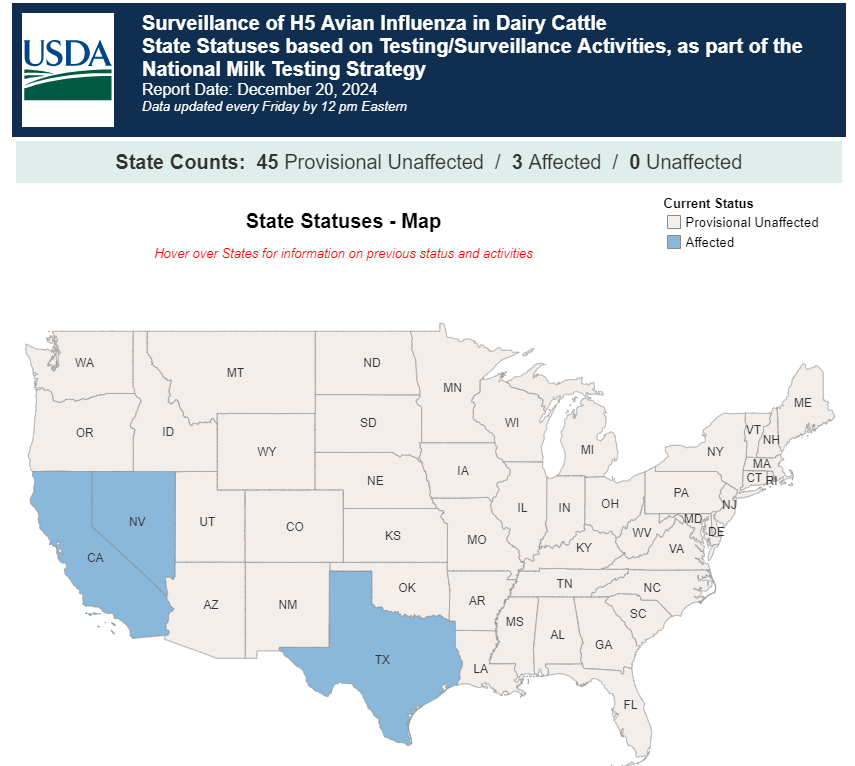
Immediately after our E-News went out last week, USDA announced seven more states will begin testing for H5N1 as part of the agency’s National Milk Testing Strategy. The new states are Indiana, Maryland, Montana, New York, Ohio, Vermont, and Washington.
USDA APHIS has also unveiled its new NMTS tracking page to show the status on a state-by-state level. USDA will show states as provisional unaffected, unaffected, and affected. Provision unaffected means the state is phasing into the national program with no known cases, unaffected means testing and surveillance demonstrate an absence of H5N1 in that state, and affected means the testing has found/continues to find H5N1 in the state.
Resources for Dairy Producers
Information on Assistance for Farmers Affected by H5N1 in Dairy Cattle
USDA HPAI in Dairy Cattle Resource Page
USDA Order on Movement of Lactating Dairy Cattle
USDA Additional Guidance on Movement Order
USDA Movement Order FAQ
Secure Milk Supply Biosecurity Website
UGA Veterinary Diagnostic Lab Email Guidance
To learn more about USDA’s response to HPAI in dairy cattle, visit www.aphis.usda.gov/livestock-poultry-disease/avian/avian-influenza/hpai-detections/livestock.
| Reminder: Two Hurricane Relief Programs Taking Applications From Affected Farmers | |
The Weathered But Strong Hurricane Relief Fund is now taking applications for assistance from farms that experienced damage from Hurricane Helene. The deadline for applications is December 31, 2024 and the goal is for review to take place in January with payouts beginning in February.
Eligibility Requirements:
- Eligible farmers must hold a current valid GATE card number issued through the Georgia Department of Agriculture.
- All farming operations impacted by Hurricane Helene may apply but priority will be given to the counties that make up the disaster declaration.
- Designated Disaster Relief Counties: Appling, Atkinson, Bacon, Ben Hill, Berrien, Brantley, Brooks, Bryan, Bulloch, Burke, Butts, Camden, Candler, Charlton, Chatham, Clinch, Coffee, Colquitt, Columbia, Cook, Dodge, Echols, Effingham, Elbert, Emanuel, Evans, Glascock, Glynn, Hancock, Irwin, Jeff Davis, Jefferson, Jenkins, Johnson, Lanier, Laurens, Liberty, Lincoln, Long, Lowndes, McDuffie, McIntosh, Montgomery, Pierce, Rabun, Richmond, Screven, Stephens, Taliaferro, Tattnall, Telfair, Thomas, Tift, Toombs, Treutlen, Ware, Warren, Washington, Wayne, Wheeler, Wilkes
Farmers can apply for assistance at supportgeorgiafarmers.org/application. If producers have any questions about the application or process, you can email grants@gafoundationag.org or email Bryce (bryce@gamilk.org) with Georgia Milk Producers.
The Weathered But Strong Campaign is also still taking donations as they aim to raise an additional $500,000 before the end of the year. If you would like to support the campaign and Georgia’s ag community, click the “donate” button below.
| |
The Georgia Development Authority is accepting applications for low-interest loans to producers impacted by Hurricane Helene. The SAFETY 24 Program is the successor of the SAFETY 21 program started in the aftermath of Hurricane Michael. See below for details on how to apply:
How to Apply:
-
The application form and additional details can be found online at https://www.gdaonline.com/hurricane-helene-loan-program/
- Applications can be submitted online via email or via regular mail.
- Online applications should be sent to anita@gdaonline.com
- Printed applications should be sent to the below address:
Georgia Development Authority
1890 Highway 130
Monroe, Ga 39655
- Applications must include the following documents to be considered:
- SAFETY 24 Application Form
- SAFETY 24 Product Loss Verification
- This form is to be completed by your crop insurance agent, UGA Extension Service, Farm Service Agency, or a loan specialist.
- Operating Credit Continuity Agreement
- An agreement must be obtained from applicants’ primary operating credit provider stating that the primary operating credit provider will continue financing operating capital for the applicant, after the SAFETY 24 loan closes, for the next year of operation. If the operation does not require credit for operating capital and therefore a letter from a primary operating credit provider is not obtainable, a letter of intent from an entity the farm has a contractual relationship with stating that the entity will continue the contractual relationship with the farm will suffice.
| |
7 Valve Federal Filler for Sale in Hall County (GA) - $30,000
Used mechanical filler for sale. Good Condition. Great for Start-Up Processing Plant. Email gcdairy@gmail.com for more details, photos, and vidoes.
Dairy Farm for Sale in Screven County (GA) -
Green Meadows Dairy for sale. 986 acres (600 irrigated), 60-stall rotary parlor, 1,000 cow feed pad, 8 pivots,
Call Leo Ruijne for more details 806-292-9909 or email leo@unitedagllc.com
| Want to showcase your business to dairy producers and industry professionals across the Southeast and US? Email info@gamilk.org to learn more about how you can advertise in the GMP E-News | |
Upcoming Events
If you have an event that you would like to see added to our GMP Events Calendar, email bryce@gamilk.org
Georgia Dairy Conference
January 20-22
Marriott Savannah Riverfront - Savannah, GA
Register Today! Click HERE
| |
SDBII Grant Opportunities for 2025 | |
|
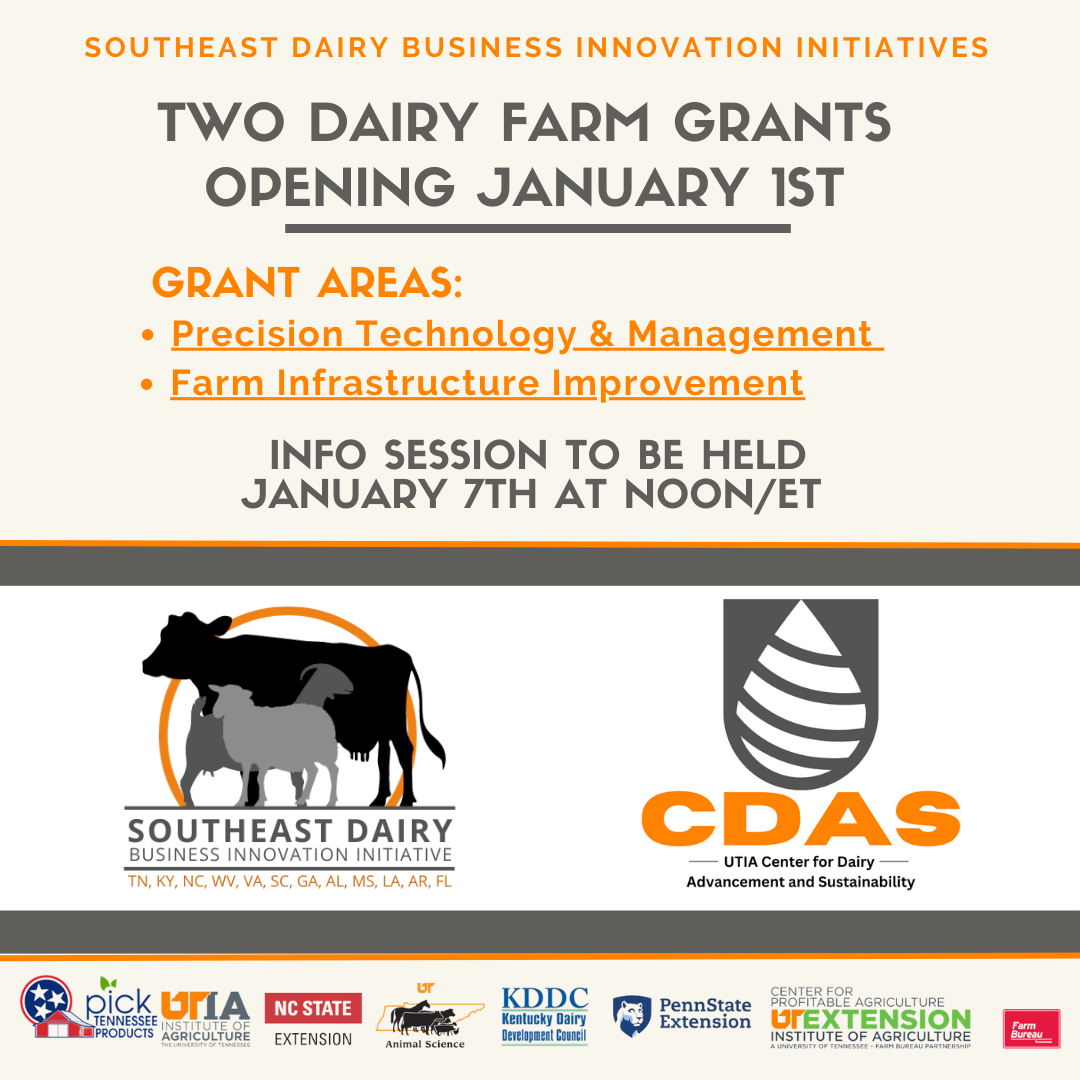
Two grants from the Southeast Dairy Business Innovation Initiative are opening on January 1st:
Farm Infrastructure Improvement Grant
Applications open January 1st and close March 5th. The Farm Infrastructure Improvement Grant will provide funds for projects that increase milking parlor throughput to reduce labor costs, improve animal comfort to increase production, and facilitate milk marketing efficiencies by expanding storage and ease of transportation of raw milk. Applicants may apply for up to $100,000 in funding and must provide a cash match of 25% of the requested amount in eligible expenses.
https://sdbii.tennessee.edu/farm-infrastructure-improvement-grant/
Precision Technology and Management Grant
Applications open January 1st and close March 5th. The Precision Technology & Management Grant will support the utilization of new and existing technologies that help farmers track and manage key farm metrics to maximize the impact of inputs like labor, feed, and fertilizer and improve farm efficiency. Applicants may apply for up to $150,000 in funding and must provide a cash match of 25% on this grant as well of the requested amount in eligible expenses.
https://sdbii.tennessee.edu/precision-technology-and-management-grant/
Both grants are open to active dairy businesses in Alabama, Arkansas, Florida, Georgia, Kentucky, Louisiana, Mississippi, North Carolina, South Carolina, Tennessee, Virginia, West Virginia, and Puerto Rico.
Register for an information session on both SDBII Dairy Farm Grants HERE. The session will be held Thursday, January 7th, from noon-1pm/ET via Zoom.
| |
The Uniquely American History of Eggnog, Everyone's Favorite - or Least Favorite - Holiday Quaff
| |
The following is an article from Smithsonian Magazine's Taryn White originally published to Smithsonianmag.com in December 2023.
In early 1815, distinguished representatives from the United States and Britain gathered in Belgium to ratify the treaty that ended the War of 1812. To celebrate the success of the peace talks, Massachusetts’ Pittsfield Sun reported, President James Madison’s stepson and secretary, John Payne Todd, “invited some gentlemen from his country and some others, to partake of a liquor with which the Americans used to treat their friends on Christmas Day.” That drink was already an American staple: eggnog.
The creamy, spiced beverage is believed to have originated in medieval Britain as “posset,” a comforting mixture of hot milk or cream, wine or ale, and spices. In the 13th century, some monks even began adding whipped eggs and figs to their possets—but the scarcity of the more expensive ingredients, including eggs and sherry, made this proto-eggnog a luxury reserved mainly for the British elite.
When the beloved drink crossed continents to North America in the mid-1700s, it became known as “egg-n-grog,” a term derived from the Scottish and Gaelic word noggin, which means cup, and grog, an English term for hard booze, often rum. The American colonists soon shortened that to “eggnog,” a term that first appeared in a poem by Maryland minister Jonathan Boucher around 1774.
George Washington was known to serve his own version to guests at Mount Vernon. The drink even once sparked a riot at the United States Military Academy at West Point in 1826, when campus staff intervened after cadets, possibly including a young Jefferson Davis, served eggnog at a boisterous Christmas party despite the school’s ban on alcohol. The drink’s wintry spices, and the preference for serving it hot, made nog a Yuletide mainstay.
As milk, eggs, sugar and rum became more affordable and abundant, eggnog became accessible to everyday Americans. Today, people around the world enjoy it, often putting regional spins on the recipe. Versions include Puerto Rican coquito, which contains coconut milk or cream, and Mexican rompope, which uses egg yolks and a few pinches of baking soda.
Despite its origins, eggnog has not always been widely loved in Britain. One contributor to its decline there is another hot beverage—tea, which took the country by storm in the 17th century, when the East India Company began importing it in large quantities. And while eggnog isn’t universally loved in the U.S.—some Americans loathe it—we nonetheless consume more than 15 million gallons of eggnog annually. That works out to around 240 million cups of eggnog each year—enough to ensure that every adult American can enjoy a seasonal tipple.
| Don't Forget to Register for the 2025 Georgia Dairy Conference | |
There's still time to register for the 2025 Georgia Dairy Conference. This year's lineup of speakers includes experts on dairy management, markets, medicine, and promotion. We're also bringing back the very popular Pre-Conference Symposium to focus on "New Developments in Dairy" on Monday morning, January 20.
To learn more about this year's conference, the full agenda, and how you can register or sponsor, check out the links below!
| |
|
Until Next Time,
Bryce Trotter
| | | | |