View as Webpage

GO! Bulletin

Legislative session in Oregon is now underway!

Support Developmental Disabilities Funding Priorities!

The Oregon Developmental Disabilities Coalition agreed to the following funding priorities for the 2025 Legislative Session, and we call upon our community members to stand with us in advocating for these key priorities.


To support the funding priorities listed below, contact your local legislator or the Ways and Means Joint Sub-Committee on Human Services:

      Click Here to Find Your Legislator      
Click Here to Contact the Ways and Means Joint Sub-Committee on Human Services
 

Funding Priorities

Case Management Entities: People receiving disability-related services depend on brokerage and case management entities to connect them to direct supports that they need. Fully funded brokerage and case

management entities:


  • In 2023-2025, the Legislature funded only 86% of the estimated costs if the state itself provided IDD case management.


  • For the next biennium, the state should fund 100% of the updated cost estimates that will be finalized in April.


  • We ask Legislative leaders to consider the current budget figures as placeholders, and plan for those numbers to increase as we account for people served and work provided.

Direct Support Professionals: FULLY FUND THE RATE AND WAGE  STUDY RECOMMENDATIONS. And at a minimum, to ensure community provider organizations and their workers don’t fall further behind, targeted investments are needed:


  • Ensure a minimum wage for all Direct Support Professionals (DSPs) of $25 per hour.


  • Tie wages and benefits in community provider rate models to an annual inflator so when costs and wages go up so does this payment.


  • Provide longevity pay to reward those Direct Support Professionals and Managers that have stayed in the IDD system.

Existing Family Networks: The State of Oregon recognizes

Regional Family Networks as a core service and a cornerstone of support to thousands of Oregon families who include children with disabilities. Family Networks provide a safety net of supports to strengthen families and communities:


  • Regional Family Networks consist of 6 organizations that operate 8 networks, providing support across 20 counties in Oregon and serving 76% of the state’s population.


  • Regional Family Networks are funded solely through the Oregon Legislature. In order to fully fund their current service level, we are requesting a $3.5 million allocation in the ODHS 2025-27 biennium budget for Regional Family Networks.


  • Regional Family Networks have been under-resourced for many years, and the number of families who seek peer-delivered supports and service navigation continues to grow.

Expanding Self-Advocacy and Family Networks: The Governor's Recommended Budget includes an additional $600,000 in funding that we support to expand Self-Advocacy and Region Family Networks throughout the state:


  • Self-Advocacy and peer support networks are vital to individuals with I/DD and the entire service delivery system by providing opportunities for more community engagement, informed system change, and representation by those with lived experience.


  • Funds will allow for expansion of Regional Family Networks in some areas not currently reached—which will allow more individuals with I/DD, their families, and communities to be supported.
 

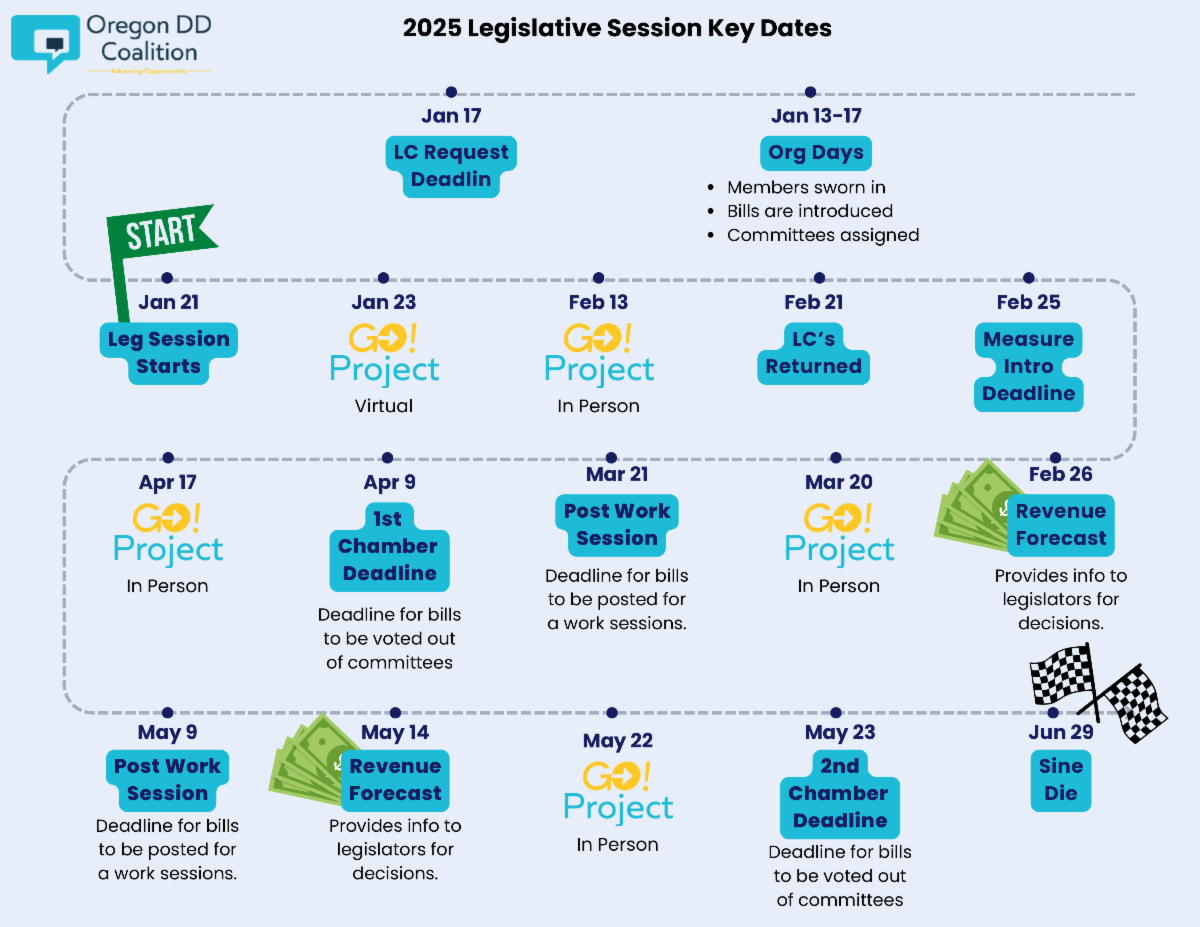
2025 Legislative Session Key Dates

Two key dates for the 2025 legislative session are fast approaching:


Tuesday, February 25 - deadline to introduce newly proposed legislation.


Wednesday, February 26 at 8am - One day later the Oregon Department of Revenue and the Legislative Revenue Office will

issue a forecast of projected General Fund revenue. This forecast is scheduled to be presented during a meeting of the Senate Committee on Finance and Revenue.


Click here to view the Committee agenda where you will find a link to a live video feed on the day of the work session.


Click to view image larger


Policy Bill Updates

Here is an update on some policy bills that the DD Coalition is tracking (the DD Coalition has not taken a position on a bill unless otherwise noted):


Senate Bill 422 directs DHS to implement a pilot stabilization program to reduce disruptions in placement and identify long-term solutions to better serve individuals with intellectual or developmental disabilities, including individuals who experience co-occurring diagnoses.


A public hearing is scheduled for Thursday, 2/27 at 8am in the Senate Committee on Human Services.


Click here to register to testify or submit written testimony.

House Bill 2163 updates Oregon’s fish and wildlife laws to allow accommodations for persons who obtain verification from a medical professional that they are a person with an intellectual or developmental disability and that the symptoms of their disability prevent them from using things like rods, reels, clam guns, shovels, and other equipment used for fishing and shellfish harvesting. As a result, people with I/DD may qualify to have others assist them when participating in angling and shellfish harvesting activities similar to how individuals with certain physical disabilities may benefit from assistance.


Following a public hearing on January 29th for which several Coalition members submitted testimony, a work session was held with a “do pass” recommendation.


The legislation had its third reading on February 18th on the House floor where it passed unanimously!


The bill moves to the Senate Committee on Natural Resources and Wildlife for further consideration.


Click here to view all the testimony submitted on the bill

Senate Bill 550 proposes modifications to existing laws in order to facilitate the repair and maintenance of assistive technology or complex rehabilitation technology. SB 550 would expand Oregon’s current right to repair law to require manufacturers to provide necessary resources—from parts and tools to embedded software and essential documentation—to both wheelchair owners and independent repair providers.


The House Committee on Energy and Environment held a

public hearing on SB 550 on February 3rd for which several Coalition members submitted testimony. A work session was held with a “do pass” recommendation on February 18th.


The bill also had its third reading on the Senate floor on February 20th, where Senators voted to pass the legislation.


The bill moves on to the House chamber for further consideration.


Click here to view all the testimony submitted on the bill.

Senate Bill 136 authorizes the Department of Human Services to revoke a license, certificate, or endorsement of a provider of community-based services to individuals with intellectual and developmental disabilities if the department deems the provider unqualified.


The DD Coalition submitted testimony directly to members of the Senate Committee on Human Services in advance of an upcoming work session.


Click here to view the DD Coalition’s testimony on the bill.


The work session is scheduled for Thursday, February 27th at 8am.


Click here to view the Committee agenda where you will find a link to a live video feed on the day of the work session.

A Special Education Trifecta of bills (3 Bills) had public hearings on February 17th and work sessions held on February 19th in front of the House Committee on Education. During those work sessions Committee members voted to approve the bills to be sent to the House floor for further consideration.


Click here to view and listen to the work session discussion.


House Bill 2953 removes the percentage cap on the amount of funds that are distributed from the State School Fund to school districts for students eligible for special education as a child with a disability.


The elimination of the cap would make more resources

available to local school districts. It does not guarantee that those funds will be used specifically to improve education services for students with disabilities.


There are a number of other bills that have been introduced on the subject this legislative session addressing the cap including HB 3152, HB 2587, and SB 317. These other bills—some of which have different approaches such as SB 317 that increases the cap gradually over three biennia or funding cycles—have not yet been scheduled for a public hearing.


HB 2448 increases the amount of money transferred each year by the Department of Education from the State School Fund to the High-Cost Disability Account that covers costs for those whose special education expenses exceed $30,000 annually. Only about 40% of the costs for students whose special education expenses exceed that amount are covered by the Account.


The legislation would increase the annual amount transferred into the Account from $55 million to $130 million.


A couple of DD Coalition members submitted written testimony on the bill.


Click here to view all the testimony submitted on the bill.


HB 2682 establishes an advisory committee to study and develop recommendations to modernize the adequate service levels for early intervention and early childhood special education.


DD Coalition members submitted testimony on the bill.


Click here to view all the testimony submitted on the bill.


Also, the Children’s Institute submitted a report on behalf of the Alliance for Early Intervention that outlines several recommendations to improve the funding model to be considered.


Click here to read the report on “Early Intervention and Early Childhood Special Education Funding Recommendations for 2025-2027 Biennium.”

HB 5025 appropriates funds to the Oregon Health Authority

(OHA). Several Regional Family Networks who are DD Coalition members benefit from Public Health Modernization funding through OHA.


A public hearing on the budget bill was held on February 19th for which community partners submitted testimony recommending an additional overall investment of $25 million toward Modernization, whereas the Governor’s recommended budget proposes $2 million. Examples of public health work carried out with Modernization funds include providing accessible emergency preparedness information to people with developmental disabilities and their families and support workers.


Click here to view all the testimony submitted on the bill.

2025 DD Advocacy Days

Please join us in advocacy during the 2025 Legislative Session

The Oregon Developmental Disability Coalition’s


GO! Project Advocacy Team


will be available to give you information, training, and support.


Thursdays 10AM to 2PM

March 20, April 17, May 22 and June 12


Oregon State Library

Room 102 & 103

250 Winter Street NE Salem


Register at https://forms.office.com/r/kHKXeJJa79


Click for more information
Haga clic para obtener más información

Advocacy Tools

If you are interested in specific legislative topics, this video goes through each step to help you find where bills are in the legislative process and how to sign up for email alerts to get updates directly.


For additional advocacy tools, visit the GO Project's You Tube Channel legislative advocacy videos created by our GO! Advocacy Team.

 
About the Oregon DD Coalition
The Oregon DD Coalition advocates for DD services on behalf of and with people with intellectual and developmental disabilities, their families, and support organizations in Oregon.

We influence DD service and community support systems and legislation by communicating with a common, consistent voice – creating better opportunities for Oregonians with intellectual and developmental disabilities.

Interested in signing up for the GO! Bulletin or
becoming a member of the Oregon DD Coalition?
Sign Up For the GO! Bulletin
 
Become An Oregon DD Coalition Member
 
 1775 32nd Place, Suite F, Salem OR 97301
CONNECT WITH US
Facebook