|
Corneal GP Lens Care
Digital rubbing is critical to success, removing almost all surface debris, which should then be rinsed off making the disinfection process more effective.
She described the non-abrasive and abrasive cleaners. The latter is not recommended with lenses that have a surface coating. However, she described several extra-strength cleaners that would be effective.
According to the US Food and Drug Administration, contact lenses should not be exposed to any water: tap, bottled, distilled, lake, or ocean. Rinsing salines include:
1. Multidose preserved
2. Multidose non-preserved: potential for contamination
3. Aerosol
4. Unit Dose: expensive, tendency to under-rinse
There are numerous GP multi-purpose solutions, but it is still important to advise patients to digitally rub and rinse. This is not the best regimen for heavy depositors who could benefit from having a separate cleaner for cleaning. Menicon has both a daily multipurpose solution along with a biweekly intensive cleaner (Progent) which is also available for home use. The use of Hydrogen Peroxide is also recommended for it’s cleaning action.
In-office disinfection of multi-use contact lenses. The AAO Cornea, Contact Lenses & Refractive Technologies Section in combination with the AOA Contact Lens and Cornea Section (with input from the GPLI and CLMA) developed a laminated card with a nomogram on proper in-office disinfection of soft and GP lenses that can be on display in the office contact lens room. This is available under printed materials at www.gpli.info.
To disinfect the storage vials, fill the vial with hydrogen peroxide. Invert and shake vigorously to disinfect the cap. It should soak for three hours, and the peroxide is then discarded and the vial rinsed with saline or MPS.
Contact lenses should be discarded immediately if used on patients with:
1. Hepatitis
2. HIV
3. Prion disease
4. Ocular herpes infection
5. Adenovirus
6. Acanthamoeba
Scleral Lens Care
Clean manually with a daily cleaner suitable for GP lenses (if no Hydra-PEG coating), rinse with saline, and disinfect with GP conditioning/disinfecting solution. If they have sensitive eyes, they can rinse with non-preserved saline prior to insertion and/or use hydrogen peroxide with a digital rub.
Larger Lens Cases. Dr. Gromacki mentioned a few companies that make larger than average cases that would be compatible with scleral lenses.
The Tangible Hydra-PEG encapsulated surface coating is recommended for scleral lenses, especially for heavy depositors. It is available in most materials. Multipurpose solutions or hydrogen peroxide is recommended for use with Hydra-PEG lenses. Not recommended for use with Hydra-PEG includes daily cleaning with abrasive or alcohol-based cleaners, PROGENT, surface polishing, and tap water. Tangible Science has recently introduced a monthly refurbishing of the coating, Tangible Boost, which is a prescription-only product.
Filling solutions for scleral lenses include LacriPure (Menicon), ScleralFil (B+L), Nutrifill (Contamac), and VibrantVue Scleral Saline (Visionary Optics, ABB).
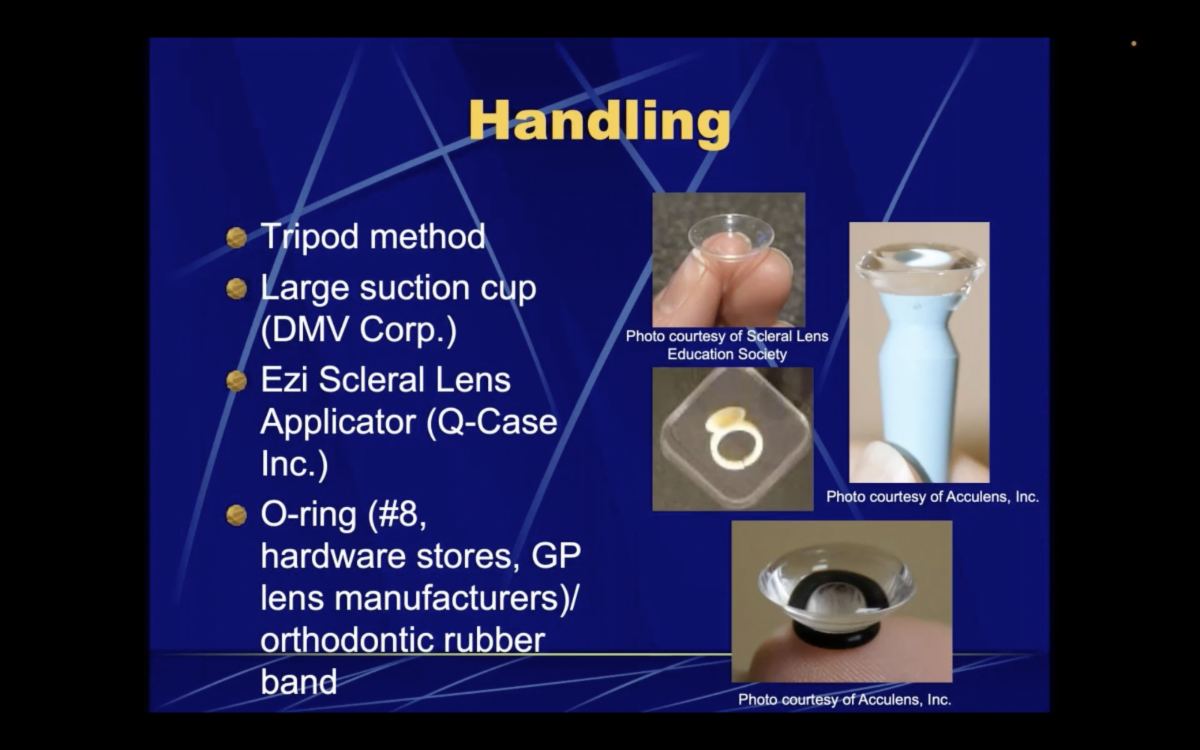
Handling. Methods to insert scleral lenses include:
1. Tripod (three finger)
2. Large suction cup (DMV Corp.)
3. Ezi Scleral Lens Applicator (Q-Case Inc.)
4. O-ring #8 (available from hardware stores)
A beneficial scleral lens patient care resource is: “Healthy Scleral Contact Lens Habits” which can be downloaded HERE.
|