|
CONTACTS
GP Lens Institute Newsletter | Feb 24, 2023
| |
This newsletter is kindly sponsored by: | |
|
This past Tuesday night was very significant as we hosted our first member-exclusive webinar with complimentary COPE continuing education credit entitled “Advancements in Scleral Lenses” from renown scleral lens innovator, clinician, author, and lecturer, Dr. Greg DeNaeyer. Dr. DeNaeyer is an Advisory Board member, past GP Practitioner of the Year recipient from the GP Lens Institute, past founder and president of the Scleral Lens Education Society, as well as their Scleral Lens Practitioner of the Year. As expected, his webinar emphasized how you can optimize scleral lens success in 2023 using the technology available to us. It also represented the beginning of a program that has been several years in the making and that is, of course, our GPLI Membership program. This program has 13 benefits associated with it including free COPE continuing education webinars, podcasts, access to an entire library of specialty contact lens presentations given at our annual Cornea and Contact Lens Residents Symposium, an online specialty contact lens clinically-based journal, access to both our coding and billing and staff modules, access to all archived webinars, free printed materials, and many more. We have almost 450 members to date and growing every day.
| | |
SPOTLIGHT ON EDUCATION:
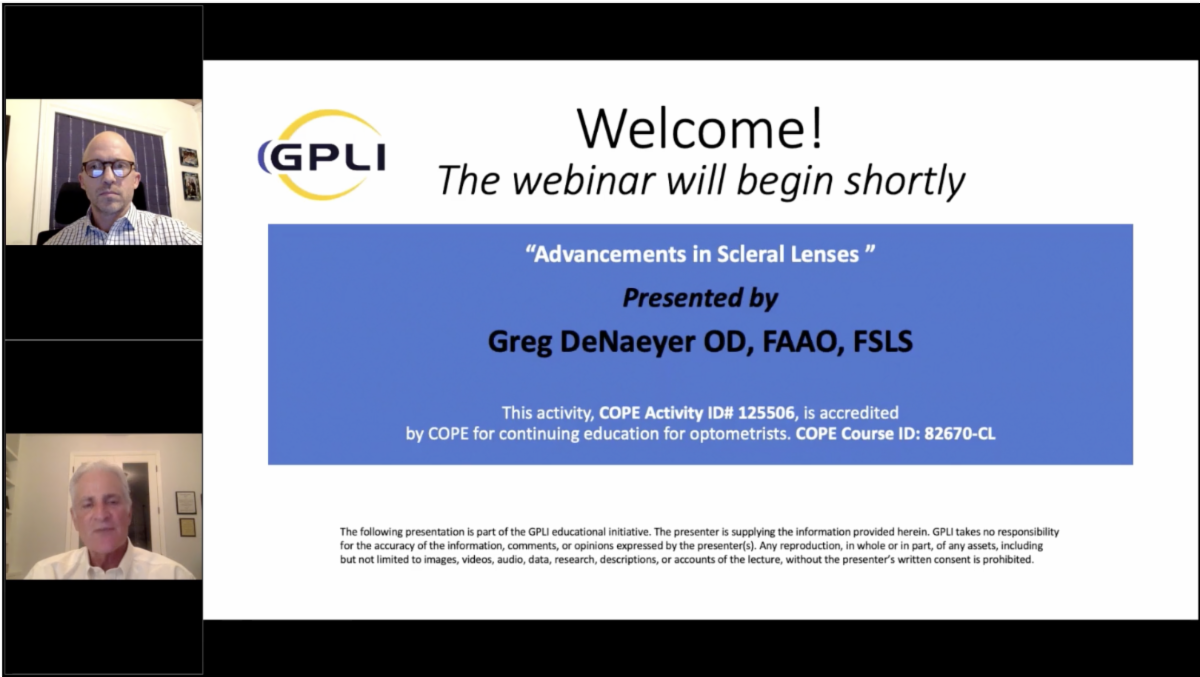
"Advancements in Scleral Lenses"
Dr. Greg DeNaeyer
|  | |
These four areas were addressed:
Advancements in scleral lens materials and clinical implications
- Importance of optimizing oxygen due to the sealed fit and potential hypoxia
- Results of studies of predicting what Dk values, center thickness (keep to a minimum), and tear reservoir would optimize oxygen transmission. A minimal Dk of 150 was recommended and there are several materials available today that meet this criterion and perform quite well. Minimizing the tear fluid reservoir can be quite effective in minimizing hypoxia.
Advances in surface treatments of scleral lenses and their clinical implications
- This began with plasma treatment but has progressed to Hydra-PEG. He recommends having a treatment/coating for all scleral lenses. There is a Boost treatment available on a monthly basis to maintain the surface coating and wettability. He presented a number of cases and a very pertinent one was a graft-versus-host-disease patient who was not successful until Hydra-PEG was used. He did mention that, on occasion, a patient would prefer a non-Hydra-PEG lens as they feel the coating interferes with the optics and impacts vision. He recommends if they are a current scleral lens wearer and doing well to not add the coating. However, for all new scleral lens patients, notably those with ocular surface disease, to utilize Hydra-PEG.
Advancements in scleral measurement and software for fitting scleral lenses. He discussed the benefits and applications with scleral lenses of using:
- Topography
- Optical Coherence Tomography
- Scheimpflug Tomography
- Corneo-Scleral Topography: this is particularly beneficial for both obtaining good scleral lens shape information and designing lenses based on this information.
The utilization of using the most advanced technology for scleral assessment has the benefits of empirical fitting, better alignment of lens-to-sclera - optimizing first-fit success - and reducing the number of lenses typically needed as compared to fitting diagnostically. The decision to utilize toric lens optics can be made quite easy and the design can accommodate pterygia and other scleral surface challenges.
Advances in optical correction and clinical implications.
- Higher order aberrations. Important to correct in keratoconus due to back surface irregularity and much of the high order aberrations are positive coma. Need to use a lens that is rotationally stable and then measure the lens with an aberrometer and this information is analyzed and used in the redesign of the lens to determine the front surface correction to correct for the residual high order aberrations. He presented an example in which the vision improved from 20/50 to 20/25 with a corrected lens versus a standard scleral design.
- Multifocal Designs. They are simultaneous designs due to lack of translation with the blink. That said, with the ability to use the same wavefront technology with multifocal lenses as spherical designs, in combination with the ability to decenter the optics, can result in good visual performance.
- Prism – up to 4 - 5D – can be added in each quadrant.
| |
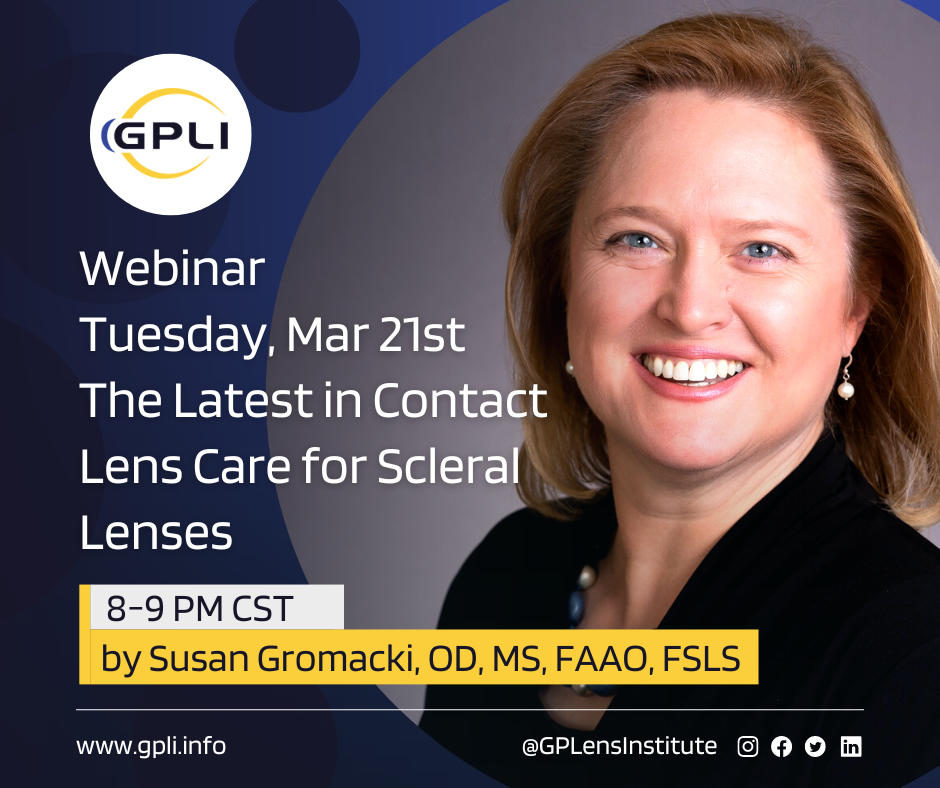
"The Latest in Contact Lens Care for Scleral Lenses"
Susan Gromacki, OD, MS, FAAO, FSLS
Tuesday, March 21st • 8 PM Central
REGISTER NOW
| SPOTLIGHT ON BONUS WEBINAR | |
"Specialty Contact Lens Coding and Billing Update"
Clarke Newman, OD, FAAO, FBCLA, FSLS, FNAP
Tuesday, April 4th • 8 PM Central
REGISTER NOW
As a result of changes in third party groups, GPLI coding and billing module coordinator, Dr. Clarke Newman, volunteered to present a bonus webinar, open to everyone, on the topic of Specialty Contact Lens Coding and Billing Update.” For anyone desiring to feel confident in coding and billing appropriately for their specialty lens patients in 2023, as well as have their questions answered, this is a “Must See” presentation.
| |
SPOTLIGHT ON RESOURCES:
Sclerals
| 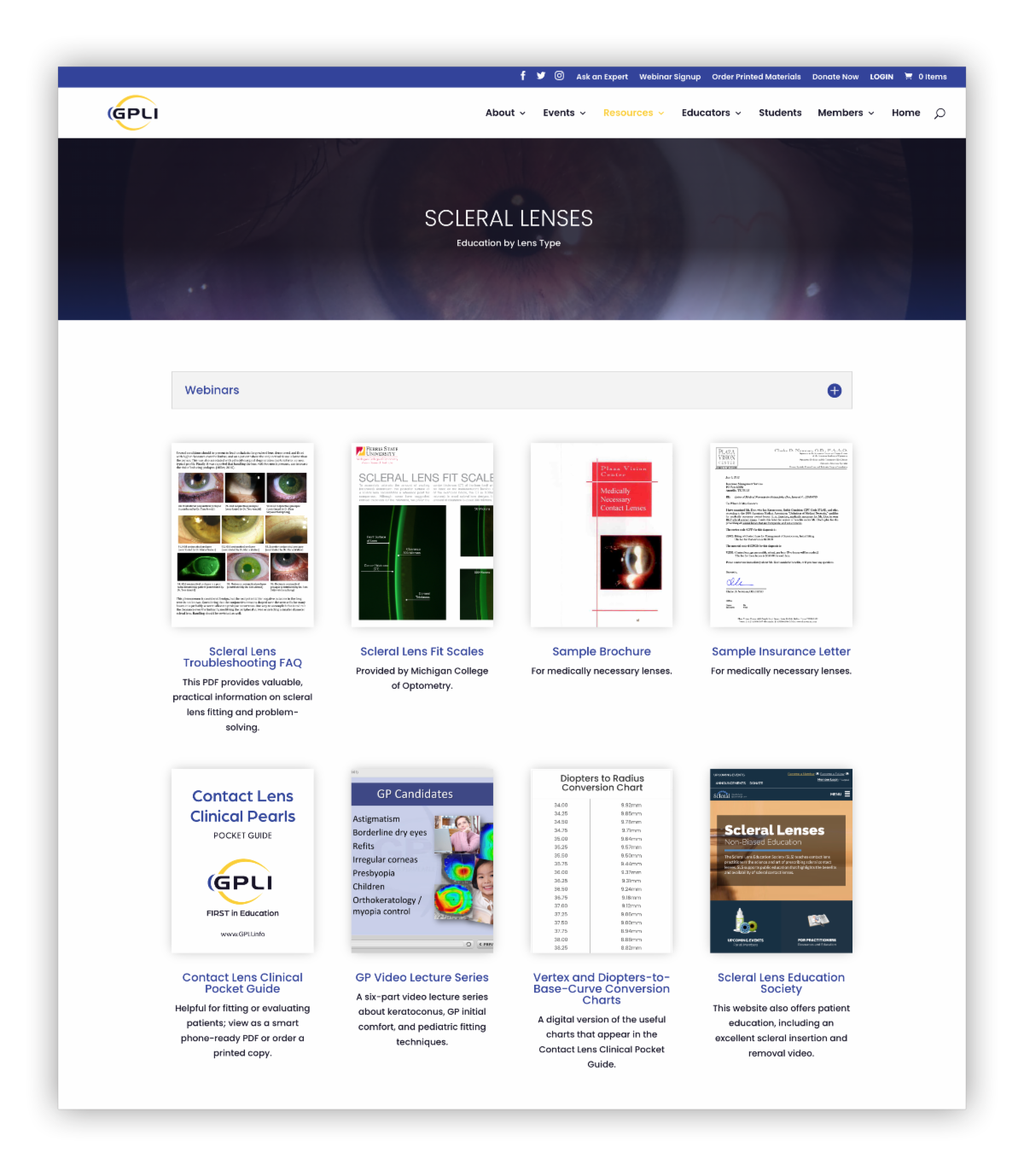 | |
Consistent with the theme of scleral lenses, the GP Lens Institute has a number of resources and programs including the following:
Scleral Lens Troubleshooting FAQs. This is a well-illustrated mini-book on scleral lens applications, design, fitting, troubleshooting, and care. This is a downloadable pdf which was developed with the Scleral Lens Education Society. You can obtain a hard copy courtesy of Visionary Lens by contacting Cindy Belliveau at Cindy.B@visionarylens.com.
GP Lens Case Grand Rounds Troubleshooting. This online text has an entire section of unique cases successfully managed with scleral lenses.
Archived Webinars (for members). Over 25 webinars pertaining to scleral lenses are included in our library.
Printed Materials (free to members). This includes a scleral lens consumer brochure and an illustrated laminated card on scleral lens handling tips.
Of course, the Scleral Lens Education Society website is always a good resource for online scleral lens education.
| |
We have almost 3000 GP specialists with their area(s) of specialty listed to assist you when you need to refer a patient or for patients looking for a GP specialist, as this resource is also available on our consumer site: contactlenses.org.
If you are interested in signing up to be a referral GP lens practitioner, you can do so here.
Specialties Include:
General GP Contact Lenses
Bifocal/Multifocal Contact Lenses
Contact Lenses for Irregular Corneas
Corneal Reshaping / Orthokeratology
Scleral Lens Designs
| Become a Specialty Contact Lens Externship Site | The GPLI is supporting an enhanced student and doctor experience by helping establish new externship sites focused on specialty contact lenses. Find resources such as webinars and digital access to practice advice for efficient and successful integration and mentorship. This can be a rewarding experience for doctors, students, and patients. | Make a Contribution to the GPLI | Your generosity is appreciated and helps the entire eye care community! | | |
|
Registration is open! Don't miss out on the many benefits our members will receive for a low annual cost. Your membership also supports the ongoing efforts of the GP Lens Institute.
The next few months will include a number of member programs including the following:
- Early March: GPLI Radio (podcast) with Dr. Tom Quinn on the topic of myopia management with guest expert Dr. Jeff Walline.
-
April issue of The Advisor will focus on the contact lens management of the irregular cornea. If you have not done so please check out the February issue, currently online, pertaining to myopia management and contact lenses. This includes brief clinical articles pertaining to “The Case for Myopia Management,” “Orthokeratology for Myopia Management,” “Multifocal Contact Lenses for Myopia Management,” and “Combination Therapy for Myopia Management.” The journal co-editors are Drs. Jennifer Harthan and Melanie Frogozo, the managing editor is Dr. Tom Quinn, and Beth Anderzhon is in charge of graphics and design.
-
Our next COPE continuing education webinar will also pertain to myopia management, to be presented by Dr. Jeff Walline on April 18th. REGISTER NOW
|  | |
|
Edward S. Bennett, OD, MSEd, FAAO, FSLS
Professor Emeritus, University of Missouri St Louis College of Optometry
President and Executive Director, GP Lens Institute (GPLI)
The Gas Permeable Lens Institute is dedicated to providing eyecare professionals with unbiased educational and practice-building resources highlighting GP and custom manufactured soft contact lenses.
Please support the educational opportunities provided by the GP Lens Institute. We will continue to support all ECPs, staff and your patients. Be kind, respectful and find happiness within yourself!!
| | |
Thank you again to our newsletter sponsors | |
GP Lens Institute | www.GPLI.info | (402) 465-4122 | (800) 344-9060 (US & Canada) | | | | |