ANAE Registration now open! Chicago, Ill. July 16-18, 2018
Sign up today!
A few of the committed speakers:
- John Horne, OSF Healthcare
- George Hersch, Norton Healthcare
- Tom Lubotsky, Advocate Healthcare
- Gary Fennessy, Northwestern
- Travis Heider, Pandion Optimization Alliance (formerly Seagate Alliance)
Enjoy back issues of National Accounts Weekly by clicking
here
Please share with your colleagues!
|
|
|
|
GPO vs. IDN: What’s the Best Sales Strategy for Your Product?
|
Check out this great article by Ken Murawski of Healthcare Links. It really gets to the core of the best strategy depending on what your product is.
Years ago, hospitals joined GPOs in order to help them negotiate the best prices based on large membership associations. As IDNs evolved, they reduced the number of staff needed to negotiate these contracts on their own. The model grew quickly as the GPOs wisely shared back a portion of the administrative fees with the health system administration of their more compliant members.
As you can imagine, when the CEO received a large check from their GPO, the next call went down to materials management suggesting, “how can we buy more from our GPO?” (and thus get bigger checks).
|
|
|
|
62 Percent of Decision Makers at Hospitals said they Support Amazon’s Entrance into the Market
|
A new survey released delves deep into what hospitals think of Amazon.
Most hospital executives also told researchers that they believe Amazon will have a positive impact on the healthcare market overall, while only 10 percent said they predict that impact will be a negative one. Three-quarters predict Amazon will be successful in this initiative.
When it comes to what supplies the platform would provide to hospitals, nearly half said they hope to see commodities sold on Amazon; fewer than 10 percent said the platform should focus on surgical supply sales, pharmaceuticals, or IV solutions, reports said.
|
|
Free Download of the Top 25 Physician Groups in the US
|
Definitive Healthcare has put together two lists of the Top 25 Physician Groups in the U.S:
- Top 25 Physician Groups by number of Physicians
- Top 25 Physician Groups by Medicare Charges
Here are some interesting facts about each list by the numbers.
Top 25 Physician Groups by number of Physicians
- The top Group has 8,711 Physicians
- The 25th Group has 2,042 Physicians
- 9 of the Top 25 are part of an Academic system
- 23 of the 25 are Internal Medicine or Family Practice Specialties
Top 25 Physician Groups by Medicare Charges
- The top Group has $2,059,026,217 in Medicare Charges and 544 Physicians
- The 25th Group has $637,628,999 in Medicare Charges and 2,656 Physicians
- The 18th largest Group has 4,016 Physicians
- The top 2 Groups are Oncology practices
|
|
|
|
|
What Interest Do Health GPOs Really Serve?
|
The Wall Street Journal posed this question earlier this week. This always interests me when main stream media takes on the Supply Chain arena.
This article was actually a couple of letters to the editor on the opinion page. Usually when we see opinions voiced about GPOs it is negative and anti-GPO. One contribution to this article however is very pro-GPO.
"...empirical evidence, as well as economic theory, demonstrate that purchasing through GPOs saves money for American hospitals, patients and taxpayers."
Jon Lebowitc Counsel to HSCA
Another person writes in voicing the opposite opinion stating "
If it looks, sounds and smells like a racket, it is a racket—with congressional blessing. It is very hard to fight off socialized medicine with government-defended fascist schemes."
Richard E. Ralston Executive Director Americans for Free Choice in Medicine
|
|
|
|
Emory Healthcare and DeKalb Medical Move to Finalize Strategic Partnership
|
Emory Healthcare and DeKalb Medical are close to completing their strategic partnership, initiated through a letter of intent signed in November, 2017. The Federal Trade Commission has approved the partnership, and the application will now be filed with the Georgia Attorney General. Pending the Attorney General’s review and approval, the deal is anticipated to close within 100 days, and DeKalb Medical will be part of the Emory Healthcare system.
“These are exciting times at both Emory Healthcare and DeKalb Medical,”
says Jonathan S. Lewin, MD, President and CEO of Emory Healthcare.
“This partnership means the communities we serve will benefit from an even stronger, accessible, high quality health care provider. We look forward to a healthy future with our new colleagues from DeKalb Medical.”
|
|
The Truth Behind IDNs: Is It Who You Know, or What You Know?
|
Pressure is at an all-time high for providers to find a way to deliver the highest quality care at the lowest possible price: Enter the shift toward integrated delivery networks (IDNs) and Accountable Care Organizations (ACOs). In an attempt to better coordinate care, the US healthcare system has identified consolidation as the ideal means to achieve significant value feats.
While cost/benefit analyses on IDNs are a mixed—and complicated—bag, from the life sciences organization (LSO) perspective, one thing is for certain: there’s a need to reframe the way provider commercial models are approached. For LSOs, high-level strategies must change today—actually, make that yesterday.
One of the biggest challenges LSOs face is determining the level of influence an IDN has over its service providers in terms of formulary decision making, and how strict the use of specific products and therapies are enforced. IDNs are not traditional providers, or friendly physicians across the table who will listen carefully about how a drug will help them deliver the best treatment possible. IDNs often are comprised of a complex web of decision makers, many of whom aren’t prioritizing friendships with pharma. Still, their interests are critical to understand, and only the right summation of data will provide the power to express LSO value measures in specific IDN markets.
|
|
|
|
|
Flying under the Radar: The Converging Paths of Drones and Hospital Administrative Expenses
|
Interesting article written by Tom Roberston of Vizient paralleling the proliferation of drones and the continued escalation of hospital administrative costs. Well worth a couple minutes to read.
There are 2.5 million drones flying in the U.S. and their typical range is two or three miles. A circle with a radius of 2 miles has an area of 12.5 square miles. The continental U.S. covers 2.9 million square miles. That means, if evenly spaced, 232,000 drones could cover the United States without overlapping their territories. We have 11 times as many drones in service today and sales are expected to add another 2.8 million buzzing hover crafts this year.
What had been a novelty – encountering a drone on an evening walk – is likely to become a regular occurrence as millions of the aircraft flit around overhead. The rapid expansion of drones has largely gone unnoticed until now, but we will reach a threshold where they will become impossible to ignore and the prospect of unintended consequences is likely.
|
|
|
|
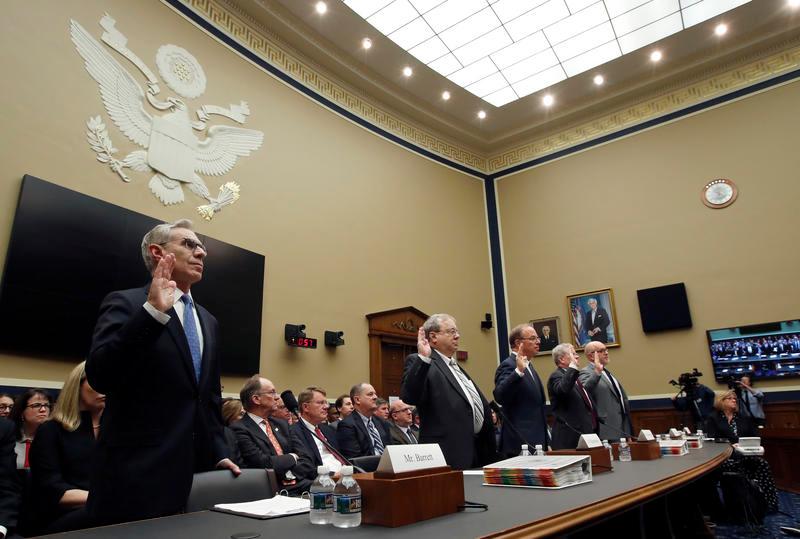
Cardinal Health Chair To Congress: We're 'Deeply Sorry' For Oversupplying Pills
|
In a scene bringing back images of Big Tobacco CEOs taking the oath, the chair of Dublin-based drug distributor Cardinal Health appeared before a U.S. House subcommittee on Tuesday to apologize for how the company sent millions of pain pills into parts of West Virginia.
|
|
|
|
The Resource Group's Scott Caldwell on recruiting the right people!
|
Positioning your organization for success: Why recruiting based on attributes enables transformational change
Successful organizations are often based on a foundation of innovative solutions to everyday problems and bringing those solutions to market. At the heart of these successful organizations are employees who pursue what is possible, rather than what has been done before.
For example, Apple taught us a phone is an enabler of possibilities, not just a communication tool. Amazon turned distribution into a better way of life for people on the go and for people who can no longer go. These innovations weren’t simply produced — they were inspired and operationalized by people, who at their core, believed they were changing lives, not just improving the bottom line. Certainly, they found financial success, but financial goals were not the catalyst for creativity.
|
|
|
|
Thanks for reading this issue of National Accounts Weekly! Let me know what you think!
You are now in the know!
John Pritchard
P.S. You can follow us on twitter @NatAcctWeekly
P.S.S.: Please forward this to your friends and colleagues. They can receive their own free subscription to National Accounts Weekly by
clicking here
.
|
|
|
|
|
|
|