Newsletter_banner_Feb2025

May-Jun 2025 | Vol. 17, Issue 3

Georgia Technology Authority

State CIO's column


View as Webpage

You don't have to speak IT to understand its impact

Ga_CIO_Shawnzia_Thomas_title

Every spring, the Georgia Technology Authority's events calendar fills up fast. There are seminars, summits, and workshops—many with "technology" in the title.


But here's something you might not expect: These gatherings aren't just for developers, engineers or those fluent in acronyms like MDM, IAM or SIEM. While we always welcome hardcore tech professionals, these events are built for a broader audience—especially government leaders who understand that technology isn't just a department; it's a driver of service, security and innovation.


If you're a CIO or public-sector IT leader, your presence matters. These are more than calendar fillers—they're where the future of government tech is being shaped.


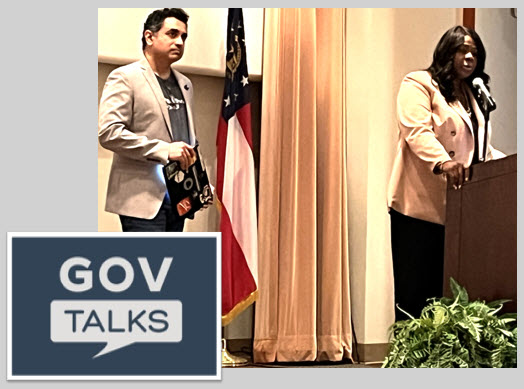
Take GOVTalks, for example. I had the privilege of speaking at the Spring 2025 edition of this long-running event hosted by GTA's Digital Services and Solutions team. This year's focus was digital accessibility, an increasingly urgent topic as federal requirements approach. More importantly, it's central to ensuring our digital services meet the needs of all constituents. Resources to help agencies evaluate and improve the inclusivity of their digital platforms were introduced. It is a perfect example of why attending these events matters: Ideas turn into action when the right people are in the room.


Next up is the GTA Technology Summit, coming June 10. This year's theme is cybersecurity in the digital supply chain—an increasingly critical area as agencies rely more on third-party tools and software. We're streamlining this into a half-day virtual event, making engaging busy leaders easier. The message is clear: Cybersecurity isn't just an IT issue; it's an operational priority and belongs on every agency's strategic agenda.


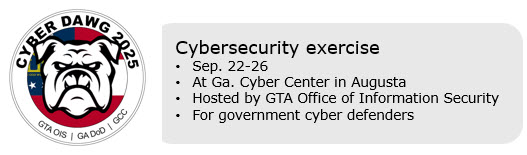
In September, we're bringing back Cyber Dawg, our live-fire cybersecurity exercise hosted by GTA's Office of Information Security. It's an immersive training event where participants defend against simulated cyberattacks in real-time. Held at the Georgia Cyber Center in Augusta, Cyber Dawg provides agency security professionals with an experience they simply can't get from a webinar or a white paper.


As we head into the fall, we'll host the Georgia Digital Government and Emerging Technology Summit. These events bring together technology and business leaders across the public sector to explore what's next—from AI and automation to cloud modernization and digital equity.


In short, these gatherings are not just informative; they're transformative. They're where we collaborate, troubleshoot and plan the path forward. Government can't afford to fall behind in tech adoption, and leaders can't afford to sit on the sidelines. We need to be in the room, engaged and contributing.


Technology is no longer a back-office function—it's front and center in how government serves its citizens. Attending, supporting and contributing to these conferences and exercises is how we keep our edge. It's how we ensure we're building innovative, secure, accessible systems that meet the moment and prepare for the next one.


I hope to see you at the next GTA event—and the one after that.

Also in this issue:

  • GTA-hosted Technology Summit coming June 10
  • GOVTalks: Accessibility is the right thing to do
  • AI Program readies for new horizons
  • Cyber Dawg looking for a few good defenders

Briefly …

- GovHub adds websites

- Top 25 Doers, Dreamers, & Drivers

Digital supply chain risk to be explored at Tech Summit

It happens too often: You've ramped up cyber defenses for known threats, and then some other vulnerability shows itself. Digital supply chain security risk is one of those, and your security strategy needs to evolve to address it. The GTA-hosted virtual Technology Summit on June 10 will size up how to manage it.


What's the risk exactly? Well, instead of trying to crash through the front doors of your systems, a cyber attacker skirts defenses by waltzing in with one of your trusted vendors and their valued tools you rely on. It could be a software application or a network tool built into your agency's operations.


Government entities have had to innovate to incorporate third-party security monitoring and new security considerations into

procurement while maintaining operational efficiency. At the half-day virtual summit, speakers will illustrate these measures and other tactics to bolster digital supply chain integrity.


Cybersecurity expert Dr. Gerald Auger will return as a featured summit speaker. An adjunct faculty member in the Citadel Military College Cyber Sciences department, he also created the Simply Cyber channel on YouTube. Other speakers will be announced soon.


IT professionals and business leaders from Georgia state and local government entities are encouraged to attend. Online registration is open now. The half-day format makes finding room on your calendar easier. GTA hopes to see you virtually on June 10.


GOVTalks promotes accessibility as the right thing to do

"Accessibility is a mindset. If you plan it, it can be part of the design.

We should do it for the right reason — so no one is left out. And if that’s not enough, there’s a little something called the DOJ ADA Rule."

Chief Digital and AI Officer Nikhil Deshpande

Follow the rules. It'll usually keep you out of trouble. But take time to understand the rules, too, and they may feel less troubling and more enabling.


This year's GOVTalks in May was partly about rules — the DOJ ADA Final Rule and accessibility standards to be complied with on government websites and digital offerings. But it was also about why accessibility is always the sensible priority, required or not. GTA's Digital Services and Solutions (DS&S) team hosted the seminar and discussed accessibility capabilities built into GovHub, Georgia's official web publishing platform. They encouraged the agency website managers in attendance to capitalize on those tools to follow the rules. And they reinforced the "why" behind it all.


Ensuring everyone who needs information and government services can get to them – that's at the heart of accessibility, regardless of physical ability. Websites and other digital paths (e.g., mobile apps, social media sites) that are accessible help government effectively serve constituents. Fortunately for Georgia agencies that host their websites on GovHub, accessibility provisions are integrated into those sites via the state's web design system, Orchard.


That's a significant head start, but the battle for compliance with the ADA rule is not won. An April 2026 deadline for meeting the stipulations looms large for Georgia state

agencies. Website and content managers at those agencies will tell you that one of the highest hurdles remains: PDF (Portable Document Format) files or .pdfs. Left unaddressed, these files appear as blank entries on screen readers used by some website visitors. PDFs can be time-consuming and tedious to make accessible.

And they appear in abundance on some agency websites. Think forms (e.g., licensing applications, tax forms), reports, policies, guidelines, public meeting records, and more.


How can we tackle PDFs and other accessibility challenges? Speakers from the Digital Services team shared the GOVTalks podium with experts from the Code for America organization who have developed an AI-powered PDF filter. It can potentially save time and effort by crawling websites to identify PDF conversion opportunities to promote accessibility. Through GTA, Georgia is the first state to partner with Code for America on this pioneering accessibility initiative.


Some 60-70 agency web managers attended the May 13 in-person GOVTalks, hosted by long-time GovHub partner Lullabot. Attendees left the event with a charge to prioritize progress over perfection and a reminder that the time to start accessibility work is always now, not later. Ensuring accessibility serves all constituents, including those with disabilities.

As AI horizon shifts, so does state's AI Program

Even in its youth, Georgia's AI Program looks to the horizon. It must stay relevant and in step as that horizon quickly gets redrawn by the changing possibilities artificial intelligence is heaping on state government.


At a May meeting of the state's AI Advisory Council, the multidisciplinary panel discussed how to shape program components now in place to suit where AI is going. Partnerships are a key consideration. Already, the AI Program prioritizes cultivating active partnerships with providers of AI tools and services to lower barriers for agencies wanting to engage with these approved vendors. Rather than some static collection of service providers, a dynamic set of partners is envisioned, with additional partnerships struck in keeping with emerging emphases in AI usage.


That ties directly to another pillar of the GTA-led AI Program—the Horizons Innovation Lab. There, vendor partners will engage with agencies who bring their ideas for AI use cases. In the secure environment

of the Innovation Lab, agencies will collaborate with service providers, experimenting with AI tools and devising and testing ways to apply them to address agency business challenges.


The lab is ready to hear from agencies and will work with them to clearly express the business requirements of their proposed AI projects. That will allow a better match between the project and a vendor partner with tools to address it. Once a match is made, work will proceed to develop a proof of concept. The process for submitting projects to the lab is spelled out on ai.georgia.gov.


AI Program leaders also envision beginning to work with agencies to develop agency-specific AI roadmaps aligned with an agency's vision. That's on the new horizon, along with expanded use cases at the Innovation Lab and even broader collaboration with non-profits, public sector associations and other governments on AI governance and implementation.


Cyber Dawg nips at the heels of Georgia's cyber defenders

Now in its seventh year, the Cyber Dawg live-fire cybersecurity exercise enhances the cyber readiness and response capabilities of government cybersecurity professionals in Georgia. Participants are immersed in real-world attack simulations over several days at the Georgia Cyber Center in Augusta. They actively defend against mock cyber threats, working in teams to improve incident response skills.


GTA's Office of Information Security hosts the exercise in partnership with the Georgia Department of Defense and the Cyber Center. Security experts from the Air and Army National Guard and active military units are engaged. Industry experts from the private sector provide mentorship and


support. The 2025 edition, slated for Sep. 22-26, will feature an advanced attack scenario involving compromised credentials, network intrusions, and nation-state tactics. Agency participants collaborate to detect, analyze and mitigate cyber threats.


Interested Georgia public-sector cyber defenders can register on the GTA website. Inquiries can be emailed to cyberdawg@gta.ga.gov.


Cyber Dawg is designed to help participants identify cyber threats in real time, react to simulated breaches, prevent damage and restore operations. Pressure is high, but without the real-world risks.


Briefly ...

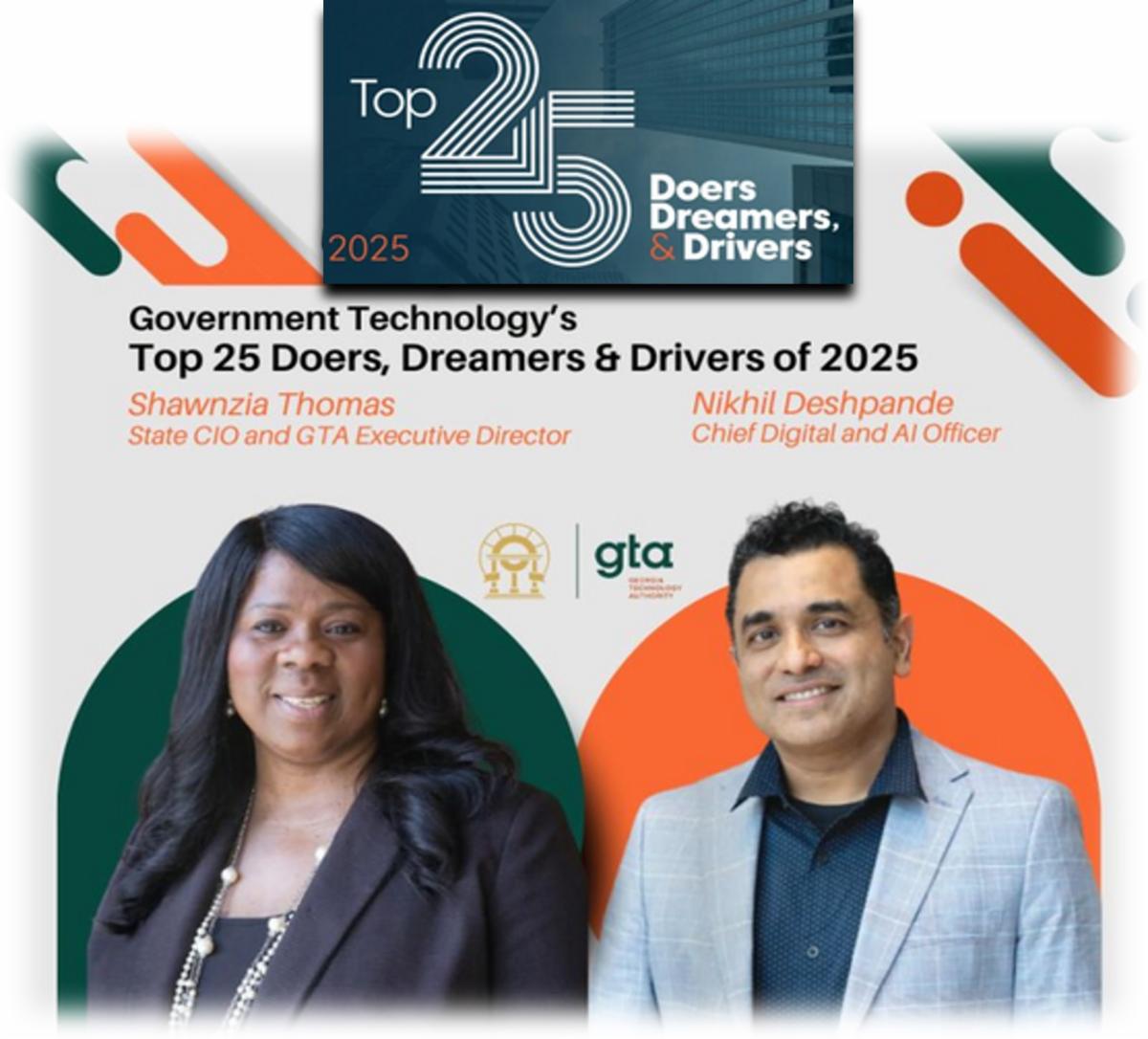
  • GTA is proud to have two leaders named to Government Technology's Top 25 Doers, Dreamers & Drivers for 2025. The distinction honors public sector IT leaders whose innovative technology efforts reshape how government serves constituents. State CIO and GTA Executive Director Shawnzia Thomas and Chief Digital and AI Officer Nikhil Deshpande earned recognition among this year's Top 25.
Banner gta pillars black
LinkedIn