|
Hello!
Well, summer is definitely underway! I hope this finds you enjoying some time outdoors—especially now that the smoke has cleared for many of us.
Lately, I've caught myself focusing on how quickly summer is slipping away instead of truly enjoying the moments I'm in. It turns out that's not a very fulfilling way to spend such a beautiful season! So, I'm giving myself a gentle reminder to slow down, be present, and appreciate today—and I'd like to challenge you to do the same.
As you take a few moments for yourself, I invite you to settle in and enjoy this edition of our newsletter. Inside, you'll find practical information on ADHD, insights for strengthening relationships and supporting couples, and so much more. We hope there's something here that informs, encourages, and inspires you.
Wishing you a wonderful rest of the summer!
All my best,
Dr. Pam McCaskill
office@mccaskillfamilyservices.com
734-416-9098
| | |
McCaskill Family Services Newsletter
Term: Summer | Issue 79| July 28, 2026
| | |
Three MORE ADHD Myths
Is ADD still a diagnosis? Does ADHD make people lazy? Does ADHD affect intelligence?
These are some of the most common misconceptions we hear, and they can have a real impact on how children, teens, and adults with ADHD are understood and supported.
MFS therapist, Jaclyn Rink's, latest article, breaks down three more of the biggest ADHD myths and shares what the research actually tells us about executive functioning, motivation, and the ADHD brain.
Read the full post to separate fact from fiction and learn how a better understanding of ADHD can change the way we support ourselves and others.
| |
At McCaskill Family Services, we specialize in working with adults, children, teenagers and families with various presenting issues. If you or someone you know could benefit from our services, please contact us. Our clinicians are trained in empirically-based techniques, and would be happy to promptly schedule an appointment in person or via tele-health. We can be reached by phone at 734-416-9098 or by email at office@mccaskillfamilyservices.com.
| | |
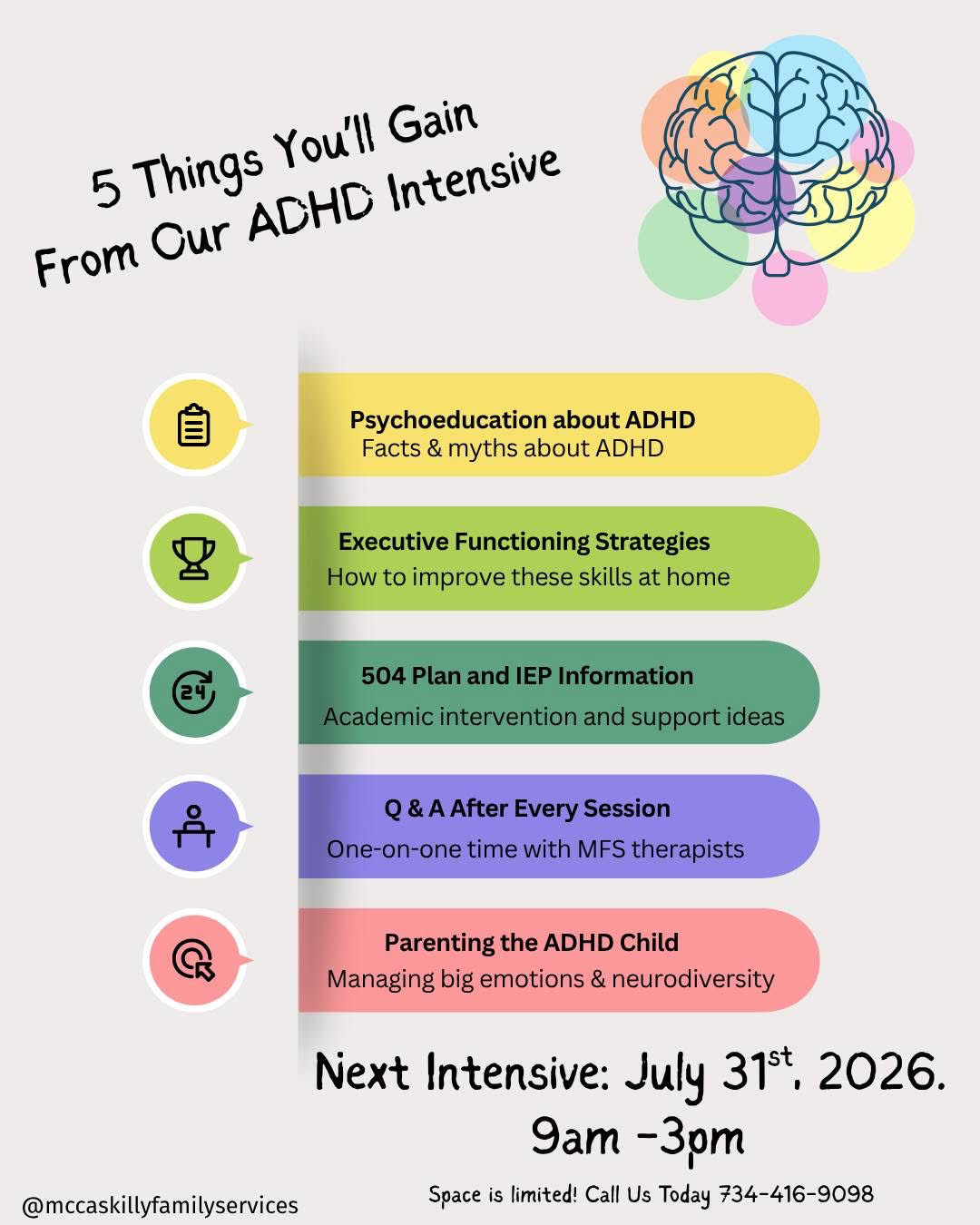
Are you missing out on July's ADHD Intensive? We've got two more opportunities this fall!
Join us on September 12, 2026 or November 13, 2026, for practical strategies, helpful tools, and evidence-based support for individuals and families navigating ADHD.
These sessions fill quickly, so be sure to reserve your spot early. We'd love to see you there!
| Awareness and Recognition Spotlight | This Month We Recognize: BIPOC Mental Health Month | |
July is BIPOC Mental Health Month, which allows us the opportunity to emphasize that feeling understood and respected is an important part of mental health care.
Our experiences, families, cultures, communities, and identities all shape how we experience stress, anxiety, trauma, and healing. Because of that, mental health doesn't always look the same for everyone. Our approach to treatment shouldn't look the same for everyone either.
Research has shown that folks who are Black, Indigenous, and People of Color are more likely to have mental health concerns overlooked, misunderstood, or diagnosed differently than their White peers. Experiences such as racism, discrimination, immigration experiences, community stressors, or generational trauma can also influence how symptoms show up and how comfortable someone feels reaching out for support in the first place.
For providers, this means continuing to listen, learn, and stay curious about experiences that may be different from our own. For individuals and families, it means knowing that it is okay to ask questions, seek second opinions, and look for providers who make you feel heard and understood.
At the end of the day, good mental health care starts with seeing the whole person sitting in front of us, not just a diagnosis, a checklist of symptoms, or a test score. Everyone deserves care that sees the full picture.
| *We acknowledge that numerous important heritage/awareness months and religious/cultural observances may occur at the same time. While we are highlighting one in this issue, this choice is not intended to diminish the significance of others. In alignment with our commitment to cultural humility and ethical professional practice, we aim to approach these acknowledgments thoughtfully and remain mindful of the diverse identities and experiences represented within our community. |
A monthly newsletter addition from our
Dietitian and Eating Disorder Recovery Team.
Food for Thought: Choose the Memory
| |
Summer has a way of inviting us to slow down, to enjoy sunshine, vacations, backyard barbecues, family gatherings, and time with the people we love. Yet for many of us, these moments can be overshadowed by worries about how we look or whether we're "good enough" to be in the picture.
This month, give yourself permission to enjoy the experience instead of critiquing how you look in it. Wear the swimsuit. Share the meal. Step into the photo. Laugh a little louder. Be fully present.
Years from now, you won't remember whether you thought you looked perfect. You'll remember the people you were with, the places you visited, the laughter you shared, and the memories you created.
The people who love you aren't focused on your appearance; they value your presence, your smile, and the time they get to spend with you.
This summer, nourish what truly matters. Make the memory. Be in the picture. Your life is so much bigger than your appearance, and the moments you embrace today are the ones you'll carry with you tomorrow.
| |
A monthly addition from our team of relationship experts: covering important topics, information, and answering common questions about romantic relationships.
| | |
It’s officially SUMMER! And for many families & couples, the summer months are primetime for family vacations. While family vacations promise connection, they can also
bring crowded schedules, parenting demands, opinionated relatives, and very little time alone. If you've ever returned home feeling like you barely spoke to your partner (unless
it was about sunscreen or whose turn it was to supervise the kids), you're not alone. Research suggests that relationship satisfaction isn't determined by whether couples experience stress—it's determined by how they respond to it together. Vacations with family often increase stress while decreasing opportunities for couples to reconnect, making intentional relationship care even more important.
Here are a few research-backed ways to protect your relationship while vacationing or traveling:
1. Remember: Your partner is on your team.
When tensions rise, it's easy to slip into blame ("You never help with your parents") or criticism ("You're always on your phone"). Instead, pause and assume positive intent. Family vacations create competing loyalties and expectations for everyone. Approaching disagreements with curiosity—"Can you help me understand what you were thinking?"—instead of accusation lowers defensiveness and makes productive conversations more likely.
2. Schedule couple time—don't wait for it to happen.
Quality time rarely appears on its own during family vacations. Even 10–20 minutes of uninterrupted connection can make a meaningful difference. Take a morning walk together before everyone wakes up, enjoy a coffee on the porch, volunteer to make a quick grocery run together, or stay up for a few minutes after everyone else has gone to bed. These small moments help couples reconnect emotionally and remind one another that they are more than just co-parents or family event coordinators.
3. Repair conflict quickly.
Disagreements are inevitable when people are tired, overstimulated, and sharing space. What matters most is how quickly couples repair after conflict. A sincere apology, a gentle touch, shared humor, or simply saying, "I know we're both stressed—I don't want us to be on opposite sides," can interrupt escalating arguments. Relationship research consistently shows that successful couples are not conflict-free; they're skilled at making repairs before resentment grows.
4. Try to engage in a “Vacation Mindset” shift
One of the healthiest reminders for couples is this: you don't have to spend every moment together to stay connected—but you do need to be intentional. It's okay to enjoy time with your children, siblings, or parents independently. The key is making sure you regularly find your way back to one another.
At the end of each day, take just five minutes to ask:
- What was your favorite part of today?
- What felt stressful?
- What can I do tomorrow that would help you enjoy this trip a little more?
Those brief conversations can help transform a vacation from simply surviving family dynamics into strengthening your partnership along the way.
| | |
Hi there! My name is Sierra Sands and I'm a masters level clinician at McCaskill Family Services who specializes in the treatment of Anxiety, Body Image/Self-Esteem Issues, Depression, Interpersonal Conflicts, and Struggling to Launch/Survive for Young Adults. I am also part of our comprehensive psychological evaluation team.
Thank you so much for staying in touch with the practice and I hope that you can use some of the useful information from our newsletter. If you or someone you know would like to schedule an appointment with me, please contact our office at 734-416-9098 or email us at office@mccaskillfamilyservices.com.
| |
409 Plymouth Road, Suite 250, Plymouth, MI 48170 • 734.416.9098
| | | | | |