|
Going a little farther, (Jesus) fell with his face to the ground and prayed, “My Father, if it is possible, may this cup be taken from me. Yet not as I will, but as you will.”
Then he returned to his disciples and found them sleeping. “Couldn’t you men keep watch with me for one hour?” he asked Peter. “Watch and pray so that you will not fall into temptation. The spirit is willing, but the flesh is weak.”
He went away a second time and prayed, “My Father, if it is not possible for this cup to be taken away unless I drink it, may your will be done.”
When he came back, he again found them sleeping, because their eyes were heavy. So he left them and went away once more and prayed the third time, saying the same thing. (Matthew 26: 39-44)
We’ve all been there—caught in a predicament, trying to decide between two or more difficult outcomes—perhaps equally unpleasant circumstances—with no obvious choice. The phrase “between a rock and a hard place” has roots in Greek mythology, in Homer’s Odyssey. The character Odysseus was found in a conundrum, having to choose between traveling a narrow strait between two “monsters”: a dangerous cliff and a deadly whirlpool. Both risky situations; no clear answer. A literal choice between getting too close to a treacherous “rock” (where loss of some life was likely) and skimming a “hard” place (where the swallowing of an entire ship was most likely guaranteed). No preferred outcome; definite loss in each decision; simply holding hope to avoid the worst-case scenario.
It takes a lot to navigate these “rocks” and “hard places” in our lives. Wouldn’t it be great if the best choices were obvious—or even made for us? Some of us resort to long pro/con lists or consultations with wiser folk. Possibly, listening to gut feelings or personal “what can I live with?” interrogations to guide us. Maybe past experiences can teach us lessons. Or, we search others’ stories—autobiographies or documentaries—for circumstances like ours, to see if they chose wisely and survived, unscathed.
In the above section of Matthew, our Savior lived out the conundrum (and pain) of such a choice. In the Garden of Gethsemane, Jesus asked His disciples to wait while He went to pray. He went to pray over His predicament: impending events—suffering and assured death—the completion of God’s plan. If Jesus stayed and gave in to arrest, punishment, torture, and crucifixion, there would most certainly be the grave agony of human suffering. If Jesus chose to run, to escape the situation and avoid the cross, He would be defying His Father and forsaking His role as Messiah for the world. Think of what this choice would have done for humanity—where we all would be right now—if Jesus had not fulfilled God’s promise and prophecy. Yes, that may be a silly thought… as in God’s plan, fulfillment was inevitable. But in that garden, Jesus’ humanity—and its flesh, doubt, and fear—came into play. It came into play as a story for us to remember: Jesus caught between a rock and a hard place. Yes, Jesus asked, “Father, if it is possible, take this cup from me.” But in the end, Jesus prayed again, this time saying that if it was not possible for the cup to be taken, then let God’s will be done.
I suppose in our lives, this is an example of how we are to navigate our most difficult life circumstances and choices: through prayer and request. Requests for struggles to be relieved; prayers for pain to be taken from us. But in the end, more importantly, we must be ready to relinquish it all—for God’s will to be done.
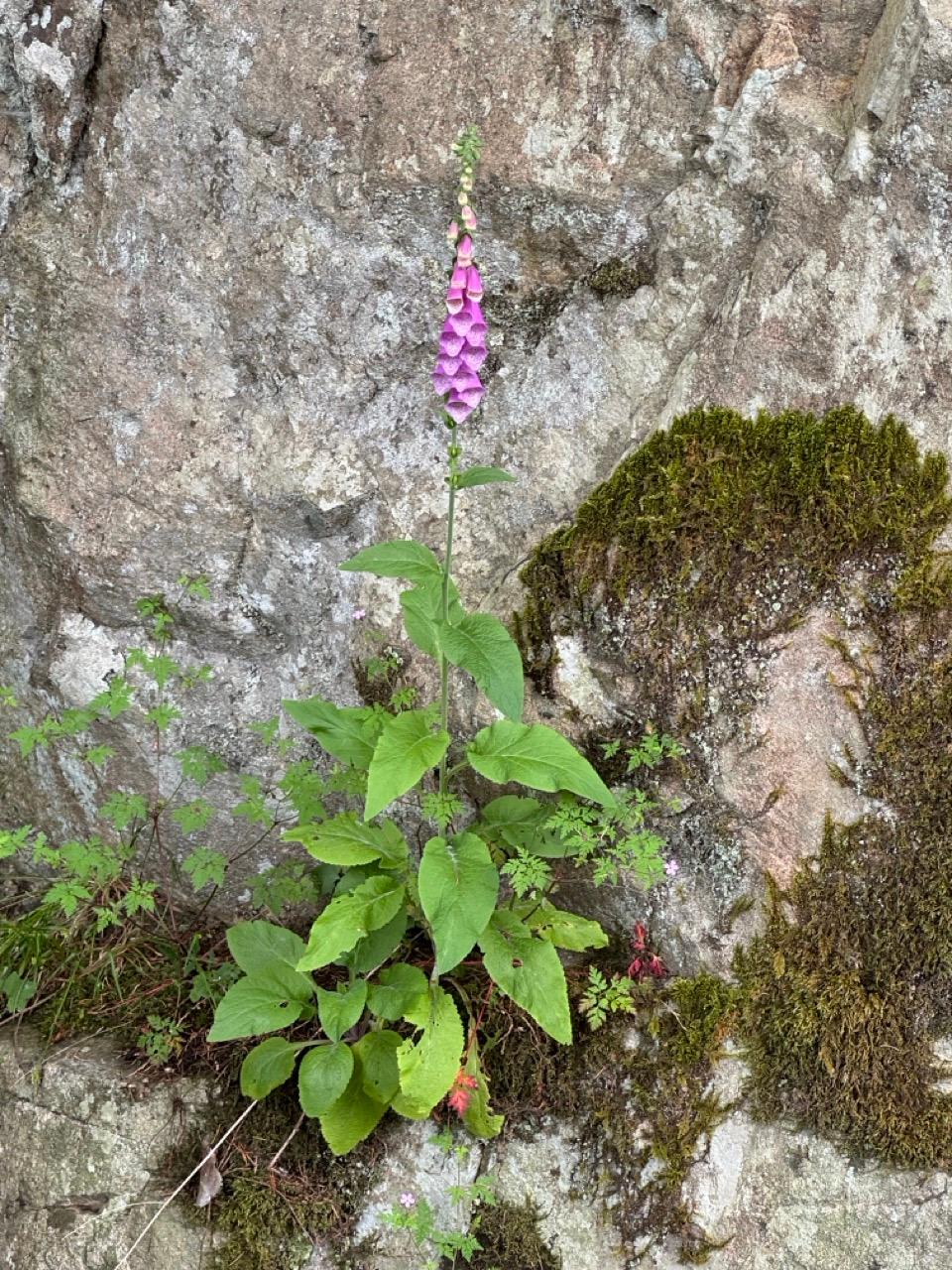
Two weeks ago, while visiting a spot in Vancouver that they call a rainforest—amidst trees and streams and rocky hills—I saw the most amazing thing. On the edge of a rough cliff, in the crack between a wall and a narrow ledge, was a long, beautiful purple flower. I couldn’t help but stop and take a picture from the rickety boardwalk under my feet. It brought to mind the miracle of Jesus. Not just in the royalty of its purple color, or the miraculous place it grew, but in the fact that from the difficulty of survival in a rocky climb, life came. It was a symbol of Christ’s resurrection out of difficulty and death. A symbol of God’s promise to us in our own suffering. A symbol that from our choices between a rock and a hard place, we can find solace and saving—if we include God in the mix. If we pray; if we ask; if we believe; if we hold hope and faith. If we truly choose to let go and let God’s will be done in our lives.
Of course, this brave bloom was not solo. I discovered that there were many such flowers surviving in the cliff sides of the Canadian “rainforest.” Fortunately, the miracle had multiplied for all to see. Just like Christ’s story in the Garden—and our own testimonies of life beyond difficult choices—brings hope to others. Little purple flowers out of rocks and hard places. So go and share your tales and blooms—and God’s good news through Jesus: the garden prayers, the suffering story, and the ultimate resurrection into new life. Amen.
|