|
Then he said to his disciples, “The harvest is plentiful, but the laborers are few; therefore pray earnestly to the Lord of the harvest to send out laborers into his harvest”. (Matthew 9:37-38)
Did your mom ever partake in the ritual of sharing bread or muffin starter dough? Did you have a bag of bubbly goo, or a bowl of puffy dough, in your refrigerator—and each time you opened the door, the thing seemed to grow bigger? Did you watch your mom feed this thing every day some flour (or milk, or sugar) and maybe even talk to it, “Hey, you’re looking good” or “Keep on, keeping on”? Then, after a week and a half, did she portion the dough out into several Tupperware containers and head over to the neighborhood coffee klatsch and give it away—of course, keeping a bit to make into yummy goodies for your family? And, a couple of weeks later, did a neighbor show up at your door with a smile and hand back your mom’s Tupperware container—now filled with a new style of goo (maybe this one had raisins in it, or some cinnamon)—and you’d bring it like an offering to the fridge, announcing, “We’ve got another one”? Maybe your mom said, “Oh, goodie!” (with a mix of excitement and sarcasm) and you wondered what the new resident in your kitchen would become?
Well, a chunk of my junior high school years was like this: funny glop in our refrigerator, Tupperware containers coming and going, and yummy (really yummy) muffins.
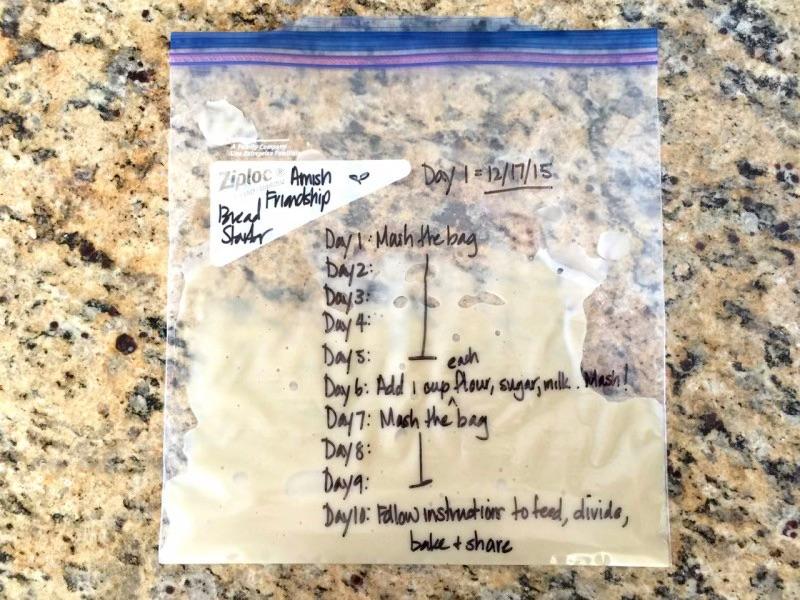
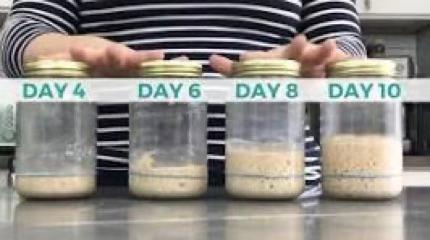
This long-time tradition, often referred to as a “friendship” bread or friendship muffins, is kind of like a chain letter—that tells you to “pass it on”—but without the threats of negative repercussions if you choose not to do so. You take the starter, feed the starter, and then after about ten days, you divide it up into four portions, bake one part, and give the others away.
If you research the origins of sourdough starters, you might find that the oldest known evidence of it was in clay pots in Egypt, from some 4500 years ago. The hypothesis is that the original discovery of sourdough starter itself could have been by “accident.” Maybe unbaked dough was kept in the clay pots—a bit too long and exposed to the elements and heat—allowing it to be introduced to “wild yeast spores” in the air, which caused a natural fermentation process to help it grow and rise into a new kind of bread. Of course, one source suggests the original cause could have been mixing beer instead of water into the dough. So many theories. But the important thing is that throughout history, many cultures have used sourdough starter, grown dough, allowing more bread and nourishment to be saved (and more importantly shared) with others.
When Jesus called on his disciples to multiply the laborers of God’s harvest, he knew that a single person could not do the work of many. One person could not reach the ends of the earth to preach the gospel, to share the Good News, and to grow God’s earthly kingdom. Such growth required the ingredients and the holy processes, and time, somewhat like the sourdough does.
Let’s think of it this way:
Note: The following could be stretching a metaphor (like over-sticky dough) but please come along with me. Of course, there could be more ways to look at the ingredients and symbolism if you wish.
Now, picture this: God, and The Word, as the portion of grain and flour; Jesus (and the promise of salvation and forgiveness) perhaps are the milk, sugar, and salt; the Holy Spirit is the yeast—in all unseen mystery and everlasting miracle on the wind; combined together, the ingredients create a “soul-changing” and holy reaction. The bowl in the refrigerator could represent each one of us (or our church, or God’s family) that holds the growing dough—the Bread of Life as the sustenance and promise of God’s love for us all. When we nurture this “starter dough” within us, with what is needed (a bit more flour or sugar or milk)—reading God’s word, vigilant prayer, worship and praise, in service to others, the practice of repentance and forgiveness, and any acts of loving-kindness—then the dough is given the chance to grow inside us. Note: We must have patience as there isn’t a set number of days in God’s recipe. Once we are ready, we can share the bounty of the dough, the Bread of Life with others. Of course, the Tupperware is the way we choose to share and serve—our actions and our words, to bring the message of Jesus to the world. But, we don’t have to travel to faraway lands, or even across the city to share the bounty of God’s love with others. And, a little goes a long way. We can give through blessings of peace, acts of assistance where needed, and by being open to opportunities to share—every single day, in both small and big ways.
Thankfully, God will do the rest. Once the “starter” is with the next person, the cycle can repeat itself, and on, and on, and on. We just have to be willing to be that container, willing to nurture our faith (dough), accept the growth within us, and be willing to share the gospel of Jesus with others. Are you willing to take part in God’s dough recipe and share the “starter” with others—continuing the friendship chain letter that makes its way around the world? I hope so. Amen.
|