|
“That the God of our Lord Jesus Christ, the Father of glory, may give unto you the spirit of wisdom and revelation in the knowledge of him: The eyes of your understanding being enlightened; that ye may know what is the hope of his calling, and what the riches of the glory of his inheritance in the saints. And what is the exceeding greatness of his power to us-ward who believe, according to the working of his mighty power, which he wrought in Christ, when he raised him from the dead, and set him at his own right hand in the heavenly places.” (Ephesians 17-20)
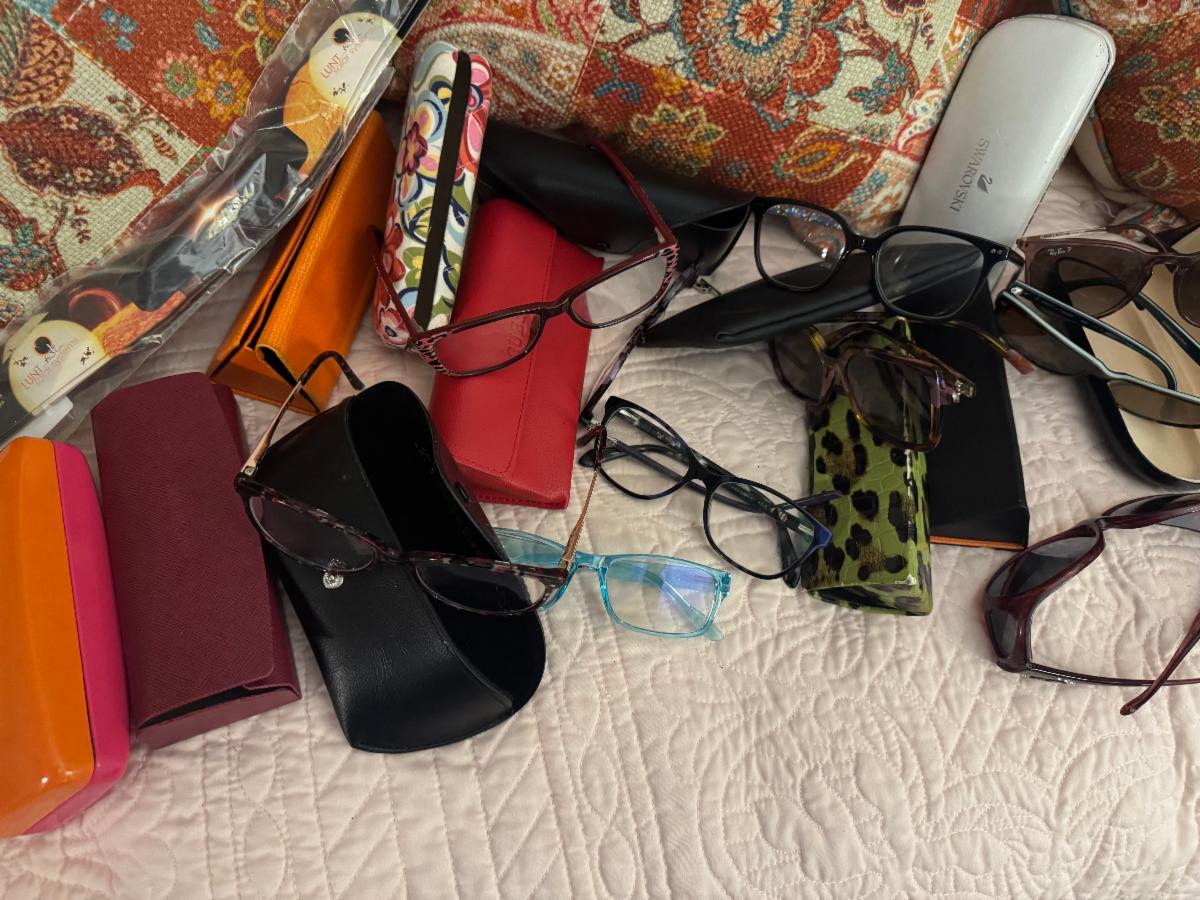
Glasses: red ones, tortoiseshell, purple rimmed, and blue; boxy or cat-eyed, delicate or bold. Single lens, bifocal, progressive, and ones for the sun. Polarized, partially tinted, narrow-bridged and thick-nosed. Metal and plastic—three paper ones (for watching solar eclipses). Some are computer-friendly, or scratch resistant. One is seriously “messed up”.
I have over a dozen different frames in my desk. All with particular prescriptions and purposes. No two are the same. I discovered this fact during a recent deep clean of my office. I knew of about six of them (the ones I travel with or use on a daily basis); the others were kind of a surprise. My doctor prescribed most and some were bought off the shelf. There are expensive ones (that I dare not lose), and grocery store readers for a mere ten bucks. Prescription sunglasses and gas station, road trip finds. Most have special cases that either fit in my purse or have to be stored in the car. One has a permanent lanyard for beach time. All have the same goal: to help me see more clearly.
It’s not that I intended to collect so many glasses. It is just that my eyes have changed so much over the past few years that not one individual pair seems to do the trick. One cataract was fixed and this changed one eye so I can’t see up close. The other unfixed one sees through a murky yellow haze, but only up close. My progressives are the most confusing with each lens having its own gradual transition from near to far and far to near. And, if they sit perfectly on my face, and I’m looking straight forward (only at arm’s length), I can see pretty well. But if I walk down the stairs, I have to lower my eyes (not my head); if I look into the distance I have to tilt my chin down and lift my eyes up. Ugh.
Of all the worries in the world, of course this is not the greatest. But still it is a pain to never be able to see everything absolutely clearly, all the time. It is expensive to have to invest in glasses for every occasion and environment. It is frustrating to realize that I can’t read something, or have to squint, if I grabbed the wrong pair on my way out the door. It is embarrassing to ask a stranger to translate words for me, or to confirm what I think I am seeing. If I close my right eye, my world is crisp and bright (albeit only in the distance); if I close my left, the world is in a cloudy haze, barely recognizable up close.
I realize that after my next surgery that my vision will change, and for this I am apprehensively grateful. I realize that I may have to toss quite a few pairs of glasses, or purchase another one to help me if the correction isn’t perfect. Donating them all will not work, because (honestly) I doubt anyone has my current vision combination, with all its quirks and idiosyncrasies. Look through my lenses and you might go cross-eyed!
And, boy do my eyes get tired. They get very tired of trying to tell my brain how to decipher what is real or distorted; what to believe in; when to trust in my surroundings, and when to doubt and seek out a greater truth. As I await my second surgery, it seems that I am getting pretty philosophical on how my eyes, and how I view things, affect my life experience, my viewpoint, and my faith.
If I am to equate what my vision is doing (or not doing)—and the amount of help it needs to give me the correct visual information—with my faith life, and my constant seeking for God’s truth, I must admit that sometimes I work too hard. Sometimes I make too much work for myself. I look through way too many different lenses to sift through what is right or wrong, what choices to make, what to worry about or not. My intuition says it has all got to be far simpler than that. I shouldn’t need multiple lenses to figure out how to interpret the world; lenses that make me feel exhausted, worn out, and confused.
Fortunately, there is good news. There really is only one pair of lenses to view life with—lenses that God gave us, in Jesus. If we choose to look at the world through the eyes of Jesus, interpret it by what Jesus taught, what Jesus said, what wisdom Jesus left us. If we keep those lenses firmly on all the time, never changing them out for other more “fashionable” or “trendy” or more “comfortable” ones—or ones that others swear by will work better and make you see more clearly. If we make the decision to wear our Jesus lenses 24/7, we will see the truth in the world around us. Truth that God wants us to see. We will better discern how to act, how to serve, how to help others. We will better discern and flesh out the wolves in sheep’s clothing and those trying to pull the wool over our eyes. We will see the beauty of God’s creation more clearly, and see through the fear that is not of God. We will see God’s purpose and presence in this world, unmistakably. Our eyes might still fail from time to time, but with our Jesus “lenses” we won’t truly be deceived. We can stand in certainty and clarity of the truth of God’s promise for us.
So, as I get ready to toss aside my dozens of glasses and seek out better vision, I will also choose to put on those lenses of Jesus. And, I look forward to what God helps me see more clearly in my life. I am definitely ready for the murkiness and uncertainty to go away, and my faith journey to behold new light. Care to join me? Amen.
|