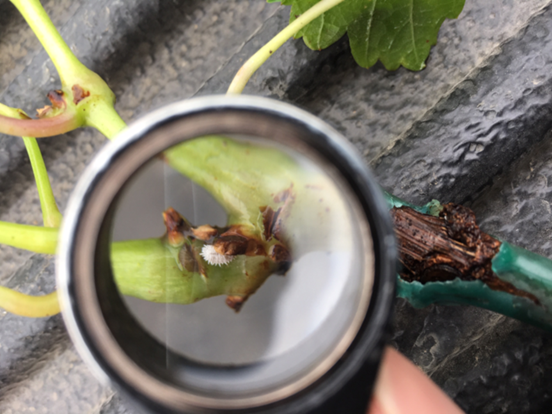
A vine mealybug in new planting material.* | | |
A year or so ago, I was talking with a colleague who’s an executive at a premium wine brand that had downsized its operations. He was in charge of making the cuts. He felt for the people who’d been separated from the company and acknowledged the pain of having to find another job. And he recognized the anxiety for the remaining employees—himself included—who would be taking on more responsibility and wondering what (or who) was next.
If there was a silver lining to the situation, he said, it was that he’d never felt smarter. In the process of finding ways to keep the company competitive and profitable, he’d been reading a lot and having lots of conversations, exploring new ideas and getting feedback.
I guess it’s easy to make money when you have money, I joked. Exactly, he said—you have to think harder and be a lot more creative when your margins get squeezed.
It seems we’re all getting smarter right now.
I don’t say that to be flippant. Much of what’s happening in the grape and wine industry seems incredible—and not in a good way. The arc of industry challenges started coming into focus a few years ago, as businesses began consolidating, cutting back and, for some, closing. And now the impact of federal actions are sinking in as tariffs take effect and government funding and staffing are scaled back.
Some reports say 16,000 of the roughly 100,000 people employed by USDA departed the agency this month, having accepted voluntary separation packages. Of that number, 16% served the Research, Education and Economics mission area, which includes the Agricultural Research Service, National Institute of Food and Agriculture, Economic Research Service and National Agricultural Statistics Service, which collectively deliver scientific solutions to stakeholder challenges. More are expected to follow as USDA’s reduction in force rolls out, seeking to cut staffing by an estimated 30,000. Meanwhile, USDA grant programs remain offline, putting research at academic institutions in jeopardy, too.
How will the grape and wine industry continue to thrive and drive the innovations we need to advance grapegrowing, winemaking and processing into an uncertain future? Conversations have started and strategies are taking shape. We’ve got our thinking caps on—and we’re getting smarter every day. If you have ideas, we’d love to hear from you.
| | | | |
*ABOUT THE IMAGE
This photo appears in the 2020 book, What Every Winegrower Should Know: Viruses, by the Lodi Winegrape Commission’s Dr. Stephanie Bolton. Read more about the region’s dogged efforts to combat mealybugs and the leafroll virus they vector in the Research Focus article below.
| | Long-Term Trends Show Decline in Federally Funded R&D | | The National Science Foundation’s National Center for Science and Engineering Statistics reports that long-term trends show a decline in federally funded research and development as a share of US GDP while the share of business-funded R&D has increased. As a percentage of GDP, federally funded R&D peaked in 1964, the study shows. At that time, federal R&D funding accounted for 1.86% of GDP and 67% of all domestic R&D. By 2022, federally funded R&D was 0.63% of GDP and 18% of domestic R&D. Business funded 31% of domestic R&D in 1964 and 75% of domestic R&D in 2022. | | Global Wine Sales and Production Are Lowest in 60+ Years | | Earlier this month, the International Organization of Vine and Wine (OIV) reported that global consumption and production of wine fell last year to historically low levels. Based on government data, worldwide wine sales fell 3.3% to 214.2 million hectoliters from 2023, and production fell 4.8% to 225.8 million hectoliters, both figures their lowest since 1961. In the US, the world’s top wine market, consumption fell 5.8% to 33.3 million hectoliters. The cost of a bottle had risen 30% since 2019-20, and overall consumption had fallen by 12% since then. Giorgio Delgrosso, the OIV’s head of statistics, said the wine industry had been hit by a perfect storm of health concerns and economic issues. US tariffs could become “another bomb” for the wine industry, he said. | | End of the Road for Roundup? | | Bayer said it could stop producing Roundup, the world’s most popular weedkiller, unless it gets court protection against lawsuits blaming the herbicide for causing cancer. Roundup has generated tens of billions of dollars in sales and represents roughly 40% of the world’s glyphosate. But over the past decade, the herbicide has also brought Bayer a wave of litigation, resulting in about $10 billion in payouts to plaintiffs. If Bayer does stop selling Roundup, American farmers would be reliant on imported glyphosate from China. “We’re pretty much reaching the end of the road,” Bayer Chief Executive Bill Anderson said in an interview. | | PD/GWSS Board Approves $2.2 Million in New Research | |
The California Department of Food and Agriculture (CDFA) Pierce’s Disease (PD) and Glassy-winged Sharpshooter (GWSS) Board this month approved $2.2 million in new funding for 11 research projects, ranging from PD biocontrol agents to spotted lanternfly detection and spread mitigation, and grapevine virus control. Although the number of research proposals received this year was similar to recent years, the number of projects funded and the totals awarded were lower than years past, and less than the average annual research expenditure of $2.6 million over the past 22 years. The lower figures reflect reduced income from grower assessments and uncertainty about program funding from federal sources.
Concurrently, the PD program assessment is up for renewal for another five years, through March 1, 2031. California grape growers’ votes are due by May 13, 2025. According to a new economic impact study, the program’s efforts save the state’s winegrape growers $56 million a year by reducing losses from PD.
| | Nuveen Wins California Green Medal Award | | Nuveen Natural Capital, a longtime NGRA member-organization, won the 2025 Business Award, one of the four categories of California Green Medal Sustainable Winegrowing Leadership Awards. The Business Award recognizes the vineyard or winery that best demonstrates smart business through efficiencies, cost savings and innovation from implementing sustainable practices. Among its many efforts to further sustainability, Nuveen was honored for its commitment to soil health and use of renewable diesel across its managed properties, custom app to monitor pests and pathogens, and use of innovative technologies like UV-C light for fungus control and electric weeders to reduce reliance on crop protection materials and associated costs. The California Green Medal is presented by the California Sustainable Winegrowing Alliance, California Association of Winegrape Growers, Wine Institute, Lodi Winegrape Commission, Napa Valley Vintners, Napa Green, Sonoma County Winegrowers and Vineyard Team. | | UC ANR’s The Plant Will Help Commercialize Ag Innovations | | UC ANR Innovate, the innovation arm of University of California Agriculture and Natural Resources, received a nearly $1 million Catalyst grant from the California Jobs First initiative to establish The Plant, a facility designed to support agri-food innovation and sustainable agriculture in California’s Sacramento Valley. The grant will fund early-stage planning for construction of The Plant, which aims to bridge the gap between advanced research and real-world application, fast-tracking the commercialization of innovations that address climate change, strengthen food systems and improve human health. Over the next year, the grant will fund critical pre-construction work, operational planning and partnership-building activities. | | Highland Community College Terminates Its V&E Program | This month, the Highland Community College Board of Trustees voted to terminate the HCC Viticulture and Enology Program, close its 456 Wineries business incubator and sell the property housing the program. The program, started in 2008 and based in Wamego, KS, will cease operations after grape harvest this fall. As Scott Kohl, HCC Viticulture and Enology Program Director, reports, “HCC Viticulture and Enology is the only hands-on, on-the-ground certificate program between Oklahoma and Canada. No other such program exists in Nebraska, the Dakotas, Minnesota, nor Iowa. The 456 Wineries business incubator is the only one of its kind east of the Rocky Mountains. And Highland is the only community college in the nation actively participating in research as a testing site for new cultivars of grapevines focusing on disease tolerance and chemical drift resistance.” | | ASEV Announces Its Best Paper Award Winners | | |
Each year, the American Society of Enology and Viticulture selects one enology paper and one viticulture paper from among those published in its American Journal of Enology and Viticulture the prior year as its Best Paper Award winners. The 2025 ASEV Best Papers are:
-
For viticulture: “Trunk Cambium Facilitates Pre-Symptomatic and Year-Round Detection of Grapevine Red Blotch Virus Using the LAMP Assay,” written by Jennifer K. Rohrs, Hannah G. Fendell-Hummel, Sarah L. MacDonald, Malcolm B. Hobbs and Monica L. Cooper from the University of California Cooperative Extension, Napa County.
-
For enology: ”Prevalence of Wildfire Smoke Exposure Markers in Oaked Commercial Wine,” by Mango Parker, WenWen Jiang, Adrian D. Coulter, Tracey E. Siebert, Eleanor Bilogrevic, I. Leigh Francis and Markus J. Herderich from the Australian Wine Research Institute.
The selected papers will be presented at the ASEV National Conference in June in Monterey, CA. Both papers are offered as open-access on the AJEV website.
| | Dario Cantù Is an AAAS Fellow | | The American Association for the Advancement of Science (AAAS) announced last month its 2024 AAAS Fellows, including Dario Cantù, a professor, plant biologist and the Ray Rossi Endowed Chair in Viticulture and Enology in the College of Agricultural and Environmental Sciences at UC Davis. Dario is recognized “for distinguished contributions to our understanding of grapevine genetics and genomics, excellence in fostering applications of science for the advancement of society worldwide, and teaching excellence.” He is among 471 scientists, engineers and innovators across 24 disciplines to have earned the lifetime honor this year. Acknowledging the accomplishments of the 2024 class of Fellows, Sudip S. Parikh, AAAS chief executive officer and executive publisher of the Science family of journals, which AAAS publishes, said, “At a time when the future of the scientific enterprise in the US and around the world is uncertain, their work demonstrates the value of sustained investment in science and engineering.” | | Manoj Karkee Joins Cornell Faculty | | Manoj Karkee is the inaugural Norman and Sharon Scott Professor in the Department of Biological and Environmental Engineering in Cornell University’s College of Agriculture and Life Sciences, continuing his studies in AI, automation and robotics in agriculture. His appointment is effective this month, following 15 years at Washington State University. Manoj relates the work of his new Ag Robotics Lab to Cornell’s transdisciplinary moonshot, Redesigning 21st Century Agri-Food Systems. “I am investigating and innovating models, tools, technologies and systems that will enable farming to be the more precise, diverse and resilient, thus helping meet global demand for nutritious food while ensuring environmental stewardship,” he says. | | Geraldine Diverres Joins NMSU Extension | | Geraldine Diverres is the new Extension Viticulture Specialist at New Mexico State University. She started there last month after finishing her PhD in Horticulture at Washington State University. Her research at WSU focused on the effects of irrigation on yield and wine quality, as well as rootstock/scion combinations’ effect on salinity tolerance—subjects that will inform her work in New Mexico. | | Clean Plant Center Northwest Seeks a New Director | | Washington State University seeks a new director for the Clean Plant Center Northwest as Scott Harper steps down to focus on teaching and research as an associate professor. The CPCNW is part of a federally funded network that helps prevent the spread of disease in clonally propagated crops, including grape. It has traditionally been led by a WSU faculty member, but a recent surge of new variety launches has driven demand for Center services beyond what a faculty member can handle. The position does not require a PhD, but experience in plant pathology and management is preferred. Learn more and apply by May 20, 2025. | | UC Davis Offers a V&E Postdoc Position | | A postdoctoral position is available in the lab of Associate Professor Ron Runnebaum, the Stephen Sinclair Scott Chair in Enology in the Department of Viticulture and Enology at UC Davis. The ideal candidate has a background in chemistry or chemical engineering, plus synthesis and characterization of materials for addressing adsorption and catalysis. The goals of the research are 1) to quantitatively establish connections between vineyard site, fermentation characteristics and wine chemistry, and to assess differences between growing sites and reproducibility across vintages, and 2) to establish structure-function relationships for synthetic materials for use in wine and agricultural applications. Learn more and apply by May 5, 2025. | | Recognize an Extension Agent for Innovative Programming | | The Cooperative Extension Section’s Extension Committee on Organization and Policy (ECOP) and USDA National Institute of Food and Agriculture (NIFA) invite applications for their co-sponsored national Extension award for Innovative Programming that Addresses New Audiences. This award recognizes novel teaching models and techniques that ensure Extension programs reach all audiences, especially those that are new and/or have not been participating in traditional Extension education. Nominations are due by June 1, 2025. | | |
Mealybugs and Leafroll Virus Can’t Hide from Detector Dogs
By Stephanie Bolton, PhD, Lodi Winegrape Commission
| | |
In 2023, the California Department of Pesticide Regulation awarded a small team of California researchers $428,118 for a proof-of-concept study looking at whether canines could detect the state’s most challenging vineyard pest-and-disease combo: leafroll 3 virus (GLRaV-3) and its main vector, the invasive vine mealybug.
The human part of the research team included myself, Dr. Stephanie Bolton (Lodi Winegrape Commission), as the Principal Investigator and overall project strategist, Lisa Finke, MS (Canine Detection Services) as the canine team leader, Dr. Neil McRoberts (UC Davis) as the detection statistician and Dr. Maher Al Rwahnih (Foundation Plant Services, UC Davis) as a provider of verified virus-tested material and grapevine virus knowledge. On the canine side, we welcomed Malbec (Black Lab), Cab (German Shorthaired Pointer), and Sauvi B and Zinny (English Springer Spaniels). Success was driven by the pups’ amazing noses and each member’s unique expertise combined with access to an established industry network that is financially invested in discovering sustainable solutions for California agriculture.
As many of our growers know all too well, vine mealybugs and the leafroll virus disease they vector threaten our entire grape industry. Leafroll disease reduces yield and quality, decreases a vineyard’s lifespan and makes land less suitable for future plantings. Mealybugs and viruses can easily move through the grapevine supply chain undetected. The tiny, lightweight mealybugs are spread between neighboring vineyards and across entire regions via wind, equipment, people, birds and vehicles. Chemical control is challenging because there are few modes of action available, and mealybugs’ cryptic habits—hiding underneath bark and on roots—make them hard to see and difficult to target with contact insecticides. By the time a mealybug infestation is detected via traditional trapping and scouting, it is far too late for eradication.
Canine detection, already used in numerous applications for human health and safety, was recently rediscovered as an integrated pest management (IPM) tool and made popular by Dr. Tim Gottwald (retired USDA). In citrus orchards, dogs are used to locate Asian Citrus Psyllid, an insect that vectors Huanglongbing disease. Applied in viticulture, canine detection offers early, real-time, non-destructive field identification of pests and diseases.
Well before we began our project, we hosted several meetings with California’s top nurseries, extension personnel, virus testing laboratories, growers, pest control advisors, consultants and leading mealybug and virus experts from across the globe. It became clear that to offer the most value to our industry, canine detection for leafroll virus should first be applied to the most popular/at risk nursery increase blocks with a focus on rootstocks and white varieties which do not show virus symptoms. Our main goal was to have trained canines available to work at the end of the grant project.
The vine mealybug detector canines (Malbec and Sauvi B) were imprinted using tennis balls paired with target odors. The target odor of vine mealybug crawlers was used during this phase and tested later to ensure that canines were able to detect vine mealybugs even in the presence of pheromone mating disruption, since this is a crucial tool in our vineyards that we want to be able to employ simultaneously. For leafroll 3 virus, canines Cab and Zinny were imprinted on a target odor of viral protein.
The canine detection project began with odor imprinting, behavior exercises and detection training with a skilled Canine Handler named Miguel Encinas. The canine’s performance on indoor, outdoor and field trials using mealybug-infested and virus-infected vine material resulted in calculations for sensitivity (identifying vines with vine mealybugs or leafroll 3 virus) and specificity (ignoring vines without vine mealybugs or leafroll 3 virus).
Our vine mealybug detector canines scored an average of 97.3% for sensitivity and 99.6% for specificity across indoor, outdoor and field trials, and the virus detector canines averaged 93.4% and 99.6%, respectively. Anything above 90% is considered exceptional. The canines even outperformed independent lab testing for leafroll 3 virus detection. Plus, the dogs’ abilities are only expected to improve with time and experience.
Clearly, our proof-of-concept project was a success! Canines can reliably detect vine mealybugs and leafroll 3 virus in vineyards, offering a promising opportunity to enhance our industry’s sustainability and long-term viability. Given that the cheapest, smartest, most efficient and most logical part of integrated pest management is prevention, we propose deploying detector dogs in critical nursery increase blocks. Canine detection of mealybugs and virus in grapevine source material before it is propagated would drastically reduce the need for future costly mealybug and virus management practices in commercial vineyards nationwide.
This article was excerpted from the original story, “Sniffing Out Threats: Dogs Detect Mealybugs & Viruses in Vineyards,” by Dr. Stephanie Bolton, posted on the Lodi Winegrape Commission’s Coffee Shop Blog on March 31, 2025. Stephanie is the Commission’s Research & Education Director and Sustainable Winegrowing Director, and an At-Large Representative on NGRA’s Board of Directors. Read her complete post here.
| | |
Applying for a grant? Request a letter of support!
NGRA is pleased to provide letters of support for research projects that directly address our industry research priorities. Request a letter via our online request form at least two weeks prior to the grant deadline (or any internal deadline you may have). Requests are reviewed and approved by NGRA Research Committee leadership, so processing times may vary.
| | |
Orchard Information at Your Fingertips
April 24, 2025 | Good Fruit Grower
Long Range Wide Area Network or LoRaWAN is helping grape growers and researchers connect precision irrigation tools such as soil moisture probes and temperature sensors to smartphones and other decision support systems in places the internet doesn’t reach. This internet of things communication technology uses unlicensed, low-frequency radio waves to transmit data (as from sensors) in small bursts across long distances, relatively inexpensively.
Okanagan Researchers Creating System to Reuse Wine Industry Waste
April 24, 2025 | INFOnews
Researchers at Okanagan College are surveying wineries, cideries, breweries and other drink makers across the province to quantify and map the byproducts of production and track disposal practices. Once they have a critical mass of data, they’ll work with regional waste management companies and local governments on innovative uses for those byproducts. The team’s goal is to improve sustainability for wine and other beverage makers by creating new value for the industry.
Soil Compaction in Action
April 23, 2025 | Good Fruit Grower
At the USDA-ARS soil health vineyard at Washington State University’s Prosser campus, soil scientist Devin Rippner is using CT scans to study the effects of compaction (as from vineyard management equipment) and soil structure on water infiltration, earthworm activity and root growth. The long-term research will take time to fully reveal results but a baseline comparison of tractor and vine rows in the vineyard, which was machine-planted in 2023, to an adjacent 10-year-old vineyard shows distinct differences in porosity.
Improving the Utility of Sulfur for Grapevine Powdery Mildew Management
April 18, 2025 | Southern Region Small Fruit Consortium
Sulfur is widely used by grape growers to combat powdery mildew for good reason. It’s an affordable contact fungicide with low human toxicity and a multi-site mode of action. But one of its primary weaknesses is it’s easily washed away by rain. Tank-mixing sulfur with surfactants not only improves application effectiveness, but two University of Georgia plant pathologists found that certain non-ionic surfactants can go one step farther, improving sulfur’s ability to control PM.
Interesting and Unexpected Wine Outcomes from Nutrient Trials
April 18, 2025 | HiRes Vineyard Nutrition Podcast
Tune in to hear Jim Harbertson, Associate Professor of Enology at Washington State University, a collaborator on the HiRes Vineyard Nutrition project, reveal the fascinating ways that even he was surprised by the outcomes of vine nutrition on finished wine. For example, this research has revealed that, by adding nitrogen in the vineyard, “we seem to be growing more (tannin) in the plant itself, which is then pre-fining the wine before we start making it and that is not what we expected at all.”
When Are Insects Actually a Problem with Dr. Rufus Isaacs
April 15, 2025 | Vineyard Underground Podcast
While some insects pose a threat to grapevines, others can actually benefit them. In this podcast, Michigan State University entomologist Rufus Isaacs helps growers better understand when and what bugs are a problem versus those that are just hanging out or even providing a benefit to your vineyard.
The Science of Vine Density
April 14, 2025 | SevenFifty Daily
“When it comes to vine density—that is, how closely spaced grapevines are from one another—the ideal choice will largely depend on a suite of other factors,” including the soil, climate, types of equipment to be used, and quality, quantity and price targets for the fruit and finished wine, writes SevenFifty Daily. “All those things have to line up like a slot machine,” says Chateau Montelena winemaker Matt Crafton.
The Network Effect on Areawide Pest Management
April 8, 2025 | Good Fruit Grower
Growers who hear about new practices from other growers are most likely to make changes themselves. ”Farmers may be the original influencers in this regard,” reports Good Fruit Grower. And extension specialists like Viticulture Advisor Monica Cooper (UCCE Napa County) are trying to harness the power of peer influence to catalyze change. That’s the hope for new area-wide efforts to battle grapevine red blotch and leafroll diseases in Napa and Washington State, respectively.
Texas White Oak Used to Age Texas Wine
April 2, 2025 | Wine Business Monthly
“In France, they match the different forests to their wines. Why not here?” asks Robert Young, founder of Bending Branch, a Texas winery that has released its first wines aged with custom-milled Texas white oak chains. “It will give the wines another layer of Texas terroir,” he says.
Grapevine Viruses in Michigan Vineyards Identified To Promote Diagnostic Testing and Virus-Free Planting
April 2, 2025 | Phys.org
“The first step in controlling viruses is knowing which ones we have in Michigan—and now we know,” said Michigan State University’s Timothy Miles. He led a group of researchers from MSU and UC Davis to determine what grapevine viruses are infecting Michigan’s vineyards to increase awareness of the importance of diagnostic testing and planting virus-free plant material. Using diagnostic technology often used in COVID-19 testing, they discovered, grapevine rupestris stem pitting-associated virus, or GRSPaV, was the most abundant.
The Evolution of Vineyard Floor Management with Alice Wise
April 1, 2025 | Vineyard Underground Podcast
The Long Island AVA is situated on the eastern end of Long Island, NY, surrounded on three sides by water, Cornell Cooperative Extension agent Alice Wise explains. “We have very sandy soils that sit atop aquifers (where) all our drinking water comes from.” Historically (prior to grape growing there), herbicides had shown up in the water supply, cueing grape-growers to focus on things like groundwater protection. Eventually, with the help of Alice and her Cornell colleague Tim Martinson, Long Island would emerge as an innovator in sustainability practices on the East Coast.
Napa Grapegrowers Review Best Irrigation Practices, Ways Growers Can Volunteer to Conserve Groundwater
April 1, 2025 | WineBusiness Monthly
At a recent Napa Valley Grapegrowers meeting, state water officials reported that the Napa Valley Subbasin is being depleted, mostly by ag. Growers are urged to step up their water conservation efforts or risk regulatory intervention. The cost, feasibility and potential water savings of many voluntary methods were presented, including augmenting supply through recharge opportunities, exploring water reuse, reducing demand and delaying replants, improving soil health and water-holding capacity, maintaining your irrigation system and more.
Predation of Spotted Lanternfly by Generalist Arthropod Predators in North America
April 2025 | Arthropod-Plant Interactions
Entomologists at Penn State have identified arthropods (a class of invertebrate animals that includes spiders, mites, mantises and ladybugs) that are not put off by the tree of heaven toxins spotted lanternfly consume to protect it from predation. Of 10 commercially available or easily field-collected predatory arthropods they tried, three effectively reduced populations of SLF, including those that had fed on tree of heaven, indicating promise as natural control agents.
How Mechanical Harvesting Impacts Wine Quality
March 27, 2025 | SevenFifty Daily
In California, 90% of winegrapes are machine-harvested and global ag labor shortages are expected to drive further mechanization worldwide. “But that shouldn’t be cause for alarm for lovers of quality wine,” SevenFifty Daily reports. “Advancements in technology are helping producers harvest more high-quality grapes without the need for a large, seasonal workforce.” As one premium winemaker says of the fruit coming in off his modern mechanical harvester, “You get what I would consider a premium, luxury-tier product.”
Sauvignon Blanc 2.0 – A Vision for Resilient Viticulture
March 25, 2025 | Bragato Research Institute
New Zealand’s Bragato Research Institute likens its fast-track Sauvignon Blanc 2.0 Program to technology innovation. In the way that satellite internet can leapfrog fiber installation, the NZ wine industry is investing in an ambitious cutting-edge grapevine improvement initiative that will produce the resilient next generation of its signature variety at an accelerated pace. Some of the most well-respected members of the global grapevine breeding community, including Gallo’s Peter Cousins and USDA-ARS’s Lance Cadle-Davidson, are lending their expertise to the effort.
Sustainable Solutions for the Spotted Lanternfly: Expert Insights from Tracy Leskey
March 24, 2025 | Future of Conservation Podcast
An important step in the fight against spotted lanternfly is monitoring its spread, says USDA-ARS entomologist Tracy Leskey. Here, she describes the monitoring tool she’s most excited about: Environmental DNA (eDNA) or “our little CSI projects.” Developed in collaboration with colleagues at Rutgers, this technique involves “collecting the DNA left behind by SLF foraging on foliage, plants and trees…by basically giving the tree a bath, taking that water and concentrating it through a special DNA filter, then amplifying it to see if there’s SLF DNA in there.” With e-DNA, Tracy says, “We can find SLF a year in advance, when their populations are very rare.”
Are We Closer to Solving Smoke Taint? AWRI’s Senior Research Scientist Explains
March 21, 2025 | Drinks Trade
In her 2024 award-winning paper in AJEV, AWRI smoke taint researcher Mango Parker explained her team’s development of a test that can quickly and accurately inform growers in or near wildfires of the risk of smoke taint in finished wines. “We can now advise what concentrations in grapes are likely to cause a sensory problem in the wines,” she says. “Winemakers can use the results to make informed decisions about managing that risk of smoke taint and minimizing financial losses along the way.”
A Chill-Safe Vineyard
March 20, 2025 | Good Fruit Grower
Figgins Winery in Walla Walla, WA, buries canes under earth and snow each winter, then trains two shoots to the drip wire. In January 2024, a polar vortex decimated their crop. For their Merlot, the previously buried canes—now trained to the drip wires—carried up to 1.5 tons of fruit per acre, while the cordons sustained 80% bud damage and carried a very small crop. Harvesting from the drip wire was slow, difficult work, paid at an hourly rate. “We put money towards a cultural practice instead of insurance,” owner Chris Figgins says.
Differential Physiological Responses of Resistant and Susceptible Grape Cultivars to Eutypa Dieback
March 18, 2025 | Journal of Experimental Botany
Why do different grape varieties react differently to fungal pathogens like Eutypa? This new research from UC Davis yields clues to how vines’ seemingly counterintuitive reactions to infection can contribute to susceptibility to trunk disease. These findings could help grape breeders identify key traits, including leaf photochemical function and gas exchange, and even wood chemistry, to leverage to develop Eutypa-resistant varieties.
Find these stories and more, published every weekday, on our Facebook and X (Twitter) feeds. You can also find us on LinkedIn. Use #graperesearch to join and grow the conversation!
| | |
May 6-7, 2025
WineAmerica Congressional Fly-In
Washington, DC
May 15, 2025
Sonoma County Vineyard Technical Group
Building LAMP Kits for Red Blotch Detection
Santa Rosa, CA
May 28, 2025
NGRA Midyear Board Meeting
Portland, NY
June 3, 2025
Sonoma County Vineyard Technical Group
Vineyard Development Masterclass
Forestville, CA
June 4, 2025
UC Davis Oakville Grape Day
Oakville, CA
June 16-19, 2025
ASEV National Conference
Monterey, CA
June 17, 2025
Smoke Taint Symposium
Monterey, CA
Co-located with the ASEV National Conference
June 18-22, 2025
Conference of the American Association of Wine Economists
San Luis Obispo, CA
July 8-9, 2025
Global Sparkling Summit
Albuquerque, NM
July 8-10, 2025
ASEV-Eastern Section Conference
Athens, GA
July 20-23, 2025
Australian Wine Industry Technical Conference
Adelaide, Australia
July 27-31, 2025
GiESCO Conference
Geisenheim, Germany
August 25-26, 2025
North American Grape Breeders Meeting
Bloomfield, MN
| | | | |