|
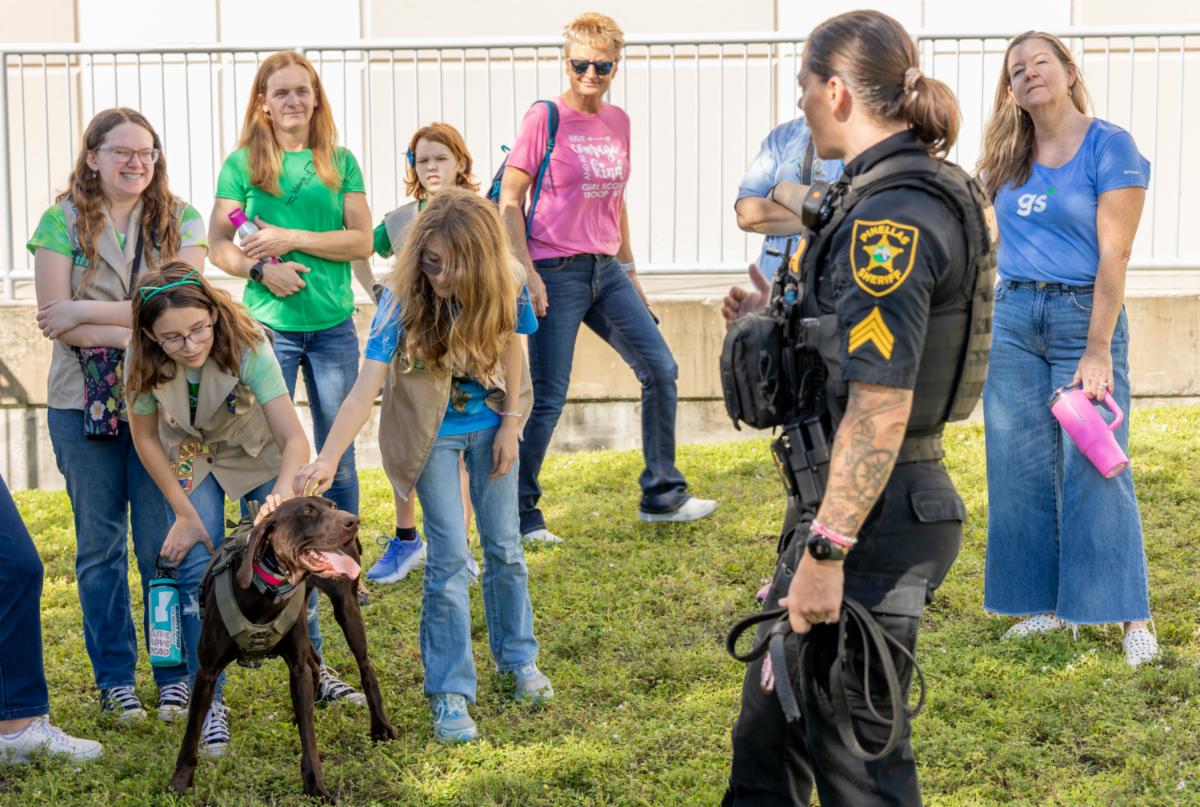
Recently, the Pinellas County Sheriff’s Office (PCSO) welcomed a group of 30 local Girl Scouts ages 11 to 13 to explore the agency and ask questions of an all-female career panel. “Today isn’t about convincing you to pursue a specific career,” said Senior Human Resources Analyst Sarah Anthony. “It’s about learning how these women found their paths, what influenced them, what challenges they overcame, and what they enjoy most about what they do.”
The day started with a K-9 demonstration from Sergeant Amanda Eddinger and her explosives-sniffing Vizsla named Linda. The pair set a great example for the girls. Sergeant Eddinger is PCSO’s first female Canine Unit sergeant, and Linda is our first female dog in the modern era of the unit. Even better, Linda is named after Air Force Retired Chief Master Sergeant Linda Cox, who became the military’s first female bomb technician in 1974. Sergeant Eddinger talked with the girls about what it’s like to lead an all-male team of K-9 handlers (and all male dogs).
The Girl Scouts then got to meet members of the Forensic Sciences Section, which is something of a demographic anomaly in the world of law enforcement in that it tends to be female dominated. They got a hands-on demonstration of how to lift fingerprints from a crime scene and find evidence using an alternate light source.
In the afternoon it was time for the highlight of the day, the panel Q&A featuring a cross-section of women in a variety of different roles at PCSO: Threat Management Division Captain Kim Kilian, Department of Detention and Corrections Corporal Brandy Rushing, Deputy Renee Pappamihiel, Communications Center Manager Jade Belcher, Forensic Science Specialist Heather Meade, and Public Relations Specialist Annie Schneider.
The Girl Scouts took turns asking the panel questions, both serious and silly. They started out strong by asking them what they were nervous about when they started their career. Surprisingly for a group of influential women speaking in front of a large audience, a common source of nerves was… speaking in front of a large audience. They shared how they conquered their fears, found techniques to overcome their nerves, and learned how to be good public speakers. Before Schneider took the job she was intimidated by the sheer amount of information there was to learn at PCSO. She reframed that apprehension, and now she’s excited by the variety and the chance to learn something new every day.
Corporal Rushing said that when she first started her job at the jail, she was nervous about making any mistake because it could affect not just her, but her coworkers and the inmates. That’s a lot of responsibility, but she found confidence with all the training and mentors her job offered. “I learned that you don’t become good at anything overnight. You grow by learning from your experiences and being willing to improve every day.”
They talked about the importance of trying new things and being willing to make mistakes. “Almost all of our lessons and growth come from a mistake,” Anthony said. “If you want to stay in the same place you’re at, keep doing the same thing. If you want to grow you have to be brave and put yourself out there to maybe make mistakes.”
The panelists talked about what makes a great leader, and the consensus was that the best leaders are the ones who lead from the front. Great leaders understand the work their team does and are always ready to pitch in and help. They’re also open to new ideas from the people who work for them. Several of the panelists mentioned mentorship as the sign of a true leader, helping develop the leaders of tomorrow. Anthony brought up the idea of formal and informal leaders, and the girls realized that they could be leaders in their class or among their friends.
There were a lot of questions about what kinds of education and experience they need for each of the represented positions, and the panelists shared information about Cadets Unit 900, where teens can learn about law enforcement careers, and about internship programs when they are older.
Some of the questions made the Girl Scouts realize that these successful women were once like them, not entirely sure of their career path. Captain Kilian once wanted to be a pharmacist because she loved chemistry. Corporal Rushing was going to train to be a funeral director, while Deputy Pappamihiel wanted to be a lawyer when she was in middle school because she loved arguing with people. Meade planned to be a veterinarian until she realized that though she wanted to help animals she couldn’t stand to see them hurt. Belcher first wanted to be an FBI agent because of The X Files, then later hoped to be a marine biologist. Schneider knew she wanted a people-focused job, but thought she’d end up doing social work.
No one expects them to know what they want to do with their lives yet, but it’s never too early to think about the possibilities, and part of the career panel was to let them know exactly how many possibilities exist at PCSO. Beyond being a certified patrol or detention deputy, there are 187 different types of civilian jobs. “If you’re interested in a career in public safety but don’t know if you can be the cop in the car, you don’t have to be,” Anthony said. “There are so many things that happen behind the scenes to support that role.”
At the end, the girls asked what one piece of advice the PCSO panelists would give for their future careers. “Start believing in yourself now, don’t wait until you’re older,” said Corporal Rushing. “Know that you’re capable of doing anything.”
Panelists thought that the girls should be able to say both “yes” and “no.” Schneider encouraged the girls to say yes to opportunities that come their way, even if it’s not something they planned on. At best they find a new passion, at worst they learn what they don’t like. Belcher reminded them that though it can be hard to say no, it’s a valuable skill to learn. “You don’t have to be a yes person. You can say no, have your own opinions. Don’t be afraid to ask for what you want.”
“Be comfortable being uncomfortable,” Captain Kilian advised the Girl Scouts in parting. “Embrace what you’re afraid of.”
Whatever career they choose, these Girl Scouts showed that they have the poise, confidence, curiosity, and leadership skills to succeed.
|