|
In our last Investment Commentary that we shared on April 6th, we encouraged our readers to maintain their composure despite the extreme market volatility that we were experiencing due to the impending tariffs of President Trump’s “Liberation Day”:
It is during these types of rapid market downfalls…that intelligent investors can distinguish themselves from the crowd - by maintaining control over their emotions…history has shown us that the one true way to permanently destroy wealth is by selling out of the majority of one’s stocks in the midst of a market correction. Over time, corporations have proved resilient and continued to innovate and increase their earnings, and, thus, their stock price.
We did not predict the speed at which the market would reward investors who kept their cool. Just two days after the stock market bottomed out, it then went on to reach an all-time high on June 27th, making it the fastest rebound from a 15%+ decline in history. (1)
However, this does not imply that investors will experience smooth sailing ahead. The stock market and economy are still actively digesting what the current reshuffling of the world order means for the future, and there are plenty of worrying data points. For example, since December 2024, China’s share of exports to the U.S. has declined from 15% to 9%, which is likely to increase the cost of some goods for American businesses and consumers. (2) Additionally, over the long term, the U.S. economy is likely to experience slower growth due to the government’s growing debt burden. As a nation, we currently pay $3.3 billion in interest payments every single day, and for every dollar the US government collects in tax revenue, about twenty cents goes to paying interest on debt rather than improving roads, schools, or healthcare. To put that in perspective, if we divided the national debt evenly across all U.S. households, each household would owe an astounding $273,914. (3)
It would be a mistake, however, to view these types of challenges and the stock market’s return to a new all-time high as indications that another correction or downturn is imminent. In fact, since 1950, the average return for an investor who invested in the stock market at an all-time high was 9.4% and 29.1% over the next one-year and three-year periods, respectively. (4)
So, given all the above, what areas should investors be looking at in this environment, which is full of uncertainty?
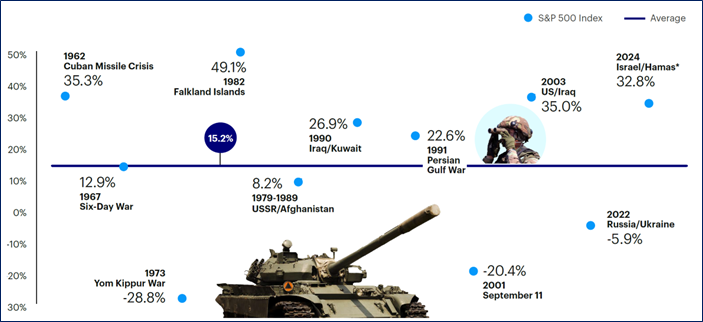
1) Defense Stocks: Ongoing conflicts in Ukraine and the Middle East have raised concerns about potential market disruptions. However, history shows that major geopolitical events involving military conflict since the 1960s have been followed by strong market performance, with the S&P 500 returning an average of 15.2% one year later. (7) These events also tend to boost demand for defense-related products and services. This is particularly true now with NATO members—Germany included—aiming to raise defense spending to as much as 5% of GDP. As globalization retreats and new spheres of influence form among global powers, we expect defense spending to remain a tailwind for select companies in the sector.
|