The Business Transition & Valuation Review
January 2, 2018
Next issue: Tuesday, January 16
|
|
In this issue
Lead Commentary:
Globalization, U.S. Trade Deficits, World Trade, Recommendations
& 6 news curations relevant to business transition and valuation that discuss automation, business sale, Cdn household debt, China, minimum wages, & online shopping
|
|
|
|
Globalization, U.S. Trade Deficits, World Trade, Recommendations
|
Synopsis
: This commentary discusses important economic causes and effects beginning in 1971 in the contexts of ongoing globalization, U.S. net trade deficits after 1970, and world trade. It includes resultant recommendations for business owners and their advisors.
|
|
|
I found 'Globalization, U.S. Trade Deficits, World Trade, Recommendations:
|
|
Very Informative and useful
|
|
|
|
|
Not informative and useful
|
|
|
|
|
|
|
Want commentary on a
business transition or valuation topic?
Write to me at icampbell@ircpost.com. I will write a commentary on your suggested topic, or find someone better equipped than me to write one.
|
|
|
|
Please forward this Newsletter email to a colleague, friend or client interested in Business Transition and Valuation
|
|
Comment
: This article reports a projection that suggests 21 U.S. states and 38 U.S. cities and counties will see minimum wages increased in 2017. One month ago Canada’s Province of Ontario passed legislation increasing its $11.60 per hour to $14 per hour effective January 1, with a further increase to $15 per hour on January 1, 2019 thereafter to be adjusted upward with inflation. See
$15 minimum wage, emergency leave become law as Ontario passes labour reform legislation, CBC News.
For business owners this is a big deal in the U.S., Canada, other developed countries. By way of surprising example, I have been told one Ontario golf course expects its employee wages to rise by $140,000 per year – where a good part of its staff are seasonal workers. Its Board apparently has already increased annual dues to accommodate this cost increase.
I suggest these substantive minimum wage increases are predictive of even bigger deals to come as government debt and consumer debt in relation to consumer disposable income both continue to escalate.
I have previously said, and say again, that going forward businesses are likely to be subjected to various forms of government levies, tariffs, tolls, and taxation as wealth disparity increases and an ever broader band of developed country populations experience lifestyle erosion.
This is something for business owners and their advisors to focus on now – although the problem seems circular. This where it is arguable that the better businesses perform going forward, the greater the likelihood they will be called on by governments to subsidize society.
|
|
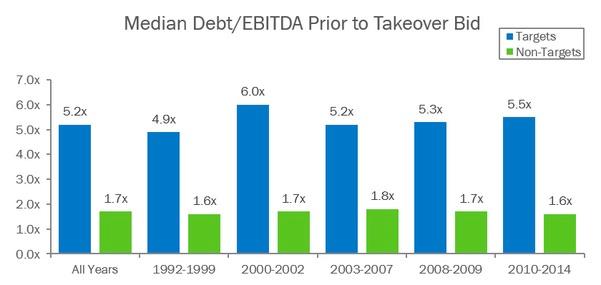
Comment: This article discussed five things its author suggests business acquirers look to. They are purchaser attraction to (1) growth, (2) historic profitability, (3) companies with higher leverage, (4) larger size, and (5) lower liquidity as measured by current ratio.
Certainly the growth potential and size criteria mentioned in the article make sense. However, one might reasonably question whether the statistics and commentary set out in the article related to ‘higher leverage’ and ‘lower liquidity’ purchaser ‘attraction’ do anything more than suggest the most likely takeover targets are those in – or close to – financial distress. That is something I doubt.
My experience is that strategic buyers ‘pay up’ for businesses that have good prospective growth, good returns on equity and are solidly financed. I have less experience with financial buyers. However, in a competitive market place financial buyers may have to ‘pay up’ for ‘synergies equivalents’ they have no way of realizing post-closing. I have always thought it important that with exceptions financial buyers are purchasing businesses with ‘other people’s money’. This where it can be argued businesses become ‘commodities’ in the hands of financial buyers. Something to think about if you are a business owner before you let the ‘financial buyer camel’ into your ‘business tent’.
|
|
Comment: There can be little doubt that aided by ongoing technological change – perhaps with emphasis on big data –consumer conversion to online shopping is escalating at what seems to be an increasing pace.
This article does not emphasize what this means and increasingly will mean to bricks and mortar retailers – something those retailers and their advisors need to focus on in long-term business viability tests and business value determinations. It also does not talk about what this means to delivery businesses and their prospective value. It does emphasize how technology is improving the enabling of comparison shopping – potentially generating an anti-inflation result.
A chart shows online shopping as a percentage of retail trade for nine countries – including Canada and the U.S. escalating significantly after 2010. The article suggests that by 2030 half of all credit card purchases will be made online. One might wonder whether the rate of change may be more exponential than that.
|
|
Comment: This article focuses attention on a
ZipRecruiter survey titled
State of the American Job Seeker. The survey of 1006 U.S. adults 18+. was conducted online over 19 days ending September 18, 2017. That survey of ‘job seekers’ – 599 were employed and actively looking for another job while 407 were unemployed and looking for work – found:
1. 77% said they have heard the term automation, but that only 30% said they are very familiar with the term and have an actual understanding it.
2. 64% think that in their lifetime workers in most industries will be replaced with computers or robots.
3. 49% believe technological advances have negatively impacted their career.
4. 66% believe technological advances have negatively impacted their town.
5. 60% believe fears around robots taking away jobs are overhyped.
6. Over 80% agree current technology has left certain people and cities behind. ‘Certain is undefined’.
7. 50% think the Internet has done more harm than good.
8. 44% believe there is no ‘bad technological advancement’.
These survey results are interesting to say the least. One might think these U.S. survey results would be similar was the same survey given in other developed countries. Accordingly business owners and their advisors everywhere will do well to think about these study findings and technology as it may impact specific businesses in the contexts of future business viability, value and transition.
|
|
Our information/reference book receives
|
|
|
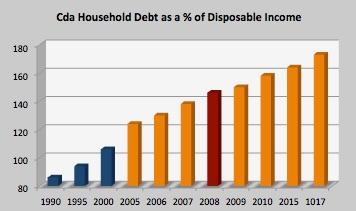
Comment: This is an article that focuses on Canada’s household debt to disposable income ratio – 173% in late 2017. It does this in the context of the possible negative influence on Canadian house prices going forward. I suggest that may be talking about an ant possibly biting a person on the foot, where a hungry lion may be lying in wait just around the next corner.
The chart is one I developed from readily available statistics. It shows the increase in the Cdn household debt to disposable income ratio from 1990 to date – with emphasis on the years leading up to and after the 2008 world financial crisis (orange columns). Note the rapid acceleration in this ratio after 2000 and continuing.
Canada’s reported household debt to disposable income level at 173% is among the highest in the world. Canada is the world’s 10th largest economy measured by nominal (inflation included) GDP. Of the nine other world economies included in the top 10 by size, four – France, Germany and Italy and the United Kingdom – if consistently reported all have significantly lower reported household debt to income levels than does Canada. I was unable to find a similar statistic for the other five ‘big ten’ economies – being Brazil, China, India, Japan and the U.S.
My bottom line? The game of economic musical chairs continues as the rusty can being kicked down the road becomes ever more battered and tattered. Obviously not everyone – including financial markets participants – agrees with me. But if I prove to be right business owners will be better off with stronger than weaker balance sheets at some future date. Something for them to ponder as they drive their cars between meetings.
|
|
Comment
: There can be no doubt China is increasingly important on the world stage. Whether “this is China’s century” remains to be seen – but that it might be can’t be disregarded out of hand.
This article includes five maps of China with accompanying narrative. The maps and narrative give readers a quick education on China’s language groups, population density, income by province, China’s topography, and the seas south and east of China, physical protections. The article claims “the core strategy of China is internal. It has only one external strategic interest – the seas to the east”. One might question that statement given China’s strategic investments in both developed and developing countries over past years and continuing.
That said, this article and its maps provide a quick overview of China’s physicality – and a quick narrative overview of China.
In the circumstances of China’s economic growth and increasing influence I recommend readers print this article and learn more about China than they may know.
|
|
No financial markets news articles are included in this issue.
|
|
Ian R. Campbell
is the principal contributor to this Newsletter. He has given business valuation and transition advice to both public and private company owners for over 45 years. Other contributors are experts in business transition or specific disciplines relevant to business transition and valuation.
|
|
Newsletter content ('Content') does not constitute individualized business transition, valuation, technology, economic or investment advice. The ideas, views and opinions expressed in the Content are solely those of the authors/contributors. Provided 'as is', Content may change without prior notice, may be incomplete, inexact, incorrect or jurisdiction specific. It is used at the reader's own risk.
|
|
Copyright © 2017 Transitus Publishing Inc. All Rights Reserved.
|
|
|
|
|
|
|