|
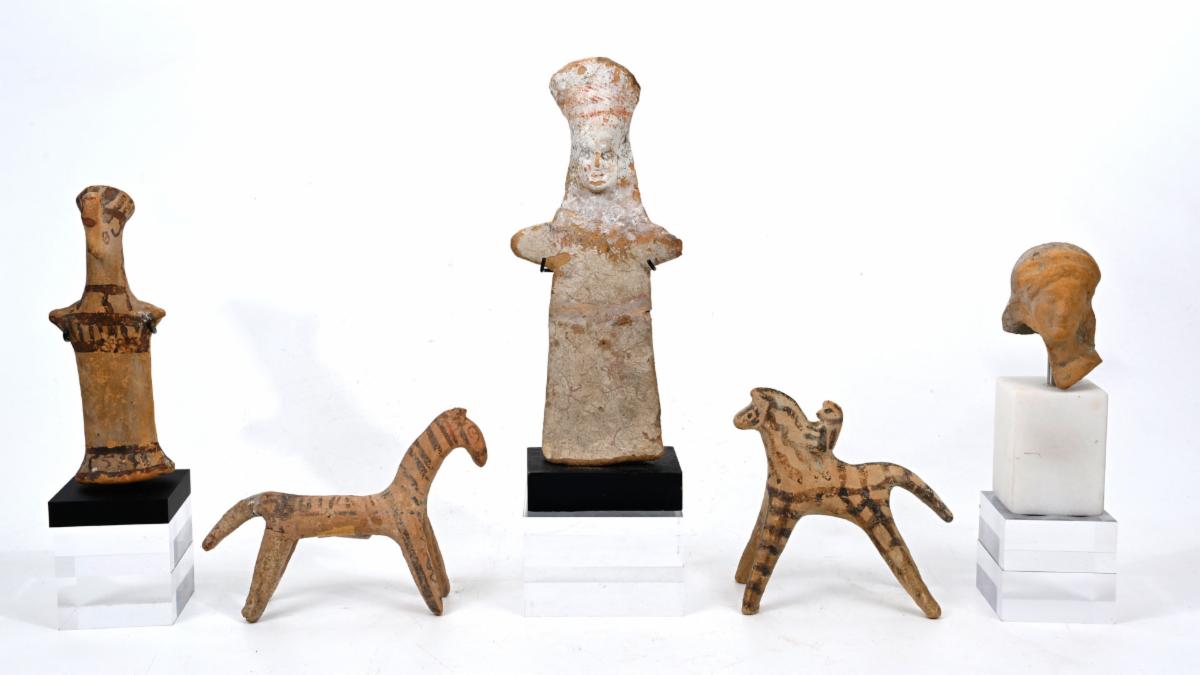
Two goddesses, two horses, and the head of a third goddess: five Greek terracottas, now together in the gallery. Three stand out.
The Boeotian plank goddess, ca. 550–500 BC, belongs to a type known as “Papades,” a name taken from the figures’ tall, priestly crowns. She is hand-modeled and nearly flat, with short peg arms and a rolled lock of hair on the forehead under her polos. Her garment is painted in brown-red slip. A comparable example is in the British Museum.
The second goddess, also from Boeotia and dated ca. 650–500 BC, is larger, at 7⅝ inches. She stands with arms outstretched, and her face and radiating headdress are painted directly onto the clay.
The horse and rider, Boeotia, 6th century BC, reduces horseman and mount to a few lean shapes: long legs, a prominent snout, and a crested mane, with traces of umber stripes. In Archaic Greece a horse was a mark of standing, and these small riders carried that meaning in clay.
Please also check out our recent acquisitions.
New: Howard has started a monthly newsletter on LinkedIn, Provenance and Value, on valuing and handling ancient and tribal art in estates. The first issue covers three questions to answer before anyone names a price.
Best,
Howie and Dara
|