Gwyn Guenther, President, The Wheeler Report

October 20, 2025

Governor Moving Forward with Prison Changes


Governor Evers announced his administration plans to move forward with his correctional facilities plan announced in February. The plan aims to close the Green Bay Correctional Institution and Lincoln Hills and Copper Lake Schools. The Governor, as chair of the State Building Commission, intends to ask the Commission at their meeting on Tuesday, October 28th, to release $15 million from the 2025-27 State Budget to allow the Department of Administration to get contracts in place for the development of the preliminary plans.


In February, Evers announced that Wisconsin’s prison population was beyond its designed capacity (housing 23,074 with a capacity of 17,638). He called his proposal a “domino” series of facility changes, improvements, and investments. The proposal announced in February included:  


  • Completing construction on the planned Dane County Type 1 facility in late 2028, with plans to close Lincoln Hills and Copper Lake schools in early 2029.  


  • Making key upgrades that allow the Department of Corrections (DOC) to convert Lincoln Hills and Copper Lake Schools into a 500-bed, medium-security adult facility. 


  • Closing Green Bay Correctional Institution and converting Stanley Correctional Institution to a 1,500 maximum-security institution with the ability to “flex” as a medium-custody institution. 
  • Converting the facility would allow DOC to absorb all persons in care at Waupun and Green Bay Correctional classified as maximum-security.  


  • Converting John Burke Correctional Center to a female institution, adding 300 women’s beds to DOC’s system at no cost.  


  • Expanding Sanger B. Powers Correctional Center to increase bed space by 200 minimum-security beds, adding much-needed minimum-security beds to the system, and accounting for some of the displaced workforce at Green Bay Correctional Institution. 


Wisconsin FY2025 Ended with $4.6 Billion


According to a release from Governor Evers, the state ended Fiscal Year (FY) 2025 with a positive ending balance of $4.6 billion in the General Fund. The release comes in response to the Department of Administration Annual Fiscal Report for FY2025 which states, “The General Fund has an undesignated balance of $4.606 billion as of the end of the fiscal year. General purpose revenue taxes were $22.363 billion compared to $21.330 billion in the prior year, an increase of $1,033 million or 4.8 percent. General purpose revenue expenditures, excluding fund transfers, were $21.118 billion. This is $169 million more than the budgeted expenditure allocation of $20.949 billion.”


The report went on to say, “In fiscal year 2025, the State of Wisconsin continued to devote a major share of state tax collections to the assistance of local school districts, municipalities and counties. Local assistance accounted for 44.8 percent of total general purpose revenue expenditures. Aid payments to individuals and organizations represented 30.1 percent of total general purpose revenue expenditures. The University of Wisconsin accounted for 6.3 percent of total general purpose revenue expenditures and state operations expenditures for all other state agencies accounted for 18.8 percent of the total.”


Session Updates


Both the Senate and the Assembly were on the floor on October 14th. The floor session started with both houses recognizing First Responders from across all of Wisconsin. On the 14th, both chambers took up a number of public safety proposals while the Senate also passed several health care proposals. A week prior, the Assembly was also in session to pass housing proposals.


There are currently between two and three dozen bills which have passed both houses and are ready for executive action by the Governor. The next floor period for the Legislature is scheduled for November 11th-20th. While no specific dates have been set yet, it is anticipated that each house will meet at least once during that two-week period. 


Flurry of Introductions


Legislators have been introducing bills in succession recently. Since the signing of the budget (July 4th), Legislative Democrats have introduced over 10 bill packages and Republicans have introduced at least two packages and created four Speaker’s Task Forces to draft legislation for the January/February session. Those packages include:


Republicans

  • Housing
  • Elections


Democrats

  • Accountability for For-Profit Colleges
  • Rights of Nature
  • Higher Education
  • Pro-Democracy
  • V.O.T.E.
  • CWD Prevention
  • Freedom from Fear
  • Kids First
  • Education
  • Labor - Build a Stronger Wisconsin
  • Keep Families Together
  • Gun Safety

Important Updates from the League


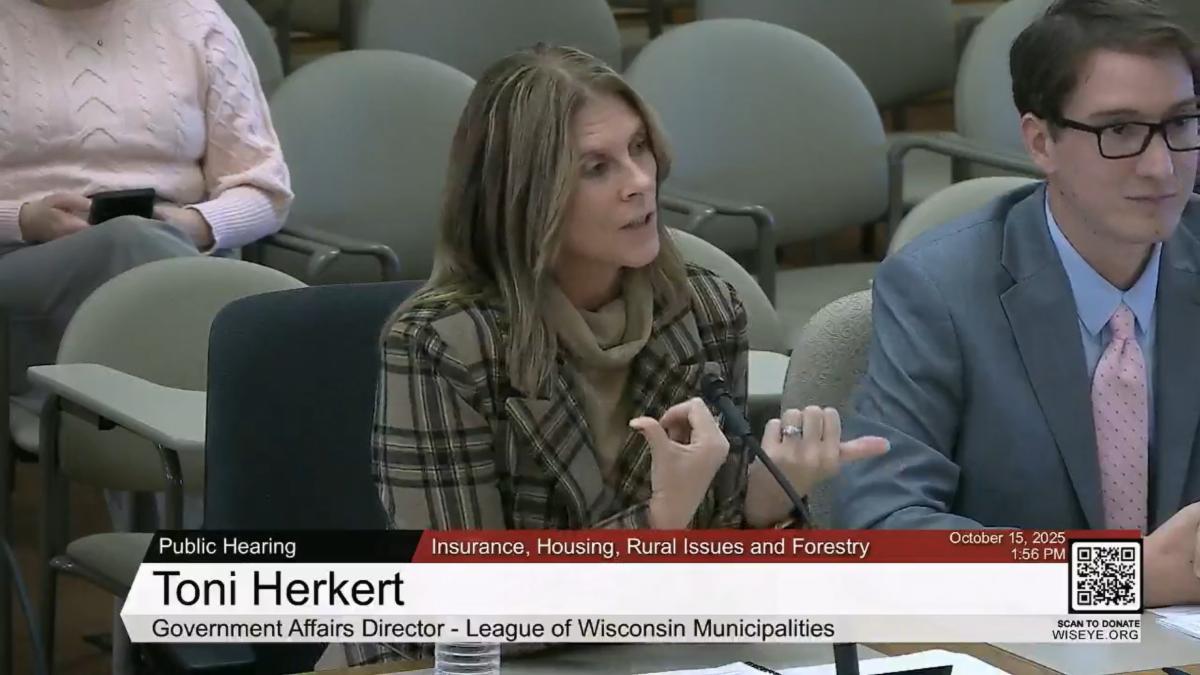
⭐ Senate Hearing on Housing Bills: Last Wednesday, October 15th, the League Government Affairs team testified in the Senate Committee on Insurance, Housing, Rural Issues and Forestry on a series of housing bills. Of the seven bills, five have already passed the full Assembly and the remaining two have passed Assembly committee with all seven receiving bipartisan support in the process.

According to a recent analysis by the National Association of Realtors, Wisconsin is home to six of the top ten and seven of the top twenty hottest housing markets in the country. Listings in those metropolitan areas saw an average of 2.8 times the number of views compared to all U.S. listings in September and sold an average of 27 days faster.

Municipal leaders have created communities that people want to live and work in, but our housing supply has fallen behind.


The League’s testimony, which may be read here, addresses the need for municipal officials to continue playing a leading role in addressing Wisconsin’s housing shortage and affordability crisis while recognizing that a statewide approach may be beneficial when appropriately tailored. With the League’s engagement and advocacy prior to introduction and through the amendment process, that balance has been more appropriately achieved in these bills as amended. 


To learn more about the housing legislation, review the League’s overview of this package including the status of the bills as of last week and an overview of the amendments on each bill. More action is expected in the Senate committee in the coming weeks. Stay tuned to the Legislative Bulletin for additional updates on this package as it continues through the process. 


⭐ EPA Webinar on Brownfield Grants: The U.S. Environmental Protection Agency (EPA) is hosting a webinar this Wednesday, October 22nd from 12:00pm to 1:00pm Central Time to assist applicants who are interested in applying for its competitive Brownfield Assessment and Cleanup Grants. The webinar will cover key requirements and provide an overview of the process from application to evaluation and selection.


Municipalities of all sizes across the state have received funding from this program in previous grant cycles producing shining examples of effective redevelopment as a result of this assistance. If your municipality is looking at a brownfield redevelopment you may register to attend this webinar here. Examples of recent Wisconsin recipients may be found on EPA’s website. 


⭐ Housing Loan Program Applications: The three loan programs at the Wisconsin Housing and Economic Development Authority (WHEDA) created through a historic $525 million investment in the 2023-2024 Legislative Session will soon open again for applications. The Restore Main Street Program, Vacancy-to-Vitality Program, and Infrastructure Access Program all offer low-interest rate loans to close financing gaps for workforce housing projects in Wisconsin.


On Tuesday, October 21st, the next round of loan applications will open for these three programs. Applications are due on Friday, November 21st. While municipalities are only eligible to apply for the Infrastructure Access Program, all three programs require municipal participation in the loan application from housing developers. To learn more about these programs and prepare an application, visit WHEDA’s website. 


⭐ Municipal Flood Control Grants: The Wisconsin Department of Natural Resources has announced that the 2026 Municipal Flood Control Application Cycle is now open. This popular competitive program assists local governments in addressing flooding concerns through property acquisition, structure removal, floodproofing, riparian restoration, flood control detention ponds, studies and mapping projects, and more.


$3 million is available in the 2026 application cycle with a per project cap of $600,000 in grant assistance. Each grant may be awarded for up to 50% of total eligible costs and local matches may not be met with other sources of state funding. Applications are being accepted through March 16, 2026, but if your municipality is interested in applying, you’re encouraged to submit early. This is a highly competitive grant program that is always oversubscribed!

Email questions or comments to:

Toni Herkert, Government Affairs Director, therkert@lwm-info.org

Evan Miller, Government Affairs Specialist, emiller@lwm-info.org

Facebook  Twitter  LinkedIn  Web