|
In this edition:
- A message from the Director of Education
- Senior Leaders' Briefing
- Inspection Updates: SIAMS
- Inspection Updates: Ofsted
- Safeguarding
- New Diocesan Academy Strategy
- Appraisal, Pay and Capability
- Admissions
- Overwhelming Challenge of Headship
- Attendance Guidance Changes
- ESFA to Close
- Academy Trust Handbook
- Chair of Governors' Network
- Diversity, Teacher Recruitment and Progression
- Good Governance Report
- Foundation Governor Vacancies
- Six Free Briefings for Governors
- School Leaders' Conference
- Additional Updates
| |
|
A message from Simone Bennett,
Diocesan Director of Education
Dear Governor Colleagues,
As summer draws towards a close, so our new school year begins. This is a time of fresh starts, the simple pleasure of a new exercise or notebook, new pupils and staff and the anticipation of what lies ahead.
Every new school year is a time of opportunity. A time for new goals, new roles and personal and professional growth. Lamentations 3 reminds us, “The steadfast love of the Lord never ceases; his mercies never come to an end; they are new every morning; great is your faithfulness.” Trusting in God, each other and ourselves can bring us the wisdom, courage and joy we so often need day to day.
In school, we do not journey alone. We are part of the wider diocese and the family of church schools. Over the Summer I visited an ancient church. On the wall was the outline of a cross, long since removed and yet the outline remained. Similarly, each headteacher and leader serves as a gatekeeper for a time. They, along with every staff member, governor, pupil and family leave their mark. Each one contributes something unique, enriching the lives of our schools and communities for everyone.
So, whether returning or starting out with us for the first time, welcome back. Wherever you are on your faith and education journey, on behalf of myself, the education team and the Diocesan Board of Education, thankyou for all you are and will bring this academic year. Thankyou for all you will sacrifice and all you will share as you create the next chapter of your school.
One thing is certain, there will be moments of joy and triumph, disappointment and struggle. We are here for you. We offer you our on-going support, encouragement and love as you navigate your role with purpose, kindness and integrity.
As you shine and share the light of Christ in every classroom and with every member of your school community, may this year be a manageable one - one where you can fully flourish.
I look forward to seeing you at this term’s Senior Leaders’ Briefing, on September 19th 5 – 6 pm.
God bless.
Simone
| |
|
|
Senior Leaders' Briefing
Thursday 19th September 5 pm - 6 pm
FREE to schools in the ESP
A termly meeting for senior leaders, including governors, to update them on national, local and diocesan matters. An excellent opportunity to keep up to date and network with colleagues from across the diocese.
Please note that you will need to enrol even if you booked last time.
| | | |
|
Inspection Updates
SIAMS
SIAMS Inspections 23/24 Annual Report Findings
The Church of England’s National Society for Education has published its latest annual inspection report for Church schools, showcasing the successful shift to the new framework in September 23 which replaced single-word inspection grades. The report highlights that over 99% of SIAMS inspections in 2023-24 were described as less stressful for school leaders but more rigorous in evaluation. Dr Margaret James, National Director of SIAMS, is keen to point out that this illustrates that compassionate accountability can coexist with high standards.
In the academic year 2023-2024, a total of 904 inspections were conducted by SIAMS. These inspections account for approximately one-fifth of all Church of England and Methodist schools in England. The total number of inspections is almost double that of the previous year, reflecting a significant increase in inspection capacity.
The report praises schools that have embedded a robust Christian vision, noting that such environments foster spiritual, moral, and emotional development, leading to well-rounded and resilient pupils. Inspirational and inclusive collective worship, embedded into daily routines, has been essential in promoting spiritual growth and community spirit. The report also commends schools where the curriculum aligns with Christian vision and values, enhancing pupil engagement and holistic development. Schools that encourage spiritual exploration have seen pupils demonstrate a deeper understanding of both their spirituality and broader human experiences.
However, the report also identifies areas needing improvement. Over 25% of Church schools struggle to integrate spirituality into the curriculum, hindering personal development. The report urges schools to regularly review their RE curriculum to reflect Christianity as a global faith, while exploring diversity within all world faiths within their syllabus.
Inspection evidence since 2021 has shown that some schools only engage with expert support from their diocese in the year before or during their SIAMS inspection. The report is keen to stress that, as this only happens every five years, school leaders are taking longer to understand important concepts, slowing down the overall improvement of Church schools across the country. We encourage all of our schools to engage with the Diocese annually through the ESP. Governors have a key role in ensuring that schools sign up and make best use of the support.
You can read the full report here.
Support for schools with SIAMS and Self Evaluation
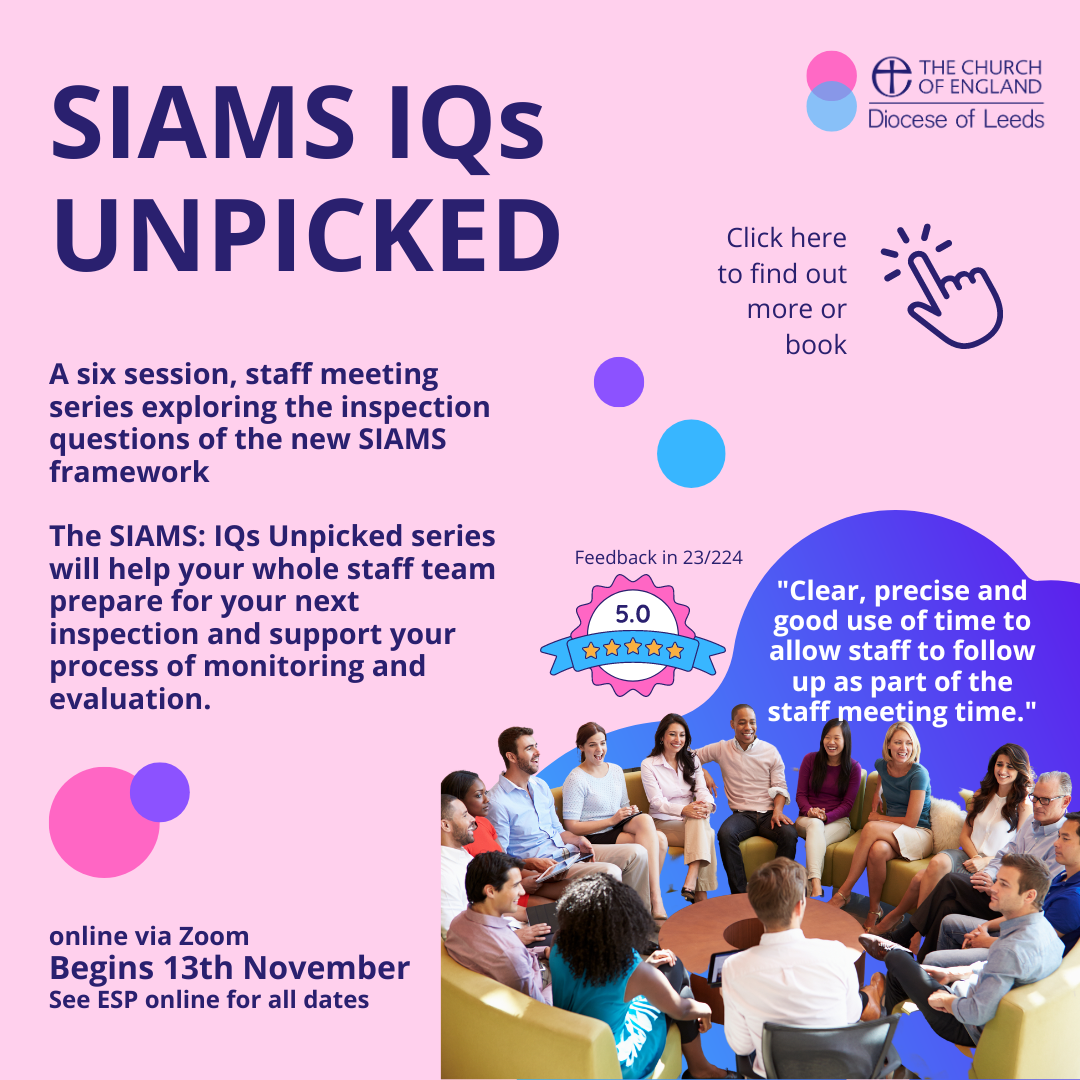
Following the success of the course last year, we are delighted to be repeating our programme for whole staff teams, which could include governors. Called SIAMS: Inspection Questions Unpicked, this course is threaded throughout the year and designed to slot into a schedule of staff meetings. This is so that whole staff teams can learn about the new framework whilst also exploring and self-evaluating the distinctiveness of their school. Find out more here.
Changes to SIAMS in September 24
The only change of significance is that the report format for schools that receive a J2 judgement has been amended. You will also notice that much of the SIAMS paperwork has changed this year. Please note that this is purely cosmetic as documents have been updated to match the new logo and design suite of the National Society.
| |
|
|
New to the SIAMS Framework
Tuesday 1st October 1 - 3.30 pm
Church House, Leeds
£90 for schools in the ESP
Join us for this half-day exploration of what this means to schools. This session is for all those new to the SIAMS framework and is suitable for all school leaders and governors.
| | | |
|
OFSTED
Ofsted has hogged the educational headlines at the start of this term. Below is a summary of changes, both immediate and expected.
Summary of Ofsted changes
- Graded inspections resume in the week beginning 23rd September.
- Schools will be notified of inspections on Mondays, inspections will take place on Tuesdays and Wednesdays.
- The government has scrapped the 'overall effectiveness' grade for schools with immediate effect, schools will still receive grades in sub-judgments.
- Promotional material, following inspection, in future should not include Ofsted logos
- Ungraded inspections will resume in the week beginning October 7th.
- Ungraded inspections will not include deep dives.
- Judgements will be withheld from schools where there are safeguarding concerns, with schools being revisited within three months.
- The coasting schools' policy, which triggered intervention in schools with two or more consecutive ‘requires improvement’ judgements, has been withdrawn. Instead, those schools will now be known as “struggling” and be given support instead.
Forthcoming changes
- Regional improvement teams are to be introduced early in 2025.
- Ofsted will use this year to consult on new phase-appropriate inspection frameworks. These may well have a greater focus on pupil outcomes but it has been stressed will not lose the importance of curriculum and early reading.
- The new report card system will come in next September alongside the new inspection frameworks.
- There is expected to be a greater focus in the new frameworks on how well schools meet the needs of their vulnerable pupils, with talk about a possible separate grading for this.
Surveys and Reviews on the Culture of Ofsted
Ofsted described feedback on its internal culture as the "most challenging" aspect of its Big Listen survey. Counter to the view often portrayed by politicians that parents welcome Ofsted, a study by NatCen involving 4,349 parents and carers, revealed that only 49% trusted the inspectorate, while 25% disagreed that it could be trusted. Schools were even less likely to express trust in Ofsted. According to IFF Research findings, less than three in ten schools agreed that Ofsted achieved its goal of being trusted.
This was echoed in the review commissioned by Sir Martyn Oliver following the tragic death of Ruth Parry. Former chief inspector Dame Christine Gilbert’s lessons learned review said the headteacher’s suicide had “shone a light on a climate of fear and frustration around school inspection, which had been building for years”. And that this climate “had the consequence of weakening trust in Ofsted, which was increasingly seen by many as defensive and unwilling to respond constructively to criticism”. It also impacted school leaders’ and staff wellbeing “and thereby contributed to the recruitment and retention crisis evident across the sector”.
See the links below which may be helpful:
Changes to ungraded inspections
| |
|
Focus on SEND: Hear from Gary Aubin about best practice at our conference.
Ofsted have announced that inclusion will be a key part of the school report card to be introduced in September 25.
In the national press, Gary has warned of the dangers of the unintended consequences of planned Ofsted changes. Gary Aubin, author of The Lone SENDCO, is the SEND Content Specialist for the Education Endowment Foundation. He has worked with many school leaders on high-quality teaching for SEND and writes the SEND Matters UK blog. Currently, he's Head of Special Educational Needs for a Multi Academy Trust and has experience as a secondary teacher, SENDCO, and Head of Year.
| |
|
|
Safeguarding
As usual, on the first day of this term, the Department for Education (DfE) released an updated version of Keeping Children Safe in Education (KCSIE), the statutory safeguarding and child protection guidance for schools in England. This new edition replaces all previous versions and was first published for information in May 2024.
Governors should read the full document to understand their safeguarding responsibilities thoroughly to ensure they are aware of the statutory requirements and are able to oversee and monitor safeguarding procedures within the school effectively.
Notable updates in KCSIE 2024 include:
- An updated definition of ‘safeguarding and promoting the welfare of children,’ aligned with Working Together to Safeguard Children 2023.
- Additional details on when children may need early help, in line with the Working Together guidance.
- A recommendation for school staff, governors, and trustees to refer to the DfE’s Data Protection guidance for schools to better understand data protection requirements.
- Clarification that schools remain responsible for safeguarding pupils placed in alternative provision settings.
The Southport attacks and Violent Disorder.
Following the above events the DfE published information on 30th August which may be helpful to Governors, including links to resources and guidance available elsewhere.
You can read the article here.
Mental health and wellbeing
The team at Anna Freud's Mentally Healthy Schools campaign have updated their termly calendar for this coming term. Not only is this a good resource for schools but also provides a useful resource for governors who don't have the educational background to demonstrate the work schools are able to do in this area.
The resources can be accessed here.
| |
|
Revised Diocesan Academy Strategy On Its Way
This term we will be launching an updated Diocesan Academy Strategy. The Board of Education maintains its neutral view on whether maintained schools should become academies but also emphasises that all maintained schools should give due consideration to becoming an academy on a regular basis. Updated guidance to be published will provide additional support to boards on this. The new strategy document will provide greater clarity in some areas as well as additional assurance to our schools that the distinctiveness of our church schools will be protected in multi-academy trusts.
The strategy will be launched and sent to schools on Monday 30th September and be followed by a briefing for governors on Thursday 3rd October at 6 pm.
| |
|
|
Governor Briefing: The Academies Programme
Thursday 3rd October 6 - 7 pm
FREE to schools in the ESP
What is an academy? What is a MAT? What are the Diocesan expectations about becoming an academy? How would the distinctiveness of our school be protected in a MAT?
| | | |
|
Appraisal, Pay and Capability
The DfE has updated its appraisal, pay, and capability guidelines, effective from September 2024, following recommendations from the School Teachers’ Review Body (STRB). These updates, including a 5.5% pay rise, apply to maintained schools and encourage a more supportive appraisal process, focusing on fairness, openness, and reducing workload.
The new guidelines stress collaboration with all stakeholders minimising unnecessary burdens like paperwork and extensive evidence collection. With the removal of performance-related pay requirements, there is an increased focus on professional development (CPD) and teacher wellbeing and workload.
From 2024/25, pay decisions will no longer be tied directly to appraisal outcomes, but schools will still need to make pay decisions after appraisals. Schools can retain aspects of performance-related pay but must reduce workloads and clarify their pay policies annually. Supportive measures should precede formal capability procedures if performance issues arise. Appraisal and capability guidelines are now published separately, though the capability process remains unchanged.
Schools that use our headteacher appraisal service will be emailed our updated guidance document regarding headteacher appraisal, which includes a more detailed summary of changes.
Links to the latest guidance are below:
Teacher Appraisal: Guidance for Schools (from September 24):
Teacher capability Guidance for schools when dealing with serious under-performance July 2024:
Managing Teachers’ and Leaders’ Pay Advice for maintained schools, MATs, academies and local authorities July 2024
| |
Please share this Update with the rest of your board. Back copies of Governor Updates are now stored on ESP Online. | |
|
Headteacher Appraisal Service
Just under 100 of our schools have already signed up to use our service to support governors as external adviser to the headteacher appraisal service. This service has grown quickly as a result of word of mouth between school leaders. Feedback last year was positive, 100% of respondents stating that they would recommend it. As one chair of governors stated:
'The service is excellent, as is my school adviser. Extremely supportive, challenging, approachable and a really good person to work alongside.'
Schools in the ESP receive a 40% discount, worth £300, please contact your named adviser if you are interested or arrange dates as soon as possible if you have already signed up.
| | |
|
Admissions
For those schools that are responsible for their own admissions.
Just a reminder that we advise schools to revise their admissions policies on an annual basis. The result of this review will be that you either wish to amend your policy for 2026-27 or keep it the same.
If you are keeping it the same you merely need to ensure it is up to date (amending dates, checking links etc.). If so, it still needs to be officially adopted at a full governing body meeting before February 28th 2025.
If you are making changes to your policy then you need to go through a consultation process. The draft policy needs to be sent to the Diocese in advance of the consultation. Please send it to info.ed@leeds.anglican.org. Consultation must take place for six weeks between October 1st and January 31st. For schools wishing to make changes to their policy, Diocesan guidance is to use the Church of England Admissions Builder tool. This is an online tool where governors simply upload a logo, answer questions and select oversubscription criteria and it produces a PDF of a compliant admissions policy.
Click here to access Admissions Builder online.
Diocesan Guidance and Admissions Information
| |
|
Sutton Trust Dashboard
In the last issue of the Update, we promoted the work of the Sutton Trust on Admissions, their report findings on secondary schools and suggested actions for ensuring that admissions policies are inclusive. They have since published a School Admissions Dashboard. This is an interactive map that enables users to compare Year 7 admissions over a three-year period in terms of students eligible for free school meals (FSM), relative to the proportion of those eligible for free school meals in their local area.
You can access the Dashboard here.
| |
|
 | |
Report Finds Overwhelming Challenge of Headship
Nearly half of experienced headteachers feel "trapped" or plan to leave their roles due to overwhelming challenges and insufficient preparation, training, and support, a recent study has found.
One contributor to the survey captured the mood of the report in stating that:
“I thought I had the skills and experience needed to do the job, but it is a job that is impossible to do in its current form. I have decided to leave while I am whole and still not broken.”
The report from SSAT, published in July, was based on a survey of 236 current and former headteachers with almost 2,000 years of combined experience, and highlights serious concerns about headteacher well-being. It raises the issue of rising demands alongside inadequate induction and training. Notably, 47% of headteachers with 6-10 years of experience do not intend to stay beyond the next three years, with many citing the role as "impossible" and lacking the necessary support to succeed.
The report provides a worrying insight into headteacher wellbeing. It identifies that a failure to provide effective preparation, induction, training and support (alongside significantly increased demands on them from all quarters) needs to be urgently addressed. This sense of a skills gap for newly serving headteachers is supported by the report’s insight that 34% of respondents felt that their preparation was limited, even those that had studied the NPQH. Many reported having to “sink or swim” whilst “learning on the job”. This is echoed for more experienced heads, with 40% of respondents reporting that they had very little or no formalised support for meeting the challenges of the role. As another respondent said, “Support for heads is truly inadequate in my experience. It is a very vulnerable position.”
You can access the full report here.
What Can Governors Do To Support School Leaders?
The Diocese recognised a gap in effective support for headteachers some time ago. As a result, the Education Team developed a series of Pathways for school leaders at different stages of their development. Each Pathway lasts a full year. During which time cohorts of leaders with similar levels experience reflect deeply on their own leadership practices, learn from each other and develop a strong network of colleagues with which they find mutual support. We would encourage governors to invite their heads and deputies to consider signing up to one of our Pathways. Attendance can even form part of the professional and personal development targets linked to appraisal.
| |
Attendance Guidance Changes | |
For those who missed our update last term, the DfE published an updated Working Together to Improve School Attendance Guidance in March. This is mandatory from this September. Changes include expectations on supporting pupils with mental health or physical ill health, new fine rates, absence thresholds at which penalties must be considered, requirements to share daily data and new absence codes. New expectations on schools and local authorities are summarised on page seven of the document.
Governors who don't want to read the 94 page document but would like to know about the changes, may find the following DfE webinar (1 hour) helpful:
Working Together to Improve School Attendance: DfE guidance overview for schools
| |
Closure of the ESFA announced from March 25 | |
The government has announced the closure of the Education and Skills Funding Agency (ESFA), with its functions moving to the Department for Education. Since 2017, the ESFA has managed funding for education and skills from early years to adulthood. Under the new structure, these tasks will continue within the department, offering schools a single point of contact for financial management. The Schools Financial Support and Oversight (SFSO) teams will transfer to the Regions Group by October 2024, while other core functions will join the Operations and Infrastructure Group by March 2025, centralising financial management and related operations.
You can read the full announcement here.
| |
Academy Trust Handbook 2024 | |
On 31 July 2024, the Education and Skills Funding Agency (ESFA) published the Academy Trust Handbook 2024, which will replace the current handbook, setting new expectations for trusts and academies effective from 1 September 2024. The key updates include:
- Trusts can now enter finance leases listed on the Department for Education's (DfE) approved list.
- Trusts with an annual revenue income exceeding £50 million must have a professional internal audit function, becoming a requirement from 1 September 2025.
- Trusts must consult the ESFA before implementing electric vehicle salary sacrifice schemes.
- Greater emphasis on meeting the DfE’s digital and technology standards.
- Clarified qualifications and experience requirements for trustees and peer reviewers.
- Trusts must take steps to meet DfE cyber-security standards.
- Management of the school estate is now an added example where a ‘notice to improve’ may be issued.
| |
|
|
|
Chair of Governors' Network
Thursday 24th October 6 pm - 7 pm
FREE to schools in the ESP
A termly opportunity for those in the role of Chair of Governors to share ideas and resources and discuss matters relating to the leadership of the board. You may wish to invite your vice-chair of governors as part of your succession planning process.
| | | |
Diversity, Teacher Recruitment and Progression | |
We have previously reported on a lack of diversity on governing boards, which remains a long standing issue. At a recent WomenEd event, Evelyn Forde, former ASCL president, highlighted that non-White teachers face significant barriers to and how non-White candidates have lower success rates in teacher training and career advancement compared to White candidates. Forde also emphasised the lack of diversity on school governing boards. Which we have previously highlighted. Where an NGA national survey showed 95% of governors identifying as White.
The Diocese is putting together a planned programme of support for our schools in the area of Equality, Diversity and Inclusion and would like to hear from best practice examples. Please get in touch if you have something to share. Email our Deputy Director at darren.dudman@leeds.anglican.org.
| |
Focus on diversity: Join us at our conference and hear from Jeffrey Boakye
Jeffrey is an author, broadcaster, and educator focused on race, masculinity, education, and culture. From Brixton, London, he taught secondary English for 15 years and is now a senior teaching fellow at the University of Manchester. His books include Hold Tight, Black, Listed, and I Heard What You Said. He co-presents BBC Radio 4's award-winning Add to Playlist and lives in Yorkshire with his wife and two sons.
| |
|
Growing Good Governance Report | |
Before the summer, the National Governance Association (NGA) published a report that captures the state of governance practice in England. The report draws upon the analysis of external reviews of governance (ERG) reports from the National Leaders of Governance (NLG) programme and NGA's wider sector intelligence. Holding leadership to account is a significant challenge for a majority of governing boards across all structures.
The report recognises positive evidence of improving and effective school and trust governance practice. It also calls for a shift towards proactive and strategic governance approaches, highlighting the essential role of skilled professionals in board effectiveness. This is a direct barrier to achieving good governance and was identified as problematic in 68% of ERGs.
The report also underscores the value of external reviews of governance. We support the DfE guidance which states that boards should have an external review of governance every three to four years.
Boards wishing to have a review which includes a church school distinctiveness should speak to their named adviser as our education team offers this service at a reduced rate to schools in the ESP.
You can access the Good Governance Report here.
| | |
|
Foundation Governor Vacancies
We have updated our guidance on foundation governor vacancies. It isn't a list of ready and willing volunteers but it is full of ideas picked up over time by our team. It may help support your search.
Top tip: Look for governors before you have a vacancy.
You can access the updated guidance here.
| |
Other items of news which may be of interest... |
-
The Department for Education (DfE) has launched a £4 million project to reduce teacher workload by improving AI tools for tasks like lesson planning and marking. The initiative aims to align AI tools with educational needs while addressing ethical and safety concerns through a forthcoming safety framework. See the announcement here.
-
Diversity Role Models has published a new best practice guide for schools to help with preventing bullying in school. You can access the guide here.
-
Stars In Our Schools is organised by UNISON as a celebration of all school support staff across the UK. We know our schools are great at valuing all staff whatever their roles. Schools are encouraged to take part. Read more here.
| |
|
© Anglican Diocese of Leeds, 2024
Diocesan Education team
Church House, 17-19 York Place, Leeds, LS1 2EX
0113 200 0540
info.ed@leeds.anglican.org
www.leeds.anglican.org/education/home
Why am I receiving this email?
This email from the Diocesan Education Team is sent to those who have asked to receive it by 'subscribing' or who receive it because they have a relationship with the diocese, holding an office or position in a church in the diocese, a church school or access our services through the Enhanced Service Plan. However, if you do not wish to continue to receive these emails, simply use the 'Unsubscribe' button below.
Under no circumstances are email addresses shared with third parties.
| | | | |