|
There’s a phenomenon in the lexicon of leadership, called ‘hero leadership’…
It’s where a leader makes all the decisions because they think they know better than anyone else.
Most commonly you see it in entrepreneurial organisations trying to make the step-change to becoming corporate... they won't let go.
At the other end of the scale you see it with leaders and managers appointed above their pay-grade, who think they know better and try to make all the decisions themselves.
Nearer to home we see it in the NHS, since Wes Streeting arrived...
... tear-up NHSE, trash ICBs, sack half the people… not sure which half… with no risk analysis, organisation-plan, workforce-plan or money…
… because he thinks he can make better decisions that the people who have spent a lifetime in the service, know it backwards, have studied and accumulated lines of qualifications and experience…
… his real intent… to look ‘heroic’ (save the broken-NHS) and as much like Donald Trump and mad-Musk with the chainsaw, as possible.
Under normal circumstances we would look to the civil service to advise him, restrain him and behind closed-doors, tell him his fortune.
Instead, chaos, incoherence. Hero Leadership and a system developing with huge design flaws and a single point of failure…
... called Streeting.
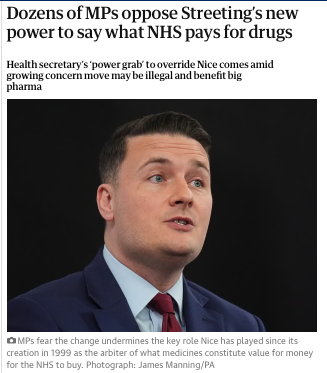
His latest madness is taking the power to lean on, or even override, NICE when it decides what the NHS should pay for medicines.
Our hero will claim to do it quicker, faster access to new drugs, fewer bureaucratic delays, a bit of ministerial-muscle to get things done.
Scratch the surface and this is not about speed. It’s about control. Since its controversial creation, (and I was there) NICE has been the NHS’s referee…
… weighs evidence, calculates value, and says ‘no’ when a drug is not cost-effective.
That independence matters. It gives cover to difficult decisions and keeps the system anchored to evidence, not emotion.
Take that away, or blur it and you change the game.
Ministers don’t operate in a vacuum. They’re lobbied, pressured, and sensitive to headlines.
We’ve been here before.
- Relenza for the flu.
- Orkambi for cystic fibrosis,
- Spinraza for spinal muscular atrophy,
- Kadcyla…
… initially rejected by NICE.
Parents campaigned, charities mobilised, headlines demanded action. In most cases, access eventually followed, but only after hard price negotiations or managed-access deals.
That’s the point...
... NICE says ‘no’ not to deny care, but to force better value. Based on science, not pharma-shareholder value. Remove that and the lobbying won’t stop…
… it’ll simply move from an evidence-based process to a political one.
Drift from evidence to anecdote, from population benefit, to individual case…
… once that gate is open, it’ll swing like a barn door.
If Streeting wants NICE to decide faster, resource them and they will.
If Streeting wants to cut corners, he'll need a bigger desk.
The NHS is not a bottomless pit. If more is spent on drugs less is available for everything else. This is not new money; it's a reallocation.
Expensive drugs approved on softer grounds carries an invisible price tag somewhere else in the system.
Streeting is shifting from an arm’s-length, rules-based system to one of heroic ministerial discretion.
That comes with risk. Consistency erodes. Precedent becomes slippery. Accountability, paradoxically, becomes harder, not easier, because…
… when everything is a judgement call, nothing is.
Supporters will argue this is about innovation; getting cutting-edge treatments to patients faster. Fair enough. The NHS can be slow, and patients do sometimes, wait too long for proven therapies, but …
… speed and value are not the same thing… the genius of NICE is it balances both.
NICE isn’t just a British quango; countries like Australia, Canada, Germany and Sweden have copied NICE-style systems, while around 50 countries follow its lead, including the International Decision Support Initiative
Tamper with it, and the ripple goes far beyond the NHS.
The NHS survives on discipline. Not glamorous, not headline-grabbing, but essential.
The discipline to live within a budget.
The discipline to make decisions that are fair across a population, not just compelling in an individual case…
… erode that and you don’t get a kinder system. You get a chaotic one.
This is not to defend every decision NICE has ever made. It gets things wrong. It can be slow. It can be frustrating, but…
… it is at least transparent, structured, and grounded in evidence.
Replace that with Streeting and you may gain speed, but you lose something far more valuable… trust in the process.
If Streeting gets his way it will mark a huge shift.
-
From rules to judgement.
-
From independence to influence.
-
From putting a rationale behind the use of resources to…
… to headline grabbing.
|