Greetings!
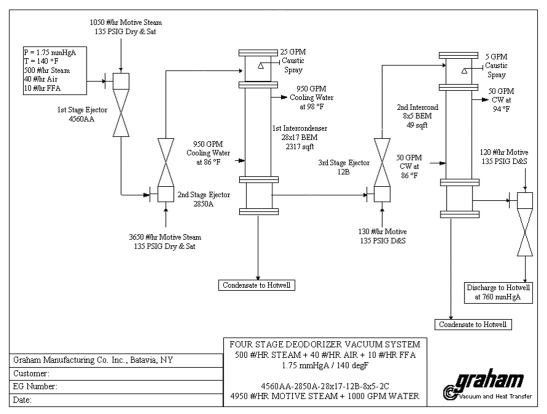
This article is going to provide an overview of vacuum systems in the service of edible oil deodorizing towers. "Edible oils" is a general term to describe cooking oils that are used to fry and bake foods. This discussion highlight how these systems are laid out and how they function. Deodorizing is an important process in the production of edible oils like vegetable oils and nut oils. It is vital to remove fatty acids and other volatile components so that they do not negatively affect the smell, color, and taste of the final products. This can only be achieved under a deep vacuum and that vacuum is usually generated using a steam ejector vacuum system.
The unwanted fatty acids and other volatile components are removed from the process using stripping steam in a deodorizing vacuum column. This is done at an elevated temperature around 450ºF – 470ºF and under a vacuum of 1.0 - 5.0 mmHgA in most instances. If the process was not at a deep vacuum, a hotter temperature would be needed to vaporize and strip out the fatty acids and volatiles. This hotter temperature would however degrade the oil, ruining the final produce, making a reliable vacuum system instrumental to a successful operation.