|
WHAT EVERY THERAPIST SHOULD KNOW ABOUT INSURANCE
By Barbara Griswold, LMFT
Author, Navigating the Insurance Maze
October 28, 2025
| | |
Hello, and happy Fall!
I can't tell you how touched I was by the outpouring of emails I got in response to my last newsletter article about therapist isolation (if you missed that one, you can read it here). So many of you wrote to tell me how it resonated with you. Repeatedly I heard, "thank you! I thought I was the only one who felt so isolated!" Best of all, many of you told me that the article motivated you to consider seeking regular consultation and support. This made my day.
If you are a Medicare provider, please read my second article below, which has two important updates for you.
Warmly,
Barbara
| | |
Year-End Reminders of "Grave" Importance
It is hard to believe it is almost Halloween, and in two busy, holiday-filled months, the year will be over.
So in the "spirit" of this spooky season, let's turn our attention to some year-end issues of "grave" importance that can "creep" up on you and your clients, and cause "mischief" for even the best therapists:
1. As we near the end of the year, clients may hit their Out-of-Pocket (OOP) Maximum. The OOP Maximum is the cap, or limit, on the amount of money the client has to pay out of their pockets for covered services in any plan year. This amount varies depending on the client's plan.
When the client reaches their OOP Maximum, claims will be paid in full by the health plan without a client copay or deductible taken out for the rest of the year. This means it is likely you will need to refund or credit any clients who paid copays for those sessions. So, at this time of year especially, closely examine your Explanation of Benefits (EOB) -- that document that tells you how each claim was processed -- for any changes in the amount paid for each session.
Keep in mind that some clients may never hit their yearly OOP Maximum. But some may reach it if the client or their family had significant health expenses that year. A client could reach their individual OOP Maximum OR their combined family expenses may use up their Family OOP Maximum. While the OOP Maximum will typically restart on January 1st, remember that some plans do NOT restart on the first of each year, so always check the dates when deductibles and OOPs restart.
2. In the next few weeks, your clients may be choosing their health plan for next year. It's a good time to ask them if they intend to make changes in health plan company or type of plan. Educate yourself about different types of health plans available (PPO vs. HMO, etc.) so you can assist clients to understand their choices. For example, if they switch from a PPO to an HMO plan, they must see a provider in their HMO network to be covered.
While you don't need to be an insurance expert, I believe basic healthcare education is an essential part of our job, and clients are usually grateful if you can help them "navigate the insurance maze." At the very least, you can help by suggesting good questions to ask. Without guidance, clients often sign up for the plan with the cheapest premiums, without evaluating the coverage, or the copayments and deductibles they will have to pay.
Help them verify that your sessions will be covered by their new insurance plan. If not, you'll need to discuss the cost of continuing treatment with you, or you may need to begin discussing a referral.
3. If you are not covered at all by the client's new plan, you may encourage the client to inquire about a possible Transition of Care (TOC) Agreement. If arranged, a TOC would mean you would sign a contract with the new insurance plan to provide a certain number of “transition” sessions JUST FOR THIS ONE CLIENT, even though you are not a network provider. The goal of the TOC is to give time to complete treatment or to transition the client to a network clinician. TOCs can often work out beautifully, but not always -- read more here.
4. Clients enrolled in Medicaid or who get their insurance through a state Marketplace (also known as an "Exchange") may be particularly vulnerable to insurance loss or changes. Due to changes in Medicaid programs, many clients will lose their Medicaid eligibility in 2026, and federal assistance for these plans will diminish in many states. Or your client may lose the Marketplace premium subsidies which have helped them to afford insurance in the past.
These health insurance cuts have been a main sticking point in the government shutdown standoff: Democrats insisted they will not pass any bill that would reopen the government unless it extended Affordable Care Act (ACA) tax credits which were expiring. These credits make health insurance cheaper for millions of Americans who get their insurance through state or federal ACA plans. Democrats also insisted on a reversal of President Trump's cuts to Medicaid, and they opposed spending cuts to government health agencies. Republicans said these healthcare negotiations could happen once the government reopened.
A final tip: Remember that in January, you will need to contact your clients' health plans (new or continuing) to check for changes in coverage -- particularly copay amounts.
| | |
Medicare Clarity?
CMS Finally Gives In-Person Guidance, but Delays Payments
Finally, we've received two important updates from Medicare!
1. About the In-Person Requirement: As you may recall from my previous article, as of October 1, 2025, Medicare now requires therapists to have an in-person meeting with NEW Medicare clients within 6 months prior to a first telehealth visit, and annually after that (with a few exceptions-- see my article).
However, it was unclear if this rule applied to your EXISTING Medicare clients -- that is, the ones you started with prior to October 1st.
Clarity? The Center for Medicare and Medicaid Services (CMS) has FINALLY updated their Telehealth FAQs to confirm:
“While section 1834(m) of the [Social Security] Act requires an in-person, non-telehealth visit within 6 months prior to the first mental health telehealth service, we do not believe this requirement applies to beneficiaries who began receiving mental health telehealth services in their homes prior to October 1, 2025. In other words, if a beneficiary began receiving mental health services on or before September 30, 2025, then they would not be required to have an in-person visit within 6 months; rather, they will be considered established and will instead be required to have at least one in-person visit every 12 months.”
But: This conflicts with what some clinicians are being told by some regional Medicare reps. One therapist was told by a Medicare rep that if the in-person session did NOT occur for a continuing Medicare client, she should have the client sign an Advanced Beneficiary Notice of Non-Coverage (ABN). An ABN is typically used when Medicare is not expected to pay for a service, to inform clients that they may need to pay for it themselves. This is the correct advice for Medicare MEDICAL services where telehealth is no longer covered (see Medicare's advice on ABNs here). But an ABN should be unnecessary for psychotherapy, since both video and audio-only sessions FOR MENTAL HEALTH continue to be covered by Medicare.
While some suggest that getting an ABN might also be used as a way of leaving the door open to charge clients if Medicare doesn't pay as expected, I would think having clients sign an ABN would be confusing for the client.
For confirmation of Medicare coverage info, read Medicare’s complete updated Telehealth FAQs here, and perhaps the more readable summary from the Center for Connected Health Policy here. (And if you aren't on the CCHP newsletter list, subscribe here! They are one of my best sources!)
2. Medicare payment delays? You may have heard that on October 1st, 2025, CMS directed all Medicare Administrative Contractors (MACs) across the country to implement a temporary claims hold of up to 10 days, to supposedly prevent a large future reprocessing of claims (when Congress gets their act together?). Then on October 15th, CMS issued an update, instructing MACs to CONTINUE to hold claims with dates of service of October 1, 2025 and later.
The good news? The hold has allegedly been lifted for behavioral health claims.
Providers should continue to submit Medicare claims. CMS states that payments will not be delayed for mental health sessions, but I guess we will see.
Remember: In the end it is up to your regional Medicare Administrative Contractor (MAC) to implement Medicare rules, so I always recommend that you contact them. A list of MACs and contact information can be found here
| | |
NEW! 2025-2026 BILLING SERVICE LIST
List of 108 nationwide mental health billing services, with details about their fees and services, plus reviews to help you find and choose a personal biller. For info, click here
| |
WEBINAR: "WHAT'S MISSING FROM YOUR CHARTS: WRITING GREAT NOTES"
This recorded webinar is aimed at all therapists, since we all can have charts reviewed by insurance, disability, and licensing boards. Includes 8 note examples, 3 note templates, and telehealth note requirements. For info, click here
| |
WEBINAR: "TELEHEALTH LAW & ETHICS: WHAT YOU NEED TO KNOW ABOUT APPS, AI, AND OTHER ADVANCES IN CARE"
While applicable nationwide, this recorded course meets the mandatory telehealth course requirement for all California MFTs, LCSWs, & LPCCs. We discuss the latest technology and how it can be safely used, including Artificial Intelligence (AI), email, texting, seeing clients in another state & HIPAA compliance. For info, click here
| |
PRACTICE FORMS PACKET
Get 24 essential forms Easy to customize. Designed to meet legal, ethical, and insurance expectations. For info, click here
| |
WEBINAR: "COUPLES THERAPY: BILLING, DOCUMENTATION,
& ETHICAL DILEMMAS"
Working with couples involves navigating complex billing, documentation, and ethical issues. This recorded webinar answers all your questions such as when can you ethically bill insurance? Who really is your client? Do you need two charts and treatment plans? What does insurance expect? For more info, click here
| |
WEBINAR:
"ARE YOU COMMITTING INSURANCE FRAUD?"
This recorded webinar answers all your questions about fraud and contract violations, including the ethics of billing two plans for a couples session, sliding fees, waiving copayments, and how to avoid common types of fraud. For info, click here
| |
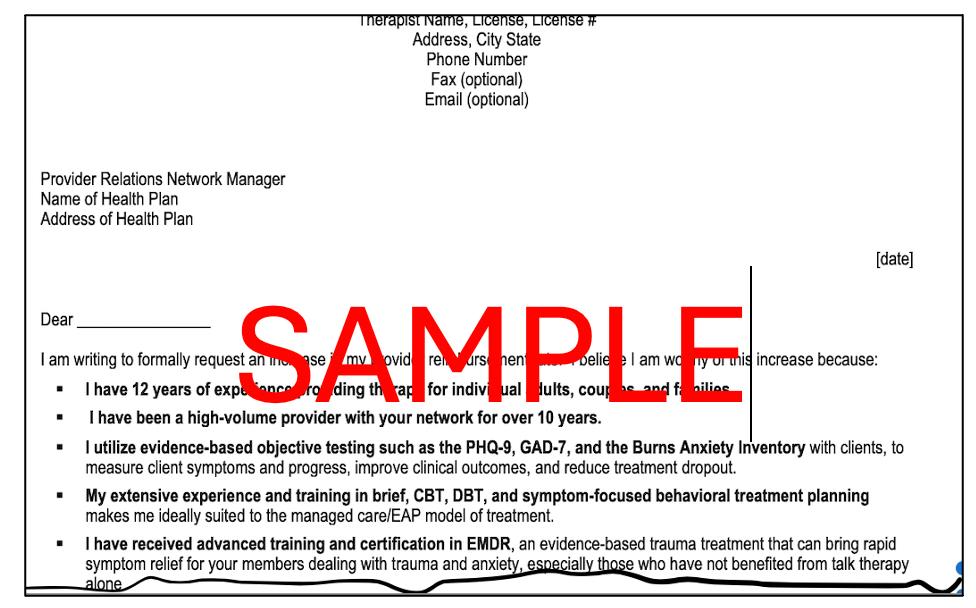
RAISE REQUEST TEMPLATE
Did you know 40% of therapists in one survey had received a raise from a health plan? This template will help you understand how to format your request and what to say when asking for a raise. For info, click here
| |  | |
WEBINAR:
"AUDITS AND RECORDS REQUESTS: WHAT EVERY THERAPIST SHOULD KNOW"
This recorded webinar is for all therapists, since even out-of-network therapists can have their notes requested by an insurance plan or other agency -- and can be asked to pay back monies already collected. Learn to prevent this. For info, click here
| |
WEBINAR: "HOW TO WRITE A 10-MINUTE TREATMENT PLAN"
Do you hate writing treatment plans, worry about the ones you write, or don't write them at all? This recorded training will teach you how to write brief plans that satisfy legal, ethical, and insurance expectations, so you feel confident if you receive a records request, and won't have to pay money back if audited. For info, click here.
| |
PROGRESS NOTES TEMPLATE
This progress note template has been designed to pass an audit by the toughest insurance plans or licensing boards. Available in fillable PDF format, Word format, and Pages format. Have confidence in your session notes. For more info, click here
| |
WEBINAR: "THE FIRST SESSION: Juggling Clinical & Administrative Tasks"
This recorded webinar gives tips on juggling all those intake tasks -- building rapport and taking a history, doing a diagnostic assessment, while handling paperwork, payment and insurance issues. For more info, click here
| |
WEBINAR:
"SHOW ME THE MONEY: Understanding Rates, Raises, and Resigning"
This recorded course tells you how to increase your chances of getting a raise from a health plan, and gives both clinical and practical steps for asking for a raise. It also outlines the practical and clinical steps to take when resigning. For more info, click here
| |
WEBINAR: "WHAT OUT-OF-NETWORK THERAPISTS SHOULD KNOW ABOUT BILLING"
This recorded webinar covers what every therapist should know about billing and insurance -- even if you have never signed an insurance plan contract. We'll discuss common errors made by out-of-network providers, sliding scale fees, and helping self-pay clients afford treatment. For info, click here
| |
|
MY 2025 Updated BOOK!!!
Navigating the Insurance Maze: The Therapist's Complete Guide to Working With Insurance -- And Whether You Should -- 10th EDITION
Get digital version, or both paperback and digital versions
Click here for info.
Please buy direct from us - Amazon keeps 55% of profits!
CALIFORNIA LMFTs, LCSWs, LPCCs, and LEPs: You can now get 10 CEs for reading my book, and 2 can count as Legal and Ethical CE credits. Buy my book here and buy the CE test here to get your CEs. You can even take the test if you have already read any edition of my book.
| | |
Know a colleague who might appreciate this newsletter?
Forward it!
| |
|
Barbara Griswold, LMFT
Author, Navigating the Insurance Maze: The Therapist's Complete Guide to Navigating Insurance -- And Whether You Should
theinsurancemaze.com 408-985-0846
| | | | |