Student Perspective Article
By Nafissatou Yattassaye
"Death is not the opposite of life, but a part of it." — Haruki Murakami
What does it mean to live life to the fullest? What makes a life worthy of remembering? Often, more times than not, the concept of life and what it means to live lingers on our minds. These thoughts awaken our consciousness and force us to question what it means to be.
In the midst of January, as winter break came to an end, Life Writing 36800, taught by Professor Elizabeth Mazzola, began as one of several internship-integrated courses facilitated by the HELPS Program (Humanities Experiential Learning Partnership Seminars) in the Division of Humanities and Arts. I initially viewed this class as another opportunity to gain internship experience even as a freshman. I knew the basics and groundwork for the class expected of me: complete 50–60 internship hours at the nursing home, attend class every Monday from 9:30–11:30. Yet I was not prepared for the semester ahead.
As someone who has always been introverted, I am very shy in classroom settings. In the Fall 2025 semester, my first at CCNY, I got used to quietly blending into the classroom, completing my work, and avoiding much attention. However, Life Writing operated differently from those classrooms. It required presence, reflection, and the willingness to tell stories. The stories began with our own and soon spread to include those of others, particularly the residents at The New Jewish Home, the internship site we would eventually come to know well.
“I was going through the hardest thing, also the greatest thing, for any human being to do; to accept that which is already within you, and around you,"- Malcolm X, The Autobiography Of Malcolm X: As Told To Alex Haley
I used to view stories as fixed narratives with clear beginnings and endings. However, one of our first readings in the course, Malcolm X’s autobiography, revealed that identity is constantly evolving through experience, reflection, and struggle. His transformation throughout the work demonstrated how a person can continuously redefine themselves.
I related to the idea of slowly discovering one’s voice over time. In many ways, I entered the course still unsure of where I belonged. Speaking openly in discussions and sharing personal reflections did not come naturally to me. Yet through Malcolm X’s story, I began to understand that growth often requires discomfort.
Our first writing assignment in the class was to choose a person, place, or thing that was still alive and compose an essay about its life. I chose the basketball player Derrick Rose—a player often misunderstood due to injuries and public criticism; however, his perseverance and resilience told a much deeper story beneath the surface. Like Malcolm X, Derrick Rose represented transformation, survival, and the complexity of every individual's life.
I ultimately knew the kind of resident I hoped to capture had to share these same virtues. Soon enough, I met Miguel Semidey Jr.
Room 724. On the seventh floor of The New Jewish Home, residents move slowly through the halls, some waiting, some watching, some wondering when or if they will leave. There is a quietness that fills the space, a kind of stillness that lingers in the air. But down the hall, one room breaks that silence. The sound of a game plays constantly, echoing off the walls, creating movement in a place where there is little physical motion.
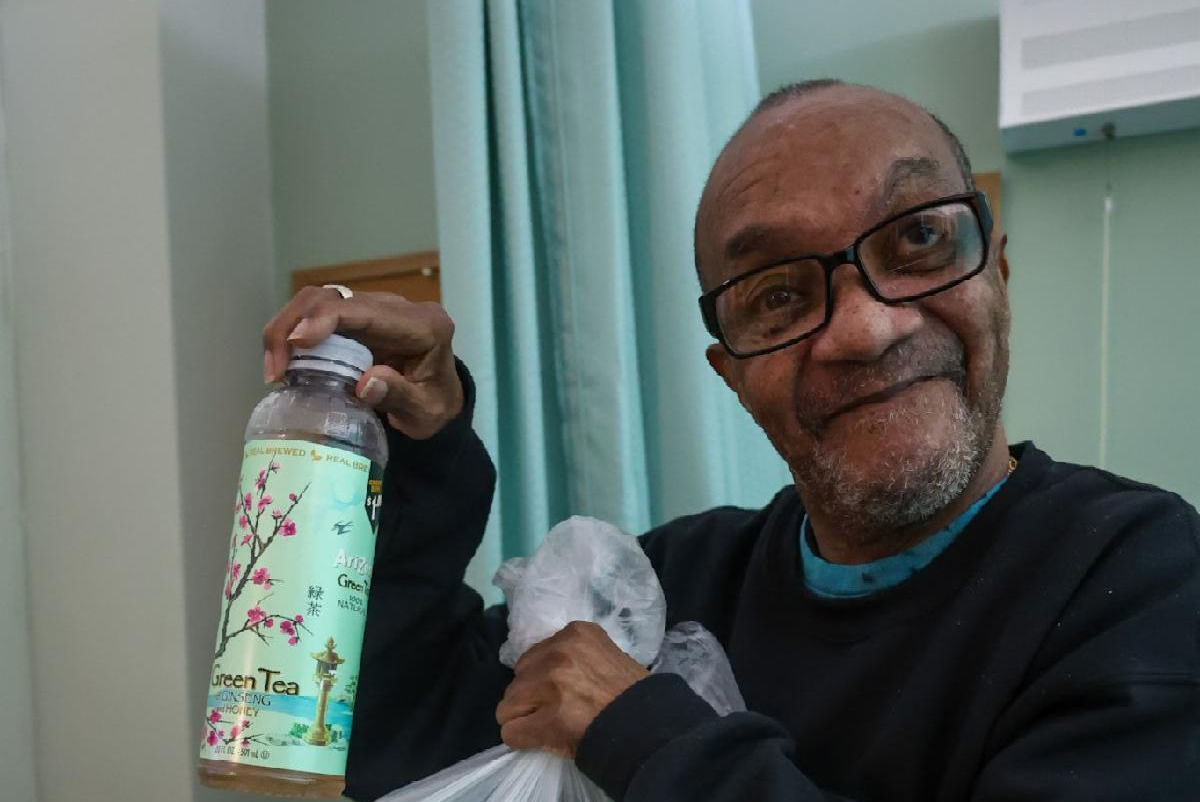
Miguel filled Room 724 with energy every Sunday as baseball games featuring the Mets, his favorite team, played on the television.
His voice rises with every close play, his body leans forward as if he is still on the field, and his reactions fill the room with energy while watching the Mets, his favorite MLB team. His eyes stay locked on the screen, barely blinking when the count gets tight, especially when they play against the Yankees, a team Miguel actually despises. Even as someone who is naturally reserved, you can tell when the game has him. His posture changes. His voice comes out quicker, more certain. For those moments, he is not in Room 724. He is somewhere else entirely.
“When we lay waste, when we efface, it isn't with raging fists or ruthless schemes or insane sprawling violence but with our words, our brains, with mentality, with all the stuff that produced the poignant abyss between our fathers and us and that they themselves broke their backs to give us,” - Phillip Roth, Patrimony
While Malcolm X’s autobiography taught me about transformation and identity, another class reading, Patrimony by Philip Roth, taught me the importance of observation and memory in biography. Life writing is not simply about documenting events but about preserving the humanity of another person through small details, routines, and intimate moments.
[Miguel’s] father played a major role in shaping that mindset. At just ten years old, Miguel would spend his summers riding along with him while he worked as a truck driver. Sitting in the passenger seat, in the heat, doing what might seem like nothing, he was actually learning everything: discipline, responsibility, and what it meant to show up.
Through Roth’s writing, ordinary interactions suddenly carried emotional weight and meaning. As I wrote throughout the semester, I found myself approaching Miguel’s story with the same mindset. Rather than focusing only on major events in his life, I became more interested in the rhythms that shaped his everyday existence: the routines within Room 724, the conversations we shared, and the quiet patience that defined his personality. I also took an interest in the relationship Miguel had with his father, which shaped his identity and influenced how he approached his own sons, siblings, and future generations.
Roth’s writing helped me realize that biography exists not only in dramatic moments but also in repetition, memory, and presence. This shifted the way I observed people entirely. Instead of seeing residents simply as subjects for an assignment, I began to understand the responsibility that comes with listening closely to another person’s life. Through Miguel, I learned that even the smallest details can preserve someone’s humanity long after a moment has passed.
The work itself, being a custodian, was exhausting. Long shifts, early mornings, and at times, overnight hours left little time to rest before starting again, Miguel noted. Yet Miguel still found pride in it. He enjoyed being around people, joking with coworkers, and feeling useful. Even as a custodian, he paid attention to detail. Miguel made sure the floors were cleaned and every task was completed correctly. The work may not have been glamorous, but for Miguel, it represented stability and survival.
Even when life became repetitive or exhausting, he kept going. That is the same mindset baseball requires: showing up every day, repeating the same actions, staying consistent even when it is hard. That sense of routine is still present in his life today, even in smaller ways. His Arizona Green Tea, something he calls ‘comfort food for me,’ became part of his daily habit. It may seem small, but it represents something deeper. It is something he can control, something that remains consistent in a life that has changed drastically.
“ ‘To grieve in peace’ is a common phrase, but it’s a peculiar one, is it not? A contradiction, a demanding, even unachievable stasis state, ”- Joy Williams, One, Four, Two, Five…
By the end of the semester, the reading that resonated with me the most was Joy Williams's One, Four, Two, Five…, reflections on Gene Hackman. Williams explored aging, disappearance, and the quiet ways people slowly fade from public memory over time. Her reflections forced me to think about whose stories are remembered and whose stories are often overlooked.
Miguel was one whose story was powerful yet hidden amid the nursing home. A story waiting to be told, yet no one had sat down and asked.
Throughout the semester, Miguel gradually became more than simply the subject of my biography project. Through our conversations, observations, and shared moments, I began to recognize the significance of preserving stories that might otherwise go unheard. Life is abrupt, and just like in baseball, where a game can change in one play, Miguel’s life shifted in moments he never expected.
His health began to decline, starting with asthma, but later becoming more serious. Miguel was diagnosed with bronchitis and breast cancer, which he survived. He experienced heart attacks, moments where his body gave out without warning.
"One minute I’m walking, next thing you know, I’m collapsed."
It was a hot summer day, Miguel says. He recalls waking up in an ambulance, confused and unsure of what had just happened. In another moment, while on his way to pay his phone bill as he regularly did, he blacked out at an ATM, only to wake up in a hospital bed and realize his money was gone.
"I got my life, so that’s all that mattered."
Williams helped me understand that life writing serves as an act of remembrance. It allows people to exist beyond a single moment or public perception. Every person carries memories, struggles, routines, and histories worthy of being documented. Through writing Miguel’s story, I learned that storytelling has the power to preserve humanity itself.
One of the biggest turning points came when he fractured his pelvis trying to lift a 100-pound box. What should have been a short recovery turned into a long stay in the nursing home, something he still struggled to fully understand, ultimately leading to his admission into the home. A recovery process that should have taken five to six months stretched far beyond that, and Miguel remained confused as to why he was still there, even after his injury had healed. No discharge date has been announced.
“I don’t want to die here,” Miguel noted.
A statement that sticks with me.
It is not just about the place; it is about his desire to keep living, to go back outside, to feel free again. Being admitted into the nursing home created a barrier between Miguel and the outside world. He did not have permission to roam around the center or go outside without assistance, so he often remained inside.
He talked about wanting to be back around his family, outside of the nursing home walls, hearing noise, laughter, and everyday life again. Even if returning fully to his old life was not realistic, the hope itself remained important to him. What he missed most was not simply freedom of movement, but the feeling of belonging somewhere beyond Room 724.
Miguel Semidey Jr. passed away on May 14, 2026. I spent the entire Spring semester with Miguel, not only telling his story but also promising him freedom and liberation: the freedom to one day roam his neighborhood again, see his friends and family, and enjoy the outside world. Miguel and I built a bond that became far greater than that of interviewer and interviewee.
During his final days in the nursing home, we achieved one of the many things on our to-do list: giving him the opportunity to physically go outside on his own and walk around the nursing home without supervision.
Miguel Semidey Jr. is now free, and I will miss him dearly, not just as Room 724 but as a person whose story I am honored to tell.
I am grateful to Professor Elizabeth Mazzola for taking the lead on a class that embodies some of the many things the Division of Humanities and the Arts seeks to cultivate: the ability to share stories through writing while building long-lasting relationships with people on a daily basis.
|