|
A Student Perspective Article by Stephanie LaBruna
I had just gotten out of class when a friend told me there was free pizza and live music somewhere on the fifth floor. I didn’t know anything about the Jewish Studies Program at CCNY, and I wasn’t looking for anything in particular: just a way to fill an hour between classes. I followed the sound to room 5-202. As it turns out, that’s exactly how most people find it.
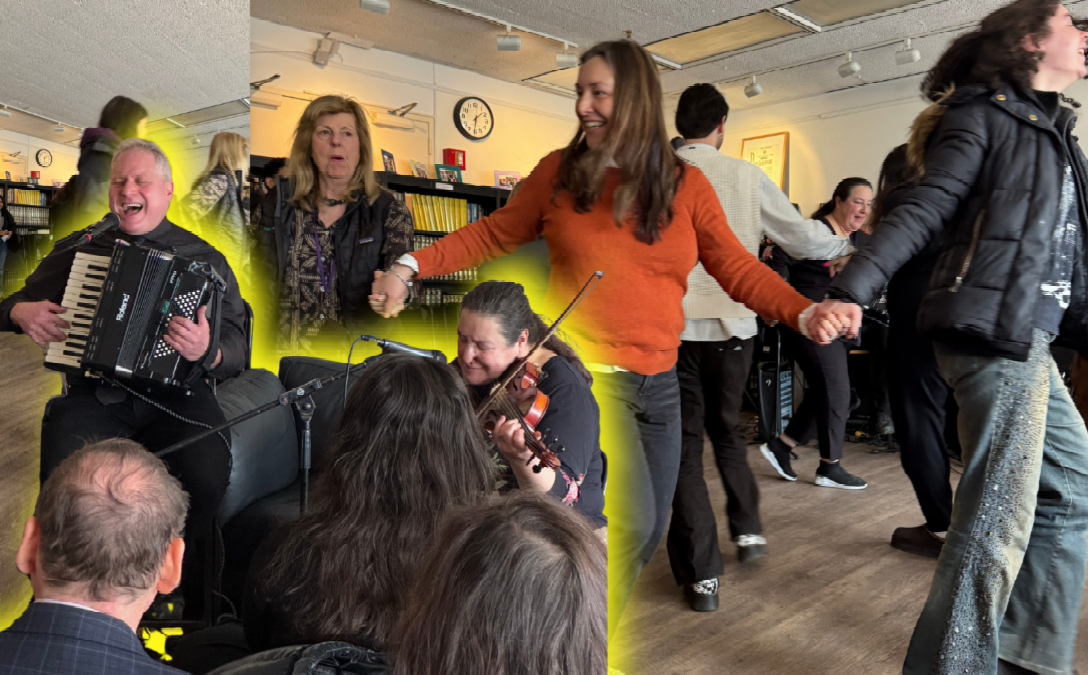
Along every wall, bookshelves rose floor to ceiling, packed with Jewish literature, history, reference books—decades of cultural memory pressed spine to spine. Natural light poured in through large windows, and at the center of it all, framed by all that accumulated history behind them, two musicians were setting up. A married couple, it turned out—klezmer musicians who made the trip down from Maine at the invitation of a professor whose sister happened to be one half of the duo.
The program’s staff describe room 5-202 as a place to hang your hat; students stop in before class to grab something to eat, return between periods, and hang out. It operates less like a department lounge and more like a home base, which explained why the room was already full when I arrived: students from what looked like every corner of campus, and professors too, all genuinely there, interested, plates of pizza balanced in their laps. I found a seat off in the corner. The girl next to me introduced herself before I even had a chance to feel like an outsider. That set the tone for everything that followed.
Before the first note, Sruli Dresdner, one half of the married duo, leaned toward the microphone and told us what we were about to hear. Klezmer, he explained, comes from two Yiddish words: kli and zemer, meaning instrument of song. The music was born in the Jewish communities of Eastern Europe: Russia, Poland, Ukraine, Romania, carried across centuries of daily life, celebration, and hardship, and then transplanted to America when waves of Jewish immigrants began arriving in the 1880s. New York became one of its great new homes. But what surprised me, sitting there on that wooden chair with my pizza in my hands, was how far the music had traveled before it ever crossed an ocean. The Ottoman Empire’s long reach into southeastern Europe had created a bridge between the folk music of Europe and the Middle East, and klezmer has crossed it, absorbing, over the centuries, the scales and rhythms of both worlds. The music had always been absorbing the world around it, taking in Romanian melodies, Gypsy rhythms, the liturgical sounds of synagogue prayer, and making something entirely its own.
Sruli picked up his clarinet, Lisa raised her violin, and then they played. The clarinet led first, and the violin came in behind it—the kind of instruments, as they describe, that can cry and sigh and even laugh. They traded melody back and forth with the ease that only comes from years of playing together. The room settled in quickly, people clapped along, leaned toward each other to share reactions, and laughed at the translated lyrics; some of the Yiddish songs were genuinely funny. The afternoon had stopped feeling like a campus event somewhere between the first song and second slice of pizza.
The Jewish Studies Program hosts various events throughout the semester, and they’re open to everyone. No background knowledge required. If you’re enrolled in a Jewish Studies course, attending an event and writing a short reflection can earn you extra credit, and more of those courses exist than you might think; several are cross-listed with other departments. What surprised me was how little any of that felt like an incentive by the end of the afternoon. The music had shifted into something celebratory, melodies that live somewhere in the back of everyone’s memory, and students and professors alike had moved toward the center of the room. They formed a line that snaked between the chairs, looping under raised arms, picking up more people as it went. Nobody needed to know the steps. The rest of the room clapped and cheered, and for a few minutes, the whole space was in motion together.
The room operates this way all the time, not just on klezmer afternoons. Club hours run every Thursday at noon, open to everyone, no membership required, and the range of what gets covered surprises people: this semester, still to come, there’s a session on medieval manuscript art, one on humor and pathos in storytelling, and even an internship workshop. The minor has only four classes, the major ten, and most surprising to me, 97% of the students in the program have no familial connection to Judaism. Professors keep their offices here, so the relationships tend to outlast the semester; past students have landed internships, received recommendation letters, and shown up at each other’s weddings years later. The program is endowed by Michael and Irene Ross, which makes possible something rarer than a well-loved lounge: certain courses come with fully funded international travel, flights and hotels included, to places like Italy, Turkey, the Dominican Republic, Ukraine. Jews of the diaspora have been everywhere, and the program believes there's a difference between reading about a place and standing in it.
When I left that afternoon, the line of dancers was still moving around the room. The accordion was still playing, people were still clapping. I had come for the pizza and stayed for something I didn’t have the phrasing for yet—the particular feeling of a room full of strangers who have, for an hour or two, stopped being strangers. The next club hour is April 16th at noon in room 5-202, come hungry for pizza and medieval knowledge.
|