Providing science-based information to serve Hawaiʻi's Farming Community | | |
Sustainable and Organic Research &
Outreach News
News from Hawaiʻi's Researchers and Extension Professionals
| | |
Himalayan Rubus on Hawaiian Rangelands and Management Strategies
Daryl Bolosan1, Mark Dragich1, Prem L. Mahato2, Roshan Paudel1 and Koon-Hui Wang1.
1Department of Plant & Environmental Protection Sciences, University of Hawaii at Manoa
2Department of Human Nutrition, Food and Animal Science, University of Hawaii at Manoa
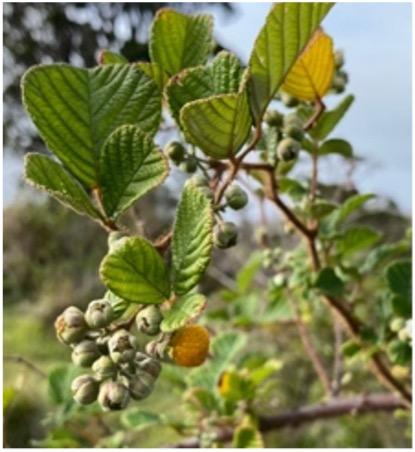
The Himalayan Raspberry (Rubu ellipticus) brought to Hawai’i in 1960 as an ornamental and very quickly became a weed. Found on the eastern side of Hawaiʻi island, it grows best between 1,800 and 5,100 feet in elevation. Ths weed grows quickly, propagating through underground stems, making mechanical removal very difficult, particularly on pasturelands. This article expores integrated weed management – combining mowing and mulching, diversified forage cropping, biological management using living organisms like livestock, fungi, and insects, and chemical management as a last resort. Read how researchers have implemented various integreated weed management practices and tools to help ranchers suppress Rubus on the island of Hawai’i.
To read the full article and results click "Himalayan Rubus on Hawaiian Rangelands and Management Strategies"
FMI: Daryl Bolosan
| | |
The Valentine’s Day Floral Event as a Community-Based Model for Connection and Engagement
Sothy Eng
University of Hawai'i at Mānoa
What happens when neighbors gather to arrange flowers from their own backyards? The Valentine's Day Floral Event answers that beautifully. Using cuttings from home gardens, recycled jars, and locally sourced blooms, families create two floral arrangements: one to keep, one to donate to people receiving mental health support.
It's a simple idea with real roots in sustainability, family bonding, and giving back. Along the way, participants swap gardening tips and build lasting community connection.
Curious how this "keep one, give one" model works, and how you could grow something similar? Read the full story.
To read the full article "The Valentine’s Day Floral Event as a Community-Based Model for Connection and Engagement"
FMI: Sothy Eng
| | |
Propagation of Regular Crown Flower (Calotropis gigantea) and Mini Crown Flower (Calotropis procera) via tip cuttings
Natalie Horsman1, Alberto Ricordi2
O’ahu County, Cooperative Extension, University of Hawaii at Manoa, 955 Kamehameha Hwy, Pearl City, Hawaiʻi
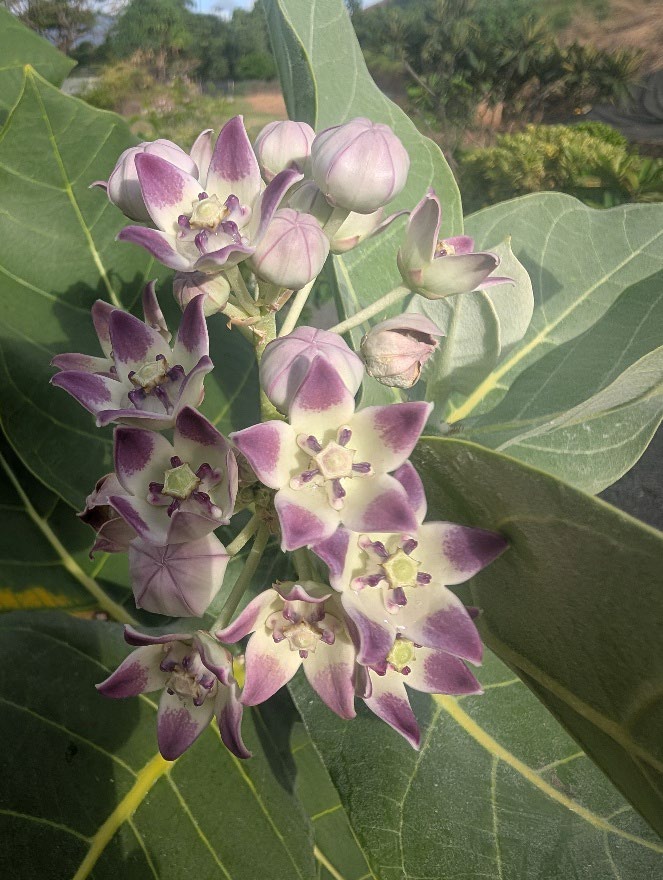
Crown flower is a favorite for lei making and a key food source for monarch butterflies, but not every type grows easily from tip cuttings. An Oʻahu greenhouse trial tested a common grower claim. Out of 90 mini crown flower cuttings, not one rooted. Regular crown flower reached up to 80% success with herbaceous (all-green) cuttings and 1.6% rooting hormone in a 1:1 perlite and potting mix. For mini crown flower, seed is the better route. The full article also explains how to keep both plants from spreading.
To read the full article Propagation of Regular Crown Flower (Calotropis gigantea) and Mini Crown Flower (Calotropis procera) via tip cuttings
FMI: Natalie Horsman
| |
A three-year field study to determine the effect of organic amendment applications on the yield of Ginger root (botanical rhizome) in Oahu
Hector Valenzuela Department of Plant and Environmental Protection Sciences Univ. of Hawaii at Manoa
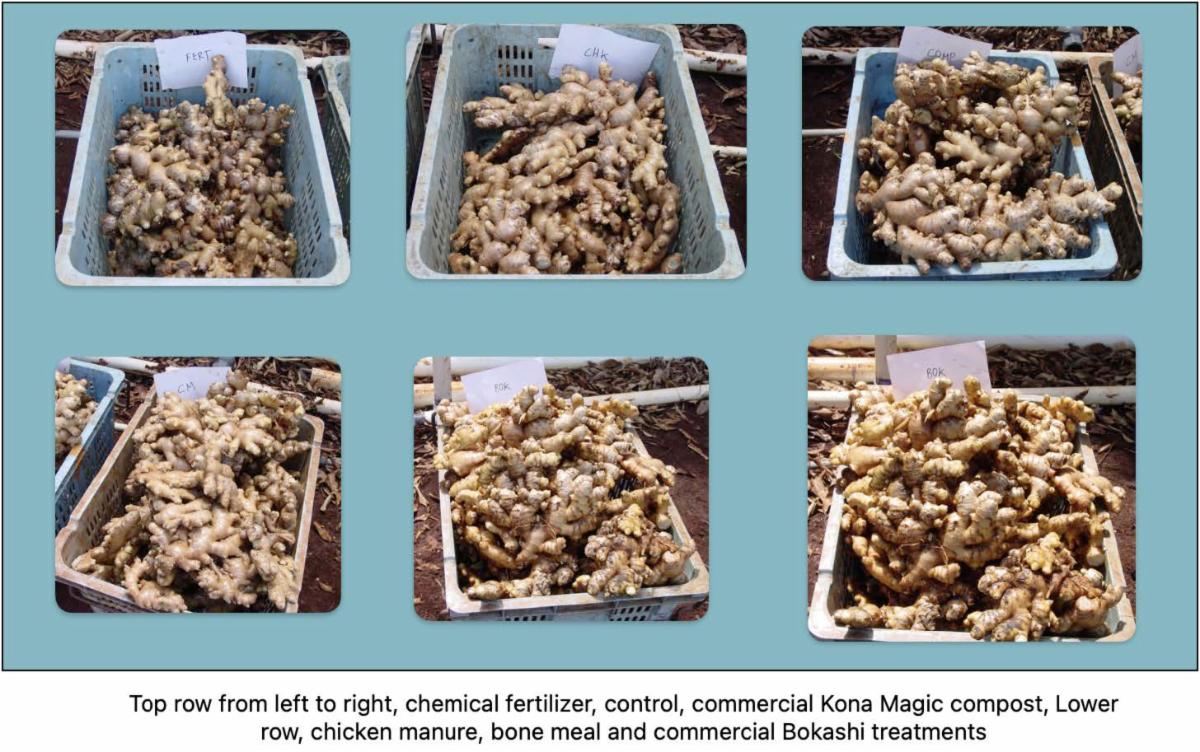
Can natural inputs really keep up with a hungry, 10-month crop like ginger? On Oahu, trials say yes. This article looks at how organic amendments, Bokashi, bone meal, chicken manure, and compost, can match or even beat chemical fertilizers for ginger root yield. The secret is timing: split applications act like slow-release fertilizers, syncing nutrients with the plant's growth. You'll also see how these choices build soil health and soil fertility over time, and why bone meal may help knock back nematode populations. If you grow ginger, these practical tips are worth a read.
To read the full article "A three-year field study to determine the effect of organic amendment applications on the yield of ginger root in Oahu"
FMI: Hector Valenzuela
| |
Velvet Bean for Nematode Suppression and Soil Health Management
Benjamin Wiseman and Koon-Hui Wang
Department of Plant and Environmental Protection Sciences, University of Hawai'i at Mānoa
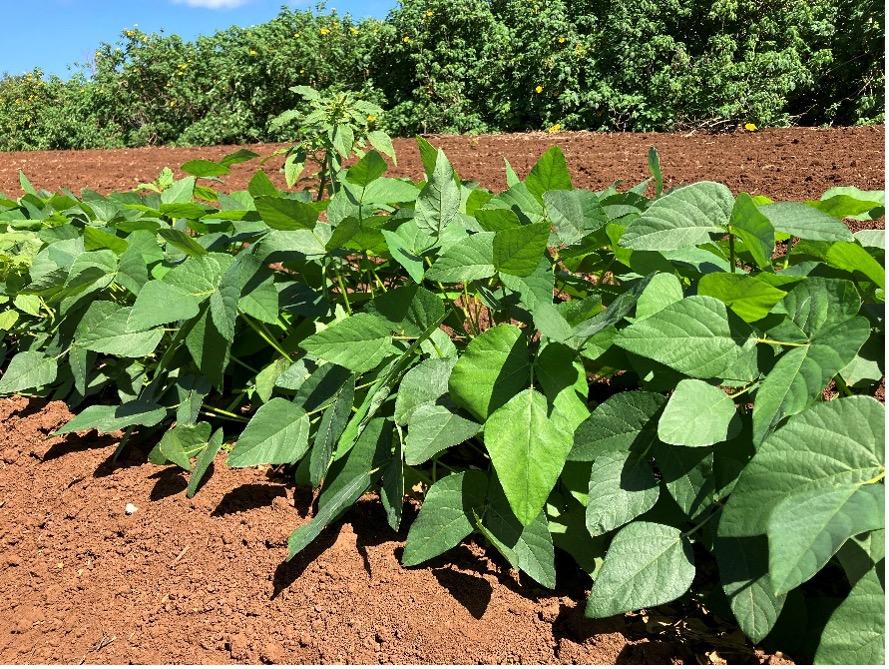
Velvet bean was once a familiar cover crop during Hawai'i's sugarcane plantation days, and it's making a quiet comeback. University of Hawai'i researchers share what they learned from on-farm trials across three islands, comparing velvet bean with buckwheat ahead of sweetpotato. On farms coming out of fallow, velvet bean lowered reniform nematodes, woke up the soil food web, and lifted sweetpotato yields by 50% or more. On other farms, the story was more mixed. Find out why farm history shapes nematode suppression, how velvet bean builds soil health, and where to find bristle-free seed.
To read the full article "Velvet Bean for Nematode Suppression and Soil Health Management"
FMI: Benjamin Wiseman
| |
Growing Microgreens Indoors in Hawai’i
Eric Collier, Theodore Radovich, and Amjad Ahmad
Sustainable and Organic Agriculture Program, Department of Tropical Plant & Soil Sciences, University of Hawai’i at Mānoa
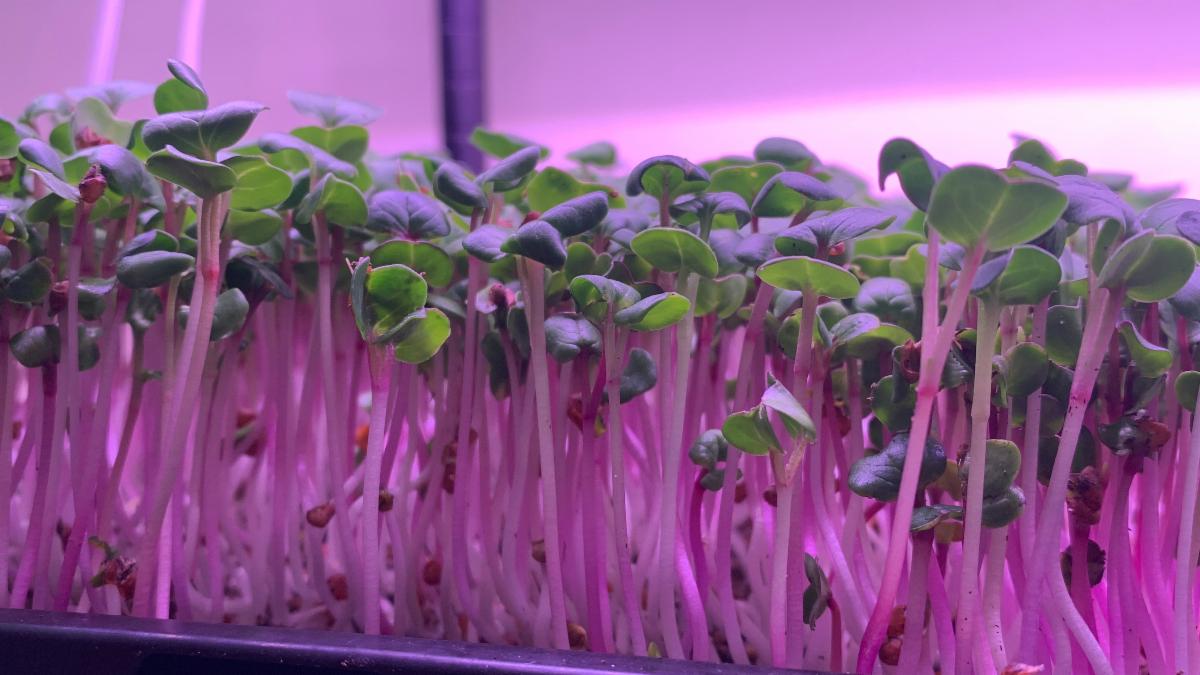
Grow fresh, flavorful microgreens year-round with a small, practical setup. This guide for Hawaiʻi gardeners and small-scale growers covers seed selection, food safety, storage and more. Learn how to prevent mold and uneven germination, with the right soaking, blackout, and germination practices. Learn a simple way to grow these functional foods for your home and as an income stream for your operation. A 31-crop reference chart helps simplify planning for your first trays.
FMI: Eric Collier
| |
Other CTAHR Publications and Programs
for sustainable and organic production systems
| | University of Hawai'i Organic Transition (UHOT) | | University of Hawai'i Organic Transition (UHOT) | | |
The University of Hawai’i Helps Interested Farmers Transition to Organic
U.H.O.T. (University of Hawai’i at Mānoa Organic Transition Program) is a TOPP partner program dedicated to fostering organic workforce development, providing organic transfer and certification guidance, mentoring services, technical assistance, and community building in Hawaii. Learn more at UHOT.org
The TOPP (Transition to Organic Partnership Program) is a 5-year collaborative partnership network covering six regions. The University of Hawai’i at Mānoa Sustainable and Organic Agriculture Program, in partnership with CCOF as the Western Region lead, Hawai’i Farmers Union United and Ma’o Farms to provide mentoring services, technical assistance, community building, and organic workforce development for transitioning and exciting organic farmers.
| |
2026 Organic Certification Cost Share for Hawaiʻi
USDA’s Organic Certification Cost Share Program (OCCSP) is accepting applications from Hawaiʻi certified organic producers and handlers for the 2025 and 2026 program years. OCCSP reimburses 75% of eligible organic certification expenses, up to $750 per certification scope. Eligible scopes include crops, wild crops, livestock, processing/handling, and state organic program fees. The scope must appear on the operation’s USDA organic certificate.
Eligible expenses include application and administrative fees, inspection fees and inspector travel/per diem, certification expenses needed to access international markets covered by USDA equivalency agreements or arrangements, state organic program fees, user fees and sales assessments, and postage related to certification or renewal. Costs must have been paid during the applicable program year.
Deadline: December 31, 2026. Separate applications are required for the 2025 and 2026 program years. Assistance is first-come, first-served until available program funds are exhausted.
What to submit to FSA
· CCC-884 — Organic Certification Cost Share Program (OCCSP) Application: Required for each program year; current form expiration date: 04/30/2029.
· Proof of USDA organic certification: The applicable scope(s) must appear on the organic certificate.
· Itemized invoices/receipts: Documentation showing eligible certification costs paid to a USDA-accredited certifying agent or State organic program during the applicable program year.
· AD-2047 — Customer Data Worksheet: Required if not previously filed with FSA; current form expiration date: 01/31/2027.
· SF-3881 — ACH Vendor/Miscellaneous Payment Enrollment Form: Needed for electronic payment if the applicant has not previously filed it with FSA.
· CCC-901 — Member’s Information: May be required for business/legal entities to document members and signature authority.
Start with your county FSA contact. FSA can register new customers in its system and confirm which customer-record forms are already on file.
County FSA Contact. Email
Hawaiʻi County. Debby Ann Itchon. Debbyann.itchon@usda.gov
Honolulu County. Josie Malepeai Lealasola. Josephine.lealasola@usda.gov
Kauaʻi County. Calvin Threat. Calvin.threat@usda.gov
Maui County. Josie Malepeai Lealasola. Josephine.lealasola@usda.gov
State of Organic Produce 2025: Organic Produce Continues to Outpace the Market
The Organic Produce Network’s State of Organic Produce 2025 paints an encouraging picture for organic growers. U.S. organic fresh produce sales reached $10.6 billion in 2025, up 5.9%, while volume increased an even stronger 6.4%. Organic sales grew nearly five times faster than conventional produce and now represent 13% of retail produce sales and 8% of produce volume.
Growth was not uniform across crops. Berries remained the largest organic category at nearly $2.4 billion, while bananas led by volume. Particularly strong sales growth occurred in citrus (+17.8%), bananas (+15.3%), berries (+12.1%), and potatoes (+10.1%). Other categories struggled: packaged salads and lettuce declined, illustrating that simply being organic does not guarantee market growth. Consumers remain price-conscious and increasingly expect quality, convenience, and value along with organic certification.
For Hawaiʻi, the banana numbers are especially interesting. Organic banana sales increased to $587 million, with volume up 9.7%, despite a 40.9% price premium over conventional fruit. The report specifically recognizes Hawaiʻi as one of the few places with domestic banana production, while noting constraints on expanding production.
Perhaps the larger message is that demand for organic remains strong, particularly among Millennial and Gen Z consumers, who demonstrate considerable trust in the USDA Organic seal. At the same time, growers face familiar pressures—labor availability, water access, rising production costs, and increasingly unpredictable weather. Continued growth will depend not only on producing organically, but on communicating its value while keeping organic food accessible to consumers.
Sources: USDA Farm Service Agency OCCSP guidance and Organic Produce Network, State of Organic Produce 2025.
| |
U.H.O.T. Podcast: Why Organic in Hawai'i?
U.H.O.T. Podcast explores why local producers choose certified organic production. Local producers hearing from local producers.
Listen to All Episodes
| | |
The primary goal of BFRDP, under assistance listing number 10.311, is to help beginning farmers and ranchers in the United States and its territories enter and/or improve their successes in farming, ranching, and management of nonindustrial private forest lands, through support for projects that provide education, outreach, and technical assistance to give beginning farmers and ranchers the knowledge, skills, and tools needed to make informed decisions for their operations and enhance their sustainability.
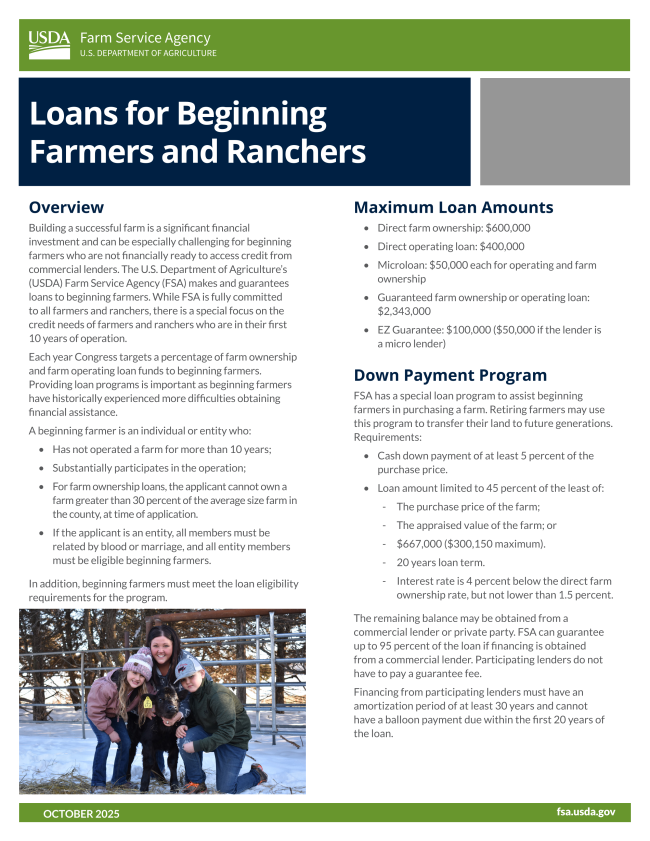
New to farming? Want to learn how to start a farm? USDA offers dedicated help to beginning farmers and ranchers. USDA considers anyone who has operated a farm or ranch for less than ten years to be a beginning farmer or rancher.
USDA can help you get started or grow your operation through a variety of programs and services, from farm loans to crop insurance, and conservation programs to disaster assistance.
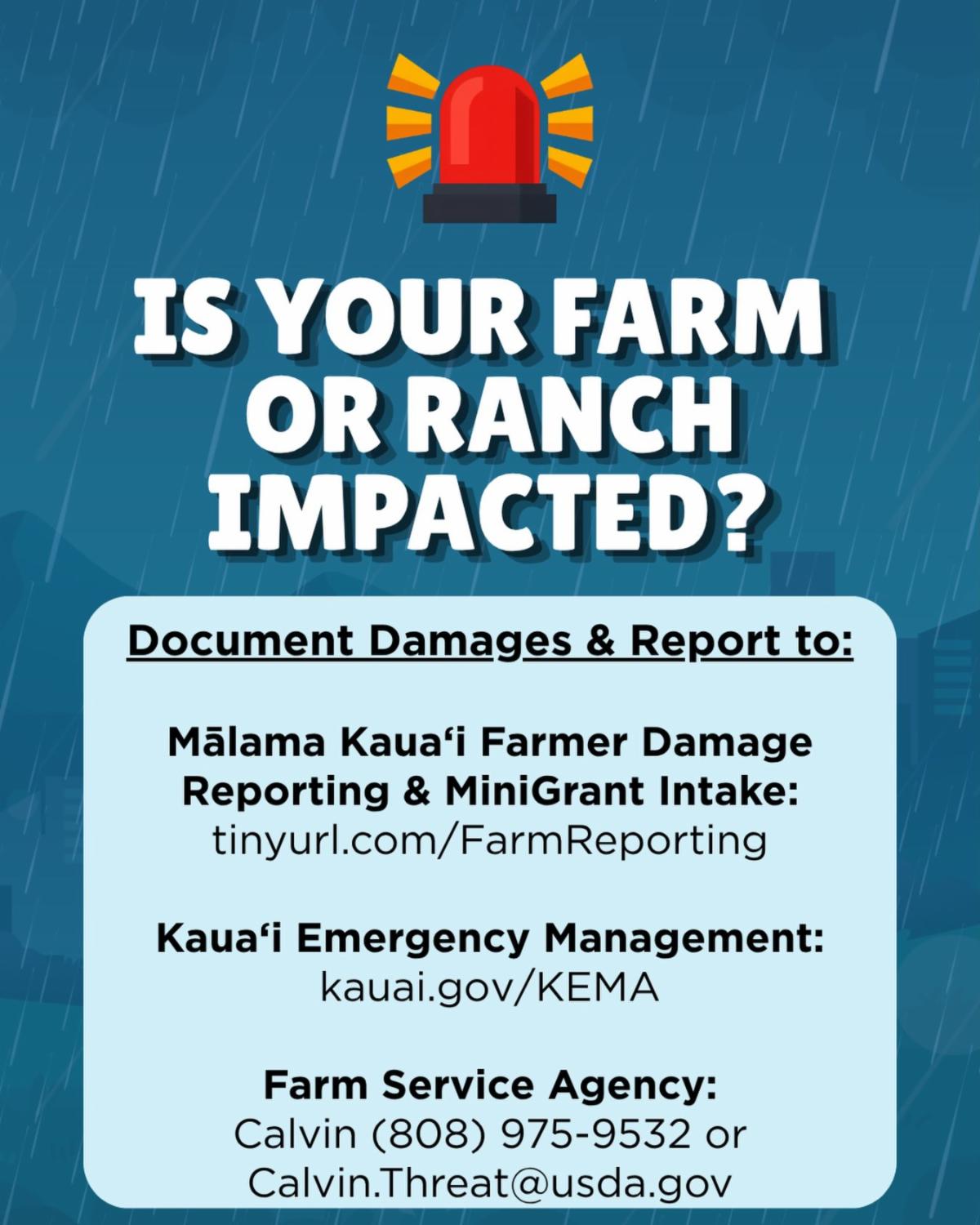
The U.S. Department of Agriculture (USDA) Farm Service Agency (FSA) in Hawaii County is accepting applications for the Emergency Conservation Program (ECP) to address damages from Hurricane Lala that occurred August 13, 2026 through August 16, 2026. ECP provides cost-share and technical assistance to producers to restore farmland to pre-disaster conditions following a qualifying natural disaster. ECP signup begins on September 1, 2026, and ends on October 30, 2026.
“The Farm Service Agency can help producers and landowners recover from natural disasters that impacted their operation,” said Keadin Fujii, FSA County Executive Director for Hawaii County. “If you have an immediate need to clean up and restore your operation, please call our office to see if restoration practice approval is needed before you take any action.”
Approved ECP applicants can receive up to 75% of the allowable cost of the approved restoration activity with a maximum cost share of $500,000 per natural disaster event.
The Tree Assistance Program (TAP), administered by the Farm Service Agency (FSA), offers financial support to orchardists and nursery tree growers who experience losses due to natural disasters. TAP helps cover the cost of replanting or rehabilitating eligible trees, bushes, and vines that produce annual crops and have been damaged or destroyed.
Eligible applicants include orchardists and nursery tree growers who produce annual crops for commercial purposes and have suffered losses due to natural disasters. Applicants must provide verifiable documentation of the losses and meet all program requirements.
Application for Payment: Must be submitted within 90 calendar days of the disaster event or when the loss is apparent.
| | |
Korean Natural Farming monthly meetings
Free, hands-on monthly gatherings at the Komohana Research & Extension Center in Hilo, 875 Komohana St. Conf room A 204 (second floor).
Open to everyone — no membership required.
2nd Tuesday, Oct 13, 2026
6:00p - 8:00p
| |
New Haleiwa agriculture park
A new 80-acre agriculture park in Haleiwa is a farming incubator of refugees, immigrants, and trafficking survivors, which helps with business development run by the Pacific Gateway Center on Kamehameha Schools land lease. Leasing an undeveloped one-acre plot on Oahu can cost $300 to $500 a month, at below market rate, more depending on location and infrastructure.
PGC Farms
| | |
Livestock Wala'au: Livestock Podcast
Livestock Wala'au podcast presented by the University of Hawaiʻi College of Tropical Agriculture and Human Resources. This podcast serves as a way for the livestock community to connect, talk story, and learn.
Listen to the Podcast
| |
Western Region Sustainable Agriculture and Education Program (WSARE)
| | |
SARE is a program of the U.S. Department of Agriculture's National Institute for Food and Agriculture that provides competitive grants and educational materials. Our grants programs are conducted cooperatively by farmers, ranchers, researchers, and ag professionals to advance farm and ranch systems that are profitable, environmentally sound, and good for communities.
The SARE grant program mission is to advance innovations that improve profitability, stewardship, and quality of life in American agriculture by investing in groundbreaking research and education. To achieve that, Western SARE believes that our programs must include the involvement of agricultural producers from inception to finish, and therefore we require producer involvement in the planning, design, implementation, and educational outreach of any funded project.
Western SARE Goals
• Promote good stewardship of the nation’s natural resources by providing site-specific, regional, and profitable sustainable farming and ranching methods that strengthen agricultural competitiveness; satisfy human food and fiber needs; maintain and enhance the quality and productivity of soil; conserve soil,
water, energy, natural resources, and fish and wildlife habitat; and maintain and improve the quality of surface and ground water.
• Enhance the quality of life of farmers and ranchers and ensure the viability of rural communities, for example, by increasing income and employment, especially profitable self-employment and innovative marketing opportunities in agricultural and rural communities.
• Protect the health and safety of those involved in food and farm systems by reducing, where feasible and practical, the use of toxic materials in agricultural production, and by optimizing on-farm resources and integrating, where appropriate, biological cycles
and controls.
• Promote crop, livestock, and enterprise diversification.
• Examine the regional, economic, social, and environmental implications of adopting sustainable agriculture practices and systems.
| |
The Western SARE Farmer/Rancher Research & Education Grant Program focuses on advancing on-farm sustainability solutions by funding innovative producer-driven research and outreach. This grant program involves agricultural producers (main applicants) and technical advisor(s) implementing projects to address identified needs in sustainable agriculture.
Deadline: Oct 28, 2026 12:00 PM (Mountain Time)
10 Steps for Conducting Research on Your Farm or Ranch
SARE Outreach
This workbook will help you create a plan for your own research project. It’s a companion to SARE’s technical bulletin How to Conduct Research On Your Farm Or Ranch (www.sare.org/research), which provides more detailed information on some of the key lessons outlined in this workbook. We recommend you refer to How to Conduct Research On Your Farm Or Ranch when learning about complex topics such as experimental design and statistical analysis of data.
Funding for the Local Education and Demonstration (LED) grants will help increase the application and adoption of the results and recommendations from previous SARE-funded research by identifying and overcoming the environmental, economic, and social hindrances of adopting sustainable agricultural practices locally.
Deadline: Oct 28, 2026 12:00 PM (Mountain Time)
| |
This e-publication is supported through the United States Department of Agriculture (USDA) Transition to Organic Partnership Program (TOPP). TOPP is a program of the USDA Organic Transition Initiative and is administered by the USDA Agricultural Marketing Service (AMS) National Organic Program (NOP).
This e-publication has been prepared by CTAHR research scientists and extension staff to deliver science-based information about sustainable and organic production systems to serve Hawaiʻi's farming community.
-
To continue receiving this newsletter, please confirm your interest by subscribing or updating your profile/email address.
- If this publication has been valuable, please forward it to others
- Send in your suggestions for what you want to read about in our articles
- Tell us about your research needs.
Mahalo nui loa,
Eric Collier Education Specialist and Managing Editor
Theodor Radovich, Kylie Tavares & Emilie Kirk Co-Reviewers
Sharon Wages & Jensen Uyeda WSARE Content Reviewers
Amjad Ahmad Editor-in-Chief
Sustainable and Organic Agriculture Program
Cooperative Extension Service
College of Tropical Agriculture and Human Resources
On-line version of newsletter as well as archived issues available at:
http://www.ctahr.hawaii.edu/sustainag/news/
Hawai‘i Cooperative Extension is an equal opportunity/affirmative action institution providing programs and services to the people of Hawai‘i without regard to race, sex, gender identity and expression, age, religion, color, national origin, ancestry, disability, marital status, arrest and court record, sexual orientation, or status as a covered veteran.
Eric Collier | Education Specialist, Social Media & Web Manager | colliere@hawaii.edu
Copyright ©2013 University of Hawai‘i - College of Tropical Agriculture and Human Resources. Updated 4 Nov, 2021
| | | | |