Humanities Academic Services

❤️ Your Time at UW


Happy February, Humanities Huskies! We hope that Winter Quarter is starting off great and that you all are keeping warm. This month, our Newsletter will cover:


  • Tools to understand your degree timeline so you can make the most of your time at UW;
  • Upcoming events and important dates;
  • Our Career Corner focusing on letters of recommendation.

Understanding All You Can Do At UW

How much time do I have before I need to graduate?

  • The Registrar's Office sets the timeline for expected student graduation, called Satisfactory Academic Progress (SAP). Students can engage with multiple programs if it fits within their maximum credit and/or quarter count (summer not included).
  • Students earning one degree (multiple majors and/or minors) have up to 210 credits or 12 quarters, whatever comes last. 180 credits minimum is required.
  • Students earning multiple degrees (ex: B.A and B.S/B.D/B.M) have up to 255 credits or 12 quarters, whatever comes last. 225 credits minimum is required.
  • Other offices/programs may have their own continuation policies (like the Office of Financial Aid). Be sure to check in with all relevant offices on your timeline.


What if I have transfer or extension credit?

  • Transfer credit applies to both your quarter and credit timeline at UW. Therefore, most transfer students can expect to spend fewer quarters at UW before graduating.
  • Extension credit is credit earned that only applies to the credit maximum, including AP/IB tests and running start. These may allow a student to graduate "early" (before using all 12 quarters) or stay beyond 210 credits if not all 12 quarters have been used.


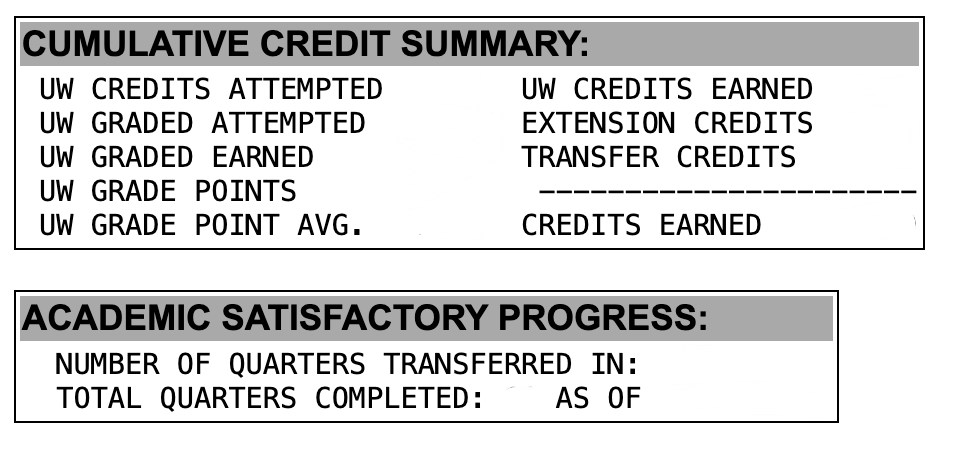
How do I see my timeline? Check your credits using the "Cumulative Credit Summary" box and your quarters in the "Academic Satisfactory Progress" box at the bottom of your unofficial transcript, as seen in the example to the right:

I'm interested in engaging with multiple programs. What should I know?

  • Everyone's SAP is different-- check with an adviser early to have enough room in your timeline and often to make sure you're staying on track.
  • Classes taken for minor, double majors, and double degrees can overlap with your (other) major's/degree's requirements. Most common are general education and area of inquiry.
  • Minors are a great option if you do not have the space to double major or degree.
  • Taking summer classes can create more flexibility in your timeline.
 

Events and Key Dates

Feb. 6: HASentines

PAWS 4 A Break


Join us for a special event designed to help you relax, destress, and enjoy spending time with a therapy dog! On Friday, February 6th, 2026 from 12-1 p.m. The HAS team along with the UW Counseling Center will be in Schmitz hall 4th floor lobby along with one of their therapy dogs! You will get to destress with calming furry friends as well as be in community with other humanities students. Taking care of your well-being is crucial for your success.

Feb. 12: Undergraduate Research Symposium Application Deadline


The UW's Undergraduate Research Symposium is an annual event where students from across over 100 disciplines present their research and creative work. We encourage all humanities students interested in research to apply by Feb.12, 2026. This is an opportunity to be involved in research which is beneficial if you are considering graduate school. Learn more about the symposium here.

Feb. 18: Winter Virtual

Job & Internship Fair


The Career & Internship Center invites you to explore jobs and internships at the Winter Virtual Job & Internship from 11:30 a.m.-3:00 p.m for the hosted virtually in Handshake! This fair is open to all majors and years of study, including alumni, of all three UW campuses. You can expect to see employers representing all industries.Register for the fair here. Learn more about how to prepare for the career fair.


Career Corner: Resume Writing

Person writing on notebook

Your resume is a snapshot of your experience and skills. To help you refine it, our team created a Resume Guide for Humanities Students on writing an effective resume.


 To articulate your experience, follow this formula:

Action Verb + What You Did + Value Added/ Key Takeaway/ Skill Developed


Action verb: every bullet point should start with an action word. (See page 9 of the guide)

What you did: Describe the action you took to complete the task. Mention any software and tools you used to highlight your proficiency.

Value Added/Key Takeaway/Skills Developed: Share the outcome of your actions and include metrics to help understand the scale of the impact.


Dos and Don’ts:

  • Make your resume a one-page PDF listing experiences in reverse chronological order.
  • Simple is better - don't include photos or multi colors. Keep it consistent.
  • When applying to a role, curate your resume by using keywords from the job description.
  • Don’t exaggerate or lie – this can instantly end your candidacy for a role.
  • Gather feedback from peers and the Career and Internship Center to improve your draft.


We encourage you to connect with the Career and Internship Center to review resume examples, and receive feedback. Check out their virtual Optimizing Your Resume for Today's Job Hunt workshop hosted on Monday, Feb. 9th.


From degree planning to registration to pre-career/grad school preparation, Humanities Academic Services is your support team for your Humanities academic journey.


We can support you in multiple ways. Click one of the buttons below to get started: