Welcome to this issue of the HEAL Data2Action (HD2A) Digest! Please share with colleagues, friends, and anyone else you know who might be interested in our work, and encourage them to subscribe to our newsletter. | | A New Way to Show What Preventing an Opioid Overdose Is Worth | | |
The success of an opioid-related overdose prevention intervention is measured by what it prevents: an overdose. That avoided outcome has real economic value, but it can be difficult to measure and even harder to communicate to the payers and systems that decide what gets sustained.
The HD2A Modeling and Economic Resource Center (MERC) built a tool to make that value visible. The new Value of Overdoses Averted Calculator helps research teams estimate the economic value of fatal and nonfatal overdoses that their interventions prevent, using their own population and local costs.
The calculator brings together pieces that are usually scattered across sources: immediate health care costs avoided, future health care and criminal-legal costs, and the value of years of life gained. It also accounts for the new costs an intervention introduces, so the estimate reflects a full picture rather than savings alone. Teams enter their own values, compare results against a set of defaults, and see estimates for overdoses averted with and without linkage to medications for opioid use disorder (MOUD).
The results can be substantial. In one worked example, averting a single nonfatal overdose and successfully linking a 30-year-old to MOUD carries an estimated value of roughly $528,000 in economic savings, including immediate emergency and hospitalization costs and health care and criminal-legal costs avoided over the next 33 years.
Although built for the HD2A Innovation and Acceleration Projects, the calculator is useful to any team working to quantify the economic impact of overdose prevention and opioid use disorder treatment.
| | Using Data to Strengthen Overdose Fatality Review Teams | | |
Drug overdose remains one of the most urgent public health challenges in the United States, with 70,000 to 111,000 deaths each year since 2022, despite a recent decline. Evidence-based interventions, such as medications for opioid use disorder, naloxone distribution, and harm reduction services save lives, but communities often struggle to identify where and how to apply them most effectively. Overdose Fatality Review (OFR) teams bring together partners from public health, health care, public safety, and community organizations to review overdose deaths and develop local prevention recommendations.
Through the FORTRESS project, investigators are working to strengthen OFR practices across Indiana by integrating Data-Driven Decision Making (DDDM) and a new Overdose Touchpoints Dashboard into the review process. The dashboard combines data from multiple statewide sources to help OFR teams see the common interactions individuals have with health care, public safety, and community systems before a fatal overdose. These touchpoints may point to opportunities to offer harm reduction services, connect individuals to treatment, and intervene before an overdose occurs. The approach is now being tested in 18 Indiana counties, comparing DDDM to standard OFR practices.
Investigators are also studying how knowledge and attitudes about overdose, treatment, and harm reduction differ among OFR stakeholders from different professional backgrounds. The findings will help identify ways to strengthen collaboration, close knowledge gaps, and support teams in turning data into action, ultimately reducing overdose deaths across Indiana.
Recent Publications:
Salvi, A., Holladay, C., Dir, A. L., Ray, B., Aalsma, M. C., & Reda, K. (2026). Barriers to population data use in overdose fatality reviews: Observational and interview study of dashboard deployment. JMIR Human Factors, 13, e98864. https://doi.org/10.2196/98864
Ray, B., Gillenwater, L. A., Dir, A., Ouyang, F., Monahan, P. O., McGladrey, M. L., Reda, K., & Aalsma, M. (2026). Variation in knowledge and attitudes among overdose prevention collaborations: Insights from fatality review teams. Drug and Alcohol Dependence, 286, 113287. https://doi.org/10.1016/j.drugalcdep.2026.113287
| | HD2A at the Addiction Health Services Research (AHSR) Conference 2026 | | |
“Challenges to and Solutions for Data-Driven Decision Making for Substance Use Service Delivery, Design, and Policy.”
Scientific Breakout 3: Tuesday, Oct. 6, 2026, 1:15–2:45 p.m., in the Idaho Room of the Little America Hotel.
The symposium includes presentations from Gracelyn Cruden, PhD, Erika Crable, PhD, MPH, Lisa Saldana, PhD, and colleagues.
| |
"HEAL Data2Action: Harnessing End User Feedback to Strengthen a Coordinated Network,” moderated by Heather Gotham, PhD, Stanford University School of Medicine.
Scientific Breakout 4: Tuesday, Oct. 6, 2026, 3–4:30 p.m., in the Idaho Room of the Little America Hotel.
The symposium includes presentations from three of the Innovation and Acceleration projects and two of the support centers:
-
Dashboard Design: "Engagement With End-Users and Outcome Evaluation," Matthew Aalsma, PhD, Indiana University School of Medicine.
-
"Engaging Direct Service Providers in Decision-Making Around Recruitment for a Telehealth Intervention for People With Opioid Use Disorder," Robert Heimer, PhD, Yale University School of Public Health.
-
"Engaging State, Provider, and Patient Stakeholders to Design a Multidimensional Implementation Strategy for Flexible Methadone Take-Home Dosing," Charles Neighbors, PhD, MBA, NYU Grossman School of Medicine.
-
"HEAL D2A Modeling and Economic Resource Center (MERC): Semi-Structured Interviews to Support Opioid Intervention Decision-Making," Jocelyn Vititow, Boston Medical Center.
-
"HEAL Research Adoption Support Center (RASC): Employing End-User Feedback to Design Pragmatic Tools and Guide a Coordinated Network," Sara Becker, PhD, Northwestern University Feinberg School of Medicine.
| |
- Mapping Microcosting Data to Evaluate Scalability, Transportability, Generalizability, and Sustainability: A Conceptual Framework for SUD Interventions
- Kathryn E. McCollister
- MERC
- Oct. 6, 2026, at 6–7 p.m.
- Medicaid Payment and Billing Policies for Methadone Maintenance Treatment for Opioid Use Disorder, 2020–2025: A policy synthesis
- Yuhua Bao
- Innovation Project: Leveraging regulatory flexibility for methadone take-home dosing to improve retention in treatment for opioid use disorder: A stepped-wedge randomized trial to facilitate clinic-level changes
- Oct. 5, 2026, at 6–7 p.m.
- Partner Engagement in Research on Medications for Opioid Use Disorder: A Rapid Review
- Thuy Hanley
- RASC
- Oct. 5, 2026, at 5–6 p.m.
| |
- Using Multi-state Medicaid Data in Substance Use Services Research: T-MSIS Analytic File (TAF) and beyond
-
Yuhua Bao, Shashi N. Kapadia, Jake R. Morgan
- Innovation Project: Leveraging regulatory flexibility for methadone take-home dosing to improve retention in treatment for opioid use disorder: A stepped-wedge randomized trial to facilitate clinic-level changes
-
Oct. 5, 2026, at 1:15–2:45 p.m., in Snowbasin at the Little America Hotel.
- Conducting Economic Evaluations Alongside Substance Use Disorder Clinical Trials: Statistical Methods and Best Practices
-
Kathryn E. McCollister, Sean M. Murphy, Ali Jalali
- MERC
-
Oct. 5, 2026, at 10–11:30 a.m., in the Wyoming Room of the Little America Hotel.
| | HD2A Publication Checklist | A reminder for those publishing HD2A-related publications and products to please complete the HD2A Publication and Product Checklist. This checklist serves as a guideline to ensure that HD2A-related publications and products follow the proper HD2A Publication Policies and Procedures, including funding attribution and disclaimer language, as well as authorship and acknowledgment conventions. This checklist also provides the publications and products to the RASC for summarizing into HD2A reports and disseminating through communications channels. |
What We're Reading and Listening To
| |
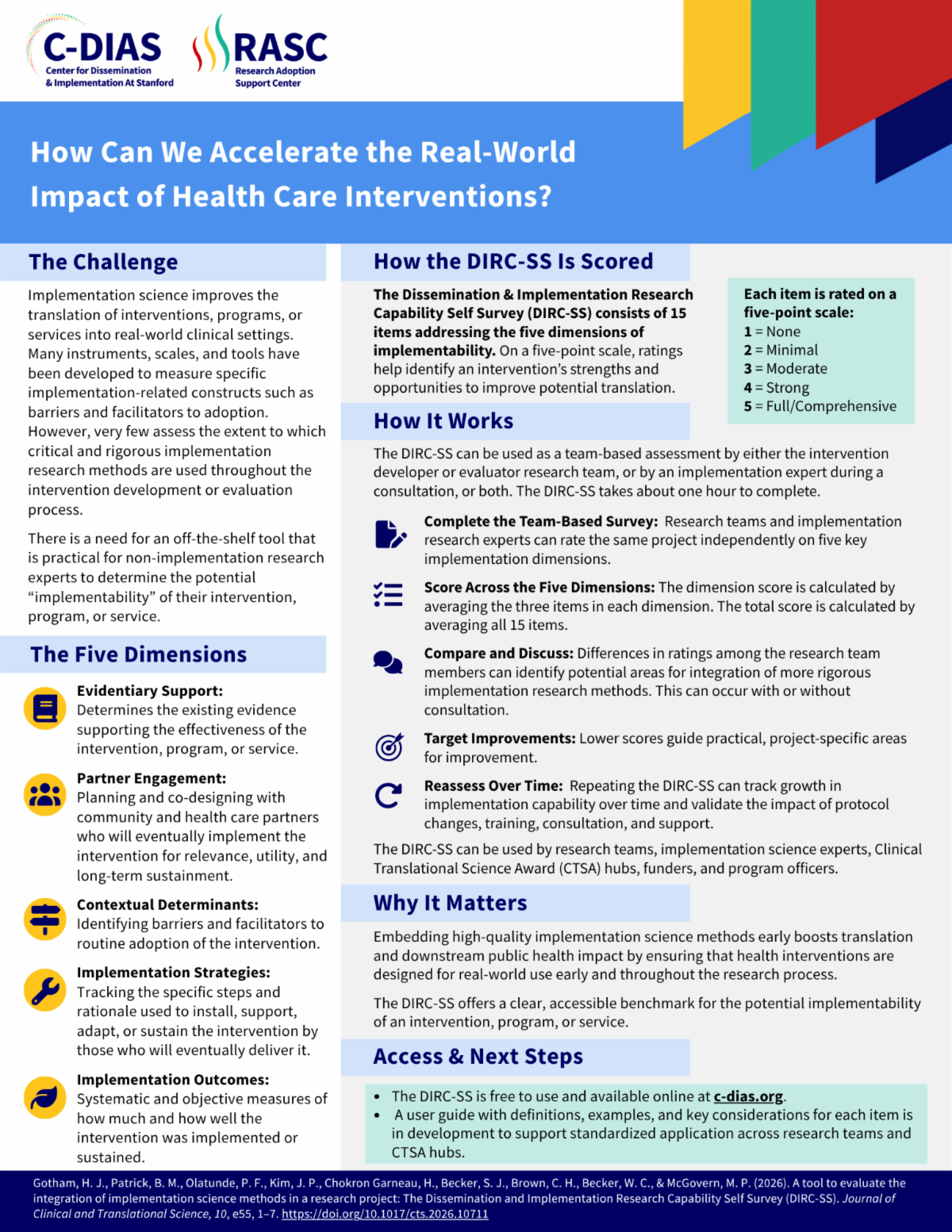
How Can We Accelerate the Real-World Impact of Health Care Interventions?
A new infographic from C-DIAS and RASC introduces the Dissemination and Implementation Research Capability Self-Survey, or DIRC-SS. It shows how research teams can use the public-access, 15-item tool to assess five dimensions of implementability, identify opportunities for improvement, and strengthen an intervention’s potential for real-world use.
| |
Explore Recent Additions to the HD2A Publication Library:
Growth in pain management procedures performed by nurse anesthetists
Hyman and colleagues analyzed Medicare and private insurance claims to examine trends in interventional pain management procedures performed by nurse anesthetists. Although nurse anesthetists still perform a small share of these procedures, their involvement grew substantially during the study period, particularly in spine-related care. https://doi.org/10.1097/ALN.0000000000005965
Low-threshold buprenorphine in community settings
Patterson and colleagues reviewed 41 studies of low-threshold buprenorphine programs delivered outside traditional health care settings, including mobile units, syringe service programs, and community centers. The review highlights community partnerships as an important implementation facilitator while identifying continued needs for sustainable funding and more consistent outcome measurement.
https://doi.org/10.1177/29768357251371854
Using digital health to improve access to opioid use disorder treatment
Canty and colleagues describe a study protocol that combines digital health, motivational interviewing, and system dynamics modeling to address barriers to evidence-based treatment for opioid use disorder. The research will examine how these approaches can support timely connections to medication treatment and inform broader implementation efforts.
https://doi.org/10.1136/bmjopen-2025-102796
| | You are receiving this email because you either subscribed to receive updates from us or someone you know thinks you'd be interested in our work. If this email was forwarded to you, please subscribe to our newsletter to continue getting updates. | |
This work was supported by grant no. 1U2CDA057717 from the National Institute on Drug Abuse, National Institutes of Health. |
| | | |