Welcome to this issue of the HEAL Data2Action (HD2A) Digest! Please share with colleagues, friends, and anyone else you know who might be interested in our work and encourage them to subscribe to our newsletter. | | |
Dear Colleagues,
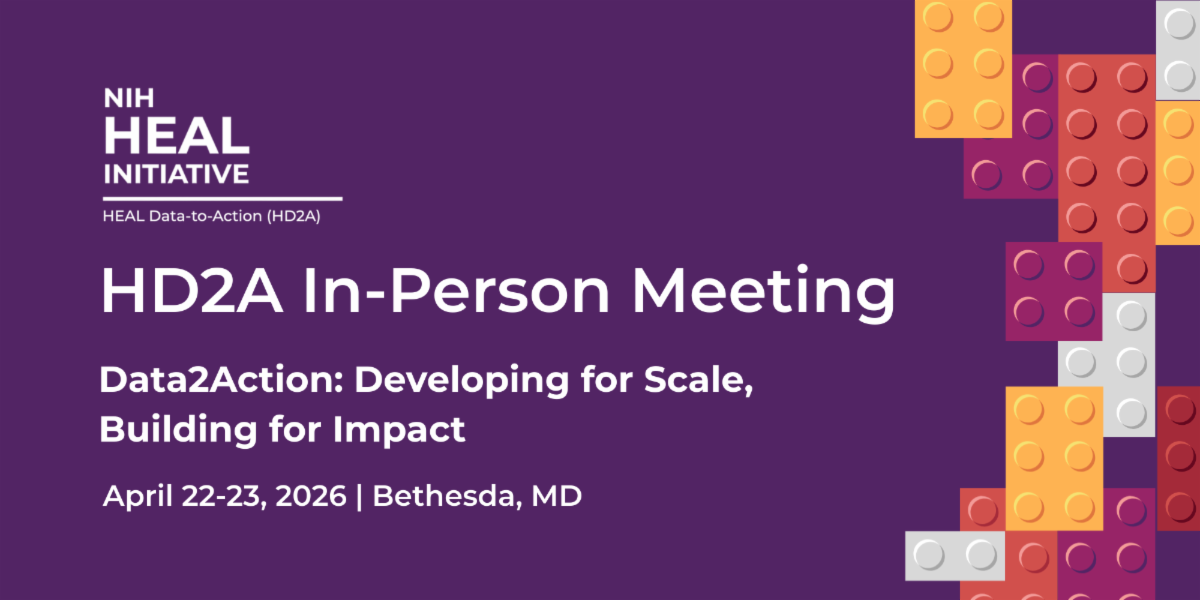
Members of the Helping to End Addiction Long-term (HEAL) Data2Action Initiative (HD2A) will gather April 22-23, 2026, in Bethesda, Maryland, for the initiative’s upcoming in-person meeting. The one-and-a-half-day convening will bring together Innovation and Acceleration Projects, Support Centers, and our NIDA colleagues for focused discussion, shared learning, and collaboration.
Organized around the theme Developing for Scale, Building for Impact, the meeting will highlight how teams across HD2A are using data to develop scalable solutions with the potential to improve real-world outcomes. Participants will share progress, explore challenges, and participate in breakout discussions designed to strengthen partnerships and accelerate the initiative’s collective mission.
In addition to the working sessions, the meeting will provide time for colleagues across the network to reconnect, exchange ideas, and deepen the collaborations that drive HD2A’s work forward.
We look forward to gathering in April!
| | Improving Access to MOUD and Prenatal Care | | Jennifer Marshall, PhD, CPH | | | |
Perinatal opioid use disorder (OUD) is the leading cause of maternal mortality during pregnancy and in the first year after delivery and contributes to out-of-home placements in the child welfare system. Medication for opioid use disorder (MOUD) is the standard treatment; however, access to MOUD and prenatal care remains limited and fragmented. Insufficient data integration also makes it difficult to identify mother-infant dyads requiring care.
In this project, investigators will create an interactive data dashboard to track maternal, neonatal, and infant outcomes for pregnancies affected by opioid use disorder, pilot an integrated Continuous and Data-Driven Care (CADENCE) program in a health system, evaluate clinical outcomes and implementation using the dashboard, and assess costs. Primary outcomes include mothers’ engagement in treatment and the number of neonates with neonatal withdrawal syndrome requiring pharmacologic treatment. The program is expected to improve maternal, neonatal and infant outcomes.
Over the past year, the project team developed an internal data dashboard that leverages a patient-identification algorithm created during earlier phases of the project. Using this tool, the team evaluated outcomes associated with the CADENCE care pathway and implemented multiple continuous quality improvement initiatives targeting key clinical and care coordination priorities. Examples include improving transitions of care from incarceration, enhancing SBIRT utilization and documentation, and advancing perinatal hepatitis C care and treatment.
-
Fryer, K., Reid, C. N., Chaphalkar, C., Marshall, J., Szalacha, L., Johnson, K., Wright, T., Read, C., Khan, A., Wilson, A., Ratani, M., Cox, K., Tavolieri, A., Sampayo, M., Su, R., Campbell, K., & Salemi, J. L. (2024). Development of a 5-Step Electronic Medical Record-Based Algorithm to Identify Patients with Opioid Use Disorder in Pregnancy. Journal of registry management, 51(2), 69–74.
| | NIDA Program Officers (POs) will be attending two upcoming national conferences this spring and summer. NIDA staff plan to participate in the Society for Prevention Research (SPR) Annual Meeting (May 2026) and the College on Problems of Drug Dependence (CPDD) Annual Meeting (June 2026). | | Explore the New HD2A Publication Library | | |
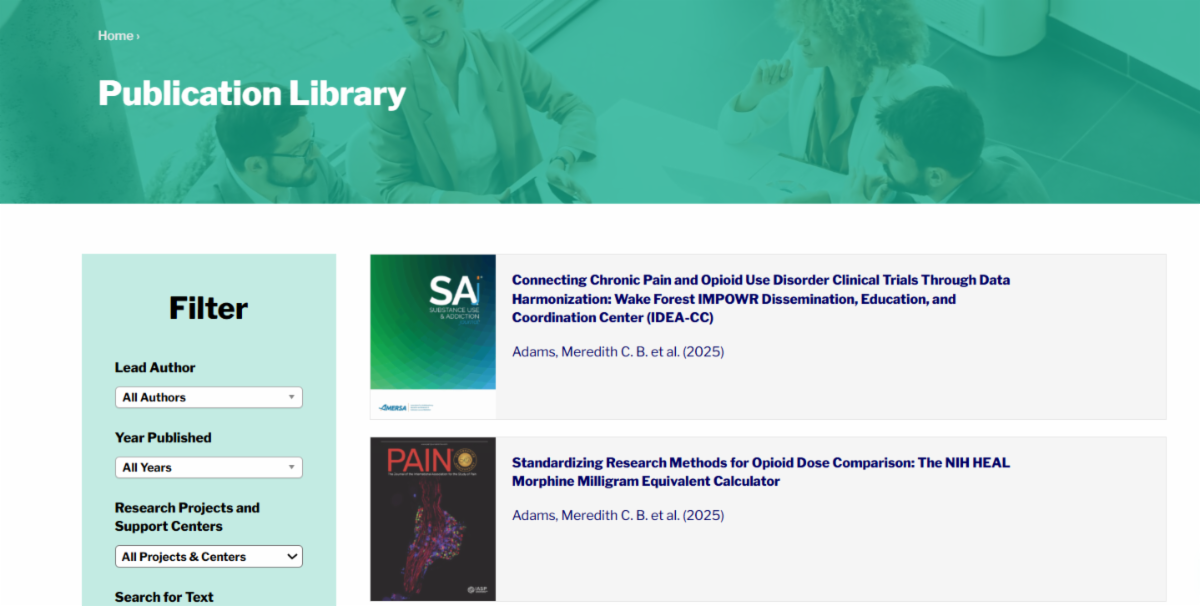
The HD2A RASC website now features a redesigned Publication Library, making it easier than ever to explore the growing body of research produced by HD2A investigators.
The updated library introduces improved functionality that allows users to filter and browse publications by multiple criteria, helping visitors quickly locate papers relevant to their interests. The new interface also presents publications in a clearer, more organized format, making it easier to scan, navigate, and access full articles.
This update replaces the previous publication list with a more flexible and user-friendly resource designed to support discovery and dissemination of HD2A research.
| | What We're Reading & Listening To | | You are receiving this email because you either subscribed to receive updates from us or someone you know thinks you'd be interested in our work. If this email was forwarded to you, please subscribe to our newsletter to continue getting updates. | |
This work is supported by grant 1U2CDA057717 from the National Institute on Drug Abuse, National Institutes of Health. |
| | | |