Your monthly news: everything haiku |
|
The HSA appreciates your continued support and your participation in society activities.
As primary supplement to the HSA website, this monthly report strives to bring you news from the Executive Committee and the Regional Chapters.
|
|
Jay Friedenberg
President
|
January is the start of a new year and the birth of new possibilities. Human birth and babies thus seem a relevant subject matter for this time. Babies are a source of amazement and awe. It seems almost impossible that we are capable of creating something as complex as an actual person but it happens all the time and with little initial effort of our own. Babies show us the preciousness and fragility of life and are an example of the wonder of the universe in which we live.
Baskin-Robins
we sample new
baby names
In this poem by Susan Burch, a mother-to-be is trying out different flavors of ice cream. Each type of ice cream seems to stand either for a possible name or baby. The couple are sampling each, getting a feel for what they like. It isn't certain what flavor or name they will ultimately choose but the fun is in deciding. This haiku is light and humorous in a classic karumi style.
a ripple carried
past a bend in the river . . .
her baby's ashes
Agnes Eva Savich paints a dark but hopeful scene in this haiku. A baby's ashes are scattered in a river and a ripple in the water is seen to pass out of sight around a bend. The ripple might be carrying the ashes down the river, but there is a larger metaphorical understanding here. Our lives can be likened to ripples on a river that change, merge, and flow forward with time. New ripples and new lives emerge with time and the future is pregnant with possibilities.
delivery room—
the gentle light
of the beginning
There is a quiet sense of hush and expectation in this poem by Steliana Cristina Voicu. One can palpably sense the gray tones of a darkened delivery room. A gentle light permeates the scene, perhaps from morning sun filtered through window shades. The gentle light seems to imply that the time of day is morning, connecting the start of the day with the start of a life. Interestingly, at least in the U.S., most babies are born on weekdays between 8:00 a.m. - 9:00 a.m. and 12:00 p.m. - 1:00 p.m., times that are actually earlier in the day and week.
|
|
Gary Hotham
1st Vice-President
|
Now Accepting Submissions to the
HSA Merit Book Award
Deadline for submissions is 15 February 2022!
If you have questions about the process, please e-mail Gary Hotham, 1st HSA VP.
|
|
Chuck Brickley
2nd Vice-President
|
***ANNOUNCEMENTS***
HAIKU SOCIETY OF AMERICA
2022 CONTESTS
HSA Renku Award
in memorial of
Bernard Lionel Einbond
Yes! The HSA Renku Award will be
up and running again this year!
• The window of submissions will be September 1 - October 31, 2022. Plenty of time to manage long-distance collaboration during the continued pandemic.
• Any recognized form of renku will be accepted (to be specified with submission).
• First Prize, $200; Second Prize, $150; Third Prize, $100.
• Full details will be posted on the HSA website in August.
HSA Nicholas Virgilio
Memorial Award
February 1, 2022 the gates will open for the 33nd Annual Nicholas Virgilio Haiku and Senryu Competition for Grades 7-12!
Deadline: In hand by March 21, 2022. Entries received after that date will not be accepted.
Eligibility: Any student in grades 7 through 12 enrolled in school as of September 2021 may enter.
Regulations: Submit up to three haiku/senryu per student.
For full details: check the HSA website:
https://www.hsa-haiku.org/virgilioawards/Virgilio-contest-guidelines.htm
HSA Rengay Award
The third annual HSA Rengay contest will accept submissions from April 1 to May 31, 2022. Full details will be posted on the HSA website in March.
HSA Haiku, Senryu
and Haibun Awards
The submission window for HSA's venerable summer contests — the Haiku, Senryu and Haibun Awards — will be from June 1 to July 31, 2022. Full details of the contests will be posted on the HSA website in May.
|
|
Haiku Poet Interviews Blog:
Glimpses into other worlds
by Jacob Salzer, January 1, 2022
There are so many people writing haiku these days. Have you ever read an excellent haiku in a journal by a name you recognize, but you don’t know anything about the poet?
The Haiku Poet Interviews Blog was created to provide background information on haiku poets, along with links to books and resources. Each month, a new haiku poet is featured.
The poet’s background information includes:
- Personal Website/Blog(s):
- Country of Residence:
- Current Occupation:
- Past Occupations:
- Haiku-Related Volunteer Positions/Affiliations:
- Interests/Hobbies:
- Journal Publications:
- Book Publications:
- Anthologies & Collaborations:
The interviews are short and simple, consisting of 6 questions, but they provide a real glimpse into the lives of fellow haiku poets.
The 6 interview questions are:
- When & how were you introduced to haiku & Japanese-related poetry?
- What do you enjoy the most about haiku?
- What do you enjoy the most about tanka?
- What do you enjoy the most about haibun?
- Who are your top 5 favorite poets?
- What haiku/writing projects are you currently working on?
Each interview finishes with 3 poems by the poet.
So far, I have interviewed the following haiku poets: Carolyn Winkler, Michelle Hyatt, Michael Dylan Welch, Diana Saltoon, Alan Summers, an’ya, John Budan, Roy Kindelberger, Garry Gay, Clayton Beach, Richard Gilbert, John Stevenson and Terry Ann Carter!
I have some more great interviews coming up this year. I also currently have openings for interviews in 2023. If you would like to be interviewed or know someone who is interested, please email me with the subject line: Haiku Poet Interviews.
Best wishes for the New Year!
Jacob Salzer
____________________________________
Jacob Salzer enjoys writing haiku, tanka, and haibun, and is the editor of 3 haiku anthologies: Yanty’s Butterfly, New Bridges, and Half A Rainbow. He is the co-author of Echoes: A Collection of Linked-Verse Poetry (2020) with Michelle Hyatt. His most recent solo collection is Mare Liberum: Haiku & Tanka (2020).
Weblinks:
|
|
The Unseen Go-Between in Haiku
Alan Summers
"We are all in the gutter, but some of us are looking at the stars.”
Oscar Wilde, from his play Lady Windermere's Fan, written in 1892.
“If one were to look at a comic we would see empty space between the panels that contain the illustrations and dialogue. In the comic world this space is known as the gutter. The gutter is essential for comics… because it allows for closure to happen. The gutter is used to take two separate images and transform them into a single idea…”
Scott McCloud, author of Understanding Comics: The Invisible Art (HarperCollins 1993)
Professor Delwiche (Trinity University, San Antonio, Texas), quotes McCloud, who explains that while a reader cannot see what is happening within the gutter, assumptions can be made … that allow for those panels to be related in some way. McCloud then describes closure as a “phenomenon of observing the parts but perceiving the whole.”
Let’s see how McCloud describes his six types of panel-to-panel transitions, each requiring a different degree of closure/reaction from the reader:
- Movement-to-movement transitions
- Action-to-action transitions
- Subject-to-subject transitions
- Scene-to-scene transitions
- Aspect-to-aspect
- Non-sequitur transition
1. Movement-to-movement transitions present basic movements occurring:
woodfire
flickering in the silence
corralled horses
Alan Summers
Modern Haiku vol. xxvi no. 3 (1995)
The middle line of this haiku published by Modern Haiku is what we would call a pivot line. The movement of the wood-burning fire (think camp fire) is throwing up shadows, so that flames and shadows, this is a night scene and people are tucked into their sleeping bags, are flickering. As the horses mill around their movement is caught up by the flames throwing shadows around. If there was no fire, and no flickering flames, there would be no flickering shadows. We can imagine continuous movements being picked up by the light of the flickering flames making everything else flicker too.
2. Action-to-action transitions present a single subject progressing through a specific movement:
kicking
through the leaves
sound of its season
Alan Summers
BBC Television Regional Arts feature (November 2003)
The haiku is about a set of actions around a single image of leaves on the ground, as it’s the Fall/Autumn. What child, and even adult, has not wanted to kick through a mound of autumnal leaves! So many of us love to hear the sound of the dry crispness, and crackling sound, of the leaves that are a strong symbol of Autumn. We are literally kicking through the sound of the season! The BBC film crew caught me drawing this haiku using chalk across the sidewalk (and into the gutter between sidewalk and road) during a big Art Trail festival that was both outside and also in private homes open to visitors.
Here are two explanations describing the differences between “movement” and “action”:
“movement is physical motion between points in space while action is something done so as to accomplish a purpose.” Movement vs Action - What's the difference? | WikiDiff
Paraphrasing Professor Delwiche:
The gutter serves as a way to keep actions separate. Movement is where a group of actions encapsulate individual actions.
All those children and adults, including me, kicking the fallen leaves just to hear them, and hear the season!
3. Subject-to-subject transitions present one situation, and stay within that specific scene, showing one thing, perhaps suggesting something else about that scene as well. It calls for more reader involvement: As readers we might need to inhabit the scene for longer.
an attic window sill
a wasp curls
into its own dust
Alan Summers
Haiku of Merit, Professor Hoshino Tsunehiko (Ginko/Kukai, London, UK 1997)
Yomiuri Shimbun, Japan (published for my birthday, September 16th 2002)
My parents’ home had an attic with a window at each end. During the height of a Summer heat a lot of wasps died, and then dried out. Many of the wasps were curled up in death, and one in particular was a perfect round curl, with a circle of dust from its own body surrounding it in a perfect circle. The fairly thin wooden sill/shelf was also drying out, as there was no ventilation in the attic. The sill was beginning to curl up a little and it looked like both the wasps and the sill/window base were curling up together. It was if it was a case of who or what was curling whom?
At first reading, there is the first subject (attic window sill) and a second subject (a wasp) tethered together by dust. Most things can turn to dust and here we move from the window sill made out of a natural substance (wood) to another natural entity (wasps) and both can be prone to heat and desiccation (basically losing all moisture). This is a haiku that stays with the main motif of dust and just staying at that single window sill and its occupant.
4. Scene-to-scene transitions take place across significant distances within time and space, a sort of both “here” and “there” at the same moment:
twilight on snow shadows deepen the grip of stars
Alan Summers
Frogpond 37:2 (2014)
Anthology: big data The Red Moon Anthology of English-Language Haiku 2014
The sheen on snow, whether we see fresh snow in the morning before it turns to slush, or that also magical shine as dusk arrives, and all the shadows created by the sun (daylight) or by the moon (evening/night) that always lends character to this phenomena we often associate with special wintery celebrations. Here I have the time (twilight) and the first concrete image (snow) interacting with subtle shadows caused by amongst other things, the moon. When I look up, I can see either some or many stars, and within me I feel delightfully small and in awe of the vast expanse above me that goes on and on and on, and I am in the grip of stars.
An effective method for some of our haiku is to capture something close up and and something far away, or the reverse. Usually this is perhaps something close up like a bird on the ground or on a fence, for instance, that then flies up to a tree. Here I make the scene shift from snow on the ground, and shadows, to deep space. I’m still in awe that standing on this planet’s surface I can look up and into the galaxy.
5. Aspect-to-aspect is unique in that it shows different things occurring simultaneously within the same scene.
First of all the ‘aspect-to-aspect’ transition originates from Japanese manga and animé, to evoke a mood gently stimulating focus on ‘just being there' rather than the ‘goal orientated process of getting there’.
Here are two haiku (Easter Wedding, and hazelnut picking) which are both also seasonal.
Easter Wedding
the chauffeur in a tangle
with the umbrella
Alan Summers
Presence #44 (2011)
Easter is one of the popular times to have a wedding, and where everything needs to be perfect, but it’s also the Spring season with its sometimes wide and varied mix of weather conditions. The scene is set for the various family and friends to pour into the church. A Rolls Royce pulls into a side street, out of sight. The weather is picking up, the bride is holding her dress down, there are no helpers. The driver tries to manage an umbrella as it’s starting to rain. The wedding party is unaware that the main guest is struggling, and her driver is trying to do the work of several brides maids, unsuccessfully. One event (a wedding) and two aspects of that wedding.
hazelnut picking
the child in a memory puts
my hand to the moon
Alan Summers
Honourable Mention, Autumn Moon Haiku Contest 2021 (judge: Bruce Ross)
It’s the Fall, and alongside the main feature of leaves turning colour, and eventually falling, is the various nuts that squirrels prize, and some humans too! September and October are the main months for hazelnuts, and we once used to forage for them, partly to save money, partly as a family outing, or as youngsters enjoying free snacks as we play games outside. And it was all free, fresh air and exercise, and a great walk into the green outdoors rather than driving around and then entering a supermarket to buy things that hung on trees.
This is all about being part of nature, and a hazelnut picking activity. One activity but two aspects, the now (present) and “then” (past). We were all once children, perhaps this is a universal child, or one that really got into the spirit when we didn’t. Now that memory comes back and that child is helping me to enjoy the simple and free things again.
6. A Non-sequitur transition provides no logical connection between panels, unless we have fun, and make a leap of logic connecting ‘the dots’ or even “creating our own dots.” Have a go yourself with these two single line haiku examples:
each window its own night train
Alan Summers
Honourable Mention, British Haiku Society Awards 2018/19 (judge Scott Mason)
Many of us may have lived or visited a home, apartment, motel/hotel, or even a restaurant by or inside a railway station that looks onto the railway platforms; or we might be on that train and passing through residential areas. We might see, as a train passenger, the reflection of the train running across residential windows. We then get reflection upon reflection. Is each window we see representing each individual apartment, and ‘each window its own’ feels amplified by us inside the ‘night train’. Of course the people in an apartment or hotel room have their own perspective, where each train window, containing a different view, is perhaps of just one person per train window, or a couple, or a family. You decide. And in turn “each window its own night” short for each window becomes its own night scene for a moment and then the train moves on, or we do.
nightfall the key turns into a blackbird
Alan Summers
Blithe Spirit 31.4 November 2021
This might feel that it is not logical! Does it really matter though? It can be broken down into logical pieces and I’ll attempt to do this. It was written in my fugue zone, but there is linear detail: The first word lets us know, or tells us, that it is nighttime. The next ‘phrase’ appears as ‘the key turns’ so we can guess it’s about someone turning a key into the lock of their home front door and perhaps returning from a good night out. We can go the linear logical route and guess the numerous streetlights are fooling the blackbird into singing at night: So as the key is being turned into the lock, the person might be very quiet as it is so very late; and they might be a little tipsy too, and doing that ‘extra quiet shuffle’ and in turn they can’t help but hear the blackbird song. There is more, but I don’t want to spoil the fun by over-explaining the haiku and my sometimes quirky process. Just know this, even what appears to be an extreme juxtaposition might have its logical connections and we can refer back to the six transitions listed above to break its code.
In my concluding thoughts, let’s look at one of my writing techniques, and how I feel haiku can be more than just one type of putting these intriguing sometimes contrary poems together. Alongside using the definitions of the transitions above, I wonder if we could also think of haiku as a combination of storyboarding and storytelling techniques?
Storyboarding:
An important part of a preproduction process of showcasing images to show what’s going to happen in a finished piece.
Storytelling:
The postproduction stage where we now invite the reader to be as active in our process, and join us in looking at the stars.
Let’s start with storyboarding:
I started with these words:
- hands
- clocks
- gloaming
- evenfall
And now I’ll explain a little about each word choice:
hands:
Our hands are so important for gestures/communication, to be able to eat, to hold things, and each other.
clocks:
We regularly do things ‘by the clock’ governed by time, for work, for sleep, and all the activities in between.
gloaming:
A beautiful word from the early Middle Ages (England and southern and eastern Scotland) and now mostly a poetic term in Scotland. It’s the time of day when it’s not yet fully dark. For those who work certain shifts it might be that you walked to work or are heading home in the gloaming, as the city lights are being switched on.
evenfall:
the onset of evening; dusk.
Let’s look at Storytelling:
I have my images:
- hands
- clocks
- gloaming
- evenfall
Let’s start from top to bottom:
Hands are often messengers aren’t they, and during the hours of dusk they can even be a little ethereal, communicating by accident or design, in animated discussion, whether we are able to talk, or using them while being vocally quiet.
The storytelling aspect is important in haiku, and we can only ‘show’ so much, because storytelling is in our blood, isn’t it?
I noticed I had the pronoun ‘our’ in my quick explanation about ‘hands’ so I will start the haiku with:
our hands
I often associate the movement of both our physical hands with hands of a clock, or is that just me!
Time to add a “connector” which are those little bits of grammar that can make or break or even elevate a haiku.
our hands as clocks
Connectors can be prepositions, conjunctions, even articles (a, an, the).
Now I realise I have twilight twice! We might regularly be told or instructed to avoid saying something twice, even though that happens in other types of poetry but I really want both, and although ‘gloaming’ is rarely used as a verb, I’m determined to keep it:
our hands as clocks gloaming
Now I need another preposition. Should I go with ‘among’ or ‘amongst’? I’m tempted to go with the lesser used and poetic ‘amongst’, as ‘among’ feels awkward this time. I considered ‘along’ but that took me into a different direction, and I wanted ‘our hands’ to be either about an individual explaining to someone else, or a group of friends, or family; or even simply finding myself amongst a group of people heading to a party with all their anticipatory excitement. The preposition ‘among’ didn’t have enough oomph for me so I decided on this:
our hands as clocks gloaming amongst
We know it could do with one more word at least. As this feels more like the time of nights drawing in, late Autumn or into Winter, I could have snow. But this is a poem about the dusk, and just dusk. So forgive me if I’m breaking any rules, but then perhaps the rules are bending for me to avoid being stiff imperatives.
The logical choice of ‘evening’ just doesn’t do it for me, again a little too mechanical and generic, although it pays to keep words simple in many haiku, exceptions are healthy too. Before I add the last word, I realise I need another connector, and as I’ve written an article about articles, yes really, I’m going for the definite article [the] and I have my final word right after that too!
our hands as clocks gloaming amongst the evenfall
The key image is the continuous flow and movement of our hands into the gathering dusk, an almost luminous set of actions, as if our hands are glow-sticks. And maybe this group are taking turns at telling stories via anecdotes and jokes.
Which transition does this haiku use? Each of you might have a different idea, and why not, just have fun using the transitions in any way that you see fit to do so.
Alan Summers is founder of Call of the Page, and a twice Japan Times award-winning writer.
|
|
Haiku Poets of Northern California (HPNC)
At HPNC’s fall quarterly meeting in October we were treated to a double feature of readings, the first by Gideon Young and the second by Sarah Paris. Attendees, many of whom joined the meeting from outside the Bay Area, included: Mimi Ahern, Susan Antolin, Fay Aoyagi, Betty Arnold, Brad Bennett, Chuck Brickley, Anne Burgevin, David Chandler, James Chessing, Juanito Escareal, Ignatius Fay, Bruce Feingold, Patrick Gallagher, Garry Gay, John Green, Lee Gurga, Johnnie Johnson Hafernik, Carolyn Hall, Christine Horner, Lynne Jambor, Deborah P Kolodji, Kristen Lindquist, Patricia Machmiller, Tanya McDonald, Helen Ogden, Renée Owen, Lorraine Padden, Linda Papanicolaou, Sarah Paris, Joseph Robello, Michael Sheffield, Laszlo Slomovitz, Dennis Sullivan, Jennifer Thiermann, David Watts, Kath Abela Wilson, and Gideon Young.
After welcoming remarks by HPNC president Garry Gay and about a quarter of an hour socializing in small groups, Garry introduced our first reader, Gideon Young, who joined us from his home in Chapel Hill, North Carolina. Gideon Young is a member of the Carolina African American Writers’ Collective and Carrboro Poets Council. Find recent and forthcoming poetry in Acorn, Journal of Black Mountain College Studies, North Carolina Literary Review, and Wales Haiku Journal. Gideon’s debut haiku collection my hands full of light was published by Backbone Press, April 2021. Prince Rivers: A Leader for Justice, a biography for young readers, is forthcoming from Gibbs Smith Education in Fall 2021. He is co-author of One Window’s Light: A Collection of Haiku, published by Unicorn Press, 2017, winner of the Haiku Society of America Merit Award for Best Anthology. Gideon is a Fellow for A+ Schools of North Carolina, a K-12 Literacy Specialist, and stay-at-home Dad. His current work is with the Arts Education Partnership and the Education Commission of the States. Discover more at www.gideonyoung.com.
From Gideon’s reading:
shaded chickadee
her first notes
an Ellington tune
Our second reader, Sarah Paris, joined us from her home in Santa Rosa. Sarah Paris is a Swiss-American poet, writer, photographer, editor, and former journalist. Sarah co-founded and for many years led the Four Seasons Haiku group at Mercy Center, Burlingame. She is a long-time member and facilitator of Parnassus Writers and Poets, the longest-running writers group in San Francisco. Sarah is the author of two novellas, “The Hermit” and "The Traveler,” as well as a German-language novel, published in Switzerland. Her haiku have appeared in many of the leading journals, and she is currently working on a collection of haiku poetry and photography. In her professional life, she works as an editor, communications consultant, and career coach. You can find her on Twitter as @SFSwissPoet.
From Sarah’s reading:
a gray dawn
again, and again the call
of the mourning dove
Both of these readings were recorded and are now a part of our growing library of recordings we encourage you to explore on the “Recordings” tab of the HPNC website. We hope you enjoy revisiting these readings!
We have just posted some of the upcoming HPNC events for 2022 here. Due to the continued uncertainty surrounding the safety of in-person gatherings, we have decided to continue to meet virtually on Zoom. The added benefit of meeting this way is that we can hear from poets outside our geographic area. Our first meeting of the year will be on January 23 with readings by Massachusetts poets Janice Doppler and Brad Bennett. While attendance at our meetings is limited to HPNC members, we welcome anyone to become a member. If you are not a member but would like to enjoy the readings and presentations, the recordings are available to the public on our website afterwards.
Entries to the HPNC-sponsored Rengay contest are due by January 31, 2022, and submissions to our Haibun contest are due by May 1, 2022. Complete contest guidelines are posted on the HPNC website. Downloadable PDF forms for writing rengay are also available on the website. Thank you in advance for supporting HPNC by participating in the contests!
With best wishes for the New Year,
submitted by Susan Antolin
Yuki Teikei Zoom Holiday Party — December 2021
Our holiday party has been an annual event since the early 1980’s when David Wright was President. Friends gather to share haiku and haiga greetings. This year, our 2nd party held on Zoom, nearly 50 members attended. It was 11:00 a.m. in CA, 2:00 p.m. on the east coast, and 4:00 a.m. in Japan—a day ahead. No champagne toast to the end of the year and the beginning of the new, but indeed, there was quite a bit of magic in everyone’s holiday greetings.
A special viewing of 12 New Year’s cards, a collaboration over the years of June Hopper Hymas and Patricia J. Machmiller started the program. They sent their cards to haiku friends they had made in Japan while attending an international haiku conference along with other YTHS members in 1997. Either a photograph of June’s or an art work of Patricia’s adorned the front, and inside — their lovely tan-renga. Here are cards from 2005 and 2018:
sigh of rice paper
as she refolds the letter—
fleeting, the short day pjm
the aria’s final note—
perfect, like a winter rose jhh
all is quiet
in the garden except for
the persimmon pjm
a book of sonnets
lies open on a bench . . . jhh
On January 8, 2022, our first meeting of the new year will be held on Zoom. Kath Abela Wilson, Tokutomi Memorial Contest Chair, along with Dojin Phillip Kennedy will discuss the kigo choices for the coming year’s contest.
submitted by Alison Woolpert
December 18, 2021 Workshop
On Saturday, December 18th, the Southern California Haiku Study Group met for a presentation and discussion led by Robin Smith, “Signature Style: How Identity Informs Voice in Haiku.” Nineteen poets attended: Lynn Allgood, Jackie Chou, Billie Dee, D’ellen, Joan Fingon, Deborah P Kolodji, Yvette Nicole Kolodji, Richard Matta, Naia, Claudia Poquoc, Wakako Miya Rollinger, Diana Rosen, Bona M. Santos, Robin Smith, Patricia Wakimoto, Michael Dylan Welch, Kathabela Wilson, James Won, and Sharon Yee. Joan Fingon acted as the technical coordinator for the meeting.
After a read-around of haiku, led by Deborah P Kolodji, Robin presented a PowerPoint presentation which discussed aspects of culture that influences voice in haiku, as well as how culture informs how an editor might evaluate a haiku. They discussed how we might find cross-cultural understanding to broaden our view of haiku styles and topics. They presented the work of 8 poets: Hifsa Ashraf, Jan Benson, Susan Burch, Kat Lehman, Vandana Oarasgar, Orrin Tyrell Prejéan, Réka Nyitrai, and Shloka Shankar, and led a discussion of the poems by these poets.
The next regularly scheduled meeting will be on Saturday, January 15, 2022 at 2:00 pm, by Zoom.
|
|
HSA Oregon News – December 2021 for January 2022 Newsletter
December Meeting Notes
Five members of the Portland Haiku Group and Oregon HSA met on December 11thh at the home of Shelley Baker-Gard. This was a face to face meeting and a zoom meeting too. Those attending were Shelley Baker-Gard, Ray Caligiuri, Jim Rodriguez, John Budan, Jacob Salzer. For the first part of the meeting, we held or regular kukai and had wonderful flute accompaniment by Jim Rodriguez. Here are the results:
For the Haiku/Senryu category:
1st place was "winter solstice" by Sam Blair with 3 votes and 1 honorable mention.
2nd place was a tie between "foggy morning" by Jim Rodriguez, "late autumn wind" by Ray Caligiuri, and "early spring mornifgo, it became a tourist attraction for those interested in the beat poets. After our tour, we stopped at the nearby Blue Kangaroo cafe for tea and coffee.
|
|
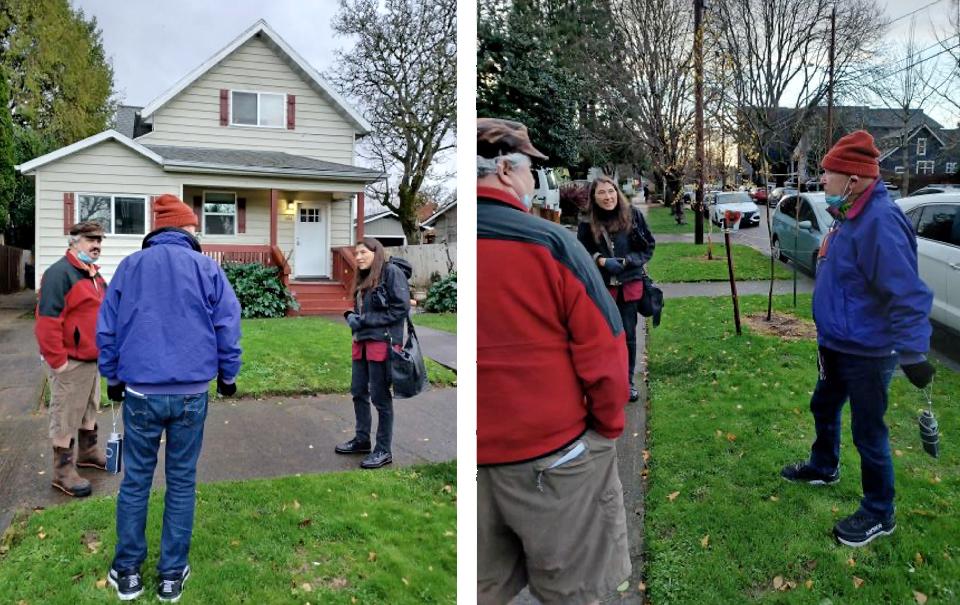
Picture of the house and Jim Rodriguez, John Budan and Shelley Baker-Gard
taken by Jacob Salzer
The next face to face meeting for the Portland Haiku Group/HSA meeting will be Saturday, January 8th at 2 pm at the Sellwood Community House at1436 SE Spokane St., Portland. Attendees need to be vaccinated.
The leader for the kukai will be Jim Rodriguez, rodriguez5140@comcast.net Please send him your poems by 1/2/2022 ( 2-3 haiku, senryu, tanka, 6 word story, or 1 haibun and 1 other) Please RSVP to Shelley if you want to join us via email or call 503-232-6560;. We will also have limited zoom access.
The next Bi-monthly ZOOM only meeting is Sunday 1/30/22 –at 2pm – 4 pm and will be hosted by Lynne Jambor (Shelley will moderate the Zoom)This every other month Zoom meeting time is set for the last Sunday of that month –Email Shelley, if you want to receive the invitation. The meeting is open to anyone in the Northwest including Canada or to others interested from different areas (email Shelley if you want to attend as the size is limited to 15 attendees). Email Lynne Jambor with your kukai entries by 1/20 (2-3 haiku/senyru/tanka or 1 haiku/senyru/tanka and 1 haibun).
Other Announcements:
Jacob Salzer has recently published a new collection of his wonderful poetry entitled Origins. This collection of haibun by Jacob D. Salzer provides excellent examples of the genre. Haibun is a Japanese poetry form that combines prose with haiku (or sometimes, tanka, termed tanka stories.) The haiku or tanka link-and-shift with the prose, adding additional depth and resonance. This collection features haibun previously published in: jar of rain: The Red Moon Anthology of English-Language Haiku 2020, Modern Haiku, Chrysanthemum, Prune Juice, Contemporary Haibun Online, and Drifting-sands-haibun.org. It also has a preface by a Japan Times award-winning writer Alan Summers. Edited by Brendon Kent and Nicholas Klacsanzky. Link
|
|
Haiku Northwest met on Thursday, December 9, with 24 people in attendance: Aidan Castle, Bob Redmond, Carmen Sterba, Connie Hutchison, Curtis Manley, David Berger, Delores Schneider, Diane Wallihan, Dianne Garcia, Eliot Simons, Gary Evans, Helen Ogden, Ida Freilinger, Kim Weers, Kristen Gianaris, Michael Dylan Welch, Michelle Schaefer, Noreen Ash Mackay, Peter Fischer, Richard Tice, Susan Lee Roberts, Tanya McDonald, Terran Campbell, Theresa C.
*
We announced the results of Officer Elections for the 2022 term:
• President: Tanya McDonald
• Vice-President: Bob Redmond
• Secretary: Dianne Garcia
• Treasurer: Curtis Manley
• Website Manager: Michael Dylan Welch
For complete officer bios, please visit here. Congrats to the new officers; who look forward to serving! Also, big thanks to outgoing Board President Michelle Schaefer and Vice-President Gary Evans. Thanks for your time and dedication!
*
We then had a haiku workshop.
NEXT MEETING: Saturday, January 8th, from 1 pm - 4 pm PST, featuring Lew Watt and a workshop on "How Haibun Work," plus a haiku workshop.
Lew Watts: How Haibun Work
What makes the haibun form so powerful and exciting? This presentation will introduce the basic elements of haibun and how, if handled well, they interact to create something magical. Through examples, we will examine how writers can best achieve this effect, and how readers can fully appreciate it. Finally, we will explore how to break the rules with examples of experimenting with form, voice, rhythm, and focus.
Lew Watts is the haibun co-editor of Frogpond and the author of Tick-Tock (Snapshot Press, 2019), a haibun collection that received an Honorable Mention in the Haiku Society of America’s 2020 Merit Book Awards. His publications also include the novel Marcel Malone, the poetry collection Lessons for Tangueros, and a forthcoming collection of haiku and haibun from Snapshot Press. Born and raised in Cardiff, Wales, he moved to the U.S. in 2002 after working in the energy industry in Europe, Scandinavia, the Middle East, and Africa. He lives in Chicago with his wife, Roxanne Decyk. His other passions are fly fishing, rugby, and gin martinis.
Anonymous Haiku Critique Session: Got a haiku that needs some friendly, constructive feedback? All attendees are welcome to send in a haiku for consideration in the anonymous critique session. (During the session, poems will be presented without the poet’s name, hence the anonymous part.) Please send to Tanya by Thursday January 6 at 10pm PST for consideration. Depending upon the number of poems received, we may not be able to discuss all haiku submitted for critique, but we hope you will find all of the discussions valuable regardless of whether your poem is randomly selected or not.
End note: Anyone is welcome to attend Haiku Northwest meetings and to join the Haiku Northwest emailing list at this link.
— submitted by Bob Redmond
|
|
Ohaio-ku Study Group
The Ohaio-ku Study Group met Saturday, December 11th, from 10am to noon via Zoom facilitated by Nicky Gutierrez. The following Ohio poets were in attendance: Matthew Markworth, Nicky Gutierrez, Nancy Brady Smith, Jill Lange, Nancy Pownell, and Barbara Sabol. The following visiting poets were in attendance: Janice Doppler, Ruth Holzer, John Mori, and Sarah Metzler.
We started our meeting with announcements, read around, and had general discussion. After some general discussion, we looked at haiku that were published by The Heron’s Nest and discussed them.
We then did our kukai. Our kukai theme was “holiday music reference.” Top poems were Sarah Metzler in third, Jill Lange in second, and Barbara Sabol in first. In lieu of book awards, they received a rousing round of applause! Congratulations!
Our next meeting will be held Saturday, January 8th, on zoom 10 AM -12 PM. Janice Doppler will be reading from her new book, Stardust, at the next meeting! Our kukai theme will be “freaky winter weather.”
Please check the Ohio Haiku Facebook page for meeting information. Or for out-of-staters who wish to join us, please contact Nicky Gutierrez.
All are welcome! We'd love to see you there.
____________________________
Illinois State Poetry Society-Haiku Society of America Haiku Chapter
The ISPS-HSA Haiku Chapter held its bimonthly Zoom chapter meeting, December 12, 2021. Those who attended were: Susan Auld, Tom Chockley, Janice Doppler, Susan Farner, George Gerolimatos, Lee Gurga, Margie Gustafson, Michael Kozubek, Jeff Kressmann, John Mori, Jennifer Thiermann.
We began the meeting looking at three innovative haiku recently published in Kingfisher 4 haiku journal and in the most recent Frogpond. Then we moved on to the workshop conversation of draft haiku from participants, who wanted feedback regarding their poems. Each haiku was presented anonymously and discussed. We also asked the poet to tell us about the “haiku moment” that had been the impulse for the haiku. Then the haiku poet had the chance to give his or her feedback about the haiku. And we had time to talk about the continuing evolution of English-language haiku, particularly in regard to Lee Gurga’s and Robert Epstein’s essays in Modern Haiku 52.2 and 52.3.
Our next Haiku Chapter Zoom Meeting: Sunday, February 20, 2022 from 1:00 p.m. to 3:00 p.m. CST. The deadline for RSVPs to attend will be Tuesday, February 15. Contact Tom Chockley to attend the Zoom meeting and to receive further information.
***
Global Poetry Open Mic
Charlotte Digregorio will host another global Poetry Open Mic (via Zoom), Sunday, Feb. 6, from 2-4 p.m., (Chicago–USA Time). It will be sponsored by the Winnetka-Northfield (IL) Public Library District.
Poets may read any form of poetry. Those who are just reading haiku, may read up to eight poems. At the last open mic, many HSA members attended, including those from six foreign countries.
For more information, and to register, click here.
|
|
Saturday December 11th was our last HSA SE Region event of 2021. "One Step Beyond" was an open mic with Terri French as our featured reader debuting "Arr Arr V Adventures - Poetry in Motion". Terri presented a fantastic collection of haiga she generated during the nomadic lifestyle that she and her husband Ray have enjoyed in retirement. Terri was encouraged by the group to create a book showcasing her latest creation. Stay tuned!
Here are our top three kukai contest vote-getters (in alphabetical order):
Diane Alleva Caceres
to see
beyond
the
long
neck
of
the
lotus
plant
Peter Meister
some above,
some just below the surface-
stepping stones
Tom Painting
child's play
a yellow-brick road
of words
|
|
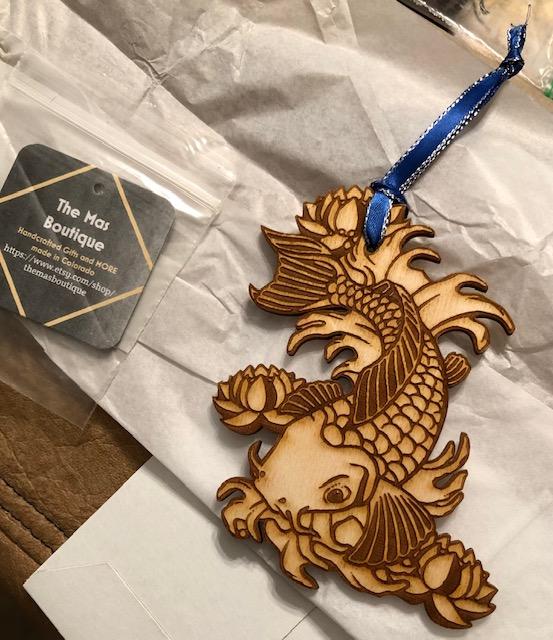
Custom-made Koi Plaques (as seen above) designed by The Mas Boutique, each with a commemorative inscription, were virtually presented and subsequently mailed to the award winners, The Mas Boutique may be accessed through etsy.com.
Stanford M. Forrester made an exciting announcement concerning his upcoming bird anthology, with the specific submission details coming in February 2022 on the bottle rockets website
bottle rockets press
For the balance of the festivities, the group enjoyed listening to a number of readers share their words. Antoinette Libro, Co-host, did a superlative job keeping everyone on track. (A glitch with the Zoom recording prevented any video or photos.) Coming in 2022, we plan to offer two or three Zoom Poetry Roundtables. Interested parties may email michaelhenrylee39@gmail.com.
Happy New Year everyone! May 2022 be a very good year.
Best, Michael Henry Lee
|
|
Global Poetry Open Mic
Charlotte Digregorio will host another global Poetry Open Mic (via Zoom), Sunday, Feb. 6, from 2-4 p.m., (Chicago–USA Time). It will be sponsored by the Winnetka-Northfield (IL) Public Library District.
Poets may read any form of poetry. Those who are just reading haiku, may read up to eight poems. At the last open mic, many HSA members attended, including those from six foreign countries.
For more information, and to register, click here.
|
|
San Francisco International Haibun Contest
Sponsored by Haiku Poets of Northern California
Deadline — May 1st, 2022
Entry Fee — $5 for 1-3 haibun
Contest Details —
The contest is conducted in a “double-blind” manner, meaning the identities of judges and entrants are withheld until the results are announced.
All entries must be original, unpublished, and not under consideration elsewhere.
The winning haibun will receive a $100 grand prize. At the discretion of the judge/s, an unspecified number of haibun will receive honorable mention awards (no prize money and no ranking).
Haibun with multiple authors will be considered a single entry for each author, and in the case of such a haibun winning the grand prize or honorable mention, the authors will share that award and prize money.
Contest winners will be announced at the summer HPNC meeting, and the full results, including commentary, will be published on the HPNC web site. The grand prize winning haibun will be published in the HPNC journal Mariposa. All rights revert to authors after the contest results are announced.
This contest is open to all except the HPNC president, the contest coordinator, and the judges (who will remain anonymous until after the competition).
Submission Guidelines —
Submissions are by email; however, so as not to exclude anyone wishing to enter, if you are unable to send your entry via email, please contact the coordinator and an accommodation will be made for you.
Send all submissions in a single email to the contest coordinator J Hahn Doleman. In the subject line, please type: HPNC Haibun Contest 2022, your name, the date. At the top of your email, type: your name, address, phone number, email, and the PayPal transaction ID number for your entry fee (see below).
Type or paste haibun directly into the body of your email; no attachments will be opened. Identify any haibun with multiple authors, and provide names of each.
Please send payment of $5 via PayPal to HPNC. In the 'Add a Note' section, type: 2022 Haibun Contest Entry Fee. Locate the PayPal transaction ID number and include it with your email submission.
|
|
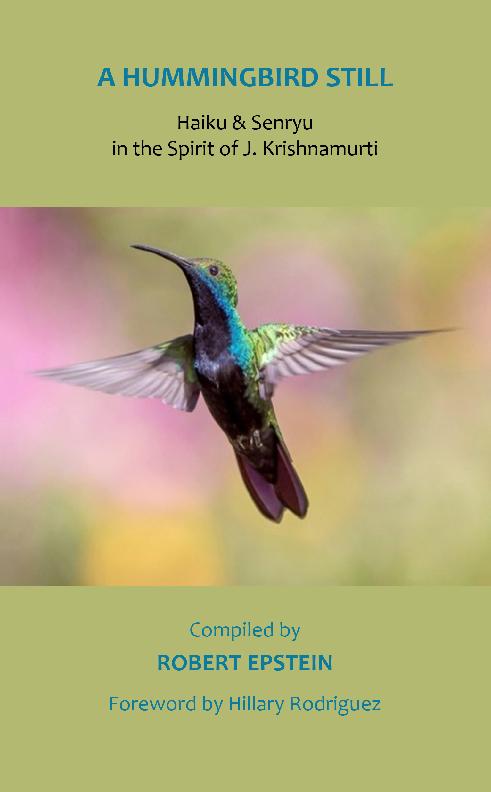
A Hummingbird Still:
Haiku & Senryu in the Spirit of J. Krishnamurti.
Robert Epstein is pleased to announce the publication of a new book titled,
A Hummingbird Still: Haiku & Senryu in the Spirit of J. Krishnamurti.
Paperback: 164 pages.
Middle Island Press; $15
|
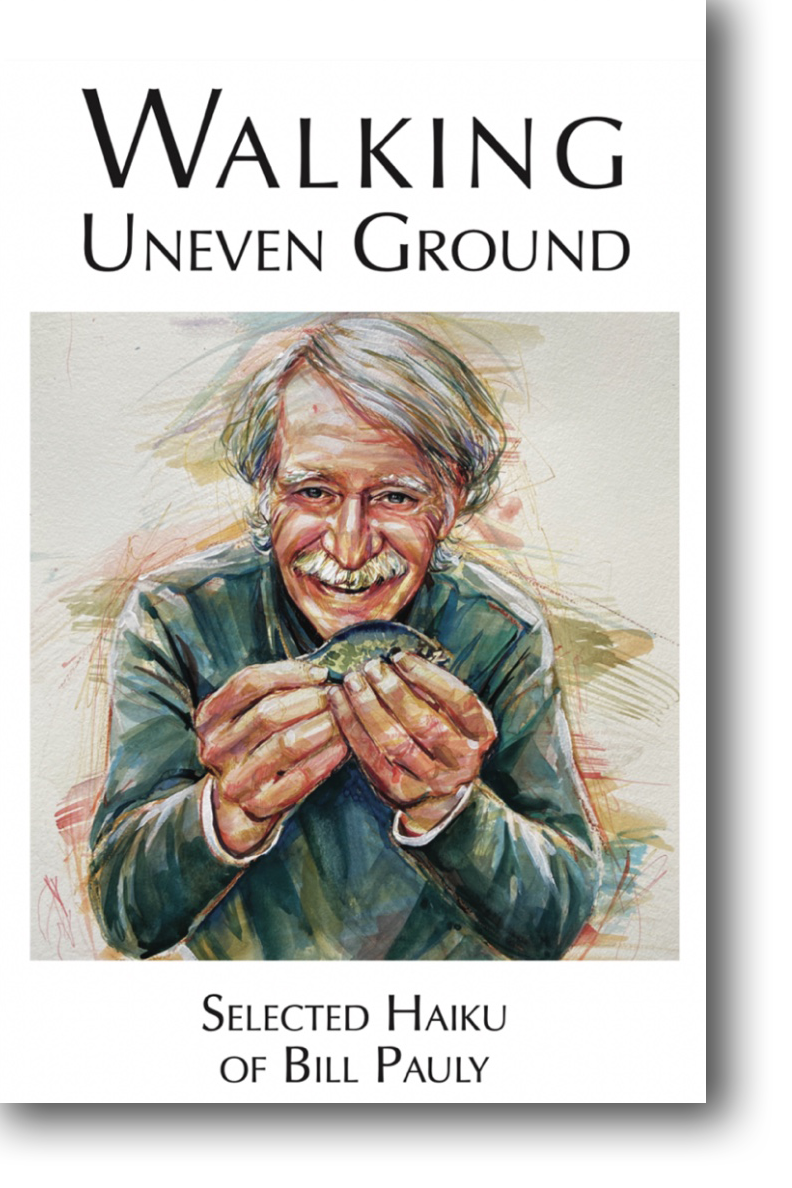
SELECTED HAIKU
OF BILL PAULY
Bill Pauly embraced a life of creative exploration of the possibilities of haiku and senryu. This collection of haiku, senryu and tan-renga is arranged, as much as possible, by the date of composition or publication SO that you can follow his development and growth in this art. It was our pleasure to publish one of his last haiku in issue 70 of Mayfly magazine in January 2021, shortly before he passed on February 15, 2021. It has been an honor to know Bill Pauly and to celebrate a life well lived as a haiku poet. ~ Randy & Shirley Brooks feel I'm speaking for a host of others who knew Bill as teacher, poet, mentor, friend…Bill encouraged all of his students and mentees. He taught us "The Way of Haiku,' to be aware and open to every moment. He taught us to write in the "here and now" in concrete imagery and beyond into the "real-seeming." He was an avid cheerleader: "Write your life!" "Find an editor worthy of your work!" "Excelsior!" ~ Francine Banwarth
Order The Book
ISBN 978-1-929820-22-4 • 2021
170 pages
Price: $30
Receive a 20% discount ($24 & $3 shipping to US addresses) by ordering a copy of Bill Pauly's Walking Uneven Ground directly from Brooks Books (send a check for snail mail orders or order online with PayPal). Make checks out to Brooks Books and send your order to:
Brooks Books
6 Madera Ct.
Taylorville, IL 62568
Be sure to include your shipping address with your order.
|
|
Submissions to
Tandem: The Rengay Journal
Tandem: The Rengay Journal will be accepting submissions from January 15 to February 15, for the Volume 2, Number 1 issue. Please visit our website for Submissions Guidelines.
We look forward to reading your collaborative efforts!
___________________________________________________
New Anthology:
Poems About Illness, Pain, Healing
For a new anthology, Robert Epstein is seeking submissions of no more than 10 published or unpublished haiku, senryu, tanka and black-and-white haiga related to the theme of illness, pain, and healing.
These criteria will be broadly conceived. No remuneration for inclusion.
Submission deadline: 3/31/21.
Please send poems by email or by physical mail including an SASE to Robert Epstein, 1343 Navellier Street, El Cerrito, CA 94530.
____________________________________
|
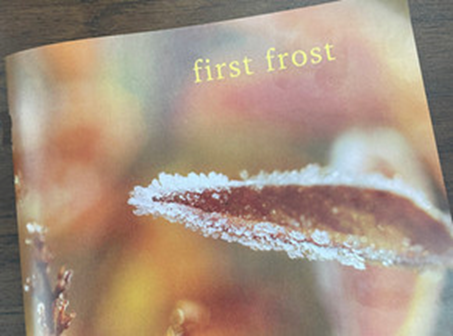
First Frost is Open for Submissions
On January 1, First Frost began accepting submissions for Issue 3, Spring 2022. We’ll close submissions on January 31. For submission details, please visit our submissions page.
Each issue of First Frost features 44 haiku, interspersed with color photographs, edited by Eric Burke, Elizabeth McMunn-Tetangco, Michael Dylan Welch, and Dale Wisely. One poem from each issue receives the First Frost Award, and the two winners so far, Angela Terry and Cherie Hunter Day, both have an additional ten haiku featured in the following online collections:
For information about subscribing, please visit our subscribe page. To see a short video collecting selected poems from the first issue, see here.
We look forward to your submissions!
|
|
|
|
HSA NEWS Editor
Haiku Society of America
|
|
|
|
|
|
|