HSRM Safety Newsletter

April 2026

HSRM 2025 Annual Report

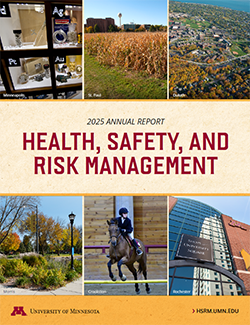
annual report cover page

HSRM’s 2025 Annual Report is finished and on our website! HSRM publishes this annual report to provide a transparent account of our efforts to ensure the health and safety of the University community. By documenting key metrics such as training completions, inspections results, and service data, this report highlights our progress in maintaining a safe and compliant institution. Furthermore, it serves as a platform to share significant accomplishments, reinforcing our primary goal of fostering a culture of safety throughout the University of Minnesota System. Ultimately, this publication reflects our ongoing commitment to delivering high-value services that support a safe and healthy environment for the entire community.

training hub banner

New Report Lets Lab Managers Track Training Completion

We’re excited to introduce the Multiple Learners and Courses report recently created by the Training Hub team, which allows lab managers to easily track departmental training completion. To get access to the report, you must first request access for the Reporting role in the Training Hub if you do not currently have administrator access. Once your access is granted, you will find the report in the Training Hub. When you launch the report, you can either upload a list of internet IDs or employee IDs and then select the courses you want to track. The report also lets you narrow down your report to show either only those who have completed training or only those who have not. You can also save the report and run it whenever you need to.


For more information on using this report, see the Training Hub’s page on using the Multiple Learners and Courses Report. 

Volunteers, Visitors, and Minors in the Laboratory

three people in front of lab

With summer around the corner, please take a moment to review our laboratory protocols for volunteers, visitors, and minors (under 18).


  • Volunteers and Visitors in the Laboratory: Volunteers and visitors in University laboratories must complete all of the same training requirements as lab employees. Volunteers must complete the Research Volunteer Agreement and visitors conducting research in University laboratories must complete the Visitors Laboratory Use Agreement. If the volunteer is a minor, a parent or guardian must also sign the agreement.
  • Minors in the Lab: Persons under 18 years of age are generally not allowed in University laboratories or other areas where hazardous materials are present or hazardous activities take place. Exceptions to this rule are detailed in the University’s Safety of Minors administrative policy.  

Shipping Hazardous Materials

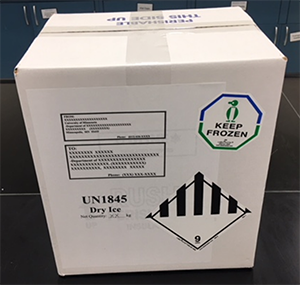
Properly packaged and labeled box containing research samples on dry ice

Are you in need of shipping hazardous materials to a colleague at another institution or location? If so, please note shipping hazardous materials by ground or air is a highly regulated activity that requires specific procedures followed and requires specific training. Please contact HSRM, we can assist you with the shipment, or if the shipment is routine, we can help provide training and guidance. Please contact us at HSRM (612) 624-6870 or hazwaste@umn.edu with questions.

Laboratory Waste: From Lab to Disposal

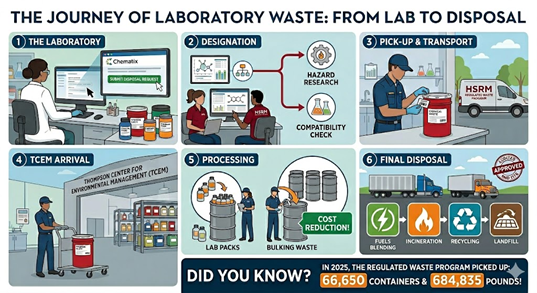
Have you ever wondered what happens to the waste chemicals as they leave your laboratory? HSRM’s Regulated Waste Program is here to help! Let’s look at the journey a waste container takes once a disposal request is entered into Chematix. 


When the Regulated Waste Program receives a waste pick-up request through Chematix, they begin the designation process. They research the composition of the waste container contents for hazards and compatibilities, applying EPA waste code(s) and a storage location for the container in the Thompson Center for Environmental Management (TCEM).

After designation is complete, a technician is scheduled for the pick-up. A barcoded label is applied to the waste container at the time of pick-up. The waste container is then delivered to TCEM and placed in the proper storage room awaiting processing.


Waste containers are processed at TCEM in bulk containers. Having the ability to consolidate waste containers at TCEM is extremely helpful in cost reduction for disposal of University of Minnesota regulated wastes! 


The bulk containers are shipped out for disposal at an audited approved end site for fuels blending, incineration, recycling, or landfill. 


Did you know? In 2025 the Regulated Waste Program picked up 66,650 waste containers which totaled 684,835 pounds!  

six steps of waste process

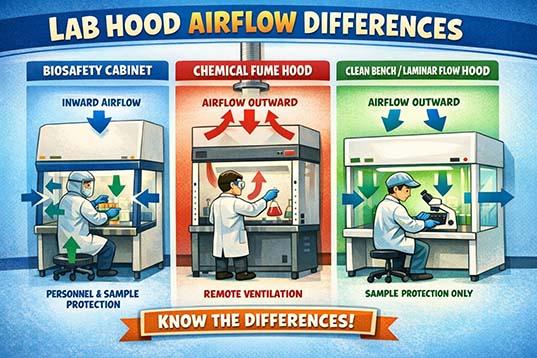
Biosafety Cabinets, Fume Hoods, and Laminar Flow Hoods (Clean Benches) – Which One Should I use?

Class II Biosafety Cabinet (BSC)


How it works

  • Pulls room air into the front grille to protect the worker
  •  Air passes through HEPA filters before entering the work area
  • Provides product protection by blowing HEPA‑filtered air downward onto the work surface
  • Exhaust air is HEPA‑filtered before release back into the room or ducted out
  • Maintains biocontainment using directional airflow and filtration


Safe for use

  • Biological materials (Risk group 1, 2 and 3 agents)
  • Cell culture work
  • Microbiological manipulations
  • Aerosol‑generating procedures involving biological agents


Not safe for use

  • Volatile chemicals (unless the BSC is hard‑ducted and specifically rated for chemical use)
  • Radioactive materials (unless in a specialized, ducted BSC)

Chemical Fume 
Hood


How it works

  • Pulls room air into the hood and away from the user
  •  Air is exhausted out of the building through ductwork
  • Protects the user only—does not protect the product or the environment inside the hood
  • No HEPA filtration; relies on airflow and exhaust


Safe for use

  • Volatile chemicals
  • Toxic fumes and vapors
  • Flammable solvents
  • Hazardous chemical reactions


Not safe for use

  • Biological materials requiring sterility or containment
  • Work requiring product protection
  • Powdered biological agents (airflow is not filtered)

Laminar Flow Hood (Clean Bench)


How it works

  •  Blows HEPA‑filtered air across the work surface toward the user (horizontal) or downward (vertical)
  • Provides product protection only—keeps samples sterile
  • Does NOT protect the user from aerosols or splashes
  • Air is exhausted directly into the room


Safe for use

  • Sterile, non‑hazardous work
  • Media preparation
  • Plate pouring
  • Assembly of sterile equipment


Not safe for use

  • Biological agents (Risk group 1, 2, 3 or 4)
  • Toxic chemicals or biologically-derived toxins
  • Volatile chemicals or fumes
  • Aerosol‑generating procedures

Device

Worker 
Protection

Product Protection

Safe for
Biologicals?

Safe for Chemicals?

Class II BSC

Yes

Yes

Yes

Only if hard ducted and rated

Chemical Fume Hood

Yes

No

No

Yes

Laminar Flow Hood

No

Yes

No

No

Additional Resources

Inaugural Safety Champion Award Winner


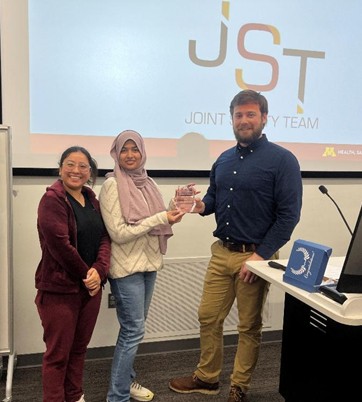
Congratulations to our inaugural Safety Champion award winner, the Chemistry and Chemical Engineering and Materials Science (CEMS) Joint Safety Team (JST). Their peer-to-peer communication strategy, collaborative safety audits, and creation of practical safety resources have resulted in a measurable improvement in lab safety. The JST model is so successful that it is now the foundation of many safety committees at the University and the so-called "Minnesota Way" has been adopted by universities around the nation. In this context, their impact on safety culture has extended beyond the University of Minnesota and they represent what it takes to be a true Safety Champion.


The award was presented to the JST co-presidents, Homayra Tabassum Mumu and Jaya Jakhar (pictured above), at the spring session of the Safety Committee Chair Forum on April 2nd, 2026. The Safety Champion award was created by HSRM to honour individuals or groups who have made a significant contribution to campus safety based on the following criteria:


  • New or innovative methods for the implementation of safety
  • Excellence in safety program implementation
  • Demonstrated improvement in a safety program
  • Personal leadership in safety
  • Consistent safety performance over time


Nominations are submitted by Safety Committee Chair Forum attendees. However, the award is open to any individual, group, department, etc. across the five campuses and participation in a safety committee is not required. The award will be presented annually at the spring session of the Safety Chair Forum. Contact your safety committee if you would like to nominate a Safety Champion for 2027.  

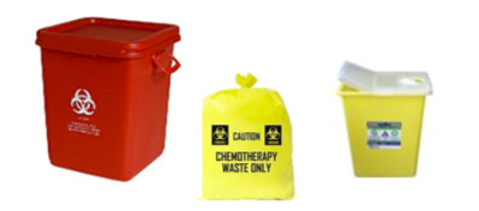
Special Case- Incineration Waste Stream: 
Yellow bag/Red tub


When we are experiencing a shortage of yellow tubs, yellow bags may be placed in red tubs since they end up at the same incineration destination.


These can be stored at room-temp and no special designation needs to be made after the bags are tied and the lid snapped shut. The red tub will reach the proper incineration destination. 


If you currently do not receive enough yellow liner bags to use in red tubs contact Facilities Management.


NOTE: The waste stream is determined by the tub color. The lid colors do not have to match the tub color.

light bulb

HSRM is here to help!


  • Ergonomics: Would you like to have an ergonomic evaluation conducted? Visit our Ergonomics web page and schedule an appointment to visit our Ergonomics Showroom.
  • Regulated Waste: Have questions about how to properly dispose of regulated waste (biological, chemical, radiological)? Visit our Hazardous Waste Disposal web page or contact our Regulated Waste team directly at hazwaste@umn.edu.
  • Hazard Assessment: Have questions about how to properly handle a hazardous chemical, proper PPE, or need a laboratory safety consultation? Contact our Research Safety team.
  • Health and Safety Training: Interested in learning more about the health and safety courses that HSRM offers? Visit our Training website to view the online training courses that we offer.
  • Safe Campus: Want to learn more about additional safety resources offered by the University such as public safety and personal well-being resources? Visit the Safe Campus web page.
  • Clinical Services: Need to complete medical requirements to work in your role? Visit the Clinical Services website for a list of clinics that offer these services across the state. Employees that have sustained an occupational health injury, illness, or exposure are also strongly encouraged to visit these clinics.


Please feel free to contact us anytime at:

hsrm@umn.edu

(612) 626-6002

speech bubble

Suggest a topic for a future newsletter or provide feedback to HSRM


Is there a topic that you would like us to include in a future HSRM newsletter? Would you like to provide HSRM with feedback on this newsletter or more broadly on our services? If so, please go to the HSRM Feedback Survey.

Have a question for HSRM?

Health, Safety, and Risk Management | hsrm.umn.edu

Facebook  Twitter  Pinterest