|
HaKol
The Voice of the
Pelham Jewish Center
September, 2026/Elul-Tishrei 5786-5787
| | |
Leadership Messages
Rabbi Benjamin Resnick
President
Adam Gerber
Education Director
Ana Turkienicz
HaKol Editor
Barbara Saunders-Adams
| |  | |
Congregant News
& Donations
Book Notes
Barbara Saunders-Adams
Food for Thought
Share a Simcha
Tributes & Donations
| | | |
Dear Friends,
A few days ago several of us gathered together in the library to share favorite poems and to explore the piyyutim (liturgical poems) in the Machzor. One question that came up ---it’s a question that I wonder about often and not only around the High Holidays --- is why so much of the Jewish communal prayer experience makes use of poetry as a basic building block.
The answer is not immediately apparent, perhaps in large part because poetry itself ---and certainly the poetry in the Machzor ---tends to be somewhat obscure, at least in comparison with other forms of writing. The form and structure of poems can be abstruse, the language more often challenging, the ideas not readily apparent or easily excavated.
Appreciating poetry, in most cases, takes work.
It’s a question that also comes up in the midrash in response to one of Moshe’s final injunctions to the people at the end of Parashat Vayelech, which we read just before the Holidays. “Moshe spoke into the ears of the entire congregation of Israel the words of this poem until their completion.” (Devarim 31:30). What follows in Parashat Ha’azinu (read this year on Shabbat Shuvah between Rosh Hashanah and Yom Kippur) is a lengthy poem, which marks a stark stylistic shift, both for Moshe and for the Torah in general.
There are a variety of approaches to this phenomenon --- the Torah’s abrupt shift from prose to poetry ---in later commentary. One of my favorite explanations comes from Rabbi Naftali Tzvi Yehudah Berlin, an important 19th century commentator often known as the Netziv. Puzzling over an earlier midrashic idea that in some sense the entire Torah (and not just Ha’azinu) is a kind of poem, he wrote:
But the Torah is not written as poetry?! Still, you must admit it has the nature and charm of poetry. For it is well known that the flowery words of a poem are different from a prose composition.
In a poem the meaning is not entirely clear as it is in a prose composition, and one needs to make annotations along the margins, i.e. that this couplet refers to this aspect of the composition and that couplet refers to that aspect. This is not simply a matter of creative interpretation; rather it is simply the nature of poetry. And moreover, for one who understands the meaning of the poem well, how sweet is the language of the poem and its intricacies, much more so than for a person who does not understand the composition! [For the latter person] studying the poem will only confuse matters, leading to erroneous assumptions that the poet did not intend. Thus is the nature of the Torah, for the story it tells is not readily explained; instead it demands footnotes and explanations and careful attention to the language. And this is not merely a matter of creative interpretation, rather it is the plain meaning of scripture.
The Netziv, I believe, makes an important point not only about the nature of sacred text but also about the nature of sacred experience generally. Holding the Machzor in our hands, with reverence and attentiveness, is not an easy thing. It’s heavy. It’s full of unfamiliar words and difficult concepts that are not always expressed in straightforward ways. But important things are like that. The great adventure of human life is like that. Experiencing its fullness requires focus, openness, curiosity, intensity, generosity and imagination.
The reward is great but it is mighty work indeed. It’s time to get down to it.
Shanah tovah,
Rabbi Benjamin Resnick
Ben
| |
|
Peace…Love…Compassion
--Yosef Chaim Ohana, abducted Oct 7
I recently had the privilege of attending a small gathering, organized by Chabad of Nantucket, where I met Yosef Chaim Ohana, one of the Israeli hostages freed after 738 days in captivity. He was on the island to share his story, and talk about his focus -- A Future For the Survivors and the Wounded -- which was started by his childhood friend and fellow Nova attendee Daniel Sharabi.
I wasn’t sure what to expect…our serene surroundings were diametrically opposed to the tunnels and torture Yosef endured just 11 months earlier. How could someone who experienced such deprivation and pain be able to engage openly so soon after his release?
Yosef -- without prompting -- answered that question almost immediately as he started talking to the 50 people gathered under a tent in the rain, on September 1. He spoke softly and humbly by introducing himself and talking about who he was before his ordeal began. He said he was a simple person who “lived in the moment.” More importantly, he spoke about the core values he cherishes fiercely: peace, love and compassion. His life experiences before October 7 were all about moving from one experience to the next, and doing it with empathy and grace. That is what gives him strength.
Yosef offered a glimpse into the confusion and fear of Oct 7: the pain, resilience, and miracles experienced through his captivity, and his hopes and dreams for the future. His story was gut-wrenching, intimate, and inspiring.
As we begin the Days of Awe -- Teshuvah (repentance), Tefilah (prayer) and Tzedakah (charity) -- I’d ask that the PJC community consider Yosef’s journey, and the values he holds onto so dearly. They have always given him clarity and purpose --- but most importantly direction for a new beginning.
As I begin my personal journey to consider and repent for those I have wronged, identify ways to improve myself for the benefit of others, and focus on priorities that matter, I will be thinking about Yosef and his moral compass.
I hope and trust that each of you will be able to find a similar motivation as well to help shape your teshuvah.
Shana Tova!
Best,
Adam
| | | | |
Education Director
Ana Turkienicz
| | |
“More than the Jews have kept Shabbat, Shabbat has kept the Jews.”
- Ahad Ha’am
I have always loved this beautiful and often-quoted idea. For generations, Jews have gathered around Shabbat tables, lit candles, prayed, sang, studied Torah, shared meals, celebrated, mourned, and simply spent time together.
And perhaps, as Ahad Ha’am suggested, all the while we thought we were preserving Shabbat, Shabbat was quietly preserving us.
There is something about Shabbat that creates community. During the week, our lives pull us in a hundred different directions: work, school, activities, errands, appointments, screens. Shabbat asks us to do something different To show up. To sit beside one another. To sing together. To eat together. To ask how someone is doing and actually have time to hear the answer.
Rabbi Abraham Joshua Heschel defined setting time apart for Shabbat as two “bookends,” two special moments where we can make that intermediate 25 hours holy; The Opening Bookend (Kiddush): Lighting candles and reciting Kiddush over wine sanctifies the arrival of the seventh day, formally stepping past the six days of conquering space and entering eternity.
The Closing Bookend (Havdalah): The ritual of Havdalah ("separation") acts as the final boundary marker, drawing a line between the sacred holiness of Shabbat and the return to the ordinary work of the six weekdays.
Rabbi Heschel writes in his book, “The Sabbath”, There is a realm of time where the goal is not to have but to be, not to own but to give, not to control but to share, not to subdue but to be in accord. Life goes wrong when the control of space, the acquisition of things of space, becomes our sole concern.
As Jews congregate in community week after week, for Shabbat celebration, over time, something happens. Acquaintances become friends. Children grow up knowing one another. Families begin to feel that they belong not simply to a synagogue, but to a community. That’s the beauty of Shabbat: keeping the Jewish people alive, caring and supporting each other, and bringing goodness into the world surrounding them.
Recently, Jeniece Ilkowitz, our new Education Chair, surveyed Learning Center families about the kinds of Shabbat experiences they would most enjoy sharing at PJC. We were thrilled to see how many families chose Friday night dinner and Kabbalat Shabbat as their favorite way to celebrate Shabbat together.
That response tells us something important: our families are looking for opportunities to be together.
And we are listening!
Throughout this year, we look forward to welcoming our Learning Center families for Friday evenings filled with singing, prayer, conversation, good food, and the wonderful, sometimes slightly chaotic energy that comes when children and adults celebrate Shabbat side by side. These evenings are not an “extra” to our children’s Jewish education. In many ways, they are Jewish education. Our children learn that being Jewish means belonging to a community, and that Shabbat is something we experience; not simply something we learn about.
At the same time, we would like to invite our families to discover another part of Shabbat at PJC: Shabbat morning.
Friday night has its own magic: the candles, the melodies of Kabbalat Shabbat, Kiddush and dinner. Shabbat morning offers something different.
On Shabbat morning, we open the Torah and read the portion that Jewish communities around the world are reading that same week. It is when Rabbi Resnick helps us wrestle with those ancient words and discover what they might have to say to our lives today. It is when members of our community mark some of life’s most meaningful moments: a Bar or Bat Mitzvah, a baby naming, an aufruf, a milestone birthday or anniversary, or the memory of someone we have lost.
And it is when we have the opportunity simply to be there for one another.
There is a powerful lesson for our children in seeing that community. They learn that when someone celebrates, we celebrate with them. When someone remembers, we remember with them. When someone stands before the Torah, or says the Mourners’ Kaddish, we are there to answer Amen. Judaism is not only something that happens within our own families; it is something we carry together, for the sake of the next generations to come.
And then, of course, there is Kiddush!
Anyone who has spent a Shabbat morning at PJC knows that Kiddush is not merely a cracker and a sip of grape juice on the way out the door. It is practically Shabbat lunch! A chance to mingle, eat, talk, catch up, delve deeper into the ideas Rabbi Resnick shared with us, perhaps even meet someone new, and allow those relationships to grow.
This year, our Learning Center calendar will include a particularly special Shabbat morning toward the end of the year, when our Kitah Gimmel students will receive their siddurim. After a year of learning, they will stand surrounded not only by their teachers and families, but by their PJC community. I hope many of you will join us --- not only the Gimmel families, because those children belong to all of us, and their milestone is a celebration for our entire community.
But I also hope we will see one another on other Shabbat mornings throughout the year.
You don’t need a special occasion. You don’t need to know all the prayers. You don’t need to arrive knowing exactly when to stand or sit. Come when you can, as you are. Bring your children. Sit with another family. Listen to the Torah. Learn something. Sing what you know, or just hum together.
Because community is built through repeated moments of simply being together.
Perhaps that is part of what Ahad Ha’am understood so well. We may think that we are making time in our busy lives for Shabbat. But when we gather around the table on Friday night, when we sit beside one another on Shabbat morning, when we celebrate and mourn and learn and eat together, Shabbat is doing something for us, too.
We are keeping Shabbat. And Shabbat, quietly and beautifully, is keeping us --- and our community --- together.
Wishing each and everyone of you a sweet, healthy, and happy new year, filled with meaningful moments of joy and discovery together in community.
Shanah Tovah u’metukah
Ana
| | |
HaKol Editor
Barbara Saunders-Adams
| | |
Dear Friends,
With an ever increasing rise in antisemitism, this is an unsettling time to be Jewish in America. As 5787 approaches, I am comforted by my connection to the Pelham Jewish Center Community.
I look forward to davening with Rabbi Resnick, Avinoam, Havi, and my friends and acquaintances at the PJC. The Days of Awe (Yamim Nora'im), the time between Rosh HaShanah and Yom Kippur, is our opportunity to imagine a better tomorrow --- a sweeter New Year. Imagining better times is the Jewish way of surviving the many difficulties we face. We look to our sources --- the sacred poetry and texts in the Machzor, Lev Shalem, (Full Heart) --- to guide us in our quest. As we chant our sacred prayers with Avinoam, let the music lift our spirits and reinforce our sense of community.
This Rosh HaShanah begins on Friday night September 11. As we welcome both Shabbat and Yom Tov, we can also take a moment to remember those who lost their lives on September 11 2001.
I look forward to seeing you in the sanctuary of the PJC praying, chanting and kibbitzing together.
Wishing you a sweet, peaceful and fulfilling 5787.
שנה טובה ומתוקה
Barbara
| | |
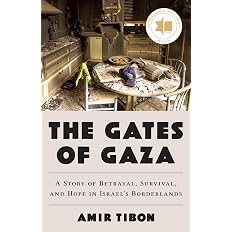
The Gates of Gaza
Amir Tibon
The title, The Gates of Gaza, refers to the story of Samson heroically lifting up and destroying the gates of the Philistines, in what is present day Gaza.
Written by the Haaretz journalist, Amir Tibon, this book is a clear-eyed memoir recounting Tibon's first-hand experience of the massacre that took place on October 7, 2023 in Kibbutz Nahal Oz on the Gaza border. Alternate chapters provide a short history of the founding of Nahal Oz in the 1950's and the war between Hamas and Israel which began in the 1980's with the vision of Sheikh Ahmed Yassin.
According to Yassin and echoed by Yaya Sinwar, the Jews will face two choices once the Muslims have conquered the entire region; swear allegiance to the Islamic regime and accept their fate as second-class citizens in a new Palestine -- or leave. For the Islamists, there is no such thing as a two state solution. The Islamists faced little scrutiny from Israeli occupation authorities as long as they didn't engage in violent acts like the secular Palestinian Authority. In Tibon's thinking, the powers that be in Israel didn't take the Islamic threat seriously.
Awakened by the stinging sound of a mortar at 6:15 am, Amir and his wife, Miri, raced into their daughters' bedroom, a reinforced safe room in their home called a maamad. In the dark, without food or toys for their toddler and baby, they had to remain silent and still for many hours while mortars were falling around and shots were fired into their home. Hordes of Hamas fighters were on a mission to kill as many Israelis as possible.
With a dying cell phone, Amir called his father, a retired IDF general in Tel Aviv, to entreat the military to rescue them. The death and destruction Noam Tibon encountered on the road to Nahal Oz and the fate of Amir's friends and neighbors make The Gates of Gaza an engrossing story. Along the way, Tibor provides a clear and succinct story of betrayal, survival and hope in Israel's borderlands.
Barbara
| | |
"Share a Simcha" allows congregants to share their news with our PJC community. Please submit news about family members -- engagements, births, job updates, kid achievements, community acknowledgements and any other milestones -- to the HaKol Editor, Barbara Saunders-Adams.
Mazal Tov to our September Birthday Celebrants: Victor Birutti, Ariel Spira Cohen, Naomi Jaffe, Helen Stephenson, Rachel Radvany, Talia Rossman, Tina Kasper, Lydia Read, Anne Bresnick, Naomi Smyser, Sarah Grossman, Nicklas Breskin, Jonah Birutti, Chenxi Jiao, Eugene Holtzman, Yelena Spitzer, Theresa Breskin, Gloria Horowitz, Harrison Peck, Eleanor Einzig, Alexy Scholl, David Teitell, Lucy Mason, Rachel Cochie, Avi Malkis, Kimberly Pauley, Matthew Sigel, Steve Almo, David Grossman
Share a Simcha is a regular HaKol feature, so keep your news and updates coming!
| | |
Donations to the General Fund & Tributes
Adam & Magdalena Bukowski, in memory of Abbey Goldstein
Bob & Sandra Goldman, in honor of Desmond Bazeli’s Bar Mitzvah
Bob & Sandra Goldman, in memory of Abbey Goldstein
David & Jeanne Radvany, in memory of Abbey Goldstein
Jeb & Betsey Singer, in honor of Rhonda Singer’s 75th birthday
Joel & Beth Serebransky, in memory of Lee Cohen
Mark & Linda Levine, in memory of Carey Hochberg
Mark & Linda Levine, in memory of Lee Cohen
Michael Bowen & Judy Shampanier, in memory of Lee Cohen
Mitchell & Julie & Cepler
Neco & Ana Turkienicz, in memory of Lee Cohen
Donations to the Rabbi's Discretionary Fund
Marcelo & Jakeline Fischer
| | |
An Update From The Treasurer
As of June 30, Kesef, our third-party accounting firm, will no longer deposit checks on our behalf. Starting immediately, all checks should be sent to the PJC Office (451 Esplanade, Pelham, NY 10803).
Additionally, as we approach our fiscal year-end (June 30, 2026), please address any open balances. If you have any questions or concerns, I'm available to discuss them.
Key Takeaways:
-
Send all checks to the PJC. Kesef will deposit checks sent to Montvale until August.
- No more mailing checks to Kesef in Montvale, NJ.
- Best ways to pay: ACH (no fee) or a credit card directly on our website is the easiest and fastest way.
- Other ways to pay: You can also pay with investment securities or IRA distributions, which can help lower your taxes.
There are multiple ways to make donations:
Mail to: Pelham Jewish Center, 451 Esplanade, Pelham, NY, 10803
Log-in at https://thepjc.shulcloud.com/member or our new PJC member app on ShulCloud. You can set up automatic recurring payments. You can also access your account through the link in your monthly billing statement to pay online.
If you are interested in paying via appreciated securities or IRA distributions, please email Mitch Cepler.
It is the policy of the Pelham Jewish Center to make every effort to assist members experiencing financial challenges. Financial challenges should never be a barrier to being an active member of the PJC community. You can reach out to President, Adam Gerber, Treasurer, Mitchell Cepler or Rabbi Benjamin Resnick, to speak confidentially concerning your ability to pay PJC dues and Learning Center tuition.
| | | | |