Dyer & Co Newsletter - Halloween Edition

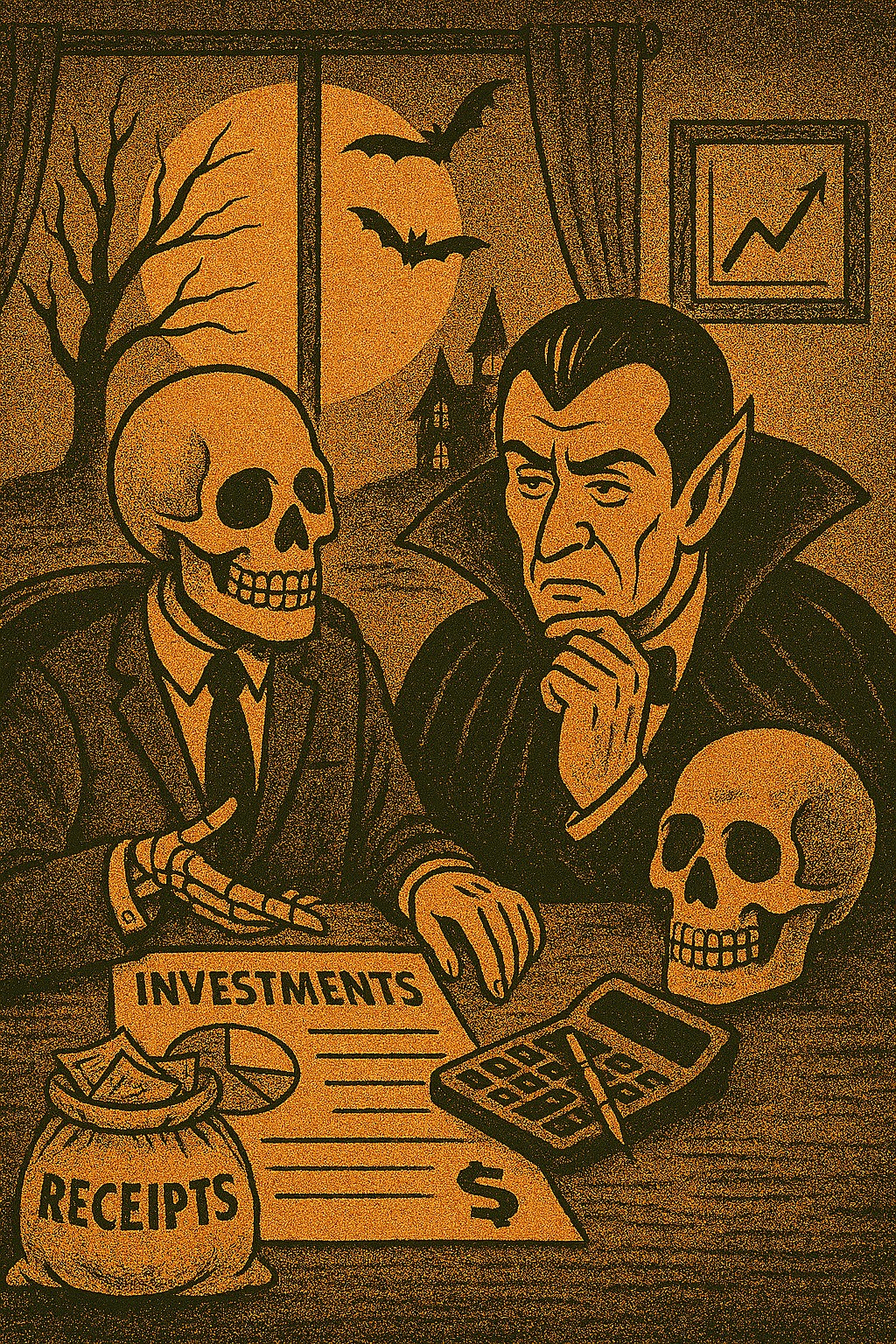
Estate planning is actually quite simple for our vampire clients.

(We had fun with the caption ideas. Reply if you have suggestions of your own.)

Caroline and I really had a good time putting this month's newsletter together for you. We hope you enjoy reading it as much as we enjoyed crafting it for you. These past few weeks have been a fun whirlwind getting her up to speed. We are grateful for all of you who've taken the time to welcome her to the Dyer & Co. family.

The End is Near:


Gather 'round and we will tell you an investing tale that is sure to chill you to your bottom line. Friends, we regret to inform you: The End is near. This AI-fueled market frenzy cannot continue forever. Schwab and Bloomberg rate the S&P 500 "very expensive" (in the 80th to 100th percentile) when you look at price to earnings ratios; price to book ratios; price to cash flow; price to dividend yield; and market capitalization to gross domestic product.


We have talked about this before, but the S&P 500 is a weighted index. The 500th smallest company makes up a very tiny percentage of the overall index. The biggest companies make up a larger portion. Right now the top 5 stocks (NVIDIA, Microsoft, Apple, Amazon, and Alphabet) make up nearly 30% of the entire index.


The last time the S&P was so heavily weighted in just a few names? 1999. Back then Cisco, Intel, Microsoft, AOL, and General Electric were the biggest companies in the land.


The End was near in 1999, 2008-2009, 2011, 2020, 2022... and again just in April. Eeek!


Since 1974 there have been 27 market corrections and 6 bear markets. Most arrive with frightening and unsettling speed. But most resolve quickly too. So we need to be just as prepared for The Beginnings.


We are up 38% (!) from the April lows. And 9.5% of that came on April 9th. If you got scared out of your wits and got out of the market, you likely missed the biggest bounce off the bottom. Timing the market well means you have to be right (or lucky) twice. Getting out is hard enough. Getting back in at the right time? That's a fool's errand.


In fact, over the last 20 years the S&P 500 has averaged 10.4% per year. But if you missed just the 10 best days during that period, your average return drops to 6.1%.


So is The End really near, you ask? We don't actually know. Sorry. But we are certain that volatility and big market drops come with the territory. We don't have to like it. But if we want to outpace inflation and successfully fund our goals, it's the bargain we must accept.


Here's what we know for sure: We are not market timers. We are planners. We have crafted a plan for you that prioritizes cash flow and is sensitive to your ability to tolerate risk and volatility. The warm blanket for this scary story is a conversation with us about your risk tolerance and a discussion about whether your asset allocation needs rebalancing. We're here to help. Let us know if you'd like to talk. (And if you want to geek out on the data used here, we're happy to email you Schwab's 4th Quarter Chart Book—a 70+ page monster of economic charts and data.)

A Thought on Giving: RMDs, QCDs, M&Ms


As we head into the final quarter of the year, we are surrounded by reminders of how financial planning intersects with our values. If you're 73 or older and have a traditional IRA, or if you're managing an inherited IRA with an RMD requirement, you're probably aware that an RMD (Required Minimum Distribution) is due by December 31st. It's a requirement that can feel like a burden, especially when that distribution seems to represent a tax burden.


But here's what makes it interesting: you can make that obligation work for you.

A Qualified Charitable Distribution (a QCD) lets you direct up to $105,000 straight from your IRA to the charities you support, completely tax-free. The distribution counts toward your RMD, but doesn't count as taxable income. It's one of those strategies where the math works out beautifully: you support the causes you care about, satisfy the IRS, and optimize your taxes all in one move. For someone with substantial retirement savings, the tax savings can be significant, and may help avoid cascading effects like Medicare premium increases. It is worth noting that for inherited IRAs, you must be over 70 ½ to make QCDs.


Oftentimes those who feel most satisfied with their financial lives aren't necessarily those with the biggest portfolios. They're the ones whose financial decisions reflect their values. A QCD is a perfect example of this: it transforms a regulatory requirement into something meaningful.


Even if you’re not yet of RMD age, life is full of opportunities for us to combine our obligations with our values. Every year on November 1st, my siblings and I (Caroline) would dump our candy hauls across the table, and choose a (rather generous) selection of our favorite candies to keep. The rest, my parents would take to the Ronald McDonald house. Though I admit I wasn’t the biggest fan of this tradition as a child, I am grateful to have been taught the value of giving, and how to do so at every stage of life.


Whether you're 73 and navigating RMDs, or trick-or-treating with a pillowcase full of candy, the principle is the same: be intentional about what you keep, and generous about what you share. If you'd like to explore how a QCD might work for your situation, we're here to help. Drop us a line. We also accept candy donations.


Today we learned we both strongly prefer Reece's peanut butter cups. How about you?

Thank you for reading. If you liked this content, please share with a friend. You can always reach us by replying to this email or at 704-323-6872.

Facebook  LinkedIn