|
Just before game time, the ice at the Memorial Centre was perfect. It had a beautiful shine and there was nary a ridge or crack. William “Bump” Watts looked out from behind the boards as he waited for the Kingston Frontenacs and North Bay Trappers to come out of their dressing rooms for a game during the 1961-62 Eastern Professional Hockey League season.
Then he spotted them. Two North Bay broadcasters were trying to slide across the ice in their dress shoes to get to the press box on the other side of the rink.
Watts darted from the ice crew door and intercepted the pair at centre ice. Bump was small in stature, but feisty enough that, when he was a player, he enjoyed mixing it up in the corners with opponents. Hence the name Bump (or Bumpedity, as he was sometimes called).
“What are you doing?” he yelled at the reporters, sticking his finger into the chest of one of them. He ordered them to get off the ice and walk around the outside of the rink like everyone else. Chastened, the duo hustled back, hung their heads and followed Bump’s command.
In the era before the now-ubiquitous Zamboni, making ice was both an art and science. In Kingston, no one was better at it than Bump, who took on the role when the Memorial Centre opened in 1950 and continued until his death in 1985.
Free ice time and a stick of gum
It was also a time when boys, nicknamed rink rats, would help with ice maintenance and other chores without pay – instead, they would get a chance to enjoy some free ice time. Sometimes Bump and other rink attendants would give them a penny, which was enough to buy one or two pieces of gum in those days.
Bob Fairman was one such rink rat. He recalls that he was about 13 years old when he began working at the Harold Harvey Arena in Portsmouth village. After hours without pay, the rink rats would be allowed to take to the ice to play hockey or broomball against one another.
It was hard work. The youths had to push heavy steel ice scrapers across the rink, gathering the snow at centre ice. They would shovel the snow into wheel barrows, take them out the door and across the parking lot, where they would dump it into a big pile.
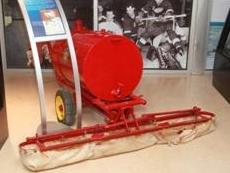
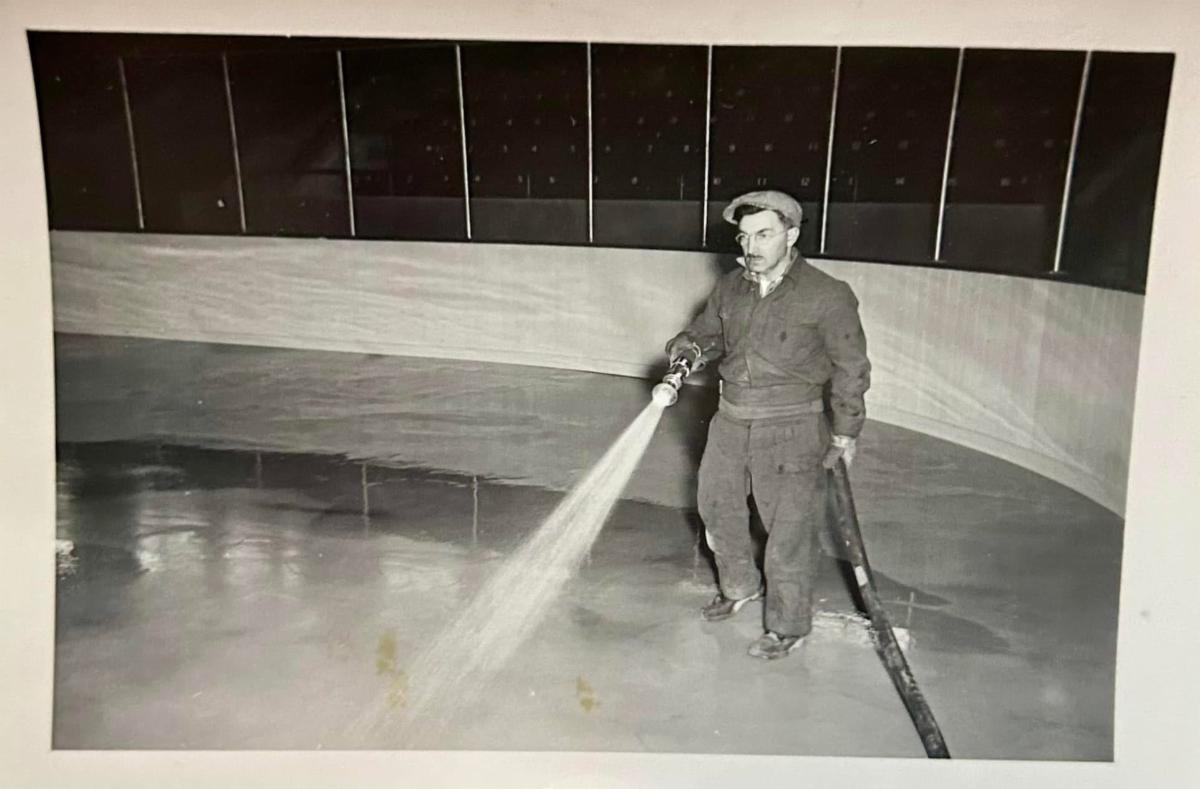
Then the adult rink attendants would flood the ice using a hand flooding machine that they pulled across the surface. They always used hot water – the hotter the better. Hot water has fewer air bubbles and less dissolved oxygen, resulting in smoother ice. It melts bumps on the ice, creating a mirror-like look. In addition, hot water flows into the existing ice, forming a single, solid block.
For an EPHL game at the Memorial Centre, the crew would flood the ice before and after the warmups and between periods. Larry Hogan, the long-serving assistant manager, recalls working on the ice crew as a teenager with Bump, earning 75 cents a game.
Hogan says it was a labour-intensive task. "There were 10 kids with ice scrapers and three handflooders, each with two adult operators," he recalls.
A large crew could flood the ice in about 15 minutes. However, on a typical day at the Harold Harvey a much smaller team would only have time to resurface the ice a few times because it would take up to 45 minutes.
Eventually, the teenage rink rats became employees, earning the princely sum of $1.25 per hour. However, they had to be at work prior to the start of 6 am practices by local teams.
Austin Slack, who served at the Memorial Centre with Bump Watts, recalls a day when a co-worker slipped on the ice and fell underneath the handflooder.
“Bump didn’t stop the handflooder because he knew doing so would damage the ice,” Slack recalls. “So he just ran over our co-worker!” Fortunately, no one was hurt.
In 1949, Frank Zamboni invented the automatic ice maker in California and it was first used in a pro hockey game by the Bruins at the Boston Gardens in 1954. It would eventually revolutionize ice-making.
However, Zambonis weren’t cheap and cities like Kingston didn’t have the budget to buy one until decades later. In fact, the Harold Harvey Arena only got a Zamboni in 1976 thanks to the Summer Olympics sailing events being held in Portsmouth.
The Summer Olympics? Yes, you read right. Local organizers made a deal that the sailors could use the Harold Harvey (with the ice out) to set up for races provided the Olympics bought them a Zamboni. By the fall of 1976, the Zamboni was cruising around the arena, doing its magic.
Manoeuvring the Zamboni was not as easy as it looks, recalls Fairman. After serving as a rink rat and finishing school, he got a job as a rink attendant at the Harold Harvey.
“The rink had sharp corners and you had to slow down the Zamboni in order to make the turn,” Fairman remembers. “A couple of times, the Zamboni went right through the boards and I had to stay late into the night to repair them.”
Fairman was pleased with the switch from handflooding to the Zamboni. “I enjoyed driving the Zamboni. It was fun.”
He recalled that Mike Mundell, who for many years ran a fish and chips shop in Kingston, would tell him: “You’re the Wayne Gretzky of Zamboni driving!”
A wrestler with a bear
Bump Watts dedicated his life to ice making. One New Year’s Eve he was on his way to a party, but popped into the Memorial Centre to check on things, only to discover that the refrigeration equipment was not working. He was dressed in a tuxedo. Of course, he didn’t want to get his fancy clothes dirty, so he stripped to his underwear and spent the next two hours repairing the system.
He got to the party just as the clock was approaching twelve. “We made it in time for the midnight festivities,” Bump recalled with a laugh.
At the Memorial Centre, horse shows and pro wrestling often resulted in headaches for Bump. One wrestler traveled with a live bear and would wrestle it in the ring. After the match, the bear would be locked in a cage at the end of the rink. However, one day the bear got out of the cage and began chewing on the ice-making pipes, attracted by the salty brine in the pipes.
"The bear chewed a hole in the pipe and an unhappy Bump was called in to make repairs," recalls Hogan.
While Bump technically retired in 1974, he never left. At age 80, he was still very much a part of the Memorial Centre, serving as a custodian in the press box and an ice-making advisor.
One of his responsibilities in the press box was to play a recorded O Canada prior to Ontario Hockey League games. One day, he hit the button and the Star Spangled Banner boomed across the ice.
"The fans and players were totally bewildered," recalls Hogan. "But Bump didn't play the Canadian anthem afterwards. He just let it go."
At the time of his death in 1985, Whig-Standard columnist Ron Brown wrote about Bump Watts: “His passing leaves a void that can never be filled.”
|