Managers of all stripes have had to deal with employees whose performance did not meet standards. A natural tendency is to let the problem exist too long, hoping it will get better on its own.
Guess what – that almost never happens. Almost always it just gets worse. The smart manager will understand the magnitude of allowing it to continue, take steps to help avoid the problem and deal with those problems when they occur.
Don’t Allow a Staff Infection
A poorly-performing employee can be a drag on the entire operation. When a manager doesn’t recognize it or just lets it slide, it manifests itself in a number of ways:
-
Poor productivity – The person in the job will almost certainly suffer from less output than is needed.
-
Impact on others’ performance – Other employees in the same job or same department will be affected, and their performance will suffer.
-
Lower morale – When your staff sees another person not contributing (they do see it) and there are no consequences, their morale and esprit de corps is negatively affected.
Avoiding the Problem
Managers who make it clear what is expected from a staff member have a lot less wailing and gnashing of teeth (their own and others) when they need to take action when performance is lacking.
Strict adherence on your part to well-defined and communicated performance expectations will lessen any hard feelings if things don’t work out. When you operate with a clear set of guidelines for managing the work of your team, results usually improve. Consider these:
-
Hire slow – An employee selection program that is designed to identify candidates who can do as well as will do has a much better chance of success. And it takes time to really know that. So don’t rush it. Look for interactions with your team, fit with the culture and take your time.
-
Be clear – Precision is your friend. Productivity goes up when a manager has spelled out (in no uncertain terms) what the expectations are for performance in the role. Be explicit on the why, who, what, when, where and how (and how much) the job requires.
-
Measure like crazy – Specific and exacting measurement against standards of performance will yield improving outcomes. Peter Drucker that if you intend to manage it, you have to measure it.
-
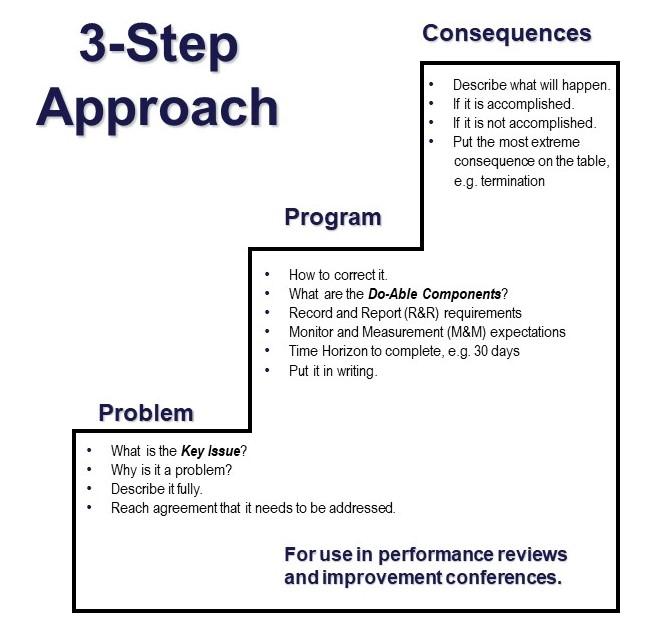
Establish reporting expectations – A well-thought-out accountability regimen is a must. That means defining what needs to be reported on, in what way and how often. A strict record and report (R&R) expectation avoids a lot of problems later on.
-
Pay attention – A manager who watches staff activity will be better positioned to identify problems in their early stages. A well-honed monitor and measure (R&R) program that samples output and stays close to the work will pay dividends.
-
Be rigorous – Avoiding a discussion of less-than-acceptable performance is not being kind. In fact, it is unfair to that person. The kindest action a manager can take is to require an employee to meet job requirements.
-
Don’t give up or give in – A manager who follows the path of least resistance (or gets tired or gets lazy) will fall prey to much less than acceptable results. Stick with it!
-
Take action – When it is time, pull the trigger and fix the problem.