|
Every year…
In the Spring, old geezers put on their shorts too early. In the summer we drink way-too-much Prosecco. December, we wonder why we ever thought Xmas could be a relaxing break, and…
… at this time of the year the NHS releases the provisional numbers on the last year’s ‘never events’… that never stop happening and no one wonders why.
Like Halloween, they’re spooky but no one cares, no one is frightened by them and everyone wonders… why bother?
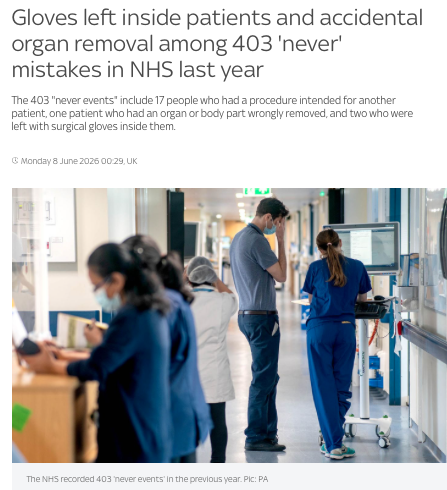
This year's provisional figures record 403 Never Events. The largest categories remain stubbornly familiar;
- 166 wrong-site procedures,
- 121 retained foreign objects
- 50 wrong implants or prostheses.
With hands on hips we all tut-tut; ‘How can this still be happening?’
Hospitals go to extraordinary lengths to prevent these incidents. It’s easy to join in with, ‘this is terrible’, but…
… we don’t ask; ‘Why the numbers hardly seem to move?’
The total has hovered around the 400 mark for years. Pre-pandemic; just under 500. After the Covid, dip, we’re back to broadly the same level, and…
… the NHS is not an international outlier. These events happen in all health systems, but… it may be an outlier in how openly and consistently it reports them.
The fact is… the NHS has succeeded in making Never Events rare. It’s not succeeded in making them rarer.
Viewed against the scale of NHS activity, these events are exceptionally uncommon.
Around 600 million patient contacts a year. In surgery, probably, one Never Event for ~25,000 procedures?
After years of effort the graph is essentially flat. That should tell us something.
Perhaps we have reached the limits of improvement through shaming, training, guidance and determination..
The stubborn reality is that the remaining incidents are not usually caused by ignorance.
They are caused by being human. No one arrives at work intending to make a mistake.
Every Never Event begins with a gap between what people think is true and what is actually true.
That is why the annual Never Event report is becoming less a report about surgery and more a report about the limits of human performance.
What do you do when people are already trying very hard and the results stop improving?
Three things…
First, top pretending the phrase ‘Never Event’ helps. NHSE’s own consultation found 66% thought the current framework was unfit for purpose…
... the terminology can worsen blame culture. (In the US they’re ‘Sentinel Events).
Second, move from blame-and-report to design-and-control. The step change the NHS wants will come from barcoded swabs, RFID tracking, implant scanning, electronic forcing functions and AI-assisted verification systems...
... that remove opportunities for human error before harm occurs.
Third, make boards own patterns, not incidents. A single retained swab may be theatre error. A cluster is a governance failure.
The NHS may have reached a safety plateau. Engineers call it Asymptotic Performance… we’ve gone as far as we can. The easy gains have been made.
The challenge now is whether the current level of Never Events represents an irreducible minimum of human error or...
... simply the limits of a safety system too dependent on human beings remembering, checking and counting.
A bad system will beat a good person, every time.
Never Events are a metaphor for the wider NHS.
Too many improvements still depend on people being more careful, more productive, more efficient and more resilient.
People are already working flat-out and the annual Never Event report reminds us of a simple truth…
… the NHS has probably extracted most of the safety gains available from goodwill, professionalism and effort alone.
The next gains will come from better system design and technology and that means investment.
The real lesson is not that people keep making mistakes.
It’s that organisations continue to rely on people to compensate for systems that still allow mistakes to happen.
|