|
There was a time when letters were all we had…
… and some letters have written themselves into history.
Henry VIII’s letters to Anne Boelyn, 1527, the upshot… the English Reformation… ah, the things we do for love!
Abraham Lincoln’s letter to Mrs. Lydia Bixby, 1864… who had lost five sons to the war. Later published, it provided comfort for the entire war-torn nation.
Siegfried Sassoon’s ‘A Soldier’s Declaration’, 1917… changed opinion of war away from a noble and patriotic duty, to a needless horror nobody should have to experience.
And…
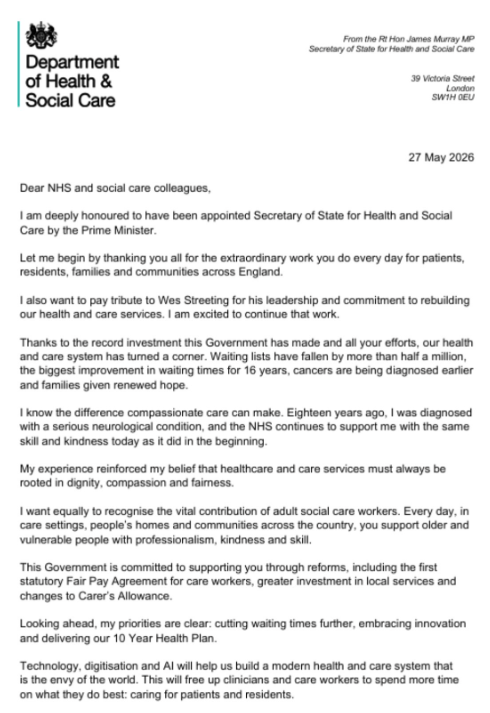
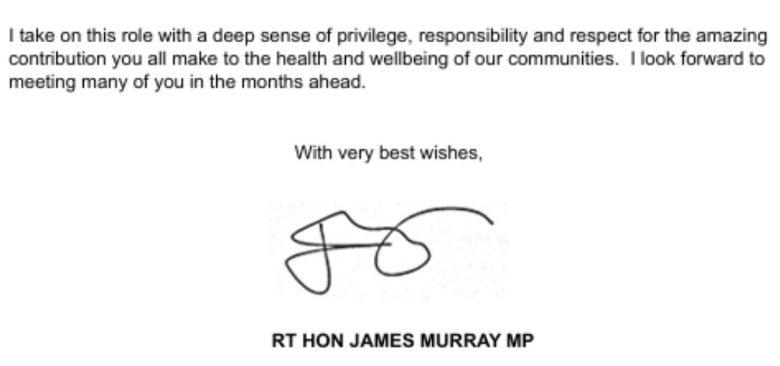
Last week, the new Secretary of State for Health, James Murray, letter (reproduced below) to all NHS staff, or…
… perhaps more accurately… someone in DH+ wrote to all NHS staff and he signed it.
It’s fascinating, not for what it says, but for what it avoids saying.
At one level it is perfectly harmless; thank-you very much… the NHS is wonderful… staff are amazing… technology is exciting… waiting lists are improving… we’ll modernise services... blah.
The sort of thing you might expect from the chief executive of a medium-sized insurance company, opening a regional office in Swindon, but…
…this is not a medium-sized insurance company.
This is the NHS, arguably the most politically sensitive, operationally unstable and structurally confused public institution in Britain.
Simultaneously wrestling with:
- industrial action,
- financial distress,
- management redundancies,
- the abolition of NHS England,
- workforce shortages,
- social care fragility,
- corridor care,
- collapsing morale in parts of the service, and...
...the arrival of AI that will pull the rug on everything.
None of which appears in the letter. Not a word about the transfer of powers from NHSE to DH+.
A constitutional, operational upheaval. Thousands of jobs affected. Accountability structures rewritten. The relationship between ministers and the service fundamentally altered, and yet… silence.
Which tells us something…
Either...
...the architecture is not settled, the government does not yet know what the future operating model looks like,
Or...
...ministers are deliberately avoiding alarming staff while the machinery is dismantled around them.
Perhaps there’s another explanation.
The letter has all the hallmarks of a classic Whitehall drafting exercise; smooth, inoffensive, carefully balanced, designed not to create headlines, not to commit to specifics, and not to expose uncertainty.
If it were a biscuit, it’d be a Rich Tea.
It obviously means no one has a coherent operational answer.
There’s a vacuum of unanswered questions...
-
who is accountable for operational performance?
-
who arbitrates between Treasury demands and clinical realities?
-
who owns workforce planning?
-
what becomes of regional authority?
-
where does institutional memory sit after management cuts?
-
who actually runs the NHS day-to-day?
You can tell… the centre itself is still working that out.
Which is why the letter defaults to abstractions; innovation, fairness, compassion, modernisation, technology.
Words that offend nobody because they commit to nothing.
The problem?
NHS staff are now highly experienced in decoding managerial language.
They know ‘reform’ can mean cuts.
They know ‘modernisation’ can mean fewer staff.
They know ‘AI freeing up time’ means job cuts.
When communication avoids operational reality, staff fill the vacuum with their own anxieties.
Reading between the lines, the letter also hints at a much more centralised NHS…
… almost nothing about local autonomy, frontline leadership, empowered organisations or clinical independence.
Instead the themes are; delivery,
waiting lists,
technology,
government investment, and ‘our 10 Year Plan’.
This feels Treasury-shaped. Control-shaped. Performance-shaped. Not reform in the visionary sense. More, programme management.
Perhaps that’s the biggest clue about how Murray may run the NHS...
... drifting quietly back toward command-and-control…. without openly saying so.
Then there’s perhaps the most revealing omission of all, management itself.
At the very moment NHS managers face unprecedented uncertainty, the letter barely mentions them.
Clinicians are thanked repeatedly. Care workers rightly recognised., but...
... operational leadership, administration and management are almost invisible.
That silence matters, because it hints at the prevailing assumption inside government; management is overhead, not infrastructure... disposable.
The reality… you can’t modernise a complex system while simultaneously hollowing out the people who make the system function.
The history of letters tells us; real leadership communication during periods of difficulty usually does one crucial thing… it recognises reality.
This letter feels like an administration trying to project calm while still working out what's happening.
-o0o-
Yes. You are right it’s easy to be critical… so I’ve written what I would have said, you can read it here…
|