Happy Forest Products Week! October 18-24
| | |
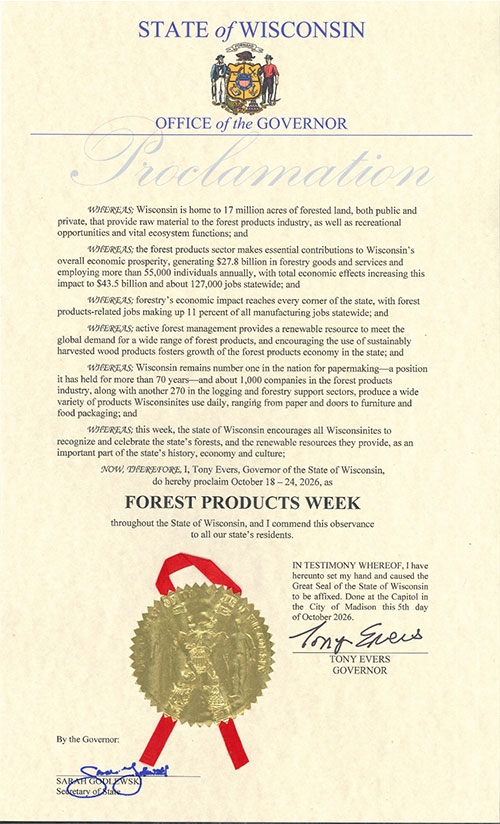
Forest Products Week 2026 is underway! Held October 18-24, Forest Products Week celebrates Wisconsin's forests and the people, businesses and communities connected to them.
Wisconsin's forests cover nearly half the state and are an important part of our history, culture, and economy. The forest products industry provides valuable jobs and supports communities across Wisconsin while demonstrating how renewable natural resources can be managed sustainably for future generations.
Throughout the week, educators and high school students have opportunities to explore the journey of Wisconsin's forests from sustainably managed woodlands to the products that build our homes, businesses and communities. Guided tours offer a behind-the-scenes look at the forest products supply chain, showcasing the people, technology and innovation behind one of Wisconsin's most important industries.
| If you weren’t able to join one of the tours this year, consider using one of the lessons available for K-12 students that can be done in your classroom or a local school forest. Send us a note or picture of how you incorporated Forest Products Week into your classroom! | | From Tree to Product: Learning Forestry Through Manufacturing and Business Experience | | For many students, wood products begin at the hardware store. At Prescott High School, in northwest Wisconsin, they begin in the forest. | | |
The forestry concepts extend beyond production. Students also learn about forest health, sustainable management, invasive species and the role professional foresters play in maintaining healthy woodlands. Prescott's curriculum utilizes the Wisconsin Forestry Center's Applied High School Curriculum, which was developed with support from LEAF and incorporates material from LEAF lesson guides.
That deeper understanding often changes the way students think about wood and natural resources, as lessons in stewardship have become a natural part of daily operations. Students begin to see trees not simply as raw material, but as valuable resources that deserve thoughtful management and use.
While the forestry education component is significant, the learning does not stop there.
What begins as a forestry and manufacturing program quickly becomes serious business.
Partially inspired by Eleva-Strum High School's Cardinal Manufacturing model, Prescott High School's R5 is a student-run business that gives students responsibility for marketing, estimating, product design, customer relations, manufacturing, record keeping and order fulfillment. The authenticity of the business experience has attracted strong community support and created steady demand for student-built products.
The program's impact can be seen in the career interests students develop. Some have discovered interests in woodworking, construction trades, arboriculture, forestry and engineering. The professional skills students gain along the way, including teamwork, communication and problem-solving, are often just as valuable as the technical skills they develop.
| |
For educators, the program offers a compelling example of how natural resource education can be connected to career readiness, community engagement and hands-on learning. Students are not only studying forests, they are seeing how forest resources move through an entire value chain from standing tree to finished product. That experience leaves a lasting impression.
For those students, forestry becomes more than a classroom topic. It becomes a pathway to new skills, new careers, and a deeper appreciation for the resources that surround them every day.
| | Self-paced, Online Trainings | |  | PLT Virtual Facilitator Training Series | |
If you have prior Project Learning Tree training and would like to become a PLT facilitator, this virtual training series may be right for you.
Session 1: 3:45 – 4:15 p.m. Monday, November 9, 2026 | Zoom
Session 2: 3:45 – 5:00 p.m. Thursday, December 10, 2026 | Zoom
| | Get outside with the GHS Earn a Badge program | | |
Is your classroom, school or district doing incredible work, but you don't always have a way to document, celebrate and share it? Green and Healthy Schools' Earn a Badge program provides a way to recognize progress and connect your initiatives to sustainability and wellness goals.
This month's spotlights include the Outdoor Classroom Badge in connection with National Take Me Outside Day on October 21.
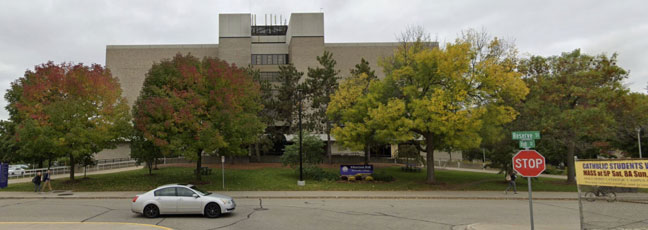
| | Reclaimed Trees find New Life at UWSP’s Library | | The University of Wisconsin-Stevens Point (UWSP) recently opened its new library. The library features a variety of sustainable design features, but its use of reclaimed urban wood was one that caught our eye here at LEAF. We sent Crystal, our student staff member, out in search of more information. | | Trees in front of the old library that were removed prior to demolition.
Photo credit: Melissa Clark | | When the old library, Albertson Hall, was set for demolition, that meant the surrounding trees had to be felled. This included pines, maples and ash trees. Three ashes, already dying because of Emerald Ash Borer, were chosen to be used in the construction of the library’s interior due to the wood quality and aesthetic value. | | |
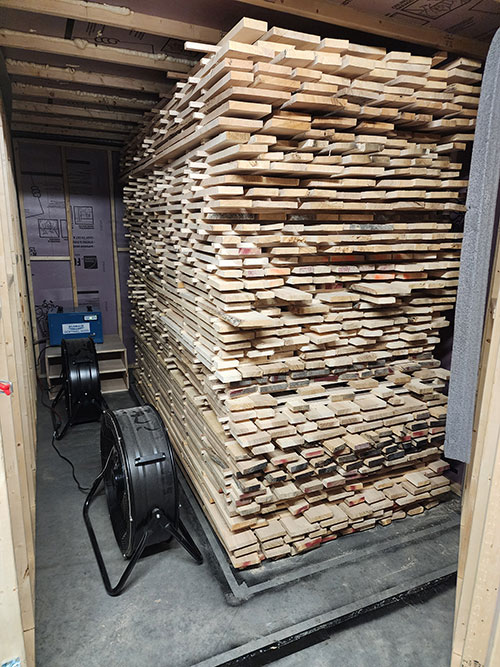
Once the trees were felled, the mission was set: these trees needed to be utilized as much as possible in the new space. They were sent to Feltz Lumber Co., a local lumber company, to be milled and kiln dried before being sent back to campus.
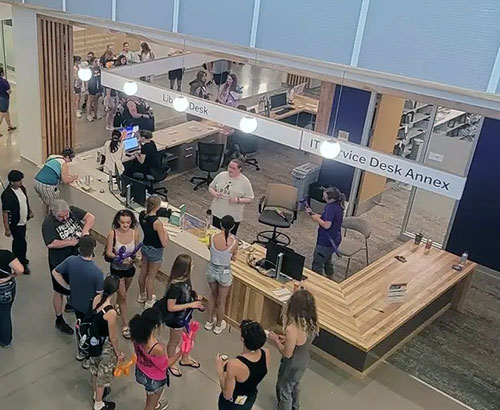
When the lumber arrived back at UWSP, the process of turning it into a usable fixture for the library began. Some work was done on campus, but the majority was completed by Discher Architectural Millwork. Ash trees that once grew on campus were transformed into the library's circulation desk.
| | |
The circulation desk is a busy place!
Photo credit: UWSP Libraries Facebook page
| | Other reclaimed urban ash trees taken down around the community due to Emerald Ash Borer were used in the library to create architectural details including accent columns. The side paneling on the main staircase was also made from local wood. | | See you at the WAEE Conference! | | |
LEAF staff will be presenting at the Wisconsin Association for Environmental Education (WAEE) State Environmental Education Conference Nov. 5 - 7 in Green Bay .
Join us for these sessions:
-
To Know Them is to Love Them: A Forestry Refresher | 10:30 a.m., Saturday 11/7
Understanding our forests helps us connect more deeply with them. We will spend time outside measuring and identifying trees and learning about sustainable forest management.
-
Eating Our Way through PLT’s Trees & Me Guide | 1:30 p.m., Saturday 11/7
Young nature explorers get HUNGRY! In this participant-driven workshop we will make nature-themed snacks and explore how food connects us to nature.
And also check out these sessions presented by staff from the Wisconsin Center for Environmental Education:
-
Bringing Together Early Childhood and Environmental Education in Wisconsin | 11:30 a.m., Friday 11/6
-
Igniting Climate Action in Wisconsin | 3:00 p.m., Friday 11/6
-
AgriSolar Innovations: Nature + Food + Energy | 11:30 a.m., Saturday 11/7
| | Share your School Forest story! | | |
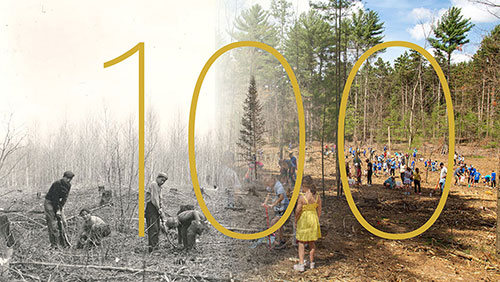
Wisconsin's School Forest Program will celebrate 100 years in the 2027-28 school year. Planning is underway for ways to recognize and celebrate school forests.
Help us prepare by Sharing Your School Forest Story.
| | Have questions or need additional resources? Contact us at leaf@uwsp.edu. We are here to support educators and students with forestry opportunities. | | Published for October 2026 | | | | |