June 2025 | Rooted in Community | |
Tsundoku
Tsundoku is Japanese for the act of acquiring reading materials and letting them pile up in one’s home. We thought it a perfect heading for this section, as we’ll feature books that are new or popular in the store. If you’re like us, tsundoku is a constant state of being.
Books about books and bookstores are plentiful. If you haven't read any yet, I highly recommend that you dive into a few. Fiction or nonfiction - they are sure to delight you. We keep a selection of bookish books by our cash register and throughout our store. As always, ask if you need helping finding any book.
Here are some of our store favorites:
How to Protect Bookstores and Why: the Present and Future of Bookselling and How to Resist Amazon and Why are two important books by Danny Caine, the former owner of Raven Book Store in Lawrence, Kansas. Both of these are packed with useful and critical information about the relevance of bookstores (and local businesses) in our communities.
In Praise of Good Bookstores is by passionate and longstanding bookseller, Jeff Deutsch. He is able to put into words what many of us have experienced within our beloved favorite bookstores. I learned so much from this book.
My Bookstore, edited by Ronald Rice, is a thoughtful, heartfelt, and sometimes humorous ode to bookstores written by 84 bestselling authors. The Bookshop: A History of the American Bookstore, by Evan Friss, explores the histories and personalities of bookstores/booksellers, the challenges and joys, the work behind the shelves of all types of bookstores in the United States.
The Sentence by Louise Erdrich, The Lost Bookshop by Evie Woods, and The Bookshop on the Corner by Jenny Colgan are just a few of our bestselling titles. There are also many, many Japanese works in translation books about bookstores and libraries. Days at the Morisaki Bookshop by Satoshi Yagisawa and The Bookshop Woman by Nanako Hanada are two notable and delightful examples.
| | |
|
Kazuya's Staff Pick
I'm a grumpy old man working at the store, Kazuya. I'm reading The Tale of Genji. It has 54 chapters. In a paperback edition, it has 2000 pages. It was written in early 11th century in Japan.
The author was called as Murasaki Shikibu. We don't know the real name.
The book is about the lives of Hikaru Genji and his son, Kaoru. It is fiction. The book was started to be written in very early 11th century and spent more than 10 years to complete.
Murasaki Shikibu was a tutor of the empress. She has chances to hear stories of emperors, vassals, nobles in the Court. The book was made from her imagination. But we think some ideas were from real world surrounding her.
One example: Hikaru Genji was the second son of the emperor. His mother passed away when he was three. She was not the official wife of the emperor. He was raised by his grandmother. The empress died and the emperor got a new wife/empress. She was very young and looked like Genji's mother. He followed her everywhere she went. He missed his mother. He had a love affair with the empress at last. He was a teenager. She was only six years older than him. She got a baby boy who would be an emperor in the future. No one knew except Genji. The boy was Kaoru, who became the emperor, but didn't know Genji was his real father.
There are more than 500 people who show up in the book. So complicated. So exciting. But so simple, too.
I'm not done yet. Let's see what's happening!
Image: Image of a NOT grumpy Kazuya enjoying friends.
| |
Monthly Pearl from Ope!
I mentioned last month that we’ve got a variety of projects in their early stages right now, so it’s a deceptively quiet time while we work behind the scenes. We love that semi-calamitous quiet, though, the wide-ranging possibilities that come from blending stories with paper design. Sometimes, as with one of our upcoming projects, the paper itself is a story.
A few weeks ago, we received a paper sample in the mail: a single rectangular sheet, densely textured and yet consistently smooth, almost silken to the touch, ruffed at the edges. The paper is white, but hints at a pale yellow, like the soft sheen of corn silk, and is speckled with tiny flecks of plant matter. One of the women working on this zine project–which is about rural spaces, immigrant labor, and pilgrimages–made the paper herself, collecting the plants from various places: Portland, Maine, the north shore of Massachusetts, and south central Wisconsin. She then fermented the collected plants in order to break down the natural fibers, creating a pulp that can then be formed into sheets. Cool, right? Having personally made paper from pulp on just one occasion, I can’t say a whole lot, but there’s definitely a grounding aspect that accompanies the process, akin to gardening. You’re assisting transformation, whether from seed to plant or plant to paper, all while considering the notion of Source: where does a thing begin, and how does it come to be?
We still haven’t decided how we’ll print on the paper, or if we’ll even print on it, but this last week, we inked up some carved rubber pads we made a while back, pressed paper to pad, then carefully lifted the paper to check out the imprints (an alien and a hummingbird). The density of the paper soaked up the ink in patterns like constellations, depths of dark and light. As someone who reads voraciously, it’s so fun to see paper and ink–something so familiar–take on such different dimensions.
So we’ll just keep following the paper trail, then. Til next time!
| |  | |
Customer Corner with Kareena Sheely
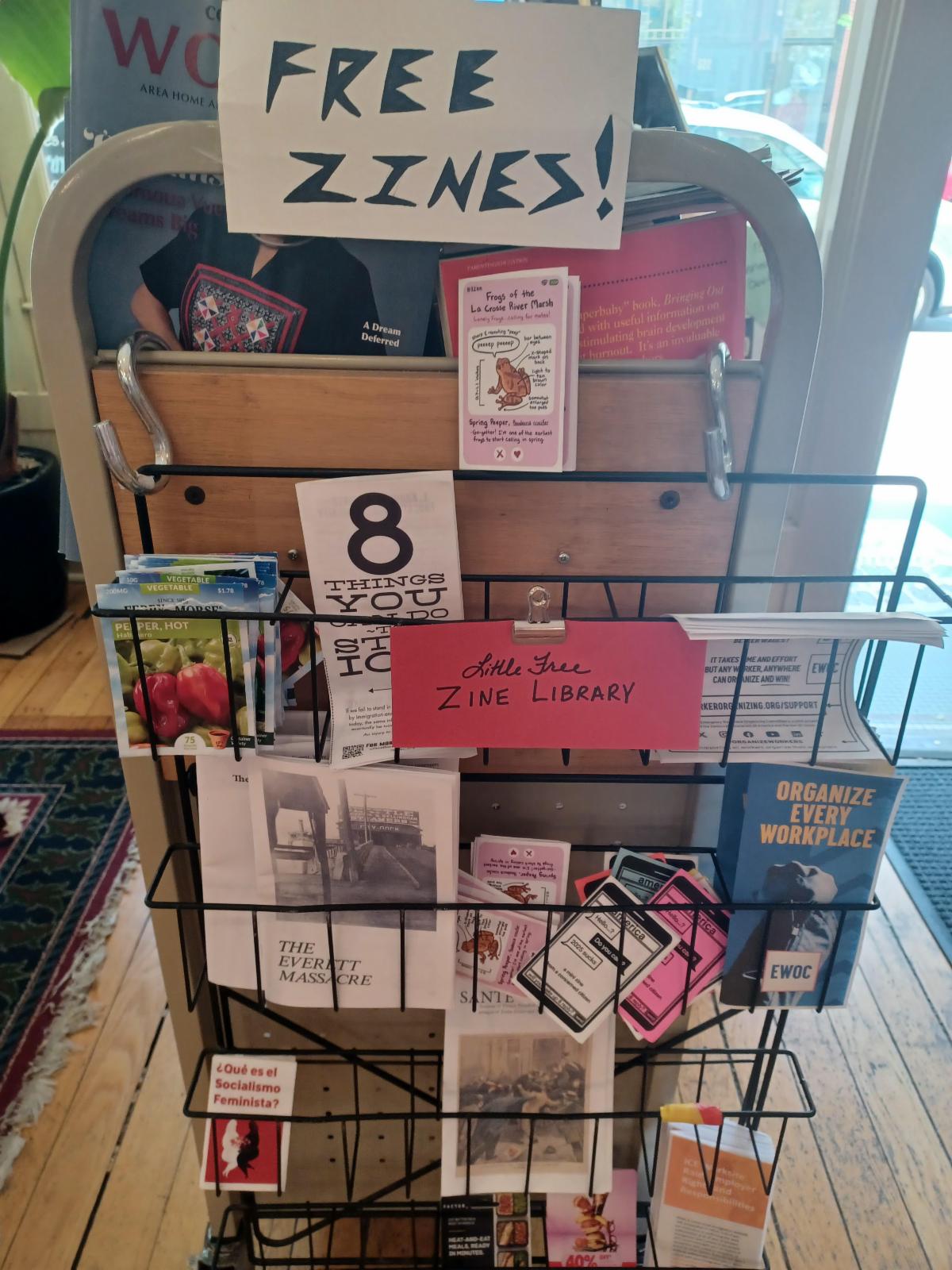
You may have noticed a FREE Zine spot on our Service Berry free book cart. We asked Kareena, one of the authors/organizers to tell us more about their project.
What is a Zine?
A zine is a self-published little booklet that can be about whatever you want - a personal expression! They are typically inexpensive to make and allow folks to easily share info within their community. The content of a zine can range anywhere from music, art, DIY alternatives, social and political activism, to just being a little pocket book of resources. Some I really love contain content with free resources and information that aren’t typically available to marginalized communities.
One of my favorites I received lately was titled “Frogs of the Marsh” and included info and photos of frogs that live in our marsh. It was very cute and very informative!
Does the group that offers zines for free at Pearl Street Books have a name?
We do not, but maybe some do? The goal is for this to be a space for many voices and groups to be able to contribute to the rack!
A collective effort to get info out!
How did you all come up with the idea of offering free zines?
Free zine libraries exist everywhere! But this particular push for a free zine rack stems from the current and wild political state of our country and world.
How are you funded?
We aren’t one group printing. So it is hard to know how or who’s funded. But generally speaking, people are funding their own work.
Image: Rack of FREE Zines at Pearl Street Books
| | | | | | | | | |