|
By Betsy Gaines Quammen
Torrey House Press
Paperback: $19.95
Best Wellers' Price: $15.96
Reviewed by Frank Pester
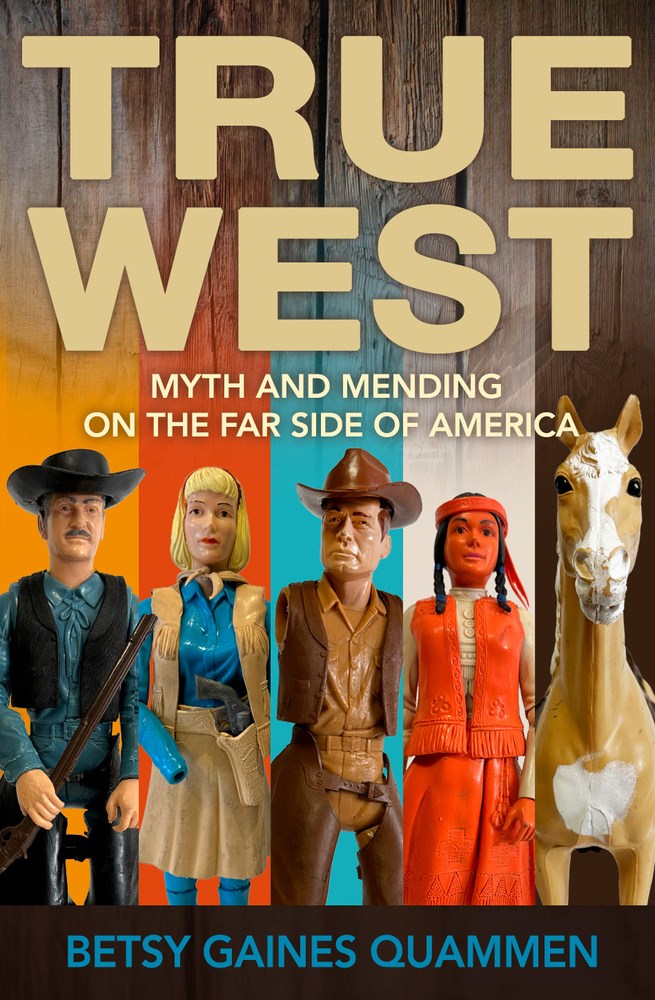
“What I do in this book,” writes Quammen, “is examine what happens when broad and bogus beliefs are affixed to the American West. Myth thus understood as an accepted but deceptive belief leads us to what I’ve come to consider a museum of toxic myths – a great cultural hall of follies based on misconceptions. The mythmakers I’ve focused on, unlike Greek muses, have promoted reckless ideas, bringing the West to a lurching instability, like a Conestoga wagon on a mountain trail, wobbling in dangerous directions. There are tall tales piled atop fabrications, seeping into memory, falsifying history, and turning caricature into grievous miscalculations.”
For anyone who has lived in the West, the myths that Betsy Gaines Quammen tackles in True West: Myth and Mending on the Far Side of America will feel very familiar. As we walk through this “Myth Museum” we encounter such examples as the “myth of discovery” of a land already inhabited; the myth of Manifest Destiny and westward expansion; the myth of Terra Nullius– land free and yours; the myth of a morally upright range-riding hero; and the myth that rain follows the plough. Add to these myths a batch of other reckless ideas, and we have views that can be very scary.
Betsy, not swayed by these myths, provides a fair and balanced discussion of all sides, starting with the views of Creationism verses Science and the attack science went under during the Covid-19 crisis. Next, she tackles the rise of Far-right, with the birth of the Oath Keepers, Stewart Rhodes, and the Bundy incidents. The Redoubt communities springing up in the Northwest are also touched upon.
Quammen chronicles the rise of ranching and the exploitation of lands in Wyoming and Montana for the creation of mini ranches and ranchettes. While working on this book just after the Pandemic in 2021, Betsy took up residence in the Hemingway House in Ketchum, Idaho. Hemingway had gone through his own Pandemic, the Great Influenza Pandemic during the 1918’s. Hemingway had marketed the Sun Valley area as a healthy and wonderful skiing resort, which gave rise to the exploitation of land in Wyoming and Montana. Especially during the Pandemic, the wealthy were trying to get away and create idyllic settings that only their money could buy. Quammen also explores the controversy over reintroducing wolves in the wilds had with ranchers.
Following into the killing of George Floyd there was racial unrest in many parts of the West. Betsy not only writes of the contemporary issues we face in the West but also the history of settlements that grew around the myth of limitless resources.
Because of the growth of our population and need to get out in the wild, we face tremendous strain on our National Parks. We also face a dire need for water in the arid parts of our country. As the West gets hotter, drier, and angrier we must reassess how we interact with the land.
Betsy sits down with many individuals who have reckless ideas and gives them a fair platform to vent their views– whether that be over a coffee or a beer. This is a book that will at sometimes anger you, but in the way the author presents these issues, it will also give you some hope. It is a necessary book for us who have made the West our home.
“I am reminded over and over how important it is to listen deeply and learn from each other. When we do, we move beyond myth making, myth busting, and misinformation to something much more powerful: connecting. This is where truth can be found, strolling together down the long halls of a museum of western myths.”
|